
Kratom Redosing: When, How & Timing Guide
Last Updated: April 2026
Kratom redosing means taking a second dose within the same day, and the key guidelines are: wait at least 4-6 hours between doses, keep to 2-3 doses per day at most, keep total daily intake below 8-10 grams, and understand that redosing typically produces milder effects than your initial dose due to kratom's ceiling effect. At Flavourz Kratom, we've guided over 10,000 customers through thoughtful redosing practices since 1999, and getting the timing right helps avoid common minor side effects while keeping effects consistent.
Here's what nobody tells you about redosing: it usually doesn't work the way you expect. That second dose rarely delivers the same quality of effects as the first. Different kratom colors affect redosing effectiveness differently, so consult our strain selection guide before planning your dosing schedule. You might extend duration, but intensity rarely matches. And if you redose too soon or too often, you accelerate tolerance and increase side effect risk without proportionally increasing benefits.
Over 5 years of personal use and thousands of customer conversations, I've identified the patterns that separate successful redosers from those who end up frustrated, nauseous, or building rapid tolerance. This guide covers exactly when, how, and whether to redose.
What Happens When You Redose Kratom
Understanding what actually happens physiologically when you take a second dose helps explain why redosing works differently than your first dose of the day.
The Kratom Ceiling Effect
Kratom's alkaloid profile creates what many users call a ceiling effect: there's a practical limit to how much additional benefit you get within a given window, no matter how much more you take. Beyond that point, additional kratom tends to add side effects rather than added benefit.
When you take your first dose, mitragynine and the plant's other alkaloids reach their highest concentration and produce the strongest effects of the day. As your body processes and clears these compounds over the following hours, taking more too soon layers a second dose on top of alkaloids that haven't fully cleared, which is why redosing within a few hours tends to produce diminished returns.
Giving your body more time to process the first dose is why waiting longer between doses tends to produce better results than taking more sooner.
Why Redosing Feels Different
Almost everyone who redoses notices the second dose doesn't hit the same way. This isn't imagination. Several factors explain the difference:
Residual alkaloid levels: Some of your first dose is often still active in your system when you redose, so there's less room for the second dose to register as a fresh effect.
Alkaloid buildup: Compounds from dose one that haven't fully cleared can blunt how strongly the second dose registers.
Diminishing returns: Each successive dose within a 12-24 hour period typically produces weaker effects than the previous one.
Tolerance initiation: Frequent redosing speeds up the tolerance-building process, so effects diminish faster with repeated same-day use.
Research on Dosing Frequency
Surveys of regular kratom users show a typical dosing frequency of 2-3 times per day, with many users taking their first dose within an hour of waking. The American Kratom Association recommends keeping total daily intake below 10 grams, with 8 grams daily suggested as a practical maximum for long-term use. These guidelines help frame general redosing limits.
Quick Reference: Redosing Guidelines
| Guideline | Recommendation | Why It Matters |
|---|---|---|
| Minimum time between doses | 4-6 hours | Allows partial alkaloid clearance |
| Optimal time between doses | 6-8 hours | Allows more complete alkaloid clearance |
| Maximum doses per day | 2-3 doses | Prevents rapid tolerance |
| Maximum daily total | 8-10 grams | Helps limit tolerance buildup |
| Wait before first redose | 45-60 minutes minimum | Allow first dose to peak |
| Redose amount | Same or less than first dose | Prevents stacking and nausea |
When to Redose: Timing Guidelines
The timing of your redose determines whether it extends your effects or creates problems. Here's what I've learned works best.
The 4-Hour Rule
The 4-hour rule is a widely-used guideline in the kratom community: wait at least 4 hours between doses. This timing is based on kratom's pharmacokinetics. Studies show mitragynine has an average elimination half-life of about 3.5 hours. After 4 hours, a significant portion of your first dose has cleared from your system, leaving more room for the next dose to register fully.
Here's how it works in practice:
- 7:00 AM: First dose (3g Green Maeng Da)
- 7:30 AM: Effects begin
- 8:30 AM: Peak effects
- 10:00 AM: Effects fading
- 11:00 AM: Minimum 4 hours reached, redose possible
- 12:00-1:00 PM: Optimal redose window (6 hours)
Cutting the gap to 2 hours means your second dose piles onto lingering alkaloids from the first. Tolerance builds faster this way, and by day 4 you're chasing yesterday's effects with diminishing returns.
Optimal vs. Minimum Timing
| Timing | Effects Quality | Side Effect Risk | Tolerance Impact |
|---|---|---|---|
| 2-3 hours | Poor (stacking) | High | Rapid buildup |
| 4 hours (minimum) | Moderate | Moderate | Some buildup |
| 6 hours (optimal) | Good | Low | Manageable |
| 8+ hours | Best | Minimal | Minimal |
| 12-24 hours | Like first dose | Minimal | Minimal |
If you can wait 6-8 hours, do it. Your second dose will feel more like a real dose rather than a diminished top-up. If you need to dose earlier, 4 hours is the practical minimum for effectiveness.
Signs Your First Dose Has Worn Off
Rather than watching the clock obsessively, learn to recognize when your first dose has actually faded:
- Energy or mood returns to baseline
- Focus or motivation feels normal rather than enhanced
- Physical comfort effects have diminished
- You can clearly tell the difference from when you were feeling the kratom
If effects are still present but weaker, you're in the danger zone for redosing too soon. Wait until effects have genuinely faded, not just diminished.
How to Redose
Careful redosing requires attention to amount, timing, form, and total daily limits. Here's the protocol that works.
Redose Amount Guidelines
Same or less than first dose: Your redose should be the same size as your first dose or smaller. Never increase the second dose trying to compensate for reduced effects.
Common pattern: Many experienced users take 2-3 grams in the morning and 2-3 grams in the afternoon or evening. Some prefer 3 grams morning and 2 grams later, reducing the second dose since effects are naturally diminished anyway.
Split dosing vs. single larger dose: Research and user reports suggest that taking kratom all at once typically produces better effects than splitting into multiple smaller doses throughout the day. If you need 5 grams total, taking 5g once will usually outperform taking 2.5g twice for effect quality. But split dosing extends total duration of benefits.
| Daily Total Goal | First Dose | Second Dose | Optional Third Dose |
|---|---|---|---|
| 4-5 grams | 2-2.5g | 2-2.5g | Not recommended |
| 6-8 grams | 3-4g | 3-4g | Not needed |
| 8-10 grams (max) | 3-4g | 3-4g | 2g if needed |
Powder vs. Capsule Timing Differences
Kratom powder absorbs faster than capsules, which affects redosing timing:
Powder: Effects begin in 15-30 minutes on an empty stomach. When considering a redose, the 4-hour clock starts from when you took the powder.
Capsules: Effects begin in 30-60 minutes because the capsule shell must dissolve first. The 4-hour clock should still start from ingestion, but recognize that capsules may still be releasing alkaloids when powder would be past peak.
If your first dose was capsules and you want to redose with powder for faster onset, be cautious. The capsules may still be releasing alkaloids, meaning you could stack effects unintentionally.
Maximum Daily Doses
General consensus from research and experienced users:
- Maximum 2-3 doses per day for sustainable use
- 8-10 grams total daily maximum to reduce tolerance buildup
- Minimum 6-hour spacing between doses (4 hours absolute minimum)
- Never exceed 8 grams in a single dose
Doses exceeding 15 grams total per day are associated with significantly higher risk of adverse effects and faster tolerance development. If you're regularly using 15+ grams daily, you've likely developed tolerance that indicates a need to reassess your use pattern.
Sample Redosing Schedules
Here are practical schedules for different use cases.
Two-Dose Daily Schedule (Most Common)
| Time | Action | Strain Example | Notes |
|---|---|---|---|
| 7:00 AM | First dose (3g) | Green Maeng Da | Empty stomach |
| 7:30-8:00 AM | Effects begin | - | - |
| 8:00-10:00 AM | Peak effects | - | Productive period |
| 11:00 AM-12:00 PM | Effects fading | - | - |
| 1:00 PM | Second dose (3g) | White Maeng Da | 6 hours after first |
| 1:30-5:00 PM | Afternoon effects | - | - |
| Evening | No third dose | - | Allow overnight reset |
This schedule provides 6 grams total, spread across two well-spaced doses. Using a different strain for the second dose provides some alkaloid variation, though this isn't required.
Three-Dose Extended Schedule
If you need effects throughout a longer day, three doses can work, but requires more careful management:
| Time | Dose | Total So Far |
|---|---|---|
| 7:00 AM | 3g Green Maeng Da | 3g |
| 1:00 PM (6 hrs later) | 2.5g White Borneo | 5.5g |
| 7:00 PM (6 hrs later) | 2.5g Red Bali | 8g |
Important: Three-dose schedules accelerate tolerance development compared to one or two doses, even at the same total daily amount. Use this schedule only when necessary, and consider taking more off days per week to compensate.
Occasional Redosing (Best for Tolerance Prevention)
The most sustainable approach: take one dose per day most of the time, and only redose occasionally when genuinely needed.
Example week:
- Monday: One dose (3g morning)
- Tuesday: One dose (3g morning)
- Wednesday: Two doses (3g morning, 2.5g afternoon) due to long work day
- Thursday: One dose (3g morning)
- Friday: One dose (3g morning)
- Saturday: Off day
- Sunday: Off day
This approach keeps most days to a single dose while allowing flexibility for longer days when needed.
Guidelines and Precautions for Redosing
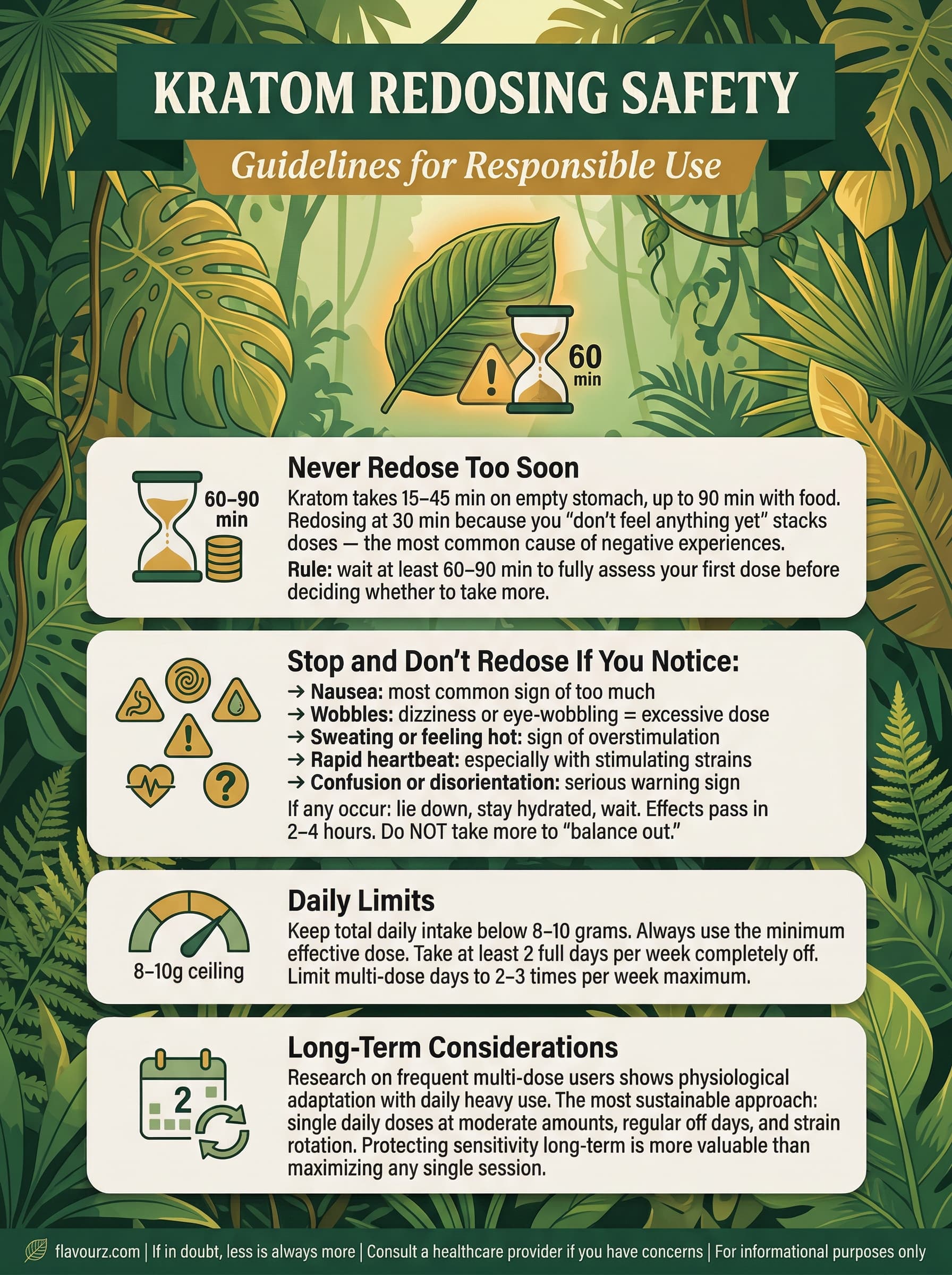
Redosing introduces additional considerations beyond single-dose use.
Never Redose Too Soon
The most common redosing mistake is taking more before the first dose has fully kicked in. Kratom takes 15-45 minutes to work on an empty stomach, up to 90 minutes with food. If you redose at 30 minutes because you "don't feel anything yet," you're stacking doses.
Premature redosing causes 80% of negative first experiences according to user surveys. Wait at least 60-90 minutes to assess your first dose before considering whether you took enough. If the first dose was inadequate, adjust for next time rather than adding more the same day.
Watch for Warning Signs
Stop and don't redose if you experience:
- Nausea: The most common sign you've taken too much
- Wobbles: Dizziness or eye-wobbling indicates excessive dose
- Sweating or feeling hot: Sign of overstimulation
- Rapid heartbeat: Especially with stimulating strains
- Confusion or disorientation: Rare but serious warning sign
If any of these occur, lie down, stay hydrated, and wait. Effects will pass in 2-4 hours. Do not take more kratom to "balance out" the effects.
Daily Limits and Long-Term Considerations
Frequent, heavy use (3+ doses daily over extended periods) is associated with tolerance and, in some users, physical dependence. If you cut back or stop after a period of heavy use, you may notice temporary discomfort. This is a good reason to keep your routine moderate rather than something to manage around: consult a healthcare provider if you have questions about your use pattern or existing health conditions.
To help minimize tolerance and dependence risk:
- Keep total daily intake below 8-10 grams
- Use the minimum effective dose
- Take at least 2 days per week completely off
- Consider limiting multi-dose days to 2-3 times per week maximum
When Redosing Does and Doesn't Make Sense
Redosing isn't always the right choice. Here's a decision framework.
Good Reasons to Redose
Long days requiring extended effects: If you need kratom benefits from morning through evening for work, events, or activities, a planned second dose 6+ hours after the first is reasonable.
Different purposes at different times: An energizing morning dose for productivity and a relaxing evening dose for wind-down can serve different goals. Using different strains (green morning, red evening) makes this approach more effective.
Structured routines: Many users on a two-dose daily routine (morning and afternoon) prefer the consistency of a planned second dose over an as-needed approach, especially on days with a long schedule ahead.
Poor Reasons to Redose
Chasing the first dose's intensity: Your second dose will not feel as strong as the first. Trying to achieve the same peak by adding more leads to excessive intake without proportionally better effects.
Effects feel weak so you want more: If your first dose wasn't effective, the solution is to increase your dose next time, not to stack another dose on top. Redosing doesn't fix an underdose, it just extends weak effects and increases total intake.
Boredom or habit: Taking kratom because it's been a few hours and you "could" rather than because you have a specific reason leads to excessive frequency and tolerance.
Should You Redose? Decision Framework
Ask yourself:
- Have my first dose effects genuinely worn off, not just diminished?
- Is it at least 4 hours (preferably 6+) since my first dose?
- Do I have a specific reason to need effects for several more hours?
- Will this keep my daily total under 8-10 grams?
- Am I prepared for the second dose to feel less intense than the first?
If you answered yes to all five, redosing is likely appropriate. If any answer is no, consider waiting or skipping the redose.
Redosing and Tolerance
How you redose significantly affects how quickly you develop tolerance.
Why Redosing Accelerates Tolerance
Research and user experience show that split dosing (multiple smaller doses) accelerates tolerance compared to the same total amount taken once. Why?
- Extended alkaloid presence: Multiple doses keep active compounds in your system for longer stretches, which speeds up the tolerance-building process
- Less recovery time: Each redose shortens the gap your body has to process alkaloids before more arrive
- Higher total exposure: Redosing often leads to higher total daily intake than single dosing
Users who dose once daily often maintain sensitivity longer than those dosing 2-3 times daily, even at similar total grams per day.
Strategies to Minimize Tolerance While Redosing
Maximize time between doses: If you must redose, stretch the gap as long as practical. 8 hours is better than 6, which is better than 4.
Rotate strains between doses: If your morning dose is green, make your afternoon dose white or red. Different alkaloid profiles reduce strain-specific tolerance buildup.
Keep multi-dose days to a minimum: Aim for more single-dose days than multi-dose days throughout the week.
Take complete off days: At least 2 days per week with no kratom at all. This is more important than any other tolerance management strategy.
Never increase dose, adjust frequency instead: If your redose doesn't feel effective, the answer is usually to wait longer next time, not to take more.
Special Considerations
Redosing with Extracts
Kratom extracts are concentrated and accelerate tolerance rapidly. If you use extracts:
- Avoid redosing with extracts in the same day
- Wait at least 6-8 hours if you must redose
- Use 10-20% of your normal powder dose for extracts
- Limit extract use to 1-2 times monthly to prevent rapid tolerance
Mixing extract doses with powder doses the same day is particularly problematic. The concentrated alkaloids from extracts make standard powder less effective.
Consistency Across Extended Use
Redosing dynamics can differ depending on how you use kratom throughout the day. Some users notice that certain subjective effects hold up more evenly across multiple doses than others do, even as overall intensity fades with each redose.
For extended, structured routines, some users find success with 3-4 smaller doses spread throughout the day rather than 1-2 larger doses. However, this comes with increased tolerance risk and should be approached cautiously.
Combining Kratom with Other Substances
Redosing increases total kratom in your system, which matters for interactions:
Caffeine: Combining multiple kratom doses with caffeine can cause jitters, unease, or a rapid heartbeat. If you drink coffee, reduce it on days you take multiple kratom doses.
Alcohol: Never combine kratom with alcohol. Both affect the central nervous system, and combining them increases risks significantly.
Medications: Kratom can interact with many medications. Higher daily totals from redosing increase interaction potential. Consult a healthcare provider if you take any prescription medications.
Common Redosing Mistakes
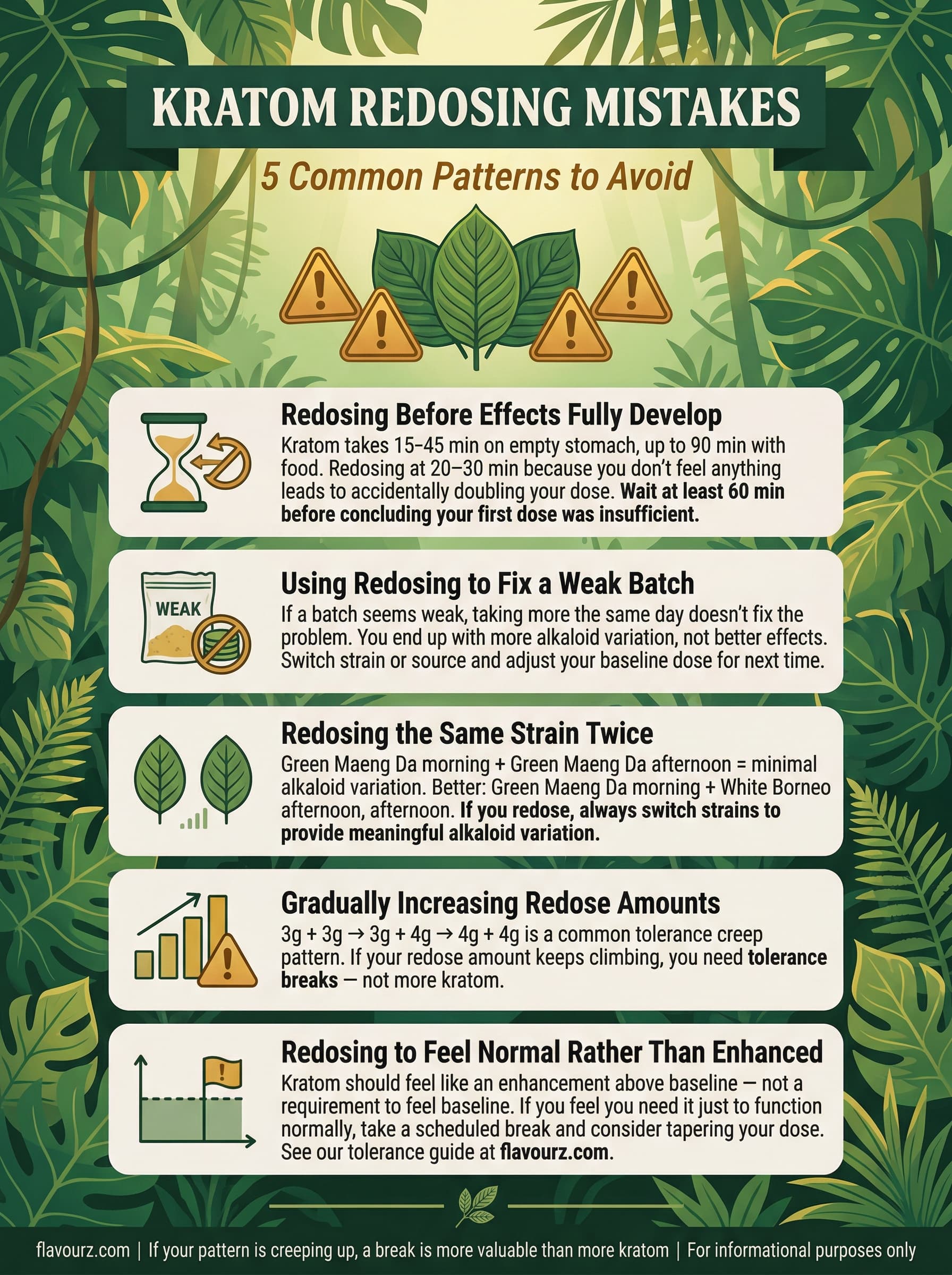
Mistake 1: Redosing Before Effects Fully Develop
Kratom takes 15-45 minutes to kick in on an empty stomach, up to 90 minutes with food. Redosing at 20-30 minutes because you don't feel anything leads to accidentally doubling your dose. Wait at least 60 minutes before concluding your first dose was insufficient.
Mistake 2: Using Redosing to Compensate for Weak Batches
If a kratom batch seems weak, taking more of it the same day doesn't fix the problem. You just end up with more alkaloid variation. Switch to a different strain or source and adjust your baseline dose for next time.
Mistake 3: Redosing Same Strain Repeatedly
Using Green Maeng Da morning and Green Maeng Da afternoon provides less variation than using Green Maeng Da morning and White Borneo afternoon. If you redose, switch strains to provide alkaloid variation.
Mistake 4: Gradually Increasing Redose Amounts
Starting with 3g morning and 3g afternoon, then 3g and 4g, then 4g and 4g is a common pattern that indicates tolerance development. If your redose amount keeps creeping up, you need tolerance breaks, not more kratom.
Mistake 5: Redosing to "Feel Normal"
If you feel you need kratom to feel normal or baseline rather than enhanced, this is a dependency signal. The solution is tapering and breaks, not continued redosing.
Frequently Asked Questions
How long should you wait between kratom doses?
Wait at least 4-6 hours between kratom doses. Optimal timing is 6-8 hours apart. Waiting longer produces better effects from the second dose because more alkaloids have cleared from your system. Redosing within 2-3 hours stacks doses and increases side effects without proportionally increasing benefits.
Can you take kratom twice in one day?
Yes, you can take kratom twice in one day if you space doses at least 4-6 hours apart and keep total daily intake below 8-10 grams. The second dose will typically produce weaker effects than the first due to kratom's ceiling effect. Two doses per day is common among regular users.
What happens if you redose kratom too soon?
Redosing too soon (within 2-3 hours) stacks doses, meaning you have overlapping alkaloid levels. This increases nausea, dizziness, wobbles, and other side effects without proportionally increasing benefits. It also accelerates tolerance development. Wait for effects from the first dose to genuinely fade before considering more.
How many times a day can you take kratom?
Maximum recommended frequency is 2-3 doses per day with at least 6 hours between doses. More than 3 doses daily significantly increases tolerance buildup. Most sustainable use involves 1-2 doses daily maximum, with regular off days throughout the week.
Does redosing kratom cause more side effects?
Redosing increases side effect risk, especially if doses are taken too close together or total daily amount is too high. Common side effects from excessive redosing include nausea, dizziness, constipation, dehydration, and wobbles. Proper spacing (4-6+ hours) and staying under 8-10g daily minimizes these risks.
What is the kratom ceiling effect?
The ceiling effect means there's a maximum benefit you can get from kratom within a certain timeframe, regardless of how much more you take. Kratom's alkaloid profile naturally limits additional benefit as you take more within that window, which is why redosing produces diminished returns and why higher doses don't always mean better effects.
Is it better to take one larger dose or split doses?
For effect quality, one dose typically works better than splitting the same amount. A single 5g dose usually produces stronger effects than two 2.5g doses. However, split dosing extends the duration of benefits across more hours. The tradeoff is that split dosing accelerates tolerance compared to single daily dosing.
How much kratom is too much per day?
Keep total daily intake below 8-10 grams for sustainable use. Single doses should not exceed 8 grams. Total daily intake exceeding 15-20 grams significantly increases side effect risk and tolerance development. If you regularly exceed these amounts, you've likely developed tolerance that indicates a need to reassess your use pattern.
Final Thoughts
Redosing kratom can work well when done thoughtfully, but it requires understanding the tradeoffs. Your second dose won't feel like your first. You'll extend duration more than intensity. And frequent redosing accelerates tolerance faster than single daily dosing.
The users who maintain kratom's effectiveness long-term typically stick to single daily doses most of the time, redosing only when genuinely needed, keeping multi-dose days to a minimum, and taking regular off days. They resist the urge to chase effects by adding more kratom and instead focus on timing, spacing, and strain rotation.
At Flavourz Kratom, we've helped customers develop sustainable routines for over 25 years. The key insight: less frequent, well-timed doses almost always outperform more frequent, poorly-spaced ones for long-term satisfaction. When in doubt, wait longer and take less.
Disclaimer: These statements have not been evaluated by the FDA. Kratom is not intended to diagnose, treat, cure, or prevent any disease. Consult a healthcare professional before using kratom, especially if you have medical conditions or take medications. Must be 21+ to purchase. Not available in all states.
Share this content