
Kratom and Alcohol: Vein Guide & Safety Info
Last Updated: April 2026
There's no scientific evidence that kratom does anything specific for a hangover. Some users describe subjective shifts in energy or mood afterward, but kratom does not address the underlying physiological drivers of a hangover: inflammation, acetaldehyde processing, and dehydration. Using kratom while hungover adds extra work for your liver and may compound dehydration. If you choose to try it anyway, wait until alcohol is fully metabolized (at least 12-24 hours), use a low dose, and prioritize hydration.
I get this question constantly from customers at Flavourz Kratom. After 25 years in this business and 5 years of personal kratom experience, here's my honest take: kratom is not a hangover fix, and anyone telling you otherwise is overselling it.
That said, white vein strains are popular with customers for a brisk, energizing character earlier in the day — check our complete white bali strain analysis for more on daytime use. Some people do use kratom the morning after drinking, and this guide walks through what's actually known so you can make an informed decision.
What Actually Causes a Hangover?
Before we talk about kratom, it helps to understand what a hangover actually is. It's not just dehydration, despite what you've heard.
According to the National Institute on Alcohol Abuse and Alcoholism, hangovers result from multiple factors working together:
The Main Hangover Mechanisms
- Inflammation: Alcohol triggers an immune response that causes systemic inflammation throughout your body. A 2024 review in Alcohol, Clinical and Experimental Research concluded that inflammation and oxidative stress are the primary drivers of hangover symptoms.
- Acetaldehyde: When your liver breaks down alcohol, it first converts it to acetaldehyde, a compound that produces nausea, sweating, rapid pulse, and general malaise.
- Dehydration: Alcohol is a diuretic, increasing urine production and depleting fluids and electrolytes.
- Sleep disruption: Alcohol fragments your sleep architecture, preventing restorative deep sleep even if you pass out for 8 hours.
- GI irritation: Alcohol directly irritates your stomach lining and increases acid production.
- Blood sugar drops: Alcohol interferes with glucose production, leading to weakness and fatigue.
Here's what many people don't realize: recent research (Mackus et al., 2024) found that dehydration alone doesn't explain hangovers, and drinking water doesn't prevent them. Inflammation and metabolic disruption appear to be more significant factors.
Does Kratom Actually Do Anything for Hangovers?
Honest answer: there is no scientific evidence that kratom changes hangover symptoms. Zero studies have examined this specific use.
What we have is anecdotal reports, and they're mixed.
What Some Users Report
People who use kratom the morning after drinking typically describe:
- A subjective lift in energy (countering that drained, sluggish feeling)
- A subjective shift in mood
These are self-reported, non-clinical impressions, not evidence that kratom changes any hangover symptom. For more on kratom's alkaloid composition, see our article on kratom's active compounds.
The Bigger Picture: Masking, Not Resolving
Here's my concern based on years of watching customers use kratom: even if someone feels different after taking it, the underlying physiology hasn't changed.
Kratom does not:
- Reduce inflammation
- Speed up acetaldehyde metabolism
- Rehydrate you (it may do the opposite)
- Restore disrupted sleep
- Repair GI irritation
You might feel different, but your body is still processing the same metabolic load.
Safety Considerations: Why This Combination Matters
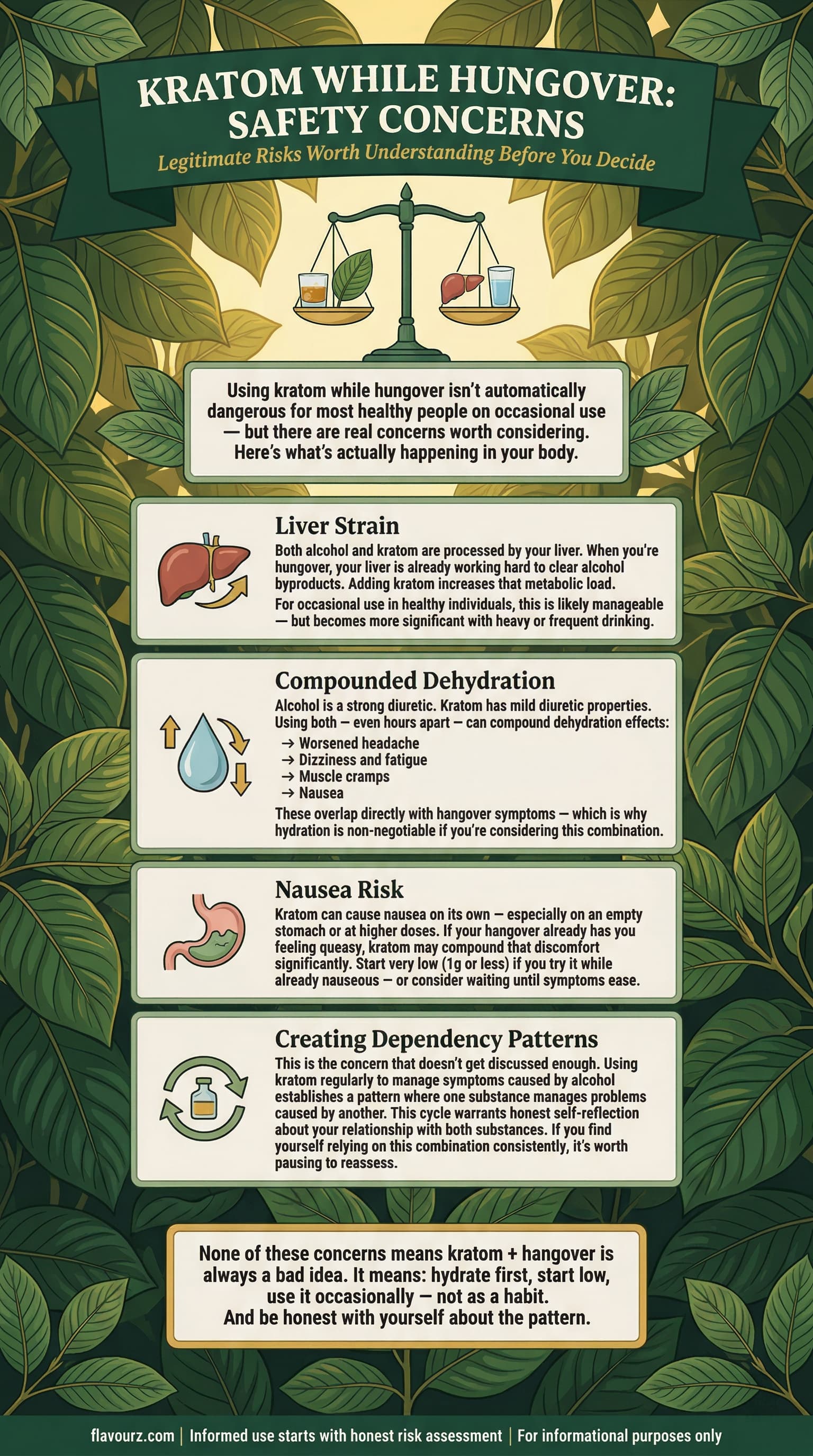
Combining kratom with a hangover isn't risk-free. Here are the legitimate concerns:
Liver Load
Both alcohol and kratom are metabolized by your liver. When you're hungover, your liver is already working overtime to process alcohol byproducts. Adding kratom to the mix increases the metabolic load.
Is this a concern for occasional use? Probably minor for most healthy people. But it's worth considering, especially if you drink heavily or frequently. For more context, see our article on kratom and liver health.
Compounded Dehydration
Kratom has mild diuretic properties. Alcohol is a stronger diuretic. Using both substances (even hours apart) can compound dehydration effects.
Dehydration can involve:
- Worsened headache
- Dizziness
- Muscle cramps
- Confusion
- Fatigue
Notice how these overlap with hangover symptoms? That's why hydration matters if you're considering kratom the morning after.
Nausea
Kratom can cause nausea, especially on an empty stomach or at higher doses. If you're already feeling queasy, kratom might push you further in that direction.
I've heard from plenty of customers who tried kratom the morning after and ended up feeling worse because the nausea compounded.
Dependency Patterns
This is the consideration that doesn't get talked about enough.
If you regularly drink and then reach for kratom the next morning, you're establishing a pattern where one substance is used in response to another. Over time this cycle can contribute to psychological or physical dependence on either or both.
Some surveyed kratom users report using it in connection with reducing alcohol intake. This is a personal-choice area that deserves honest self-assessment about your relationship with both substances, not a recommendation either way.
General Guidelines If You're Considering It
I'm not going to pretend people won't reach for kratom after drinking despite the caveats above. So here are some practical, harm-reduction-oriented notes:
Timing
| Scenario | Note | Why |
|---|---|---|
| Still feeling drunk | Do not take kratom | Alcohol still in system; interaction risk |
| 6-8 hours after drinking | Higher caution | Some alcohol may remain; use minimal dose if at all |
| 12-24 hours after drinking | Lower-risk window | Alcohol largely metabolized; standard precautions apply |
| 24+ hours after drinking | Standard use | Alcohol cleared; no interaction concerns |
For detailed information on the kratom-alcohol interaction, see our complete guide on kratom and alcohol safety.
Hydration
If you're taking kratom the morning after drinking, hydration is non-negotiable:
- Drink at least 16-24 oz of water BEFORE taking kratom
- Add electrolytes (sports drinks, coconut water, or electrolyte packets)
- Continue drinking water throughout the day
- Monitor urine color; aim for pale yellow
Dosing Notes
Consider less than your normal amount. Your body is already under load.
- If you're new to kratom: Don't start during a hangover. Your body can't give you reliable feedback about how kratom affects you.
- If you're experienced: Consider 50-75% of your typical amount
- Start low: 1-2 grams maximum for most people
- Wait longer: Give it 60-90 minutes before considering more
For complete dosing information, see our kratom dosage guide.
Vein Color Overview
Kratom is generally sold by vein color, which correlates with alkaloid composition and harvest timing. Here's a neutral look at how customers describe each, independent of any hangover use case.
White Vein
Common pick for: daytime use
White Maeng Da is a popular white-vein option. Customers often describe white strains as having a brisk, clean character, sometimes compared to coffee but smoother.
General starting range: 1-2 grams
Red Vein
Common pick for: evening or wind-down use
Red Bali and Red Borneo are popular red-vein options, generally described by customers as having a calmer, more grounded character. Higher doses tend to be more sedating, which may not suit anyone who needs to stay alert.
General starting range: 1-3 grams
Green Vein
Green Maeng Da and Green Borneo are often described as a middle ground between white and red — some customers reach for greens when they're unsure which character they prefer.
General starting range: 1-2.5 grams
Vein Comparison
| Vein Color | Example Strains | Customer-Reported Character |
|---|---|---|
| White | White Maeng Da, White Thai | Brisk, clean, alert |
| Red | Red Bali, Red Borneo | Calmer, grounded |
| Green | Green Maeng Da, Green Borneo | Balanced middle ground |
Can Kratom Itself Cause Next-Day Effects?
Yes. This is something people don't always consider.
Kratom can produce next-day effects of its own, especially with:
- High doses
- Dehydration during use
- Poor quality products
- Use late at night (disrupts sleep)
Possible Next-Day Effects From Kratom
- Headache (reported in a notable share of cases)
- Fatigue and grogginess
- Nausea
- Brain fog
- Dry mouth
Notice the overlap with alcohol hangover symptoms? If you take kratom while already hungover and experience these effects, you could end up feeling worse, not better.
This is why dose matters so much. Lower doses are far less likely to produce next-day effects than high doses.
General Hangover Recovery Information
I sell kratom for a living, but I'll be straight with you: for general hangover recovery, there are more established approaches, and kratom is not one of them.
Commonly Cited Recovery Approaches
- Time: The body needs time to process alcohol byproducts; there is no shortcut. Sleep helps.
- Hydration + electrolytes: Doesn't prevent a hangover, but supports dehydration symptoms.
- Food: Eating helps stabilize blood sugar and provides nutrients your body needs.
- NSAIDs: Some people use ibuprofen or aspirin for headaches; avoid acetaminophen/Tylenol, which adds to liver load.
- Ginger: Many people find it settles an upset stomach.
- Light movement: A short walk or gentle activity can support circulation and mood.
None of the above is medical advice — talk to a healthcare provider about what's appropriate for you.
Where Kratom Fits, If At All
Some experienced customers choose kratom the morning after for personal, subjective reasons — not as a recommended recovery method. If you're going to make that choice:
- Try the basics first (hydration, food, rest)
- Only proceed if you already know how your body responds to kratom
- Wait until enough time has passed since drinking (12-24+ hours)
- Make sure you're adequately hydrated
This is a personal choice, not a recommendation, and not a substitute for established recovery practices.
When Not to Use Kratom
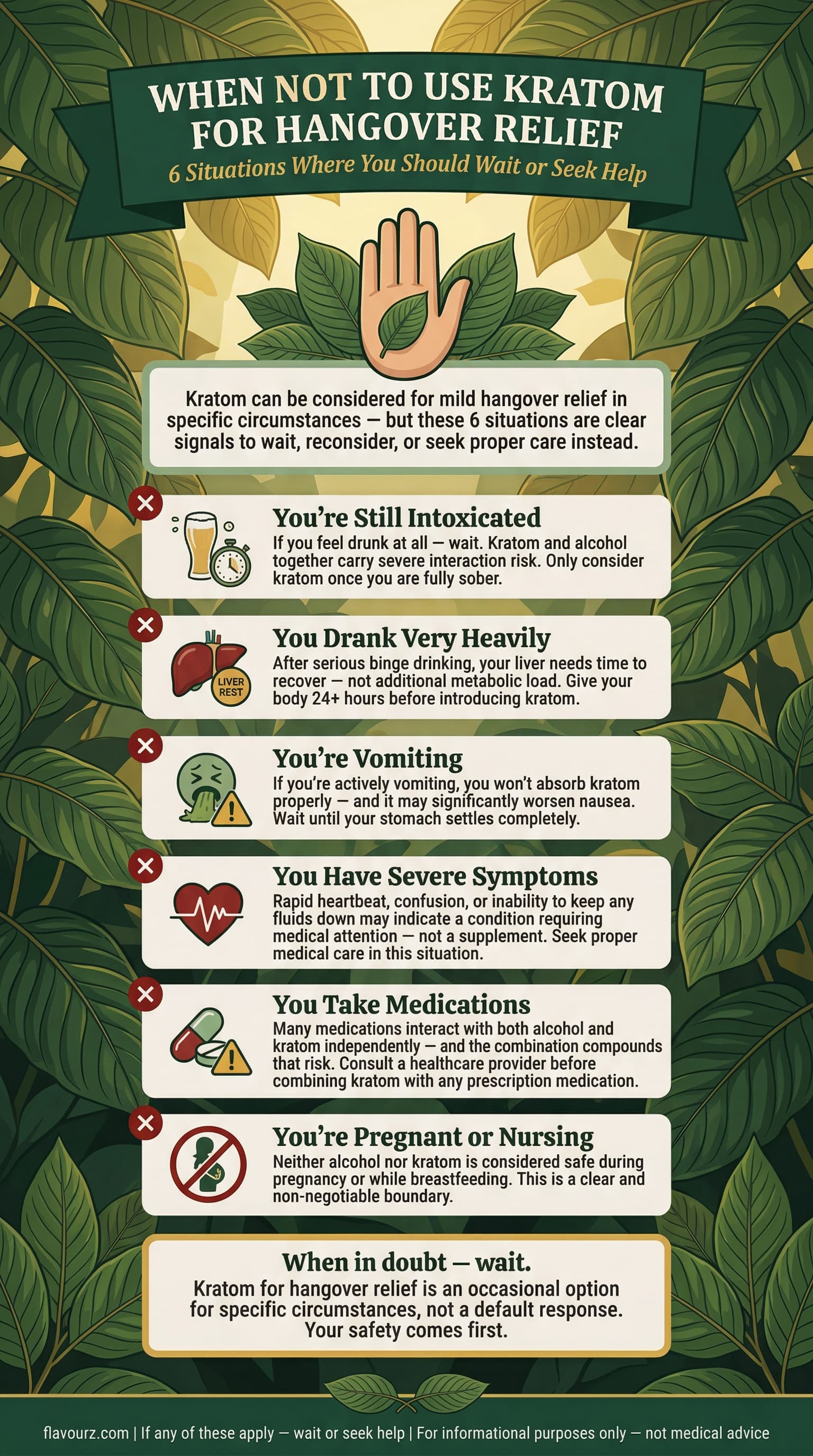
Do not use kratom in these situations:
- You're still intoxicated: If you feel drunk at all, wait.
- You drank heavily: After serious binge drinking, your liver needs rest, not more work.
- You're vomiting: You won't absorb kratom properly, and it may worsen nausea.
- You have severe symptoms: Rapid heartbeat, confusion, or inability to keep fluids down may indicate alcohol poisoning. Seek medical help immediately.
- You take medications: Many medications interact with both alcohol and kratom. Consult a healthcare provider.
- You're pregnant or nursing: Neither alcohol nor kratom is recommended during pregnancy.
The Bottom Line
Does kratom do anything for a hangover? Some people report it does, particularly for a subjective lift in energy.
Whether to use kratom after drinking is a personal decision, but go in with realistic expectations:
- It's not a fix. Kratom doesn't address the underlying causes of a hangover.
- It adds liver load. Your liver is already working hard; kratom adds to that load.
- It can compound dehydration. Hydration is essential if you choose to use it.
- It might make you feel worse. Kratom can cause nausea, especially on a sensitive stomach.
- Timing matters. Wait until alcohol is metabolized (12-24 hours is more cautious than 6-8).
- Dose conservatively. Use less than your normal amount.
If you're looking for quality kratom from a vendor serving customers since 1999, explore our kratom powder collection. For new users, I'd recommend reading our beginner's guide first, though don't start kratom during a hangover.
Frequently Asked Questions
Does kratom do anything for hangovers?
There's no scientific evidence that kratom changes hangover symptoms. Some users report subjective shifts in energy or mood, but this is anecdotal, not clinical evidence, and kratom does not address underlying causes like inflammation, acetaldehyde processing, or dehydration.
Can kratom make a hangover worse?
Yes. Kratom can cause nausea, dehydration, and next-day effects of its own. If you take it while already feeling queasy or dehydrated, you may feel worse. Lower doses and adequate hydration reduce this risk.
What are the different kratom vein colors known for?
White vein strains like White Maeng Da are commonly described by customers as brisk and clean. Red vein strains like Red Bali are commonly described as calmer and more grounded. Green strains are often described as a balance between the two. These are subjective, customer-reported descriptions, not medical claims.
How long should I wait after drinking to take kratom?
Waiting at least 12-24 hours after drinking is the more cautious approach. At minimum, wait until you no longer feel any alcohol effects (at least 6-8 hours). Never take kratom while still intoxicated.
Does kratom dehydrate you?
Kratom has mild diuretic effects. This is why hydration is especially important when using kratom after drinking, since alcohol is also a diuretic. Drink plenty of water with electrolytes.
Can kratom itself cause hangover-like effects?
Yes. Kratom can produce next-day effects including headache, fatigue, nausea, and brain fog, especially with high doses, dehydration, or low-quality products. These effects overlap with alcohol hangover symptoms.
Is it advisable to take kratom after drinking?
Taking kratom while alcohol is still in your system is not advisable. Once alcohol is largely metabolized (typically 12-24 hours after heavy drinking), some experienced users choose to use kratom with standard precautions: hydrate well, use low doses, and pay attention to how your body responds.
What actually helps with hangover recovery?
Time is the main factor the body needs to process alcohol byproducts. Supporting approaches commonly cited include hydration with electrolytes, eating nutrient-rich food, rest, NSAIDs like ibuprofen for headaches (avoiding acetaminophen), and ginger for nausea. Kratom is not an established recovery approach.
Disclaimer: This information is for educational purposes only. These statements have not been evaluated by the FDA. Kratom is not intended to diagnose, treat, cure, or prevent any disease. Combining kratom with alcohol, or using it after heavy drinking, carries risks. Consult a healthcare provider if you have concerns. Must be 21+ to purchase. Not available in all states.
Share this content