
How to Order Kratom by the Kilo: Bulk Buying Strategy 2026
Last Updated: April 2026
Buying kratom by the kilo is the smartest financial decision regular kratom users can make. The per-gram price drops 50-70% compared to ounce purchases, freeing up hundreds of dollars annually. But the kilo commitment scares many buyers. Common questions include: will I use it all? How do I store it? What if I don't like the strain? These concerns keep many users stuck paying premium prices for small packages when they could be saving significantly through bulk purchasing.
After 25 years at Flavourz Kratom and serving thousands of customers making the transition to kilo-level purchasing, I can tell you the math almost always favors bulk buying for regular users. This guide covers the complete strategy: when to make the leap, how to select the right kilo, proper storage, and avoiding the mistakes that turn bulk savings into wasted product.
Quick Answer: When to Buy a Kilo
Buy kratom by the kilo if you use 5+ grams daily, have established strain preferences after 2-3 months of regular use, can store properly (cool, dry, dark, airtight), and will consume the kilo within 12-18 months. The per-gram cost drops 50-70% versus smaller packages. For users undecided on strains, split kilo programs offer bulk pricing across 2-4 different strains.
The Math: Why Kilos Save So Much Money
| Purchase Method | Per-Gram Cost | Total for 1kg |
|---|---|---|
| 35 x 1oz packages | $0.60/g | ~$600 |
| 10 x 100g packages | $0.30/g | ~$300 |
| 4 x 250g packages | $0.20/g | ~$200 |
| 2 x 500g packages | $0.15/g | ~$150 |
| 1 x 1kg package | $0.10/g | ~$100 |
The numbers reveal the brutal economics of small-package buying. The same 1,000 grams of kratom costs roughly $600 in 1-ounce packages but only $100 as a single kilo. That's an $500 annual savings for someone consuming a kilo per year.
Even at the 250g comparison point, you're paying $0.20/gram versus $0.10/gram. That difference compounds over time: a regular user consuming 1 kilo per year saves $100 by buying the kilo versus 250g packages. Over 5 years, that's $500 in pure savings.
Browse our kratom kilo selection for current bulk pricing.
Who Should Buy a Kilo
Kilo purchasing makes financial sense for specific user profiles. Honest evaluation of your usage patterns determines whether it's right for you.
You should buy a kilo if you:
- Use 5+ grams daily on usage days
- Have 2-3 months of consistent kratom experience
- Know your preferred strains through testing
- Have proper storage capability (airtight containers, cool/dark space)
- Will use the kilo within 12-18 months
- Want to minimize per-gram costs
- Don't experiment with many new vendors regularly
You should NOT buy a kilo if you:
- Are new to kratom (less than 2 months experience)
- Haven't identified preferred strains yet
- Use kratom occasionally (1-2x per week)
- Live in temperature-extreme environments without storage solutions
- Lack airtight container space
- Frequently switch vendors
- Have unstable usage patterns
The honest evaluation here matters. Buying a kilo of a strain you end up disliking creates more waste than savings. Match your purchasing pattern to your actual usage.
When to Make the Leap from Smaller Sizes
Most users follow a natural progression: ounces → 100g → 250g → 500g → kilo. The right time to leap each step depends on usage patterns and confidence in your preferred strains.
Progression timeline guide:
| User Stage | Purchase Size | Reasoning |
|---|---|---|
| First-time (0-1 month) | 1-2 oz | Test multiple strains |
| Beginner (1-3 months) | 100g | Refine preferences |
| Regular (3-6 months) | 250g | Established preferences |
| Consistent (6+ months) | 500g-1kg | Confident in strain |
| Heavy (daily) | Multiple kilos | Maximum savings |
The signal to leap up: when you've ordered the same strain at the same size three times in a row without issues. That pattern indicates established preference worth bulk pricing.
Single Strain Kilo vs Split Kilo
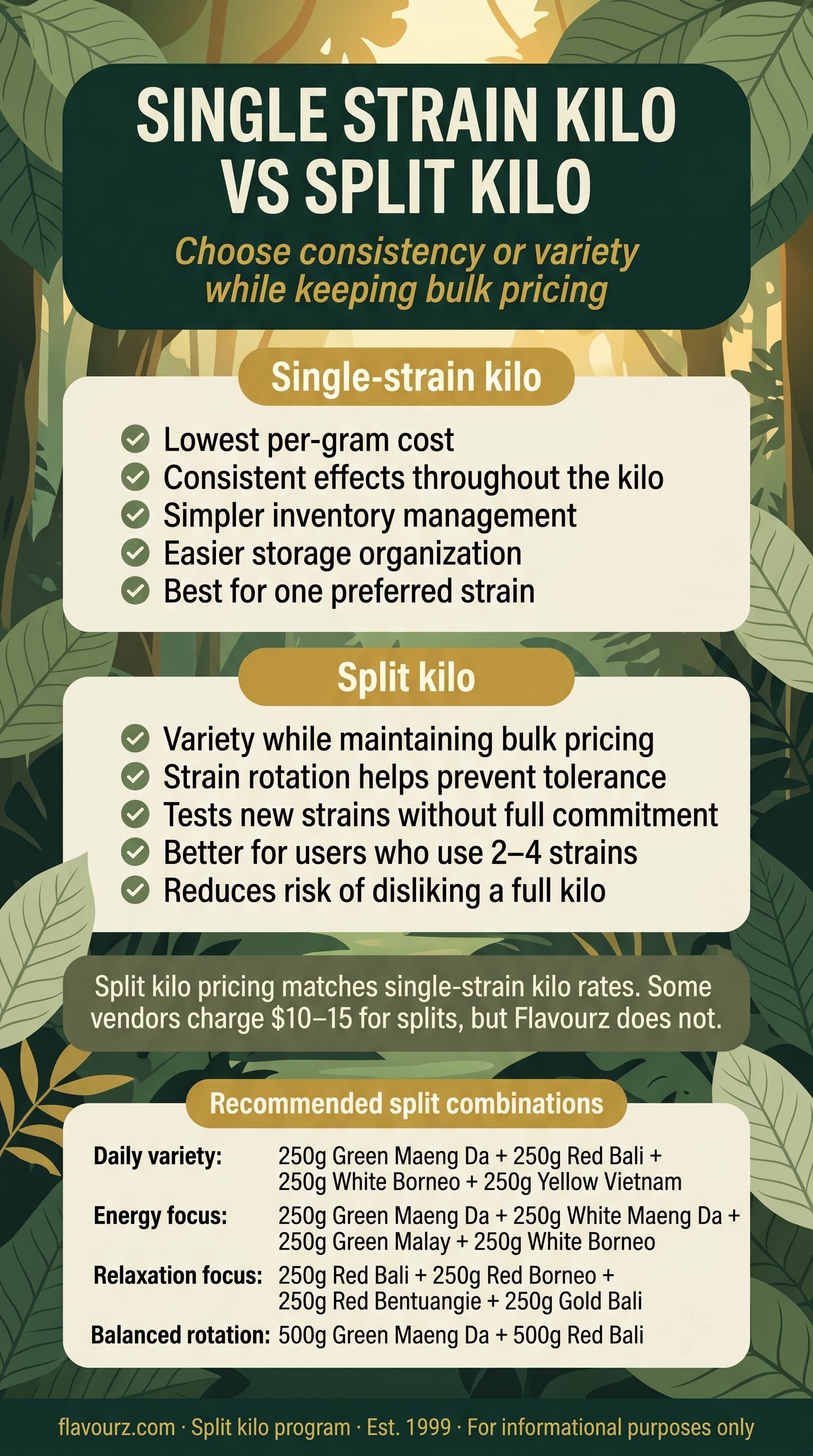
You have two options when buying at the kilo level: single-strain kilos or split kilos. Each works for different user profiles.
Single strain kilo benefits:
- Lowest per-gram cost
- Consistent effects throughout the kilo
- Simpler inventory management
- Better for users with single preferred strain
- Easier storage organization
Split kilo benefits:
- Variety while maintaining bulk pricing
- Strain rotation prevents tolerance
- Tests new strains without full commitment
- Better for users who use 2-4 different strains
- Reduces risk of disliking a full kilo
Our split kilo program offers full kilo pricing across multiple strains without any upcharge. Some vendors charge $10-15 for splits, but ours doesn't.
Recommended split kilo combinations:
- Daily variety: 250g each of Green Maeng Da, Red Bali, White Borneo, Yellow Vietnam
- Energy focus: 250g each of Green Maeng Da, White Maeng Da, Green Malay, White Borneo
- Relaxation focus: 250g each of Red Bali, Red Borneo, Red Bentuangie, Gold Bali
- Balanced rotation: 500g Green Maeng Da + 500g Red Bali
How to Verify Quality Before Kilo Commitment
The biggest mistake first-time kilo buyers make is committing without verifying quality. Spend $30-50 testing samples before placing $80-120 kilo orders. This small investment prevents expensive disappointments.
Pre-kilo verification process:
- Order a 100g sample of your intended kilo strain
- Test for 2-3 weeks with consistent dosing
- Verify potency matches your expectations
- Check freshness and packaging quality
- Evaluate vendor communication and shipping speed
- Compare effects to other vendors' versions of the same strain
- Only commit to kilo after successful 100g testing
Quality markers to verify:
- AKA GMP certification: Independent quality verification
- Batch-specific COA: Lab testing for alkaloid content, heavy metals, and microbes
- Recent harvest date: Fresher kratom delivers stronger effects
- Proper packaging: Vacuum-sealed or nitrogen-flushed
- Mitragynine percentage: 1.4%+ for Maeng Da grades
- Consistent batch testing: Less than 0.2% variation between batches
Storage Requirements for Kilo Purchases
A kilo of kratom is bulky, and improper storage destroys the savings you achieved through bulk buying. If alkaloids degrade through poor storage, you've paid less per gram but lost effectiveness.
Required storage conditions:
- Temperature: Cool, consistent (60-75°F)
- Light: Dark storage away from sunlight
- Humidity: Low humidity (under 60%)
- Air exposure: Minimal (airtight containers)
- Pest protection: Sealed against insects/rodents
Storage container options:
- Original packaging: If vacuum-sealed, leave sealed until use
- Mason jars: Excellent for medium-term storage (3-6 months)
- Vacuum-sealed bags: Best for long-term storage
- Mylar bags with oxygen absorbers: Premium long-term storage
- Food-grade plastic containers: Acceptable for active use
Best storage approach for a fresh kilo:
- Divide the kilo into 4 x 250g portions immediately upon arrival
- Vacuum seal three portions for long-term storage
- Transfer one portion to active-use container (Mason jar)
- Store sealed portions in cool, dark space
- Only open vacuum-sealed portions as needed
This approach maintains potency across the entire kilo's lifespan. Open packages lose alkaloid content faster than properly sealed ones.
Strain Selection Strategy for Kilo Buyers
Choosing the right strain for kilo commitment requires balancing your usage patterns, tolerance prevention, and effect preferences.
Single-strain kilo decision factors:
- Most-used strain: If 70%+ of your usage is one strain, single kilo makes sense
- Effect consistency: Same strain helps if your effects are reliable
- Tolerance pattern: Less rotation needed if dosing 3-4x weekly
- Cost optimization: Single kilos typically cheapest per gram
Best single-strain kilo choices:
- Green Maeng Da - The most popular strain for daily use
- Red Bali - Reliable evening/relaxation choice
- Red Maeng Da - Pain and mood support
- White Maeng Da - Morning energy and focus
- Green Malay - Long-duration balanced effects
Split-kilo decision factors:
- Time-of-day rotation: Different strains for morning, afternoon, evening
- Effect variety needs: Tolerance prevention through rotation
- Experimentation: Testing new strains at lower commitment
- Lifestyle variety: Different strains for different activities
Timing Your Kilo Purchase
When you buy your kilo affects the final cost significantly. Strategic timing can drop your kilo price by 25-40% during major sales periods.
Best times to buy kilos:
- Black Friday: Largest annual discounts (25-40% off)
- Memorial Day: 15-25% off site-wide common
- 4/20 (April 20): Industry-wide promotions
- Independence Day: Holiday weekend sales
- Labor Day: End-of-summer promotions
- Christmas/New Year: Year-end clearance
- Spring/Fall harvest seasons: Fresh batch promotions
Timing strategy:
- Estimate your kilo usage timeline (3, 6, 12 months)
- Time first kilo purchase with major sale event when possible
- Track when you're approaching the half-way point
- Plan next kilo purchase to coincide with sales
- Stockpile during major sales (Black Friday) when budget allows
Patient buyers who wait 1-2 weeks for a major sale often save $30-50 per kilo. Over multiple kilo purchases annually, this disciplined timing saves significant money.
Stockpiling vs Single Kilo Purchases
Once you've committed to kilo-level buying, stockpiling during major sales can amplify your savings. Buying 3-4 kilos during Black Friday locks in low pricing for an entire year.
Stockpiling advantages:
- Maximum discount on largest annual sales
- Insulation against price increases
- Reduced shipping costs per kilo
- Less time spent ordering throughout year
- Avoids potential supply disruptions
Stockpiling disadvantages:
- Higher upfront capital requirement
- Larger storage needs
- Risk of strain not aging well (less common with proper storage)
- Potential preference changes mid-stockpile
Recommended stockpile approach:
- Black Friday: Buy 3-6 month supply of primary strain
- Memorial Day: Buy 2-3 month supply of secondary strain
- Summer sales: Smaller experimental purchases
- Fall harvest: Refresh with new batch
Tracking Kilo Inventory
A kilo lasts months for most users. Tracking inventory prevents running out unexpectedly and helps optimize timing for next purchases.
Simple inventory tracking system:
- Label container with strain name and arrival date
- Note your typical daily consumption
- Calculate estimated depletion date
- Set calendar reminder 4 weeks before estimated depletion
- Plan next purchase around upcoming sales
Usage tracking math:
- 1 kilo = 1,000 grams
- 5 grams daily = 200 days supply
- 10 grams daily = 100 days supply
- Weekly usage variations average out over time
Most regular users consume their kilo between 4-8 months. Plan your next order for the 5-7 month mark to ensure continuous supply without overstocking.
Payment Strategies for Kilo Purchases
Kilo purchases involve $80-120+ transactions. Smart payment strategies can add additional savings beyond the bulk discount.
Payment optimization:
- ACH/eCheck: Many vendors offer 2-3% additional discount
- Cryptocurrency: Often 5-10% discount, faster processing
- Wire transfer: For larger orders, additional discounts possible
- Cashback credit cards: 1.5-5% effective cashback
- Buy now, pay later services: Available with some vendors
Total savings calculation example:
- Kilo retail price: $120
- Bulk discount: -$30 (already factored in kilo pricing)
- Sale event discount: -$30 (Black Friday 25% off)
- Coupon code: -$10 (newsletter code)
- Payment method discount: -$3 (ACH)
- Credit card cashback: -$1 (1.5%)
- Final cost: $76 (37% total savings)
Common Kilo Buying Mistakes
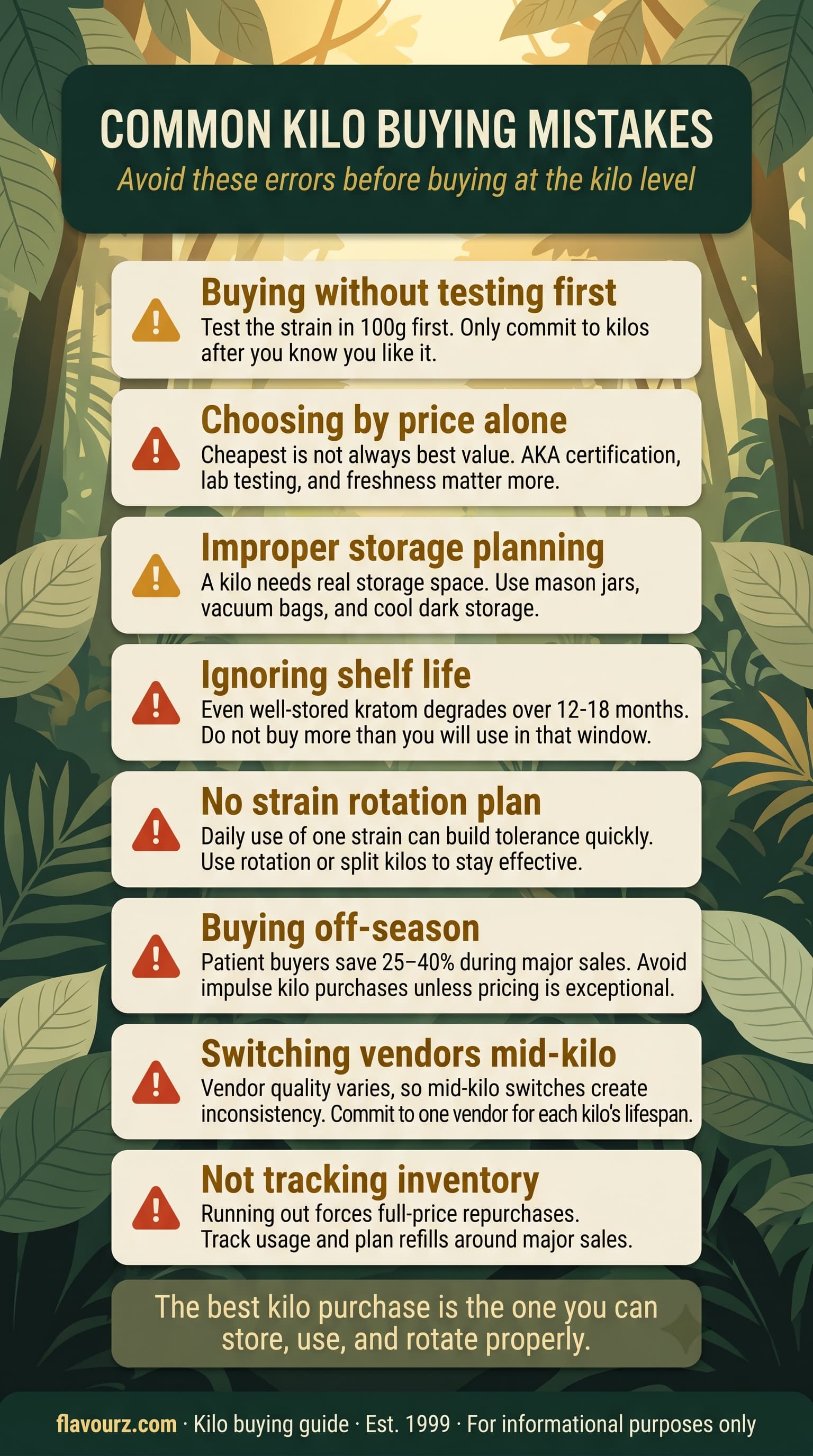
Buying without testing the strain first: Commit to kilos only after verifying you like the strain through 100g testing. Otherwise you risk stockpiling kratom you won't use.
Choosing kilos by price alone: The cheapest kilo isn't always the best value. AKA certification, lab testing, and freshness matter more than absolute lowest price.
Improper storage planning: A kilo requires real storage commitment. Plan your storage solution before ordering. Mason jars, vacuum bags, and cool dark space are minimum requirements.
Ignoring shelf life: Even properly stored kratom degrades over 12-18 months. Don't buy more than you'll use in this window.
Single-strain commitment without rotation: Daily use of one strain builds tolerance quickly. Plan strain rotation or split kilos to maintain effectiveness.
Buying off-season: Patient buyers save 25-40% by timing purchases with major sales. Avoid impulse kilo purchases unless current pricing is exceptional.
Switching vendors mid-kilo: Quality variation between vendors makes mid-kilo switches problematic. Commit to one vendor for each kilo's lifespan.
Not tracking inventory: Running out unexpectedly forces purchases at full price. Track your usage and plan refills around major sales.
When NOT to Buy a Kilo
Despite the cost savings, kilo purchasing isn't right for everyone. These situations indicate you should stick with smaller packages:
- You're new to kratom: First few months should be about finding preferred strains, not bulk buying
- You're testing new vendors: Verify quality with 100g before kilo commitment
- You're testing new strains: Don't kilo-commit to untested strains
- You use kratom occasionally: Less than 3-4 times weekly means a kilo may not be used efficiently
- Your usage patterns are unstable: Heavy and light periods make consumption unpredictable
- You lack storage space: Improperly stored bulk kratom loses effectiveness
- You experiment frequently: Constantly trying new strains conflicts with bulk commitment
- You're traveling extensively: Hard to maintain consistent storage on the road
- Cash flow constraints: $80-120 upfront may not work for all budgets
For these users, 250g-500g purchases offer better balance between cost savings and flexibility.
Comparing Kilo Vendors
Not all kilo vendors are equal. Beyond price comparison, evaluate these factors before committing:
Vendor evaluation checklist:
- AKA GMP certification (essential)
- Recent batch-specific COAs
- Mitragynine percentage guarantee
- Vacuum-sealed packaging
- 30-day return policy
- Established business track record (3+ years)
- Customer service responsiveness
- Shipping speed and reliability
- Split kilo program (if needed)
- Loyalty/rewards program
Top AKA-certified kilo vendors in 2026:
- Flavourz Kratom - 25 years, competitive pricing, split kilos available
- Bulk Kratom Now - $79.99/kilo with 1.4%+ MIT guarantee
- New Dawn Kratom - $79/kilo with 45-day guarantee
- Golden Monk - $89.99/kilo with climate-controlled storage
- Nova Kratom - $88/kilo, 4-way split program
See our complete best kratom brands 2026 guide for detailed vendor analysis.
Frequently Asked Questions
Is buying kratom by the kilo worth it?
Yes, for regular users (5+ grams daily). Per-gram cost drops 50-70% versus smaller packages. A kilo typically lasts 4-8 months for regular users and saves $300-500 versus equivalent smaller purchases.
How long does a kilo of kratom last?
Depends on usage. At 5g daily, 1kg = 200 days (about 6.5 months). At 10g daily, 1kg = 100 days (about 3.3 months). At 3g daily, 1kg = 333 days (about 11 months).
Can I split a kilo with friends?
Yes, this is common. Many users split kilos to access bulk pricing without committing to full quantity personally. Vendors with split kilo programs make this even easier by pre-splitting at order time.
How do I store a kilo of kratom?
Divide into 4 x 250g portions. Vacuum seal three portions for long-term storage. Use one portion in airtight container for active use. Store all in cool, dark space (60-75°F, low humidity).
How long does kratom stay fresh?
Properly stored kratom maintains potency for 12-18 months. Improperly stored kratom (light exposure, humidity, temperature variation) can lose 30-50% potency within 3-6 months.
What's the cheapest kilo of kratom?
Buy Kratom Kilos offers single kilos at $59.99. New Dawn Kratom and Bulk Kratom Now offer competitive pricing around $79-80/kilo with AKA certification.
Should I buy a single strain or split kilo?
Depends on usage. Single strain if you use one strain 70%+ of the time. Split kilo if you rotate between 2-4 different strains regularly. Split kilos help prevent tolerance.
What if I don't like the strain after buying a kilo?
This is why 100g testing before kilo commitment is essential. Reputable vendors offer 30-day return policies on opened products. Many users sell unwanted kilos at cost on Reddit's r/kratomexchange.
Can I order multiple kilos at once?
Yes. Many vendors offer additional discounts at the 5+ kilo level. This makes stockpiling during major sales particularly cost-effective for heavy users.
Final Strategy: The Smart Kilo Buyer's Playbook
Month 1-3 (Setup phase):
- Test 4-6 different strains in 1-2oz quantities
- Identify 2-3 strains that consistently work for you
- Find an AKA-certified vendor whose quality you trust
- Subscribe to vendor newsletter for sale notifications
Month 3-6 (Confirmation phase):
- Order 250g of your top preferred strain
- Verify consistent quality across orders
- Establish your daily usage pattern
- Calculate your annual consumption estimate
Month 6+ (Kilo buying phase):
- Time first kilo purchase with major sale event
- Start with single strain or 2-way split
- Set up proper storage system before delivery
- Track inventory to optimize refill timing
Year 1+ (Mastery phase):
- Stockpile during Black Friday (3-6 month supply)
- Establish loyalty status with primary vendor
- Consider split kilos for variety
- Optimize timing for major sales annually
Where to Buy Kilos
At Flavourz Kratom, our kilo program delivers 25 years of Indonesian sourcing experience at competitive bulk pricing. Our split kilo program offers full bulk pricing across multiple strains without upcharges.
For specific strain kilos, browse:
- Green Maeng Da - Most popular daily-use strain
- Red Bali - Best evening/relaxation choice
- Red Maeng Da - Pain support and mood
- White Maeng Da - Morning energy
- Green Malay - Long-duration balanced effects
For additional research, see our 2026 kratom prices guide or cheap kratom buyer's guide.
Final Thoughts
Kilo-level kratom buying represents the single biggest cost-saving opportunity for regular kratom users. The math is straightforward: $0.10/gram for kilos versus $0.50-0.71/gram for 1-ounce packages. Over a year, the savings reach hundreds or even thousands of dollars for heavy users.
The key is honest evaluation of your readiness. Don't kilo-commit until you have established preferences, proper storage, and consistent usage patterns. Once those three boxes are checked, the financial argument for bulk buying is overwhelming.
Start with a single-strain kilo of your most-used variety or a split kilo for variety. Time your purchase with major sales. Establish proper storage. Track inventory for refill timing. Within a year, you'll be paying significantly less for the same quality kratom you've been buying all along.
Disclaimer: Kratom is not FDA approved for any medical use. These statements have not been evaluated by the Food and Drug Administration. This product is not intended to diagnose, treat, cure, or prevent any disease. Consult a healthcare provider before use. Intended for adults 21 and older. Kratom is federally legal but restricted in Alabama, Arkansas, Indiana, Rhode Island, Vermont, and Wisconsin. Check your state and local laws before purchasing.

Leave a comment