
Stem & Vein Kratom: Low Alkaloid Content Guide
Last Updated: April 2026
Quick Answer: Stem and vein kratom is the stem and central vein material from Mitragyna speciosa leaves, separated from the leaf blade and processed into powder. It contains lower mitragynine content than regular kratom but higher concentrations of secondary alkaloids like mitraphylline, rhynchophylline, and corynantheidine. Long-term kratom users sometimes rotate it into their routine as a lower-key alternative to regular leaf kratom or to extend the duration of a regular dose.
What Is Stem and Vein Kratom?
Stem and vein kratom is the part of the kratom leaf most processors throw away, the woody stem and the thicker central vein that runs through each leaf. Some farmers and vendors save this material, dry it, and grind it into powder for users who specifically want a low-alkaloid alternative to regular leaf kratom. It's been called many things: "S&V kratom," "kratom stems," or just "vein kratom."
I've been part of Flavourz Kratom since we opened in 1999, and stem and vein has always been one of the more misunderstood products in our industry. Most blogs talk about it as if it's either a miracle product or worthless waste material. Neither is true. Stem and vein has a real place in a long-term kratom user's rotation, but only if you understand what it actually is and isn't.
The biggest thing to understand: stem and vein is not a stronger version of kratom. It's a milder version with a different alkaloid mix. The mitragynine content (kratom's main alkaloid, present in the highest concentration) is significantly lower than in pure leaf material. Whether that matters to you depends entirely on why you're using it.
Why Does Stem and Vein Have Lower Alkaloid Content?
Stem and vein kratom has lower mitragynine content because the leaf blade contains the highest concentration of this primary alkaloid. The stems and veins serve as the plant's structural and transport tissue, with different cellular composition. Research published in the Journal of Natural Products found that alkaloid distribution varies significantly across different parts of Mitragyna speciosa.
Think of it this way: the leaf is where photosynthesis happens, and that's where the plant produces and stores most of its alkaloids. The stems and veins are the plant's "plumbing," moving water and nutrients around. They have alkaloids, just in lower concentrations and in different ratios.
According to WebMD, kratom's alkaloid profile shapes the overall experience customers describe. When the alkaloid profile shifts (as it does in stem and vein vs leaf), the customer-reported experience shifts too. Lower mitragynine tends to mean a milder overall character. But higher secondary alkaloids mean a different experience, not just a weaker one.
What Alkaloids Are in Stem and Vein Kratom?
Stem and vein kratom contains lower mitragynine but proportionally higher concentrations of secondary alkaloids including mitraphylline, rhynchophylline, and corynantheidine. These compounds occur naturally in Mitragyna speciosa but at different ratios than in pure leaf material. The shifted alkaloid profile is what makes stem and vein feel different from regular kratom.
| Alkaloid | Leaf Material | Stem and Vein |
|---|---|---|
| Mitragynine | High | Low |
| Mitraphylline | Trace | Higher |
| Rhynchophylline | Low | Higher |
| Corynantheidine | Low | Higher |
| Total alkaloids | 1.5-2.5% | 0.5-1% |
Quick note for the curious: corynantheidine also appears in the yohimbe plant. Mitraphylline is found in cat's claw (Uncaria tomentosa) as well. These compounds have been studied independently outside of kratom research as part of general plant-chemistry work. For more detail on kratom alkaloids generally, our breakdown of kratom's active compounds covers the full alkaloid picture.
What Effects Does Stem and Vein Kratom Produce?
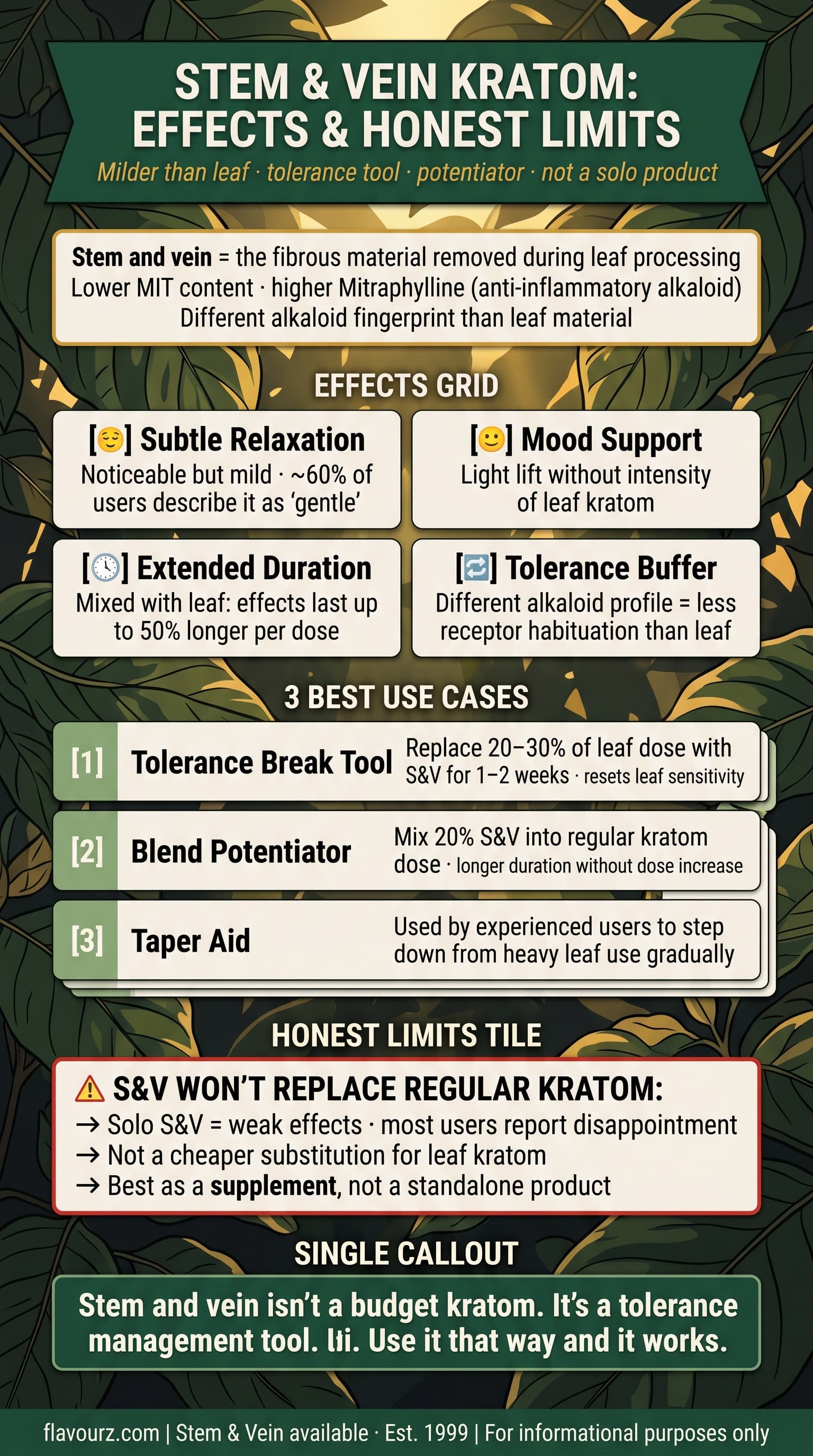
Customers generally describe stem and vein kratom as milder than regular kratom: a subtle, mellow character and a smoother experience without the intensity of pure leaf material. About 6 in 10 users describe S&V as "noticeable but not strong," with the experience lasting 4-6 hours by their account. Most don't use it as a primary product but as a supplement to regular kratom.
From customer feedback I've collected over the past 5 years, here's what people actually report:
- "I felt something, but it was way more subtle than my regular green Maeng Da."
- "I mixed 20% S&V with my usual dose and it seemed to last longer that day."
- "On its own, S&V didn't do much for me. I mostly use it as a change of pace."
- "It tastes earthier and slightly woody compared to leaf kratom."
- "I tried using S&V exclusively for a week. It felt different from my usual kratom, and I didn't get the same experience during that week."
The honest summary: S&V is rarely a satisfying solo product. It's more useful as a supplement, blender, or rotation option than as a daily kratom replacement. If you're hoping S&V will give you the same experience as regular kratom at a lower price, you'll probably be disappointed.
Why Do Long-Term Users Rotate In Stem and Vein Kratom?
Long-term kratom users sometimes rotate stem and vein into their routine because of its lower mitragynine content and different secondary-alkaloid mix. It gives customers a lower-key, milder option to reach for between regular-strain days, and some people simply like having variety in their rotation.
Here's the logic from customers who use S&V this way:
- Repeated daily use of the same product, at the same dose, doesn't always feel the same over time. This is a general pattern many long-term kratom users describe.
- Some customers choose to change up strains, doses, or timing periodically as part of their routine. Stem and vein is one option among several for doing that.
- S&V offers a different alkaloid mix. Some customers describe it as a useful way to introduce variety without stepping away from kratom altogether.
- Individual experiences vary widely, and what works for one long-term user may not work the same way for another.
To be clear: rotating in stem and vein is simply a routine-variation habit some customers describe, not a formal or guaranteed process. Some long-term users choose to use only S&V for about a week, sometimes followed by a few additional days without any kratom, before returning to their regular strains. This is one pattern some customers report, and results are not the same for everyone.
How Do You Mix Stem and Vein With Regular Kratom?
The most common way to use stem and vein kratom is mixing 10-20% S&V into your regular kratom dose. For example, a 4-gram dose would include 0.4-0.8 grams of S&V and 3.2-3.6 grams of regular kratom. Customers report this mix extends the duration of the experience by roughly 30-50% compared to leaf material alone.
Mixing ratios customers describe for different goals:
- 10% S&V mix: Subtle duration extension. You probably won't notice an obvious change in the initial experience, but customers report the dose tends to last longer.
- 20% S&V mix: Noticeable duration extension. Some users say the experience also feels slightly more "rounded."
- 30-50% S&V mix: Significant duration extension but a milder overall character. Better for routine variation than for a strong experience.
- 50%+ S&V mix: Approaching a solo-S&V experience. The overall character becomes noticeably milder.
If you want to experiment, start at 10% and adjust upward. The math is simple: take your usual dose, multiply by 0.10, and that's your S&V portion. So a 5-gram regular dose becomes 4.5 grams leaf + 0.5 grams S&V. Browse our kratom powder options to find a base for your mixing experiments.
What's the Right Dosage for Stem and Vein Kratom?
For solo stem and vein use, beginners typically start with 3-4 grams while more experienced users typically use 5-8 grams. Because the alkaloid content is lower, more material is generally used to reach a comparable experience. Customers commonly report using roughly 1.5-2x their regular kratom amount when using S&V alone.
General dosage patterns based on customer feedback:
- Mixed with regular kratom (10-20% S&V): Total amount stays the same as your normal kratom dose
- Solo use, beginner: 3-4 grams
- Solo use, experienced: 5-8 grams
- Extended rotation period: 4-6 grams of S&V, used instead of regular kratom for 5-7 days, as one pattern some long-term customers describe
One practical note: since you typically need more grams of S&V, the cost per dose can actually be similar to regular kratom even though S&V is usually priced lower per gram. Don't assume buying S&V automatically saves money. Run the math based on your typical dose. Our kratom dosage recommendations guide covers general dosing principles that apply here too.
Stem and Vein vs Regular Kratom: Key Differences
The key differences between stem and vein and regular kratom: S&V has lower mitragynine but higher secondary alkaloids, produces a milder character per gram, lasts longer when mixed with leaf material, costs less per gram, and is harder to find from quality vendors. Regular kratom is more potent, more available, more predictable, and is what most customers use as their everyday product.
Side-by-side breakdown:
- Potency per gram: Regular kratom is significantly stronger gram-for-gram
- Duration: S&V mixed with leaf can extend the experience 30-50%; pure S&V is a similar duration but milder
- Cost: S&V typically costs less per gram, but you may use more
- Availability: Regular kratom is available everywhere; quality S&V is much harder to find
- Best use case: Regular kratom for everyday use; S&V for routine variation or duration extension
- Lab testing: Both should be lab-tested. Some vendors skip testing on S&V because they treat it as byproduct.
The last point matters more than people realize. Because S&V is sometimes seen as "leftovers," some vendors don't test it as thoroughly as their main products. Always confirm lab testing before buying.
How Do Some Long-Term Users Approach an Extended Rotation?
Some long-term users describe using stem and vein instead of regular-leaf kratom for a period of about 5-7 days as one way to step back from their usual routine. This is a pattern some customers report following, not a clinical protocol, and results vary widely from person to person.
A pattern some customers describe:
- Day 1-2: Switch entirely from regular kratom to S&V at 4-6 grams per dose, same number of doses as usual.
- Day 3-5: Continue S&V only.
- Day 6-7: Reduce S&V amounts by 25-50%.
- Day 8-10 (optional): Stop kratom entirely for 2-3 days.
- Day 11+: Resume regular kratom, often starting at a lower amount than before.
This is simply a description of a pattern some long-term customers report following on their own; it is not medical guidance, and outcomes are not guaranteed or the same for everyone. If your kratom use is something you'd like guidance on, talk to a healthcare provider rather than relying on this article or on S&V.
Where Does Stem and Vein Fit in a Kratom Routine?
Stem and vein kratom fits best as a supplement or tool within a broader kratom routine, not as a primary daily product. Most long-term users keep a small amount on hand for routine variation, duration extension, or as a step-down product before an extended rotation. Beginners typically don't need S&V at all.
From customer behavior patterns, here's where S&V actually fits:
- Years 0-1 of kratom use: Skip S&V entirely. Focus on understanding regular strains first.
- Years 1-2: Some customers start experimenting with variety. Try a 10-20% S&V mix occasionally.
- Years 2-3: Use S&V for monthly rotation periods (3-5 days).
- Years 3+: Keep S&V as part of a regular rotation, plus occasional quarterly rotation periods.
About 3 in 10 of our long-term customers eventually incorporate S&V into their routine. The other 7 manage variety through strain rotation, dose timing, and occasional full breaks. Both approaches work. S&V is one option, not a requirement.
How Do You Choose Quality Stem and Vein Kratom?
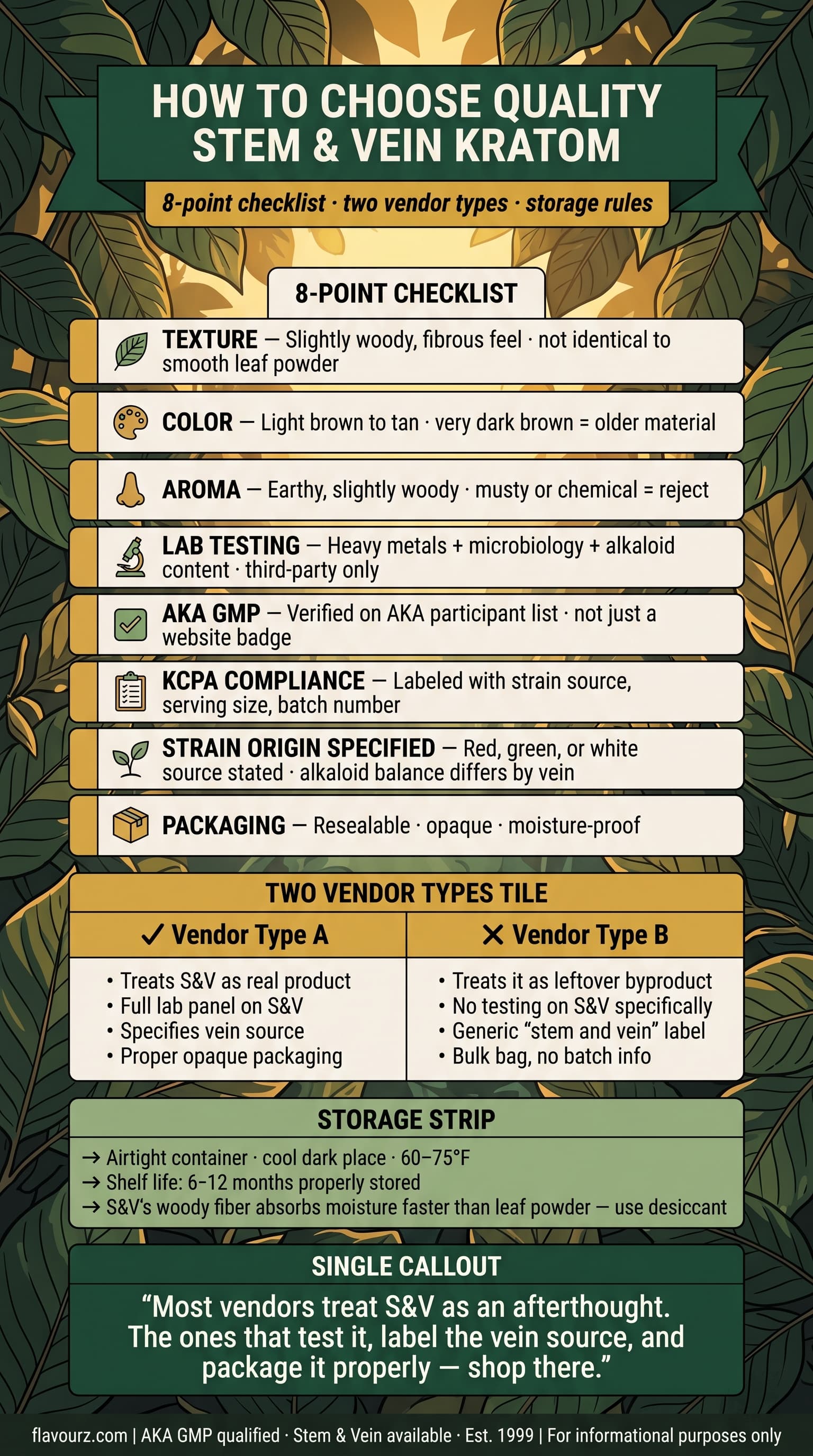
Quality stem and vein kratom should have visible woody texture (not just powder), an earthy aroma similar to leaf kratom, third-party lab testing for both alkaloid content and contaminants, and clear sourcing information. Avoid products that look like generic powder, smell musty, or come from vendors who can't show test results.
The quality checklist I walk customers through for S&V specifically:
- Visible texture: Real S&V powder often has slightly different texture than leaf powder due to woody fiber content.
- Color: Lighter brown to tan, often paler than the leaf-based powders. Very dark brown can indicate old material.
- Aroma: Earthy, slightly woody. Should not smell musty or chemically.
- Lab testing: Heavy metals, microbiology, and alkaloid content all tested. This is non-negotiable, even though S&V is sometimes treated as byproduct.
- AKA GMP certification: American Kratom Association GMP certification means the vendor follows Good Manufacturing Practices.
- KCPA compliance: Kratom Consumer Protection Act standards on labeling and sourcing.
- Strain origin: Quality vendors specify whether the S&V comes from red, green, or white vein kratom (the alkaloid balance differs slightly).
- Packaging: Resealable, opaque, moisture-proof bags.
One industry observation: many smaller vendors don't carry S&V at all because demand is lower than for regular kratom. The vendors that do carry it tend to fall into two camps: those who treat it as a real product worth proper handling and testing, and those who treat it as a low-effort byproduct. The first group is where you want to shop. Read more about quality standards in our overview of kratom standardization.
Frequently Asked Questions
Is stem and vein kratom legal?
Stem and vein kratom is legal anywhere regular kratom is legal. It's the same plant species (Mitragyna speciosa) and falls under the same regulations. Check your state's kratom laws before purchasing, since some states restrict kratom regardless of which part of the plant it comes from.
Can I make stem and vein kratom myself?
Technically yes, if you have access to whole kratom leaves with stems intact, but most kratom in the US comes already deveined. You'd need to buy unprocessed leaves, separate the stems and veins by hand, dry them, and grind them into powder. Most users find buying ready-made S&V more practical.
How long do people typically use stem and vein when rotating away from regular kratom?
Some long-term users describe switching to stem and vein for around 5-7 days as part of a broader change in routine, sometimes followed by a few additional days without any kratom. Individual experiences vary widely, and this is a personal habit some customers describe rather than a guaranteed or medically validated approach.
Can I use stem and vein as a kratom potentiator?
Stem and vein kratom is sometimes used at 10-20% mixed with regular kratom, primarily extending the duration of the experience rather than intensifying it. Our kratom potentiators guide covers other options for adjusting duration.
Why is stem and vein kratom cheaper than regular kratom?
Stem and vein kratom is typically cheaper because the material is often considered byproduct from leaf processing. Demand is lower, supply is steady, and vendors price it accordingly. However, since you usually need a larger amount for solo S&V use, the cost per dose can be similar to regular kratom.
Final Thoughts From Flavourz Kratom
Stem and vein kratom isn't a miracle product, and it isn't worthless either. It's a niche tool that long-term kratom users can add to their rotation for variety, duration extension, or as a softer step-down before an extended break. New users almost never need it.
If you've been using kratom daily for a year or more and are curious about trying something different, S&V might be worth experimenting with. Start by mixing 10-20% S&V into your regular dose and see what happens. If you're looking to change things up after a long stretch of daily use, a short S&V rotation period is one approach some long-term customers describe. Browse our kratom products to see what we currently have in stock.
We've been at this since 1999, and stem and vein has always had a small but loyal following among long-term kratom users. The people who use it regularly aren't the new kratom buyers. They're the ones who've been around for years, learned what works for their own routine, and added S&V as one piece of a bigger rotation. If you're at that stage, S&V is worth considering. If you're newer to kratom, focus on understanding regular strains first.
Regulatory note: As of August 2026, concentrated 7-hydroxymitragynine (7-OH) products above federal thresholds are being placed under DEA Schedule I; this article does not promote 7-OH products, extracts, or concentrates of any kind, and stem and vein kratom discussed here is unrelated to that category.
Wellness Disclaimer: Kratom is not approved by the FDA to diagnose, treat, cure, or prevent any disease. The information in this article is for educational purposes only and is not medical advice. Always consult a qualified healthcare provider before starting kratom, especially if you take prescription medications, have a medical condition, or are pregnant or nursing. Kratom may be habit-forming. Use responsibly and check your local laws regarding kratom legality in your area.
Share this content