
12 Kratom Juice Recipes: Citrus Blends to Green Smoothies
Last Updated: April 2026
Kratom juice and smoothie recipes do two things simultaneously: they make kratom consumption significantly more palatable for taste-sensitive users, and — when the right ingredients are selected — they actively improve the pharmacokinetics of the dose. Citrus juices inhibit the liver enzymes that metabolize kratom alkaloids. Avocado and coconut milk provide the lipid carrier that mitragynine's low water solubility specifically requires. Ginger inhibits P-glycoprotein efflux pumps that reduce intestinal alkaloid absorption. The difference between a kratom recipe built on flavor intuition and one built on ingredient pharmacology can be the difference between a 21% and a 35%+ oral bioavailability from the same gram dose. Before diving into recipes, newcomers should review our comprehensive super indo kratom guide for beginners to understand proper dosing and strain characteristics.
At Flavourz Kratom, we organize these 12 recipes into three functional tiers — citrus-based potentiators, tropical fruit smoothies, and green smoothie blends — with the pharmacological mechanism of each recipe category explained before the recipes themselves. Every recipe includes verified ingredients, method, strain pairing, and a potentiation note so buyers understand exactly what each drink is doing beyond masking the taste. Use our kratom powder for all recipes requiring loose powder; extract-compatible notes are flagged where appropriate.
The Three Recipe Tiers: What They Do Differently
| Tier | Recipe Type | Primary Mechanism | Potentiation Level | Best For |
|---|---|---|---|---|
| Tier 1 | Citrus-based (Recipes 1–4) | CYP3A4 inhibition + acid pre-extraction | Highest duration extension | Experienced users; potency maximization |
| Tier 2 | Tropical smoothies (Recipes 5–8) | Lipid carrier (coconut/almond milk, avocado) + flavor coverage | High bioavailability improvement | Beginners and intermediates; daily use |
| Tier 3 | Green smoothies (Recipes 9–12) | Avocado maximum lipid carrier + spinach taste-softening + nutrient stacking | Highest fat-carrier bioavailability | Wellness-focused; morning dose; extract compatibility |
Tier 1: Citrus-Based Kratom Drinks (Recipes 1–4)
Citrus-based kratom drinks are the most pharmacologically active recipe category in this guide. Their primary mechanism is CYP3A4 enzyme inhibition — grapefruit specifically contains bergamottin and naringin, compounds that reduce the liver's ability to metabolize mitragynine and 7-HMG, extending the duration and intensity of a given dose without increasing the gram amount consumed. As documented across multiple kratom potentiation research compilations including NRAES's 2025 potentiation methods guide, the citrus potentiator hierarchy runs: grapefruit (most potent) → orange (moderate) → lemon/lime (mild but effective through acid pre-extraction). Effects from grapefruit-potentiated kratom doses can extend to 6–8 hours versus the standard 3–5 hours for non-potentiated doses of equivalent grams.
A secondary mechanism applies specifically to lemon and lime: citric acid pre-extracts kratom alkaloids from plant cell wall material when kratom powder is allowed to sit in the acidic liquid for 15–20 minutes before consumption. As documented by AltLaw's 2025 kratom absorption guide, this acid pre-extraction "improves absorption by up to 40%" — making the lemon sit-time protocol (Lemon Tek) the highest single-mechanism absorption enhancement available from any liquid preparation short of full solvent extraction.
Recipe 1: Classic White Grapefruit Potentiator
This is the single most effective pharmacological kratom drink in the guide — not for flavor, but for duration and intensity extension per gram. White grapefruit juice contains higher concentrations of bergamottin and naringin than red grapefruit, making white juice the specific variety to use. This recipe is consumed 30–45 minutes before the kratom dose rather than mixed with it — the CYP3A4 inhibition needs time to establish before the alkaloids arrive at the liver.
Ingredients:
- 8–12 oz freshly squeezed white grapefruit juice (not from concentrate — commercial processing reduces furanocoumarin content)
- Optional: 1 teaspoon honey to offset tartness
- Your kratom dose consumed separately 30–45 minutes after the juice
Method: Juice fresh white grapefruit immediately before consuming — furanocoumarin content degrades in stored juice. Drink the full 8–12 oz serving. Wait 30–45 minutes before taking your normal kratom dose by any method (toss-and-wash, capsules, tea, or mixed into the second recipe below).
- Potentiation mechanism: CYP3A4 inhibition via bergamottin + naringin — extends alkaloid half-life in circulation
- Duration extension: 6–8 hours documented vs. 3–5 hours standard
- Best kratom strains: Red vein — the duration extension is most practically useful for red vein's pain management and sedative applications; combining red vein's profile with grapefruit's extended window maximizes the therapeutic window
- Dosing caution: Reduce normal gram dose by 15–20% when using grapefruit pre-dosing — the extended metabolic half-life means the same gram dose produces a longer, potentially stronger experience than calibrated for. Full recalibration guidance in our kratom dosage guide
- Not for beginners: CYP3A4 inhibition interactions extend to prescription medications; consult a healthcare provider if taking any CYP3A4-metabolized pharmaceuticals
Recipe 2: Iced Citrus Kratom Cooler
This is the most beginner-accessible citrus recipe — combining orange juice's moderate CYP inhibition with lemon juice's acid pre-extraction mechanism in a refreshing, cold-serve format. As Botanical Brewing Co.'s 2025 kratom drink guide documents, "this recipe combines kratom with orange and lemon for a zesty pick-me-up that hydrates and invigorates" — with the cold temperature serving the dual practical function of muting bitterness perception (cold temperatures reduce bitter taste receptor sensitivity) and making the drink format suitable for warm-weather consumption.
Ingredients:
- 1 cup cold water
- Juice of 1 orange (freshly squeezed)
- Juice of ½ lemon
- 1–2 teaspoons honey
- Ice cubes
- Your kratom dose
Method: Add kratom powder to lemon juice first and stir — let this mixture sit for 5–10 minutes to begin acid pre-extraction before adding remaining ingredients. Combine lemon-kratom mixture with orange juice, cold water, and honey. Stir until honey fully dissolves. Pour over ice and consume promptly before powder settles.
- Potentiation mechanism: Orange (moderate CYP inhibition) + lemon (acid pre-extraction)
- Best kratom strains: White or green vein — citrus's bright, energetic flavor profile pairs naturally with lighter vein types
- Best for: Beginners to citrus potentiation; summer morning dose; anyone who finds straight kratom tea insufficiently palatable
Recipe 3: Citrus Surge Triple-Fruit Blend
The Citrus Surge stacks three citrus and citrus-adjacent fruits — orange, lemon, and pineapple — with coconut water as the hydration base. As Joe's Botanicals' 2025 smoothie guide describes: "for those who love bold, tangy flavors, this recipe harnesses citrus acidity to completely neutralize kratom's earthiness — it's an excellent morning energizer." Coconut water provides electrolytes that support the hydration element of morning consumption while adding a mild natural sweetness without the caloric density of juice.
Ingredients:
- 1 peeled orange
- Juice of ½ lemon
- ½ cup frozen pineapple chunks
- 1 cup coconut water
- Your kratom dose
- Optional: ½ teaspoon honey
Method: Blend orange, pineapple, and coconut water until smooth. Add lemon juice and kratom powder, blend briefly (5–10 seconds) to incorporate without aerating excessively. The frozen pineapple chunks create a naturally chilled, slightly slushy texture that further reduces bitter temperature sensitivity.
- Potentiation mechanism: Triple citrus acid pre-extraction + orange CYP inhibition
- Best kratom strains: Green vein — green vein's balanced alkaloid profile is the most versatile pairing for a bold citrus base
- Best for: Morning energy dose; users transitioning from toss-and-wash to a more palatable method
Recipe 4: Lemon Tek Citrus Shot — Maximum Pre-Extraction Protocol
The Lemon Tek is the most pharmacologically targeted preparation in Tier 1 — not a drink designed for flavor enjoyment, but a precision absorption protocol in shot format. The 15–20 minute sit time between mixing kratom with lemon juice and consuming is the critical variable: citric acid needs time to penetrate plant cell walls and begin alkaloid pre-extraction before the mixture reaches the stomach. This sit time is what separates the Lemon Tek from simply mixing kratom into lemon juice and consuming immediately.
Ingredients:
- 2–3 tablespoons fresh lemon juice
- 1 tablespoon fresh lime juice
- 1 teaspoon honey
- 2–3 oz water (for palatability)
- Your kratom dose
Method: Combine kratom powder with lemon and lime juice in a small glass. Stir until powder is fully wetted — no dry pockets. Cover and allow to sit undisturbed for 15–20 minutes at room temperature. Add honey and water, stir once more, and consume the full volume promptly. Do not extend sit time beyond 30 minutes — prolonged acid exposure at room temperature eventually begins degrading alkaloids rather than pre-extracting them.
- Potentiation mechanism: Citric acid pre-extraction — documented up to 40% absorption increase over non-acid kratom
- Best kratom strains: All — pre-extraction improves yield from any vein type; particularly useful for kratom extract products where even marginal bioavailability improvements produce noticeable effect differences
- Best for: Users who want maximum alkaloid yield from a specific dose without increasing grams; morning preparation where 20-minute sit time fits naturally into a routine
- Potentiation synergy: The Lemon Tek is fully compatible with the freeze pre-treatment documented in our kratom freezing guide — freeze the powder overnight first (rupturing cell walls), then apply the Lemon Tek protocol to the thawed powder for compounded cell lysis + acid pre-extraction
Tier 2: Tropical Kratom Smoothies (Recipes 5–8)
Tropical smoothies are the most beginner-accessible recipes in this guide and the category that consistently receives the highest palatability ratings in kratom community feedback. Their primary pharmacological function is lipid-carrier delivery: coconut milk, almond milk, and (in Recipe 8) avocado all provide fat content that improves mitragynine's intestinal absorption by addressing its documented Class II low-water-solubility limitation. As KratomLords' recipe research confirms, "dairy and alternatives such as almond milk and coconut milk make the smoothie creamier and help with the absorption of kratom's alkaloids."
Recipe 5: Tropical Paradise Beginner Smoothie
The Tropical Paradise is the most widely recommended beginner kratom smoothie in the community — combining banana's creamy sweetness, pineapple's bright acidity, and coconut or almond milk's fat content into a format that reliably eliminates kratom bitterness for first-time users. Joe's Botanicals' 2025 guide describes it as "the perfect introduction to kratom smoothies" — the pineapple brightness and banana creaminess dominate completely while the milk base softens everything into a cohesive experience.
Ingredients:
- 1 ripe banana (frozen for thicker consistency)
- ½ cup frozen pineapple chunks
- 2 cups coconut or almond milk (full-fat coconut for maximum lipid carrier advantage)
- Your kratom dose
- Optional: ½ cup mango chunks for extra sweetness
Method: Add milk to blender first to prevent powder sticking to blender walls. Add frozen banana and pineapple. Blend until smooth. Add kratom powder, blend briefly for 10 seconds on low — over-blending after powder is added introduces excessive air that can create an unpleasant foamy top layer. Consume immediately; frozen fruit creates a naturally cold, thick smoothie that needs no added ice.
- Potentiation mechanism: Lipid carrier (coconut/almond milk fat) + pineapple mild acid
- Best kratom strains: Green or white vein — tropical brightness pairs naturally with lighter alkaloid profiles
- Best for: Kratom beginners; daily palatability; users transitioning from toss-and-wash
Recipe 6: Mango-Pineapple Green Power Blend
This recipe bridges Tier 2 and Tier 3 by adding spinach to a tropical base — creating what Kratom Country's smoothie guide calls a "simple green kratom smoothie loaded with leafy vegetables and protein" while keeping the tropical fruit flavors dominant enough to ensure the spinach contributes taste-softening without adding greenness the drinker can detect. The mango's density and sweetness completely masks both the spinach and the kratom when the ratio is correctly calibrated.
Ingredients:
- ½ cup fresh or frozen mango chunks
- ½ cup frozen pineapple chunks
- 2 cups frozen spinach (frozen releases water on blending, naturally thickening the base)
- 1½ cups water or coconut water
- Your kratom dose
Method: Blend spinach with water first until liquid and uniform green — a separate spinach-first blend step prevents spinach fiber chunks remaining in the final drink. Add mango and pineapple, blend until smooth. Add kratom powder, pulse briefly. The mango-to-spinach ratio in this recipe ensures the green color is visible but the taste is tropical rather than vegetal.
- Potentiation mechanism: Spinach taste-softening + mild acid from pineapple + coconut water electrolytes
- Best kratom strains: Green Malay or Green Maeng Da — green vein's balanced profile is the natural match for a green smoothie base
- Best for: Morning wellness dose; users who want a nutritional element alongside their kratom preparation
Recipe 7: Citrus Splash Cooler with Mint
Golden Monk's recipe guide documents the Citrus Splash Refresher as a "perfect for mornings or early afternoons when you want something revitalizing and flavorful" — combining citrus juice's potentiation with a cold-serve format specifically designed for hot-weather or post-workout consumption. The mint addition creates a retronasal aromatic cooling effect that further suppresses bitter perception by flooding the nasal passage with menthol before kratom bitterness registers.
Ingredients:
- Juice of 1 lemon
- Juice of 1 lime
- Slice of orange
- 6–8 fresh mint leaves
- 1 cup cold coconut water or sparkling water
- Ice
- 1 teaspoon honey
- Your kratom dose
Method: Muddle mint leaves in the bottom of a glass before adding any liquids — release the essential oils directly, which provides the retronasal aromatic benefit. Add kratom to lemon juice and let sit 5 minutes (brief acid pre-extraction). Combine all liquids, honey, and kratom-lemon mixture over ice. Squeeze orange slice over the top and drop in. Stir and consume within 5 minutes before powder settles.
- Potentiation mechanism: Citric acid pre-extraction + mint retronasal bitterness suppression
- Best kratom strains: White vein — mint's clarity and freshness pairs with white vein's cognitive-stimulating profile
- Best for: Afternoon refresher; post-workout recovery dose; hot weather
Recipe 8: Avocado-Spinach-Lime Power Smoothie
This recipe contains the highest single-drink fat content in the guide — one-half avocado delivers 13–20g of fat, making this the most potent lipid carrier preparation available outside of combining kratom with peanut butter. As Zamnesia's 2025 kratom avocado smoothie documentation confirms, the combination of avocado fat, spinach, and lime creates a smoothie that is "creamy, satisfying and nutritionally complete" while delivering full lipid-carrier bioavailability advantages. Lime juice simultaneously activates mild acid pre-extraction while the avocado fat provides the intestinal absorption enhancement.
Ingredients:
- ½ ripe avocado, cubed
- 1 frozen banana
- 1 cup frozen spinach
- ½ cup frozen pineapple
- ¾ cup full-fat coconut milk
- 3 tablespoons fresh lime juice
- Pinch of sea salt
- Your kratom dose
Method: Add coconut milk to blender first. Add avocado and pulse until creamy — avocado must fully emulsify before adding frozen fruits or the texture becomes chunky. Add spinach, pineapple, and frozen banana. Blend until smooth. Add kratom powder and lime juice together (the lime begins acid pre-extraction in the blender during the final brief blend). Add sea salt — a small amount of sodium heightens sweet and sour perception, making the lime and banana flavors more vivid relative to kratom bitterness. Blend 10 seconds more and serve immediately.
- Potentiation mechanism: Maximum lipid carrier (avocado 13–20g fat + coconut milk MCT fat) + lime acid pre-extraction
- Best kratom strains: Any — fat carrier advantage is universal; particularly effective with kratom extract products
- Best for: Maximum bioavailability; extract users; users with higher gram requirements who want to optimize each dose
Tier 3: Green Kratom Smoothies (Recipes 9–12)
Green smoothies are the most nutritionally dense category and the only tier where the base ingredients add functional health benefits independent of kratom. KratomSpot's 2024 green smoothie documentation specifically identifies spinach as "high in vitamins K, A, and C, as well as antioxidants" that "support brain health, eye health, and blood pressure" — making the green smoothie format a functional wellness preparation in its own right. Critically, spinach "interacts positively with kratom, softening its taste" in a way that kale does not — a spinach-specific flavor interaction that makes it the superior leafy green choice for kratom mixing.
Recipe 9: Spinach-Apple-Pineapple Clean Green
This is the simplest true green smoothie in the guide — three whole-food ingredients plus kratom, using apple's natural pectin as a body-building ingredient that creates a fuller mouthfeel per sip and slows the rate at which kratom flavor registers. KratomLords' recipe collection documents spinach + apple + pineapple as one of the most palatable green combinations specifically for kratom — the apple's mild sweetness and tannin content bridges the spinach and pineapple components into a unified flavor.
Ingredients:
- 1 cup fresh spinach
- 1 apple, cored and chopped
- ½ cup pineapple chunks
- 1 cup water or coconut water
- Your kratom dose
Method: Blend spinach with water first until liquid. Add apple and pineapple, blend until smooth. Add kratom powder, pulse briefly. This is the lightest-calorie recipe in the guide — purely whole-food based with no added milk fat. Best consumed with a small amount of healthy fat separately (a handful of nuts or a drizzle of olive oil in the drink) to restore the lipid-carrier advantage if bioavailability is a priority.
- Potentiation mechanism: Spinach taste-softening + pineapple mild acid
- Best kratom strains: Green or white vein
- Best for: Calorie-conscious users; clean eating lifestyle; mornings
Recipe 10: Coconut-Avocado Tropical Green Smoothie
Kratom Country's advanced green smoothie recipe — combining frozen spinach, pineapple, avocado, coconut milk, lime, banana, and sea salt — is the most complete single-recipe green smoothie in this guide, stacking every functional mechanism simultaneously: avocado fat carrier, coconut milk MCT fat, spinach taste-softening, lime acid pre-extraction, banana sweetness masking, and sea salt flavor-amplification. It is slightly more preparation-intensive than the simpler green recipes but delivers a nutritionally complete meal and the highest green-smoothie bioavailability of the four Tier 3 recipes.
Ingredients:
- ½ frozen avocado or ½ ripe fresh avocado
- 1 cup frozen spinach
- ½ cup frozen pineapple
- ¾ cup full-fat coconut milk
- 3 tablespoons lime juice
- 1 frozen banana
- Pinch sea salt
- Your kratom dose
Method: Identical to Recipe 8 (avocado-spinach-lime) with frozen rather than fresh avocado — frozen avocado produces a thicker, icier texture without requiring banana as the primary thickener. Blend coconut milk + avocado first, add spinach and blend, then frozen fruits and kratom + lime together for final blend. Serve in a wide glass immediately.
- Potentiation mechanism: All four simultaneous — fat carrier (avocado + coconut MCT) + acid (lime) + taste-softening (spinach) + flavor masking (banana + pineapple)
- Best kratom strains: All — the most strain-agnostic recipe in the guide
- Best for: Complete meal replacement dose; maximum green smoothie potentiation
Recipe 11: Berry-Kale-Chia Antioxidant Smoothie
As Bedrock Botanicals' innovative kratom recipe guide documents, the berry-kale-chia combination is a "delicious and effective" kratom preparation with a specific structural advantage: chia seeds form a gel layer when added to liquid that slows gastric emptying slightly, extending the absorption window and producing a more gradual onset with a longer plateau. This makes it one of the few recipes in the guide that actively modifies onset timing rather than simply improving peak bioavailability.
Ingredients:
- 1 cup kale or spinach (spinach preferred for taste-softening)
- ½ cup mixed frozen berries (strawberry, blueberry, raspberry)
- 1 frozen banana
- 1 tablespoon chia seeds
- 1 tablespoon flaxseeds (optional — adds omega-3 fat for lipid carrier support)
- 1–1.5 cups almond milk
- Your kratom dose
Method: Add almond milk and greens first. Blend until liquid. Add frozen berries and banana, blend until smooth. Add chia seeds, flaxseeds, and kratom powder — stir rather than blend at this stage, as chia seeds' gel-forming property works best when not fully broken down. Consume within 5 minutes; the chia gel sets relatively quickly and the texture changes from smooth to thicker as it sits.
- Potentiation mechanism: Lipid carrier (almond milk fat + flaxseed omega-3) + chia extended absorption window
- Best kratom strains: Red vein — the extended plateau from chia's gastric emptying effect pairs naturally with red vein's longer-duration effect profile
- Best for: Users who prefer gradual onset and extended plateau over fast peak; evening use
Recipe 12: Morning Citrus-Ginger Energizer
The final recipe in the guide is the most compound-potentiated preparation available without pharmaceutical-grade formulation — stacking CYP3A4 inhibition (orange), acid pre-extraction (lemon), P-glycoprotein efflux inhibition (ginger), and lipid carrier (coconut milk) in a single morning drink. Ginger's P-glycoprotein inhibition is a mechanism not covered by any other recipe in this guide: P-glycoprotein is an intestinal efflux pump that actively removes absorbed alkaloids back into the gut lumen, reducing net absorption. Ginger's gingerols inhibit this pump, allowing more absorbed alkaloid molecules to pass through the intestinal wall rather than being pumped back out. As documented in KratomIt's 2025 effectiveness guide, ginger in combination with citrus "aids digestion and can improve metabolism" — the mechanism behind this is the ginger P-glycoprotein component, not simply digestive comfort.
Ingredients:
- 1 orange, peeled and segmented
- Juice of ½ lemon
- 1 teaspoon fresh grated ginger (or ½ teaspoon ground)
- ½ cup coconut milk (full-fat)
- ½ cup coconut water
- 1 teaspoon honey
- Your kratom dose
Method: Add kratom to lemon juice first — let sit 5–10 minutes for brief acid pre-extraction while preparing remaining ingredients. Blend orange, ginger, coconut milk, and coconut water until smooth. Add kratom-lemon mixture and honey, blend briefly on low to incorporate. Serve at room temperature rather than chilled — warm temperatures enhance volatile aromatic release from the ginger, maximizing its retronasal flavor contribution.
- Potentiation mechanism: Quad-stack — CYP3A4 inhibition (orange) + acid pre-extraction (lemon) + P-glycoprotein inhibition (ginger) + lipid carrier (coconut milk)
- Best kratom strains: White or green vein — the energetic, warming character of the ginger-citrus base matches white and green vein's stimulating profiles naturally
- Best for: Advanced users who want maximum functional potentiation; morning focus dose; users comfortable with reduced dose to account for compounded potentiation
- Dosing caution: With four simultaneous potentiation mechanisms, reduce gram dose by 20–25% on first use. Full strategy for managing potentiation-adjusted dosing and tolerance effects in our kratom tolerance guide
All 12 Recipes at a Glance
| Recipe | Tier | Primary Mechanism | Potentiation | Best Strain | Experience Level |
|---|---|---|---|---|---|
| 1. White Grapefruit Potentiator | Citrus | CYP3A4 inhibition | Highest duration (6–8 hrs) | Red | Intermediate–Experienced |
| 2. Iced Citrus Cooler | Citrus | CYP inhibition + acid extraction | Moderate | White, Green | Beginner |
| 3. Citrus Surge Triple Blend | Citrus | Triple citrus acid extraction | Moderate–High | Green | Beginner–Intermediate |
| 4. Lemon Tek Citrus Shot | Citrus | Acid pre-extraction (15–20 min sit) | High (+40% absorption) | All + extracts | Intermediate |
| 5. Tropical Paradise Smoothie | Tropical | Lipid carrier (coconut/almond milk) | Moderate | Green, White | Beginner |
| 6. Mango-Pineapple Green Blend | Tropical | Spinach softening + mild acid | Moderate | Green Maeng Da | Beginner |
| 7. Citrus Splash with Mint | Tropical | Acid extraction + mint retronasal | Moderate | White | Beginner–Intermediate |
| 8. Avocado-Spinach-Lime Smoothie | Tropical | Max lipid carrier (avocado + coconut MCT) | High bioavailability | All + extracts | Intermediate |
| 9. Spinach-Apple-Pineapple Clean Green | Green | Spinach softening + mild acid | Light | Green, White | Beginner |
| 10. Coconut-Avocado Tropical Green | Green | All four mechanisms stacked | Highest in Tier 3 | All strains | Intermediate |
| 11. Berry-Kale-Chia Antioxidant | Green | Lipid carrier + chia extended window | Moderate + extended plateau | Red | Beginner–Intermediate |
| 12. Citrus-Ginger Energizer | Green | Quad-stack (CYP + acid + P-gp + fat) | Highest in guide | White, Green | Experienced |
Frequently Asked Questions
Which juice or smoothie makes kratom the most effective?
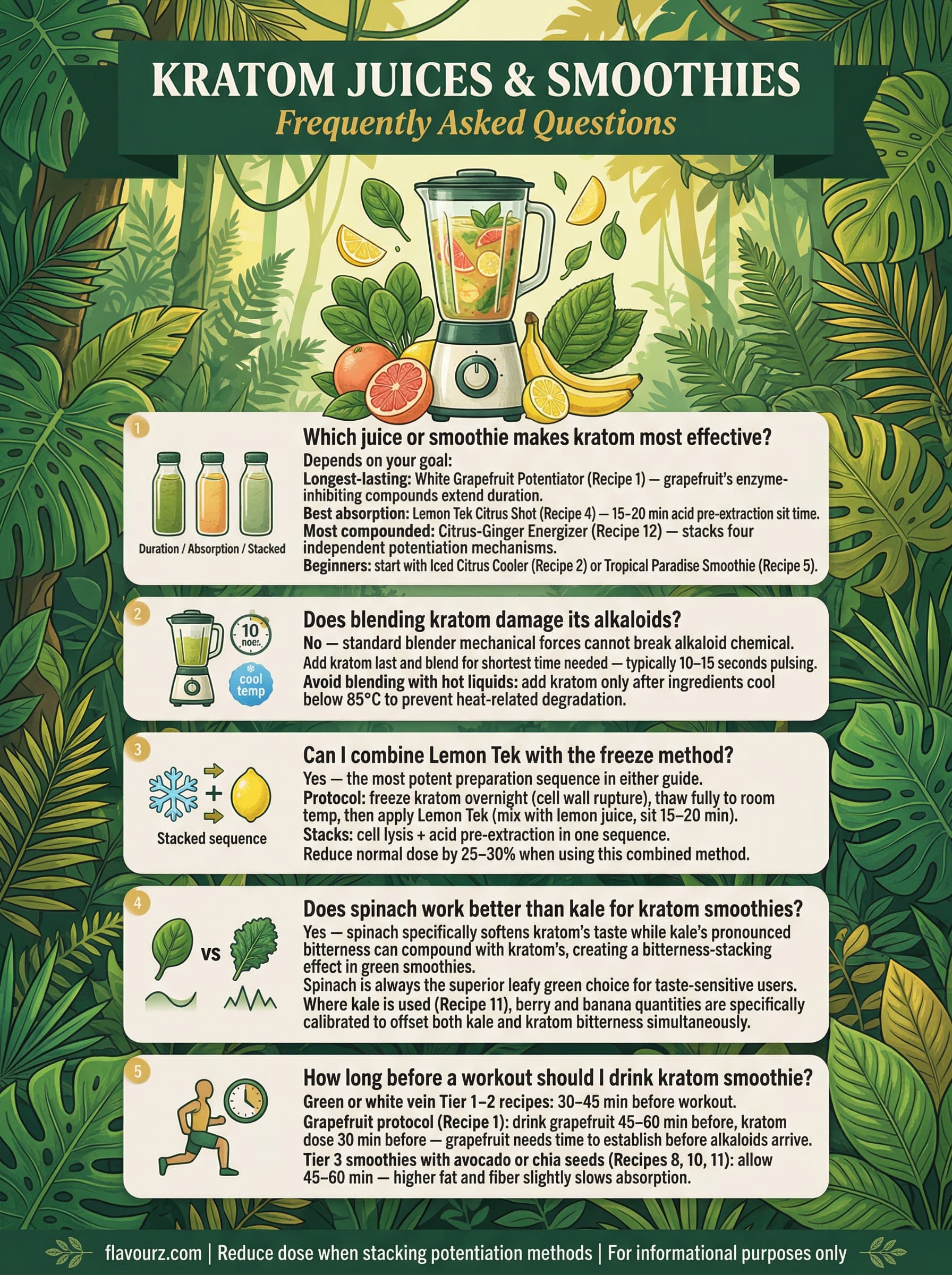
The answer depends on whether "most effective" means most potent per dose, longest-lasting, or best single-dose absorption. For longest-lasting effects, Recipe 1 (White Grapefruit Potentiator) produces the strongest duration extension through CYP3A4 inhibition — documented up to 6–8 hours versus 3–5 hours standard. For best single-dose absorption improvement, Recipe 4 (Lemon Tek Citrus Shot) with its 15–20 minute acid pre-extraction sit time improves absorption by up to 40%. For most compounded potentiation in a single drink, Recipe 12 (Citrus-Ginger Energizer) stacks four independent mechanisms simultaneously. All three of these are intermediate-to-experienced user recipes — beginners should start with Recipe 2 (Iced Citrus Cooler) or Recipe 5 (Tropical Paradise Smoothie) and recalibrate upward from there using our kratom dosage guide.
Does blending kratom damage its alkaloids?
No — blending does not damage kratom alkaloids. The mechanical forces in a standard consumer blender are insufficient to break chemical bonds in alkaloid molecules. The temperature concern (heat from prolonged blending) is real but only relevant for extended blending over 60 seconds in a high-powered blender. The solution is to add kratom powder last and blend for the shortest time necessary to incorporate — typically 10–15 seconds of pulsing. This ensures homogeneous distribution without the friction-heat exposure that extended blending at high speed could theoretically introduce. For the same reason, do not blend kratom with hot liquids — recipe preparation with heated ingredients should add kratom after cooling to below 85°C.
Can I combine the Lemon Tek with the freeze method for maximum potency?
Yes — and it is the most potent preparation sequence documented in either the freeze guide or this recipe guide. The protocol: freeze kratom powder overnight (rupturing cell walls via ice crystal formation), allow to fully thaw to room temperature, then apply the Lemon Tek protocol to the thawed powder (mix with lemon juice, sit 15–20 minutes). The freeze step maximizes the alkaloid content available in the powder matrix by rupturing cells that the acid cannot penetrate; the acid pre-extraction step then maximally dissolves those released alkaloids into the liquid fraction for direct absorption. The combined effect stacks cell lysis + alkaloid concentration + acid pre-extraction into a single sequential preparation. Full freeze method protocols are documented in our kratom freezing guide. When using this stacked protocol, reduce normal dose by 25–30% and allow extra time to assess before any redosing.
Why does spinach specifically help with kratom taste — does kale work the same?
Spinach and kale are not equivalent for kratom taste masking despite both being leafy greens. As documented by KratomLords and KratomSpot's smoothie research, spinach specifically "interacts positively with kratom, softening its taste" — a flavor-softening effect not attributed to kale in the same sources. The likely mechanism is spinach's lower oxalic acid content and milder, sweeter flavor profile relative to kale's more pungent, bitter compounds. Kale's pronounced bitterness can compound with kratom's bitterness rather than softening it — producing a bitterness-stacking effect in green smoothies made with kale-dominant bases. Where kale is used (Recipe 11), the berry and banana quantities are specifically calibrated to offset both the kale and kratom bitterness simultaneously. For beginners or taste-sensitive users, spinach is always the superior leafy green choice for kratom smoothies.
How long before a workout should I drink a kratom juice or smoothie?
For green or white vein kratom in any of the Tier 1–2 recipes: 30–45 minutes before workout start produces onset timing that aligns energetic effects with the beginning of exercise. For citrus pre-potentiation (Recipe 1 grapefruit protocol): drink the grapefruit juice 45–60 minutes before the workout start, then take the kratom dose 30 minutes before — the grapefruit needs 30–45 minutes to establish CYP inhibition before the alkaloids arrive at the liver. For Tier 3 green smoothies containing avocado or chia seeds (Recipes 8, 10, 11): the higher fat and fiber content may slow gastric emptying by 10–15 minutes compared to Tier 1 drinks — account for this with slightly earlier consumption (45–60 minutes pre-workout). Full timing and tolerance management for regular users in our kratom tolerance guide.
Disclaimer: This article is for informational purposes only. Kratom is not FDA-approved and is not intended to diagnose, treat, cure, or prevent any disease or condition. Always consult a qualified healthcare provider before use, especially if you take prescription medications — grapefruit juice specifically interacts with many CYP3A4-metabolized pharmaceuticals. Never combine kratom with alcohol, CNS depressants, or prescription opioids.
Last Updated: April 2026 | Flavourz Kratom has served over 10,000 customers since 1999. Shop our full kratom selection here.

Leave a comment