
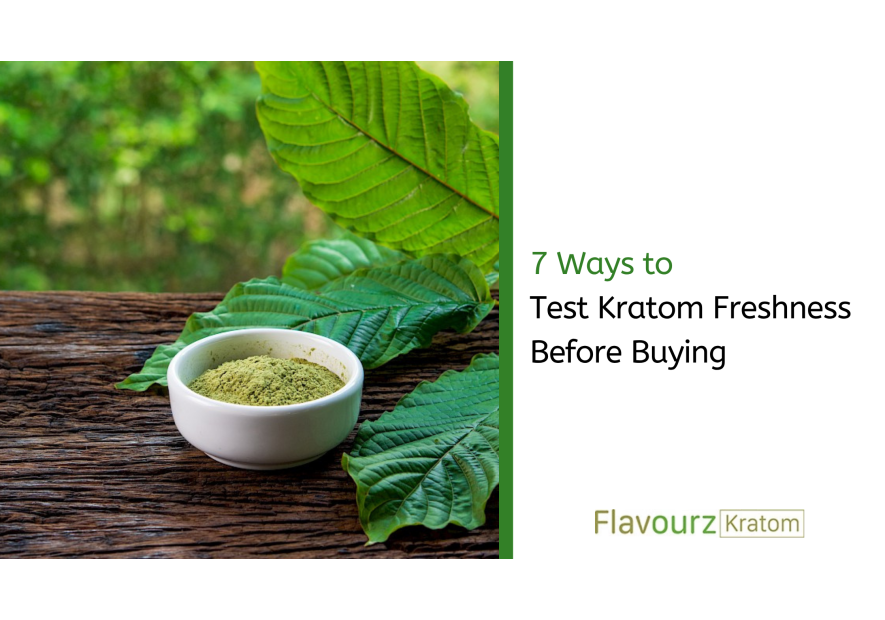
7 Ways to Test Kratom Freshness Before Buying
Last Updated: April 2026
Kratom potency degrades silently. A bag of green vein powder that looks perfectly normal — correct color, no unusual smell, sealed packaging — can have lost 30–50% of its mitragynine concentration through oxidation, UV exposure, or improper post-harvest drying before it ever reached the shelf. The alkaloids in kratom don't announce their departure: there's no expiration-date color change, no rancid smell like spoiled food, no visible mold in the early stages of degradation. The only way to know whether the kratom you're about to buy is genuinely fresh is to know exactly what freshness indicators to test and what each one reveals about the alkaloid content behind it.
At Flavourz Kratom, freshness is a sourcing-level commitment, not a storage afterthought — because research published in a 2025 NIH study on kratom alkaloid biosynthesis confirms that withering duration, drying temperature, cultivar, and harvest season all independently determine alkaloid composition before storage conditions ever become relevant. Sourcing from the best kratom vendors 2026, including those covered in our earth kratom trainwreck review, ensures you receive products with optimal alkaloid preservation and proper post-harvest handling. This guide covers all 7 freshness tests from the zero-equipment sensory checks any buyer can perform at home, to the documentation-level verification that separates genuinely fresh batches from old stock relabeled with recent packaging.
Why Kratom Freshness Matters More Than Strain Choice
This is a counterintuitive claim worth making explicitly: a fresh batch of a mid-tier green strain will consistently outperform a degraded batch of a premium Maeng Da at equivalent gram doses. Alkaloid concentration is the single variable that determines kratom's effect intensity, and freshness is the primary determinant of alkaloid concentration at the time of consumption. Choosing a premium strain from a vendor with a 9-month-old warehouse inventory is pharmacologically inferior to choosing a standard strain from a vendor with 30-day batch turnover.
The mechanism behind this is documented in four degradation pathways confirmed across multiple research sources:
- Oxidation (air exposure): Every time a kratom container is opened, oxygen reacts with mitragynine and 7-hydroxymitragynine molecules, breaking them down into less pharmacologically active metabolites. Amazing Botanicals' storage science documentation notes that vacuum-sealed storage reduces oxygen exposure by up to 99.99% — the inverse implication being that atmospheric-storage kratom degrades from the moment of processing
- UV light degradation: Prolonged UV light exposure breaks down the molecular structure of kratom alkaloids. This affects kratom stored in clear containers or in naturally lit retail environments — a particularly relevant consideration for in-store purchases from headshops or gas stations where kratom products may sit under fluorescent lighting for months
- Moisture and mold: High humidity promotes microbial growth. Even sub-mold levels of moisture absorption accelerate alkaloid breakdown through hydrolysis. Gelatin capsules are specifically more vulnerable to humidity than powder because the capsule shell absorbs moisture first, accelerating the degradation of the powder inside
- Heat acceleration: Excessive heat accelerates every chemical breakdown process simultaneously. Research published in the Journal of Analytical Toxicology established that kratom alkaloids remain stable for at least one year when stored at room temperature in dark conditions — the operative variables being both temperature control and light exclusion simultaneously, not either alone
Critically, as the 2025 NIH alkaloid biosynthesis study confirms, degradation begins at origin — not at your home. Post-harvest processing decisions at the source farm (withering duration, drying temperature, handling between harvest and packaging) determine the alkaloid ceiling that all subsequent storage either preserves or erodes. This means a kratom batch can fail freshness tests before leaving the farm, before reaching a vendor, and independently of anything the vendor does in storage. The 7 tests below are structured to catch freshness failures at each stage of this chain.
The 7 Freshness Tests
Test 1: The Color Test — Your First Freshness Signal
Color is the most immediately accessible freshness indicator and the one that most directly reflects the state of chlorophyll and alkaloid-adjacent pigment compounds in the kratom powder. Fresh kratom and degraded kratom look visually distinct under good lighting, and recognizing the difference requires no equipment beyond your eyes.
What fresh looks like by vein color:
- Green vein: Bright, vibrant, lively green — the chlorophyll-preserved color of recently processed leaf material. Should look like matcha powder or fresh dried herb, not like dried lawn clippings. The vibrancy is a proxy signal for the state of the leaf's biochemical content: if the processing preserved the color, it preserved the alkaloid profile
- Red vein: Deep, rich, earthy reddish-brown — consistent with the natural oxidation of mature leaf veins that occurs during proper red vein processing. Should not be uniformly brown or muddy; there should be depth and variation in the hue. A flat, monotone brown indicates over-oxidation beyond the intended processing level, which corresponds to alkaloid breakdown rather than the controlled maturation that produces red vein's elevated 7-HMG content
- White vein: Light, pale green — not a washed-out beige or grey. White vein's characteristic pale color should still have a green undertone; when it loses that undertone and turns uniformly pale or yellowish, it indicates the same oxidation-driven degradation as the grey signal in green vein
Freshness failure signals across all vein types:
- Dull, faded, or grayish green in products labeled green vein
- Yellow or pale sickly hue in any vein color — documented by Kratom Country's shelf life guide as a specific sign of aged alkaloid breakdown
- Brown or muddy uniformity in red vein (over-processed or heavily oxidized)
- Completely washed-out white vein with no green undertone
Limitation of the color test: Color can be partially masked by some vendors through processing adjustments or blending. A failing color test is definitive — degraded color confirms degraded alkaloids. A passing color test is necessary but not sufficient on its own; combine with the smell and COA tests for full assessment.
Test 2: The Smell Test — The Most Sensitive Freshness Detector
Aroma is the most sensitive freshness indicator available without lab equipment — more diagnostic than color because the volatile aromatic compounds in kratom degrade in direct chemical parallel with the alkaloids, providing a real-time biochemical signal of the powder's alkaloid state. Fresh kratom smells distinctly. Degraded kratom smells like nothing, or smells wrong.
Fresh kratom aroma profile (all vein types):
- Distinct earthy smell with natural herbal undertones — a deep, green, slightly bitter organic scent that is immediately recognizable once you've encountered genuinely fresh product
- The fragrance lingers when you open the container — Pharmakeia's quality identification guide specifically notes that "high-quality kratom has a fragrance that lingers when you open the container or bag." A scent that dissipates within seconds of opening indicates volatile aromatic compound depletion — a direct proxy for alkaloid depletion
- Slight bitterness in the nose — the characteristic alkaloid-adjacent aromatic quality of fresh mitragynine-containing powder
Freshness failure signals:
- Faint or rapidly dissipating aroma: The most common freshness failure signal. If you open the bag and the smell is barely detectable or fades within seconds, the volatile compounds that track alkaloid integrity have already depleted
- Musty or stale smell: Indicates oxidation-driven degradation — the same biochemical process that degrades mitragynine is producing the musty secondary compounds you're detecting
- Mold smell (damp, earthy, fermenting): Immediate discard indicator. Moisture-exposed kratom that has reached mold initiation is unsafe regardless of what the alkaloid content shows
- Chemical or synthetic smell: The most serious red flag — suggests adulteration, contamination during processing, or contact with synthetic compounds. Never consume kratom with a chemical odor
Pro technique: Cup a small amount of powder in your palm, breathe warm air across it for three seconds (warming the sample releases more volatiles), then immediately smell. This technique releases aromatic compounds at a rate proportional to the sample's freshness — genuinely fresh kratom produces a noticeably stronger scent release under this protocol than degraded powder.
Test 3: The Texture and Clumping Test — Moisture Exposure Indicator
Kratom powder texture directly indicates whether the product has been exposed to moisture at any point in its post-harvest history — during processing, during storage, during shipping, or in your home. Moisture is the most destructive freshness threat for powdered kratom because it simultaneously accelerates oxidation, promotes microbial growth, and degrades the fine particle consistency that determines how evenly alkaloids distribute in each dose.
Fresh kratom texture:
- Fine, smooth, free-flowing powder that passes easily between fingers without resistance
- Consistent particle size with no visible granulation — more like talcum powder or fine flour in texture than like sand or coarse grain
- No clumping when the bag is tilted or the powder is poured — flows freely without requiring breaking up
Freshness failure signals:
- Soft clumps that break apart easily: Early-stage moisture exposure. The powder has absorbed ambient humidity but hasn't reached mold initiation. Alkaloid degradation at this stage is in progress but may be early. Test the color and smell simultaneously — if those also show early degradation, the batch has measurable potency loss
- Hard, cement-like clumps: Advanced moisture exposure. The powder has absorbed significant humidity and undergone partial hydrolytic alkaloid degradation. The hardened clumps are the structural result of moisture-triggered chemical changes in the powder matrix
- Coarse or granular texture: Indicates improper grinding or very old leaf material. Coarse kratom distributes alkaloids unevenly — each dose pulls from a non-homogeneous mix of coarse and fine particles, making dose precision unreliable
The clumping-on-arrival test: If kratom arrives clumped despite being in sealed packaging, the moisture exposure happened during storage at the vendor's facility — not in transit. A single transit clump from humidity during shipping will typically be limited to the powder near the bag's seal area. Uniform clumping throughout the bag indicates warehouse storage humidity exposure — a vendor quality control failure, not a transit issue.
Test 4: The Taste Test — The Alkaloid Presence Confirmation
Kratom's characteristic bitterness is produced by the same alkaloid compounds responsible for its effects — mitragynine and 7-hydroxymitragynine are inherently bitter due to their indole alkaloid molecular structure. This creates a direct sensory proxy for alkaloid concentration: fresh, high-alkaloid kratom tastes intensely and distinctively bitter; degraded, low-alkaloid kratom tastes flat, mild, and dull.
Fresh kratom taste profile:
- Intensely bitter with an earthy, organic quality — the bitterness is immediate on tongue contact and has depth rather than being a simple sharp bite
- Slight astringency (drying sensation) alongside the bitterness — produced by the tannin compounds that co-exist with the alkaloid fraction in fresh leaf material
- A characteristic "green" herbal aftertaste that experienced kratom users recognize as the authentic leaf taste
Freshness failure signals:
- Mild or barely-there bitterness: The primary taste-based freshness failure. If the alkaloids have degraded, the bitterness degrades with them. Noticeably milder bitterness than expected from the same strain at the same dose is a potency-loss indicator
- Flat, tasteless, or "sawdust-like" quality: Complete freshness failure. The alkaloid fraction has degraded below detectable taste threshold — the powder is effectively inert plant fiber
- Metallic, chemical, or synthetic taste: Adulteration or contamination indicator — do not consume; contact the vendor immediately
- Sour or fermented taste: Mold-initiated microbial activity — discard immediately
Calibration note: The taste test is most useful for buyers who have experienced genuinely fresh kratom from a quality vendor and can compare. First-time buyers using this test should combine it with the COA verification (Test 6) to establish a potency baseline rather than relying on taste alone without a reference point.
Test 5: The Packaging Integrity Test — What the Container Tells You Before You Open It
A kratom product's packaging architecture tells a detailed story about how the vendor understands and protects against alkaloid degradation — before you open it, smell it, or taste it. Vendors who understand kratom freshness science choose packaging that blocks all four degradation vectors (air, light, moisture, heat). Vendors who don't make packaging decisions based on cost rather than product integrity.
Freshness-protective packaging indicators:
- Opaque or dark-colored packaging: Blocks UV light exposure during storage and retail display. As The Calm Leaf's quality identification guide notes, opaque or dark packaging specifically protects kratom from the light exposure that degrades alkaloid molecular structure
- Resealable airtight zipper or heat-sealed closure: Minimizes oxygen exposure after first opening. A resealable bag that creates an airtight closure on resealing is the baseline freshness standard; single-use heat-sealed bags without a resealable closure require the buyer to transfer to an airtight container after first opening
- Included desiccant packet: The presence of a desiccant in the packaging confirms that the vendor has thought about moisture control during transit and storage. Kats Botanicals' shelf life research specifically notes that desiccant use extends peak potency shelf life for powder and capsules meaningfully beyond storage without desiccant control
- Vacuum or nitrogen-flush packaging: The premium freshness standard. Vacuum packaging removes oxygen before sealing (reducing oxidation to near zero in sealed state); nitrogen flushing replaces oxygen with inert nitrogen before sealing. Either approach dramatically extends the alkaloid-stable shelf life versus atmospheric-sealed packaging
- Batch date, harvest date, or production date stamp: The most important single piece of packaging information — covered in detail in Test 6
Freshness failure signals in packaging:
- Clear or transparent packaging (UV exposure throughout retail life)
- No resealable closure (buyer must transfer immediately, introducing risk at first opening)
- Packaging that shows light seal damage, pin holes, or compromised zipper (atmospheric exposure during transit)
- No batch or production date anywhere on the package
Test 6: The COA Production Date Verification — The Only Objective Freshness Proof
The five tests above are sensory and contextual — valuable, practical, and field-deployable without any equipment. But they all have a shared limitation: they detect degradation after it has already occurred, and they cannot detect the "pre-degraded at origin" freshness failure that the 2025 NIH alkaloid biosynthesis study confirms is a real and separate failure mode from storage degradation. A Certificate of Analysis (COA) from a third-party lab is the only document that provides objective, chemistry-verified evidence of a kratom product's alkaloid state at a specific point in time.
What to look for in a freshness-verifying COA:
- Batch number and production/lot date: The COA must be tied to a specific batch with a documented production date. A COA without a batch-specific date — or with a generic "2025" or "2026" year-only date — cannot confirm the freshness of the specific bag you're purchasing. It could be a COA for a different batch applied to new packaging. Request the lot number on the product packaging and verify it matches the lot number on the COA
- Mitragynine percentage stated: Fresh, properly processed kratom from quality cultivar material should show 1.0–1.8% mitragynine for standard green and red powders; 1.2–2.0% for Maeng Da blends. A batch testing below 0.8% mitragynine has either degraded significantly since processing or was never properly sourced. Super Speciosa's lab testing documentation page and their published peer-reviewed White Maeng Da data (1.54% mitragynine) provide the credibility benchmark for what a legitimate COA should look like
- 7-Hydroxymitragynine reported separately: Red vein buyers specifically should confirm that 7-HMG is tested and reported on the COA — as established in the Red Maeng Da guide, 7-HMG is both the most potent alkaloid per milligram and the one most susceptible to oxidative degradation, meaning its COA value is the most diagnostically useful freshness indicator for red vein kratom specifically
- Test date relative to purchase date: A COA dated more than 12 months before your purchase date means the lab testing was performed on a batch that — even if it was fresh at the time of testing — is at or past its peak potency window. The Journal of Analytical Toxicology data confirms one year as the outer boundary of stable alkaloid maintenance at room temperature; a COA from 18 months ago is testing what the product was, not what it is today
- Contaminant panels (heavy metals, microbial): Freshness is not only alkaloid concentration — a batch that tests clean for alkaloids but has a heavy metal or microbial contamination issue is not a quality product. Full-panel COAs that include both alkaloid content and safety panels are the comprehensive freshness and safety verification standard
How to request a COA before buying: Email or chat any vendor before purchase and ask: "Can you provide the COA for the current batch of [strain name]? I'd like the lot number, production date, and mitragynine percentage." A quality vendor responds immediately with the document or a link. A vendor who delays, redirects, or provides a generic undated COA has answered your freshness question — negatively.
Test 7: The Vendor Batch Turnover Rate Test — Freshness by Inventory Velocity
The final freshness test doesn't require opening a bag, smelling anything, or reading a lab document — it requires understanding how the vendor you're buying from manages their inventory, and what that management model implies about the age of the product you receive.
Two vendor inventory models exist in the kratom market, and they produce systematically different freshness outcomes:
- Ground-to-order / fresh-batch model: Vendors who process batches in direct response to demand rather than maintaining a large pre-processed warehouse inventory. Kona Kratom's documented model — processing closer to shipping date than most vendors — is the most cited example of this approach in current vendor rankings. The practical effect is that buyers receive product that was processed weeks, not months, ago. For high-potency strains where alkaloid degradation is perceptible, this model's freshness premium is worth the typically modest price premium it carries
- Pre-packaged warehouse inventory model: Vendors who purchase large quantities of pre-processed powder, store it in a warehouse, and fulfill orders from standing inventory. This model offers lower prices and faster fulfillment but introduces the warehouse storage age variable — the product in your bag could be 2 weeks or 10 months old depending on inventory velocity, and there's no way to know without the batch date on the COA
How to determine a vendor's inventory model:
- Ask directly: "What is the average time between processing and shipping for your [strain name]?" A fresh-batch vendor can answer this precisely; a warehouse-inventory vendor will give an approximate or evasive response
- Check for batch dates on packaging: Vendors who manage freshness actively will print batch or production dates on their packaging because it's a quality signal they want buyers to see. Vendors who don't print batch dates either don't track it or don't want you to know
- Look for "ground-to-order" or "fresh-batch" language in the vendor's quality documentation — this terminology signals deliberate inventory freshness management
- Assess batch turnover from review recency patterns: A vendor with consistently recent user reviews and active community presence typically has better inventory velocity than a vendor with mostly old reviews and sparse recent activity — the review pattern reflects customer purchase frequency, which reflects batch turnover
For a complete evaluation of which vendors currently combine the best freshness management with the highest verification standards, our best kratom brands 2026 guide ranks vendors specifically on batch transparency and freshness documentation quality alongside standard AKA certification and lab testing criteria.
All 7 Tests at a Glance
| Test | What It Detects | Equipment Needed | Best Used | Limitations |
|---|---|---|---|---|
| 1. Color test | Oxidation, UV degradation, processing quality | None | First inspection on receipt or purchase | Passing color is necessary but not sufficient |
| 2. Smell test | Alkaloid volatile depletion, mold, adulteration | None | Immediately on opening; most sensitive sensory test | Requires familiarity with fresh kratom baseline scent |
| 3. Texture test | Moisture exposure at any stage | None | On receipt; diagnoses vendor storage quality | Some clumping may be transit humidity not storage failure |
| 4. Taste test | Alkaloid concentration proxy | None | After color/smell pass — confirms alkaloid presence | Requires baseline reference; bitter ≠ potent in isolation |
| 5. Packaging test | Vendor freshness philosophy; UV/oxygen/moisture protection | None | Before opening — pre-purchase screening tool | Good packaging doesn't guarantee good contents |
| 6. COA verification | Objective alkaloid content + safety at specific batch date | Internet access to verify batch number | Before buying — the definitive freshness document | COA is historical; product may have degraded since test date |
| 7. Batch turnover test | Warehouse age and inventory velocity | Vendor communication | Before buying from a new vendor | Requires vendor responsiveness; indirect indicator |
Kratom Shelf Life by Format: Reference Guide
Understanding the shelf life ceiling for each kratom format helps calibrate how urgently each freshness test applies. As documented by Kats Botanicals' comprehensive kratom shelf life guide, shelf life varies significantly across formats — with the key determinant being surface area exposure to degradation vectors:
| Format | Peak Potency Window | Maximum Under Optimal Storage | Primary Vulnerability | Most Critical Freshness Test |
|---|---|---|---|---|
| Powder | 6–12 months | 1–3 years (airtight, dark, cool) | Air oxidation, UV light | Color + smell + COA date |
| Capsules | 6–12 months | 12–18 months | Humidity (gelatin shell absorption) | Texture + packaging + COA date |
| Extracts | 6–12 months | Up to 12 months (label dependent) | 7-HMG oxidation (most vulnerable alkaloid) | COA date + mitragynine % + 7-HMG % |
| Gummies/Edibles | 3–6 months | 6 months maximum | Heat and sun (gelatin/pectin degradation) | Expiry date + packaging integrity |
The most important practical insight from this table: capsules are not inherently fresher than powder despite the perception of "sealed" protection. The gelatin capsule shell is actually more vulnerable to humidity than powder stored in a quality sealed bag — a nuance confirmed by Kats Botanicals' documentation that notes gelatin shells are "more sensitive to humidity" than raw powder. For buyers who prefer capsules for dose convenience, the freshness tests apply equally and the packaging test (desiccant inclusion) is particularly important for this format. Understanding how a strain's freshness profile changes its real-world performance is also covered in our kratom tolerance guide — where degraded-batch users often incorrectly attribute declining effects to tolerance rather than to potency loss from alkaloid degradation.
Frequently Asked Questions

What does fresh kratom look like compared to old kratom?
Fresh kratom has a vibrant, rich color specific to its vein type: bright lively green for green vein, deep earthy reddish-brown for red vein, and pale-green (not beige or grey) for white vein. As documented across multiple quality identification guides including Delta8Resellers' sensory assessment guide and Kratom Country's shelf life documentation, old kratom shows fading, dullness, grey undertones in green vein products, or a sickly yellowish hue across all vein types. The color difference is visible under good lighting when comparing a fresh sample against an aged one side by side — but req
How long does kratom powder stay potent after opening?
Once opened, kratom powder begins oxidizing immediately on every oxygen exposure event. Under optimal post-opening storage — airtight container, cool dark location, desiccant inside, 68–72°F consistent temperature — powder maintains peak potency for 6–12 months from production date and can remain usable for up to 1–3 years with gradual potency decline rather than sudden expiration. Research published in the Journal of Analytical Toxicology confirms alkaloid stability for at least one year under proper room-temperature dark storage. The key post-opening practice is minimizing oxygen re-exposure
Can kratom go bad before I buy it at the vendor stage?
Yes — and this is the most underreported freshness failure mode in the kratom market. A 2025 NIH study published in PMC specifically confirms that withering duration, drying temperature, cultivar, and harvest season all independently affect kratom alkaloid composition at the production stage. A batch that was improperly dried at too high a temperature, or that sat in post-harvest withering too long before processing, can arrive at a vendor with already-reduced alkaloid content — fresh by date but degraded by processing. The only test that catches this pre-vendor freshness failure is COA mitrag
Is the smell test reliable for all kratom formats?
The smell test applies most directly to powder and loosely packed capsules — formats where the aromatic volatile compounds are in direct contact with air and can be assessed on opening. For tightly sealed extracts, gummies, and compressed tablets, the packaging seal prevents smell assessment before purchase. For these formats, the COA production date and batch turnover rate tests are more relevant pre-purchase tools. For post-purchase freshness assessment of extracts, the taste and effect quality tests are more diagnostic than smell — a fresh extract should deliver noticeably stronger effects
Does refrigerating kratom extend its freshness?
Refrigeration is not recommended for kratom storage, despite the intuition that cold temperatures extend freshness. Amazing Botanicals' storage science documentation specifically addresses this: cold temperatures do slow degradation, but the temperature cycling that occurs every time you open and close the refrigerator creates condensation inside the storage container — moisture that accelerates hydrolytic alkaloid degradation and creates mold risk. The net result is that refrigeration typically produces more damage through condensation than it prevents through temperature reduction. The optim
How should I store kratom at home to keep it fresh longer?
Store kratom in an airtight container at consistent room temperature between 68–72°F, in a dark location like a pantry shelf, kitchen drawer, or closet. Avoid spots with temperature swings such as near windows, ovens, or vents, as cycling temperatures create condensation that accelerates alkaloid degradation. Include a desiccant packet to control moisture, and divide bulk purchases into smaller portions so your main supply stays sealed until needed. Keep the container away from direct sunlight and fluorescent lighting to prevent UV-driven breakdown of mitragynine.
Can I vacuum seal kratom at home to extend its freshness?
Yes, vacuum sealing kratom at home significantly extends its peak potency window by removing oxygen, which is the primary driver of alkaloid oxidation. A standard vacuum sealer reduces oxygen exposure by up to 99%, slowing the breakdown of mitragynine and 7-hydroxymitragynine compared to standard airtight containers. For best results, vacuum seal kratom in small individual portions of 1–2 weeks' worth so the bulk supply stays untouched, and store the sealed bags in a dark, cool location. Adding an oxygen absorber packet inside each bag before sealing provides an additional layer of protection.
What's the difference between degraded kratom and contaminated kratom?
Degraded kratom has lost alkaloid potency through oxidation, UV exposure, moisture, or heat but is still safe to consume, while contaminated kratom contains harmful substances like mold, bacteria, heavy metals, or adulterants and should be discarded immediately. Degradation signs include faded color, mild bitterness, weakened aroma, and reduced effects, whereas contamination signs include musty or fermented smell, visible mold, sour taste, chemical odor, or unusual symptoms after use. Only a third-party COA can definitively distinguish between the two by reporting both alkaloid levels and contaminant panels for heavy metals, microbial activity, and pesticides. When in doubt, discard the product rather than risk consuming contaminated material.
Disclaimer: This article is for informational purposes only. Kratom is not FDA-approved and is not intended to diagnose, treat, cure, or prevent any disease or condition. Always consult a qualified healthcare provider before use, especially if you take prescription medications or have existing health conditions.
Last Updated: April 2026 | Flavourz Kratom has served over 10,000 customers since 1999. Shop our full kratom selection here.

Leave a comment