


American Kratom Association Standards Guide 2026: GMP & KCPA
Last Updated: April 2026
The American Kratom Association (AKA) is the kratom industry's primary advocacy organization, and its GMP Standards Program is the only independent quality certification available in the U.S. kratom market. Founded in 2014, the AKA has successfully blocked federal scheduling attempts, helped pass consumer protection laws in 17+ states, and established manufacturing standards that fewer than 200 vendors currently meet. If you buy kratom in 2026, understanding what the AKA does and what their certifications actually mean is the difference between informed purchasing and guesswork. Before purchasing from AKA-certified vendors, learn about choosing red vs green kratom strains for your specific wellness goals.
I've worked with Flavourz Kratom for over 5 years, and we've seen firsthand how the AKA's work has shaped this industry. We've served customers since 1999 and watched kratom go from an obscure botanical to a product used by over 15 million Americans. That growth happened because advocacy groups like the AKA fought to keep it legal. Here's what you need to know about their standards, certifications, and why they matter.
What Is the American Kratom Association?
The American Kratom Association is a nonprofit consumer advocacy organization dedicated to protecting legal access to kratom in the United States. It was founded in 2014 by kratom vendors, consumers, and enthusiasts who saw federal agencies moving toward prohibition. The AKA's mission includes four core activities: lobbying against kratom bans, establishing industry quality standards, supporting scientific research, and educating legislators about kratom.
The organization gained national attention in 2016 when it helped reverse the DEA's attempt to classify kratom as a Schedule I controlled substance. A petition with over 100,000 signatures, letters from 51 House members and 13 Senators, and organized protests near the White House pressured the DEA to withdraw its Federal Register notice. It was the first time in history that a proposed emergency scheduling action had been reversed.
Today, the AKA continues fighting state-level battles while pushing for the Federal Kratom Consumer Protection Act, which would establish nationwide standards without banning the plant.
AKA GMP Standards Program: What It Actually Means
The AKA's Good Manufacturing Practice (GMP) Standards Program is a voluntary, third-party certification system for kratom vendors. Launched in November 2018 under chairman Dave Herman, the program requires participating vendors to pass independent facility audits, implement documented quality controls, and meet specific testing and labeling requirements. About 87% of kratom vendors claim to follow GMP principles, but fewer than 200 out of thousands operating in the U.S. actually hold current AKA GMP certification.
That distinction matters. Self-reported GMP compliance means nothing without verification. AKA certification means an independent auditor physically inspected the facility, reviewed documentation, evaluated processes, and confirmed standards are being met. There's no partial credit. Vendors either pass or they don't.
| Factor | AKA GMP Certified | Self-Reported GMP |
|---|---|---|
| Verification | Third-party audit | None |
| Audit Frequency | Annual required | None required |
| Registration Fee | $1,000/year | None |
| Public Listing | americankratom.org | Not verifiable |
| Testing Standards | Required per program | Vendor discretion |
| Labeling Standards | Required per KCPA model | Variable |
What Does AKA GMP Certification Cover?
The GMP Standards Program, currently at version 4.0, covers manufacturing, testing, processing, packaging, storage, distribution, and labeling. Requirements are based on 21 C.F.R. 111, the FDA's Current Good Manufacturing Practice regulations for dietary supplements. This doesn't mean kratom products must be labeled as supplements, but it does mean certified vendors must meet supplement-grade manufacturing standards.
Here's what the certification requires:
- Facility inspection: A pre-approved third-party auditor physically inspects the manufacturing facility, equipment, and environmental controls.
- Documentation review: Standard operating procedures, batch records, quality control documentation, and staff training records are evaluated.
- Testing protocols: Products must be tested for identity, purity, potency, and contaminants including heavy metals (arsenic, cadmium, lead, mercury, nickel), pathogens (Salmonella, E. coli, coliforms, yeast, mold), and alkaloid content (mitragynine and related compounds).
- Labeling compliance: Labels must include product identity, net quantity, ingredient list, manufacturer information, and appropriate disclaimers per the AKA's model Kratom Consumer Protection Act.
- Annual recertification: Vendors must submit proof of a successful third-party audit annually, along with the $1,000 registration fee, to maintain qualified status.
From my experience, the vendors who take this seriously test 9+ times per batch. That includes alkaloid verification, heavy metals screening, microbial testing, and identity confirmation. The ones cutting corners test once, maybe twice, or not at all.
How to Verify AKA GMP Certification
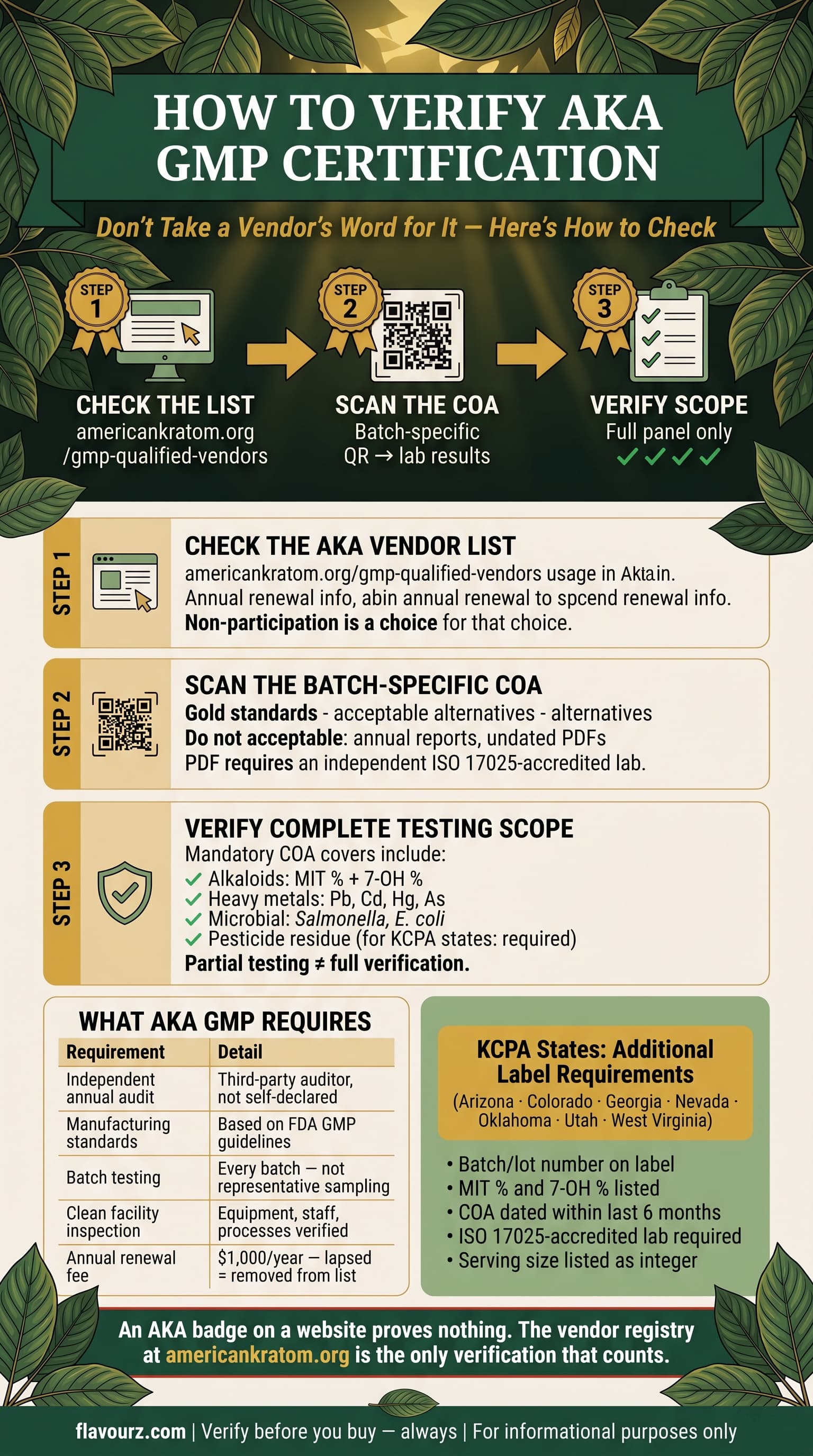
Don't take a vendor's word for it. The AKA maintains a public list of qualified vendors at americankratom.org/gmp-qualified-vendors. If a vendor claims certification but doesn't appear on that list, they're either no longer certified or never were.
When evaluating vendors, I recommend checking three things:
- AKA vendor list: Confirm current certification status directly on the AKA website.
- Certificates of Analysis (COAs): Look for batch-specific lab results from independent, named laboratories. QR codes linking directly to COAs are the gold standard.
- Testing scope: Verify tests cover alkaloids, heavy metals, and microbial contamination. Partial testing isn't sufficient.
What Is the Kratom Consumer Protection Act (KCPA)?
The Kratom Consumer Protection Act is model legislation developed by the AKA that regulates kratom products at the state level without banning them. Instead of prohibition, KCPA laws establish age restrictions (typically 21+), require accurate labeling, mandate quality testing, and prohibit adulterated or contaminated products. As of April 2026, 17+ states have adopted KCPA-style regulations.
States with active KCPA laws include Arizona, Georgia, Nevada, Utah, Oklahoma, Oregon, Texas, Colorado, Virginia, and West Virginia. Utah passed the first KCPA in 2019, becoming the model for subsequent legislation.
KCPA laws typically require:
- Age restrictions (21+ in most states)
- Prohibition of adulterated products (no fentanyl, no synthetic additives, no undisclosed ingredients)
- Accurate labeling of kratom products
- Disclosure of alkaloid content where required
- Quality testing for contaminants
At the federal level, the Federal Kratom Consumer Protection Act (H.R. 5905, S. 3039) was introduced in 2024. The bill would require the FDA to hold hearings on kratom science, establish a task force on kratom safety, and prohibit the FDA from regulating kratom more restrictively than other dietary supplements. While the bill hasn't passed, it represents the AKA's long-term strategy: regulated access rather than prohibition.
Why AKA Standards Matter for Consumers
The kratom market has a contamination problem. FDA seizures have documented kratom products containing fentanyl, morphine, and other undisclosed substances. In 2018, a Salmonella outbreak linked to contaminated kratom sickened 199 people across 41 states. More recently, Triangle Pharmanaturals received the FDA's first-ever mandatory recall order after refusing to voluntarily recall Salmonella-contaminated products.
AKA GMP certification doesn't guarantee perfection, but it does establish a baseline. When a vendor passes an independent audit, it means their facility, processes, and testing meet documented standards. When they don't have certification, you're trusting their word alone.
From 25 years serving customers at Flavourz Kratom, we've learned that quality control isn't optional in this industry. Our products go through rigorous testing before reaching shelves. We've watched vendors come and go because they cut corners. The ones that last are the ones that invest in quality.
AKA Advocacy: What They're Fighting For in 2026
The kratom legal landscape remains active. Several states have considered new bans or restrictions in 2026:
- Arizona: A proposed amendment to SB 1285 would have classified kratom as a narcotic and repealed Arizona's KCPA. The AKA mobilized opposition through protectkratom.org.
- Utah: SB 45 proposed repealing Utah's original KCPA and scheduling kratom alkaloids. A modified version passed, capping certain alkaloid concentrations at 0.4% rather than implementing a full ban.
- Ohio: The Board of Pharmacy's December 2025 emergency rule restricting certain kratom products remains under review.
- Wyoming: HB 185, a kratom prohibition bill, was introduced in February 2026.
The FDA has stated publicly that it's targeting concentrated alkaloid products rather than natural kratom leaf. This distinction between extracts and traditional powder is becoming increasingly relevant as states craft regulations.
The AKA coordinates advocacy through its American Kratom Protectors network, notifying supporters of pending legislation and organizing grassroots outreach to lawmakers. Their track record includes reversing the 2016 DEA scheduling attempt and blocking or modifying dozens of state-level bans.
Understanding Testing Standards
Proper kratom testing covers multiple categories. Here's what a complete testing panel includes:
| Test Type | What It Measures | Method |
|---|---|---|
| Alkaloid Content | Mitragynine, other alkaloids | HPLC/LC-MS |
| Heavy Metals | As, Cd, Pb, Hg, Ni | ICP-MS |
| Microbial | Salmonella, E. coli, yeast, mold | Various AOAC methods |
| Identity | Confirms Mitragyna speciosa | Spectroscopy |
| Pesticides | Chemical residues | GC-MS/LC-MS |
Quality kratom powder typically contains 1.2% to 1.8% mitragynine. Products below 0.5% mitragynine are considered commercial grade at best. When evaluating COAs, look for the lab's name, accreditation (ISO 17025 is the standard), batch number matching your product, and testing dates within reasonable proximity to your purchase.
Frequently Asked Questions
What is the American Kratom Association?
The AKA is a nonprofit consumer advocacy organization founded in 2014 that lobbies to keep kratom legal, establishes industry quality standards, and supports kratom research.
What does AKA GMP certified mean?
AKA GMP certification means a kratom vendor passed an independent third-party audit verifying their facility, processes, testing, and labeling meet the AKA's Good Manufacturing Practice standards.
How many vendors are AKA GMP certified?
Fewer than 200 U.S. kratom vendors currently hold AKA GMP certification, out of thousands operating in the market.
Where can I check if a vendor is AKA certified?
Visit americankratom.org/gmp-qualified-vendors to view the current list of certified vendors.
What is the Kratom Consumer Protection Act?
KCPA is model legislation that regulates kratom through age restrictions, labeling requirements, and quality standards rather than banning it. Over 17 states have adopted KCPA-style laws.
Does AKA certification guarantee product quality?
AKA certification verifies that manufacturing processes meet documented standards. It doesn't guarantee individual product quality but establishes a baseline of compliance most vendors don't meet.
Is kratom FDA approved?
No. Kratom is not FDA approved for any medical use. The FDA has issued import alerts and consumer warnings about kratom. The AKA disputes the FDA's characterization of kratom science.
How often must vendors recertify?
AKA GMP certification requires annual third-party audits and a $1,000 registration fee to maintain qualified status.
What testing does AKA GMP require?
The program requires testing for identity, purity, potency (alkaloid content), heavy metals, and microbial contamination including Salmonella and E. coli.
Finding Quality Kratom
The AKA's standards program provides one filter for evaluating vendors, but it's not the only one. I recommend combining AKA certification status with independent research: check Reddit discussions, read verified customer reviews, look for transparent lab testing, and compare pricing. If a deal seems too good, there's usually a reason.
At Flavourz Kratom, we've built our reputation on quality over 25 years. Browse our full selection of kratom powder, capsules, and extracts. For strain-specific information, explore our guides to red vein kratom and green vein kratom.
Want to learn more about kratom basics? Start with our beginner's guide to kratom or check kratom legality in your state.
Disclaimer: Kratom is not FDA approved for any medical use. This article is for informational purposes only and does not constitute medical or legal advice. Always verify kratom's legal status in your state before purchasing. Kratom products are intended for adults 21 and older. Effects vary by individual. Consult a healthcare provider before use.

Leave a comment