
Crushed Leaf Kratom vs Powder: Traditional Processing Guide
Last Updated: April 2026
Crushed leaf kratom and kratom powder come from the same Mitragyna speciosa leaves, but they're processed differently. Crushed leaf is coarsely broken into pieces resembling loose-leaf tea. Powder is finely ground into fine dust. Crushed leaf is the more traditional preparation method, used in Southeast Asia for centuries through tea brewing. Powder is the modern format developed for convenience and faster absorption.
I've worked with both formats for over 5 years at Flavourz Kratom, and our brand has been sourcing kratom since 1999. The crushed leaf vs powder question comes up most often from customers who've tried powder and want a more traditional experience, or from new users curious about the original methods Southeast Asian communities have used for hundreds of years. Let me walk you through what actually separates these two formats and help you figure out which one fits your goals.
What Is Crushed Leaf Kratom?
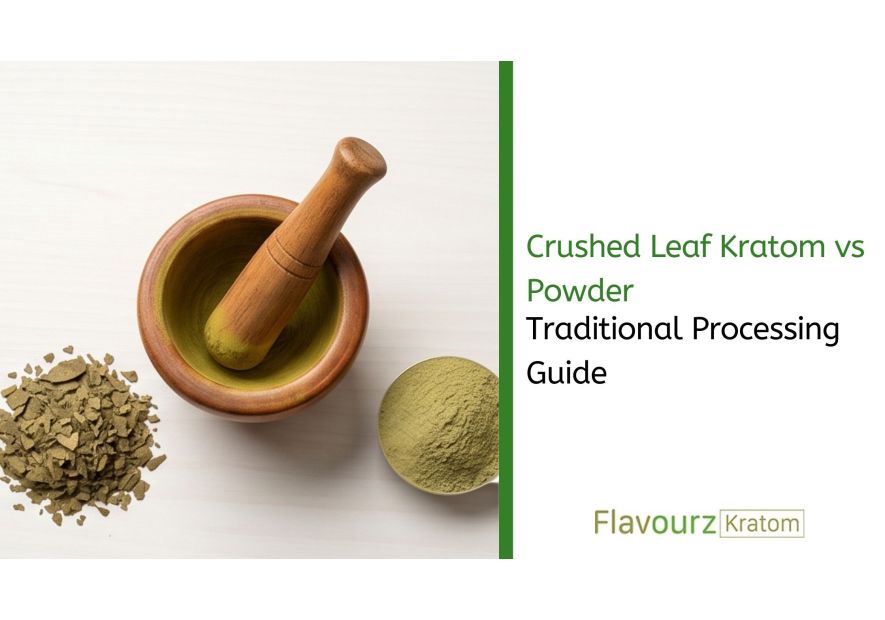
Crushed leaf kratom is dried Mitragyna speciosa leaves coarsely broken into small pieces, similar in appearance to loose-leaf tea. Unlike kratom powder, the leaves aren't milled into fine dust. The processing keeps more of the natural leaf structure intact, making crushed leaf the closest commercial format to how kratom has been consumed traditionally for centuries in Southeast Asia.
Picture loose-leaf green tea but a bit darker. That's basically what crushed leaf kratom looks like.
The Traditional Roots of Crushed Leaf
For hundreds of years, kratom users in Indonesia, Thailand, and Malaysia have prepared the leaves in two main ways: chewing them fresh or brewing them as tea after drying and crushing them. The crushed leaf format we sell today closely resembles what traditional users have always made. The leaves get harvested, dried, then broken into pieces just small enough for tea brewing but large enough to retain visible leaf structure.
This isn't a new product trend. It's actually the original kratom format, just recently rediscovered by Western users looking for something more authentic. About 3 in 10 customers I talk to about crushed leaf are specifically interested in connecting with these traditional preparation methods.
How Is Kratom Powder Made Differently?
Kratom powder is made by taking the same dried Mitragyna speciosa leaves used for crushed leaf and grinding them into a fine, consistent dust. The grinding process is more thorough, with most quality powders milled to 100-micron consistency. This finer texture changes how the kratom interacts with water, your stomach, and your absorption rate compared to crushed leaf.
The Powder Production Process
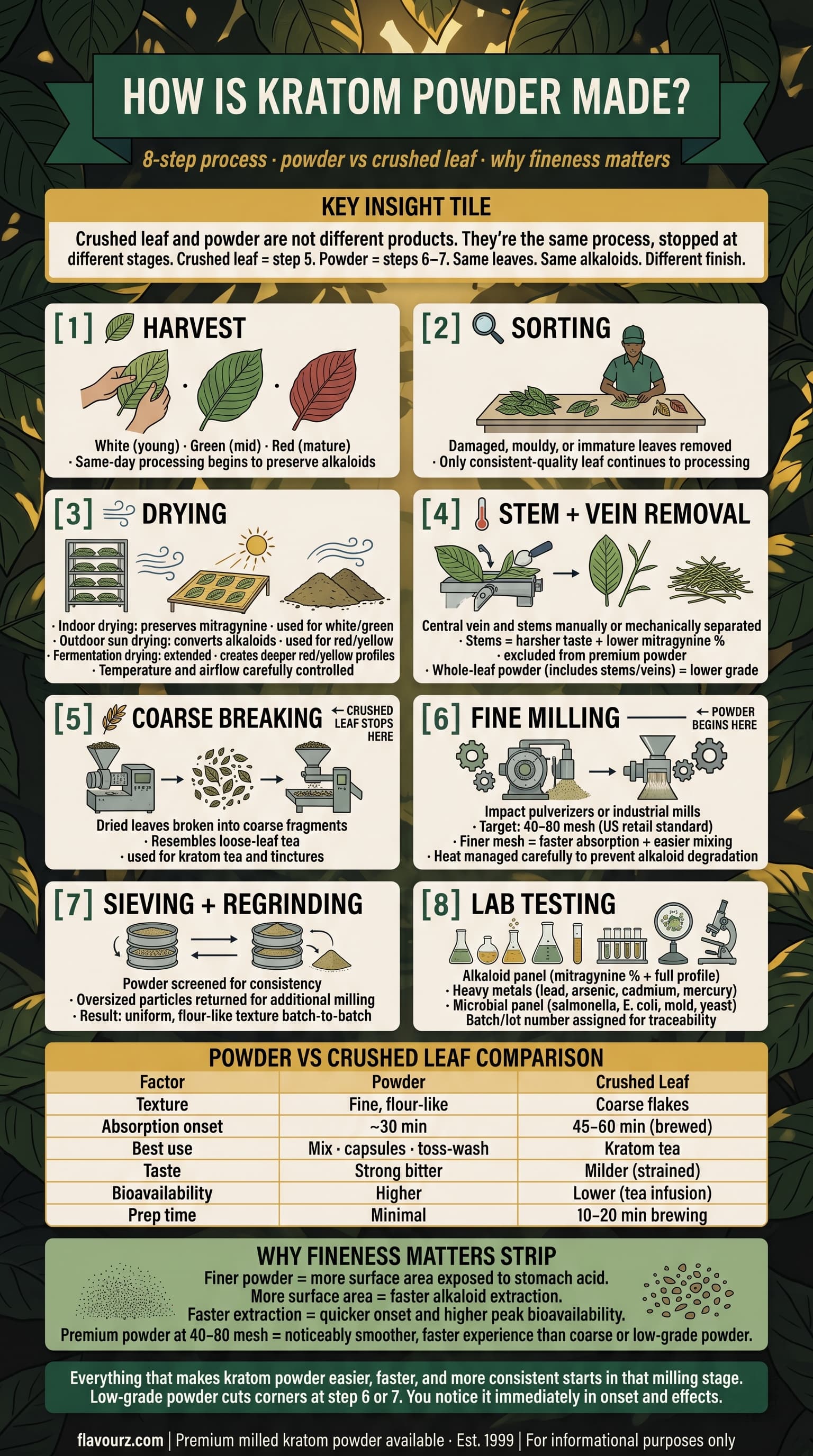
Quality kratom powder production follows specific steps:
- Harvest: Mature leaves picked at proper vein color stage
- Initial sorting: Damaged or immature leaves separated
- Drying: Indoor or outdoor drying based on target color category
- Stem removal: Veins and stems separated from leaf material
- Coarse breaking: Leaves broken into smaller pieces (this is the crushed leaf stage)
- Fine milling: Pieces ground into 100-micron powder
- Final sieving: Powder screened for consistency
- Lab testing: Batch tested for alkaloids and contaminants
The interesting thing here is that crushed leaf and powder are actually different stages of the same process. Crushed leaf stops at step 5. Powder continues through steps 6-7. Same leaves. Different finishing.
Quick Reference Comparison Table
| Feature | Crushed Leaf | Powder |
|---|---|---|
| Texture | Coarse pieces | Fine dust |
| Best Use | Tea brewing | Toss-and-wash, capsules |
| Onset Time | 45-60 minutes | 30-45 minutes |
| Taste | Milder when brewed | Stronger, bitter |
| Dosing | By volume in water | By weight in grams |
| Versatility | Tea only | Many methods |
| Stomach Friendly | Yes (no plant material) | Sometimes harsh |
How Do You Use Crushed Leaf Kratom?
Crushed leaf kratom is used almost exclusively for tea brewing. Add 5-10 grams of crushed leaf to a tea infuser or French press, pour hot water (just below boiling), let it steep for 15-20 minutes, then strain out the leaf material before drinking. Some users add lemon juice to help extract alkaloids. The leaf itself is discarded after brewing, similar to how you'd handle loose-leaf tea bags.
This is where crushed leaf really shines.
The Step-by-Step Brewing Method
Here's the method I recommend to customers based on what actually works:
- Measure your kratom: Start with 5-7 grams of crushed leaf
- Add to infuser: Use a tea infuser, French press, or fine strainer
- Add lemon juice: Splash of fresh lemon juice helps extract alkaloids
- Pour hot water: Just below boiling, around 200°F
- Steep 15-20 minutes: Longer steep means more alkaloid extraction
- Strain thoroughly: Remove all leaf material from the liquid
- Sweeten if desired: Honey, sugar, or stevia work well
- Drink slowly: Sip over 10-20 minutes for gradual absorption
Some users brew crushed leaf in larger batches and refrigerate the tea for several days. This works well if you have a consistent daily routine. Just keep the leftover tea sealed and cold to prevent spoilage.
For more brewing details, our complete kratom tea guide covers brewing methods for both crushed leaf and powder.
Is Crushed Leaf or Powder Stronger?
Powder typically delivers stronger effects per gram than crushed leaf because finer particles release alkaloids more efficiently into your body. When you toss-and-wash powder, your stomach absorbs the entire alkaloid content. With crushed leaf tea, only the alkaloids that extract into the water during brewing get absorbed. Powder is generally 15-30% more potent gram-for-gram than crushed leaf used as tea.
This is one of the trade-offs people don't always think about.
Why the Strength Difference Exists
The mechanics here are simple. Powder is fine enough that your digestive system can break down the entire leaf structure and absorb all the alkaloids. Crushed leaf used as tea only releases the water-soluble compounds during brewing. Some alkaloids are easier to extract into water than others, which means certain compounds end up in your tea while others stay locked in the leaf material that gets strained out.
If you used crushed leaf the same way as powder (toss-and-wash style instead of brewing), you'd get similar potency. But that's not really practical with the larger leaf pieces. Most people prefer the tea method, which means accepting slightly less potency in exchange for the gentler experience.
Which Tastes Better: Crushed Leaf or Powder?
Crushed leaf brewed as tea typically tastes milder and less bitter than powder. The leaf material strains out before you drink, leaving only the alkaloid-infused liquid. Powder mixed into drinks retains all the bitter plant compounds, including those that don't actually contribute to effects. Many users find crushed leaf tea more palatable, comparing the flavor to a stronger green tea rather than the harsh bitterness of powder.
The taste difference is bigger than most people expect.
Why Tea Tastes Better Than Toss-and-Wash
When you toss-and-wash kratom powder, you're consuming the entire leaf material, including bitter compounds that have nothing to do with effects. Plant cellulose, chlorophyll, and other components all hit your tongue at once. The result is the famously harsh kratom taste that newer users often struggle with.
Brewing crushed leaf is different. The hot water extracts the alkaloids and some flavor compounds, but the bulk of the bitter plant material stays in the strainer. What you drink is more like a strong herbal tea with subtle bitterness, rather than a mouthful of intense leaf powder.
About 6 in 10 customers who switch from powder to crushed leaf cite taste as their main reason. They don't want stronger effects, just a more palatable experience.
Why Do Some Users Prefer Traditional Crushed Leaf?
Users prefer crushed leaf for several specific reasons: gentler effects on sensitive stomachs, more palatable taste compared to powder, traditional preparation ritual that adds to the experience, easier batch brewing for daily routines, and connection to centuries-old Southeast Asian usage methods. The format also avoids the texture issues some users experience with powder mixed into drinks.
The Five Real Reasons People Switch to Crushed Leaf
Based on conversations with thousands of customers over the years, these are the actual reasons people choose crushed leaf:
- Easier on the stomach: No leaf material to digest reduces nausea
- Better taste experience: Tea is more palatable than gritty powder drinks
- Mindful ritual: The brewing process becomes part of the experience
- Batch brewing convenience: Make tea once, drink throughout the day
- Connection to tradition: Closer to original Southeast Asian methods
These reasons matter more for some users than others. People with sensitive stomachs or strong taste aversions often see major improvements switching to crushed leaf. People who prioritize convenience and faster onset usually stay with powder.
What's the Traditional Southeast Asian Method?
The traditional Southeast Asian method of kratom consumption involves either chewing fresh leaves directly from the tree or brewing dried, crushed leaves into tea. Workers in Indonesia, Thailand, and Malaysia have used these methods for centuries, often consuming kratom multiple times per day during physical labor. Modern crushed leaf format closely replicates the dried-leaf brewing method, though most Western users skip the fresh-chewing approach.
The Two Original Methods
Traditional users had two main consumption methods:
Fresh leaf chewing: Workers in Southeast Asia historically picked fresh kratom leaves directly from the tree, removed the central vein, and chewed the leaf material. The juice and active compounds released gradually as they chewed, often during long hours of physical labor. This method isn't practical for Western users since fresh kratom doesn't ship well and isn't commercially available outside producing regions.
Dried leaf tea: When fresh leaves weren't available, traditional users would crush dried kratom leaves and brew them into tea using hot water, similar to how we use crushed leaf today. Sometimes lemon juice was added. Sometimes spices. The tea would be sipped slowly, often shared in social settings.
This second method is what modern crushed leaf kratom replicates. When you brew crushed leaf today, you're using essentially the same process Southeast Asian communities have used for centuries.
How Should You Dose Crushed Leaf vs Powder?
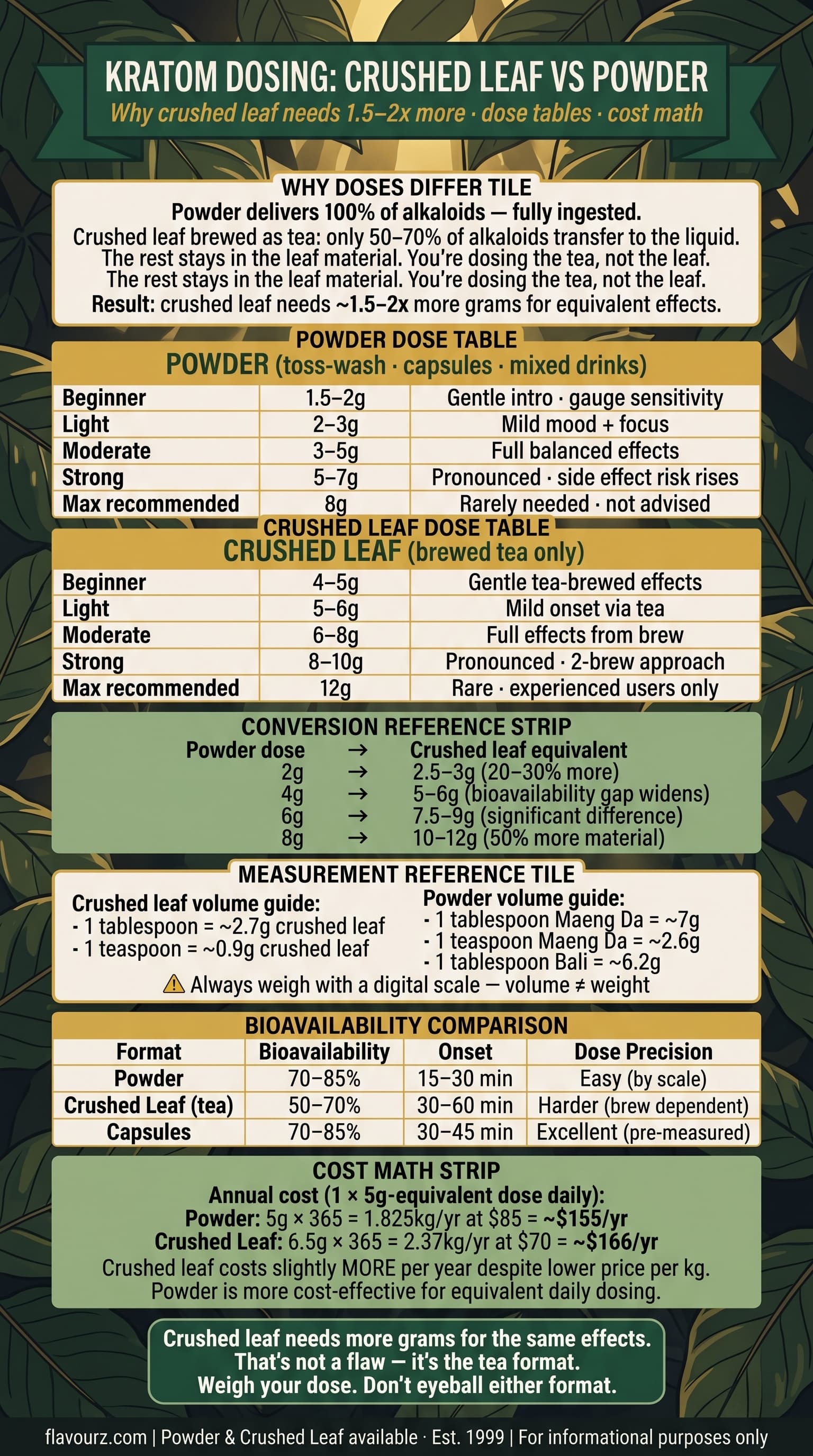
Crushed leaf dosing typically requires slightly higher amounts than powder due to incomplete alkaloid extraction during brewing. Beginners should start with 4-5 grams of crushed leaf in tea, while experienced users typically use 7-10 grams. For powder, beginners start at 1.5-2 grams and experienced users typically use 3-5 grams. The crushed leaf dose accounts for alkaloids that stay in the leaf material rather than transferring to the tea.
Dosing Reference
For crushed leaf (used as tea):
- Light effects: 4-5 grams
- Moderate effects: 6-8 grams
- Strong effects: 8-10 grams
- Maximum recommended: 12 grams (rare)
For powder (toss-and-wash, capsules, or mixed in drinks):
- Light effects: 1.5-3 grams
- Moderate effects: 3-5 grams
- Strong effects: 5-7 grams
- Maximum recommended: 8 grams (rare)
The math works out so that crushed leaf typically requires about 1.5x to 2x the gram amount of powder to achieve similar effects. This makes crushed leaf less cost-efficient gram-for-gram, though many users feel the experience trade-off is worth it.
Can You Use Crushed Leaf Other Ways Besides Tea?
While tea is by far the most common preparation, crushed leaf can also be used in cold-brew methods, slow-cooker extractions, and even some toss-and-wash applications when ground further. However, the larger leaf pieces make non-tea methods less practical and often less efficient than just using powder directly. Most experienced crushed leaf users stick with tea brewing as their primary method.
Alternative Crushed Leaf Methods
Cold brewing: Some users prefer cold-brewing crushed leaf overnight in cold water. This produces a smoother tea with less bitterness, though it takes 8-12 hours to extract properly. Add lemon juice to improve extraction.
Slow cooker extraction: A slow cooker on low heat for 4-6 hours produces a concentrated tea. Some users find this method extracts more alkaloids than standard hot brewing.
Further grinding: If you have a coffee grinder, you can mill crushed leaf into something closer to powder texture. This lets you use it like powder, though you lose the "traditional leaf" benefit at that point.
Our crushed leaf options include both regular crushed leaf kratom and a premium crushed leaf Maeng Da for users who want the strongest available crushed leaf option.
Frequently Asked Questions
Can I use crushed leaf to make capsules?
Capsules work better with powder than crushed leaf. The larger leaf pieces don't pack efficiently into standard capsules and absorb more slowly than fine powder. If you want capsules, choose powder. If you want crushed leaf, plan on tea brewing as your main method.
Does crushed leaf go bad faster than powder?
No, both formats have similar shelf life when stored properly: 12-18 months in airtight containers kept cool, dark, and dry. Crushed leaf may actually maintain potency slightly longer because the larger pieces have less surface area exposed to oxygen compared to fine powder.
Why is crushed leaf sometimes more expensive?
Crushed leaf can cost slightly more because it's a less common format with smaller production runs. The processing isn't actually cheaper despite skipping the final milling step, since maintaining proper leaf texture requires careful handling. Pricing usually runs 5-15% above equivalent powder strains.
Can I switch between crushed leaf and powder?
Yes, switching is fine and many users keep both formats on hand for different situations. Adjust your dose based on which format you're using since powder is more potent gram-for-gram. Some users use powder for quick mornings and crushed leaf for evening tea rituals.
Does crushed leaf work better for beginners?
It depends on the beginner. Users with sensitive stomachs or strong taste aversions often do better with crushed leaf tea. Users who want simple dosing and faster effects typically prefer powder. Our beginner's guide covers both formats so you can decide based on your priorities.
What strains come in crushed leaf format?
Most popular kratom strains are available in crushed leaf format from quality vendors. Red Bali, Green Maeng Da, White Borneo, and similar mainstream strains are common. Specialty or rare strains sometimes only come in powder due to lower production volumes. Check your vendor's specific catalog.
The Bottom Line: Which Format Is Right for You?
Crushed leaf works best for users who enjoy tea ritual, have sensitive stomachs, prefer milder taste, and value the traditional connection to kratom's Southeast Asian origins. Powder works better for users who prioritize convenience, faster onset, dosing flexibility, and broader use methods like capsules and toss-and-wash. Many experienced users keep both formats for different situations.
Honestly, after 25 years in this industry, I think the choice between crushed leaf and powder comes down to lifestyle more than effects. If you have time for a brewing ritual and enjoy that experience, crushed leaf adds something real to your kratom routine. If you need quick, convenient dosing and don't mind the harsher taste, powder serves you better.
For users curious about traditional methods, our crushed leaf kratom selection covers the most popular strains in this traditional format. Or browse our complete kratom collection to see all available formats and find the right starting point for your needs.
Disclaimer: This article is for informational purposes only and does not constitute medical advice. Kratom has not been evaluated by the FDA for safety or effectiveness. It is not intended to diagnose, treat, cure, or prevent any disease. Consult your healthcare provider before using kratom, especially if you have medical conditions or take medications. Kratom is not for use by anyone under 21, pregnant, or breastfeeding. Check your local laws before purchasing.

Leave a comment