

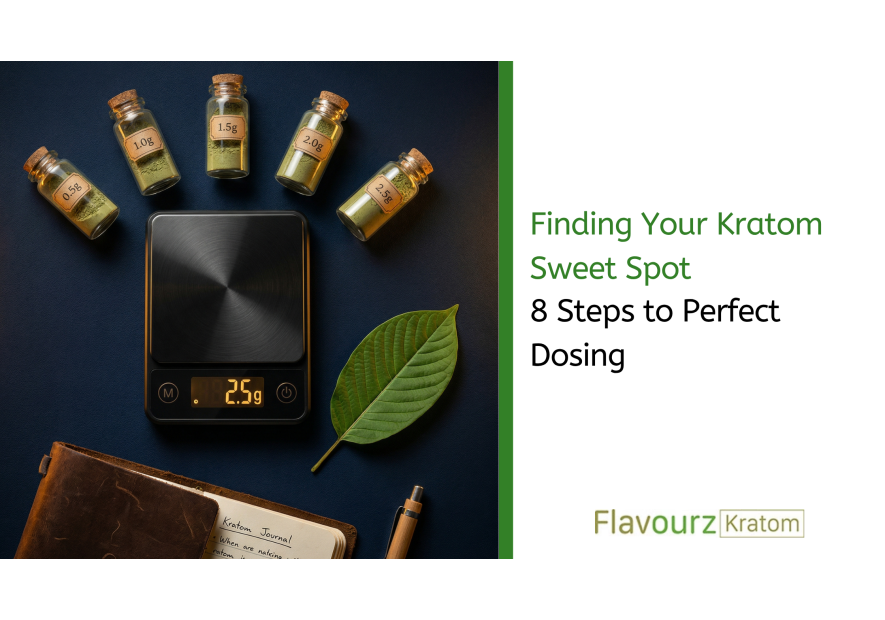
Finding Your Kratom Sweet Spot: 8 Steps to Perfect Dosing
Last Updated: April 2026
Your kratom sweet spot is the lowest dose that delivers desired effects without significant side effects. For most people, this falls between 2-4 grams, though individual variation is substantial. Finding it requires starting at 1 gram, increasing by 0.5 grams per session, keeping a simple tracking journal, and understanding that kratom's biphasic nature means higher doses don't automatically produce better results. At Flavourz Kratom, we've guided over 10,000 customers through this process since 1999, and the patterns are remarkably consistent.
Here's what most people get wrong: they assume finding the right dose means taking more until it "works." That's backwards. Kratom operates on a less-is-more principle where exceeding your sweet spot doesn't enhance effects, it shifts them in directions you probably don't want. Different strains respond differently to dosing adjustments, and Flavourz's white bali kratom exemplifies how individual strain characteristics affect optimal serving sizes. Too much turns energy into sedation, focus into fog, and comfort into nausea.
Over 5 years of personal experimentation and thousands of customer conversations, I've refined an 8-step process that reliably identifies your optimal dose within 1-2 weeks. This guide walks you through each step with practical instructions.
Why Finding Your Sweet Spot Matters
Kratom dosing isn't like most substances where more equals stronger. Kratom has what researchers call a "biphasic response," meaning low and high doses produce qualitatively different effects, not just stronger versions of the same thing.
The Biphasic Effect
At lower doses (1-3 grams), kratom's alkaloids primarily interact with adrenergic and serotonergic receptors, producing stimulating effects: energy, focus, mood enhancement, motivation. At higher doses (5+ grams), the alkaloids increasingly interact with opioid receptors, producing sedating effects: relaxation, pain relief, calm, sleepiness.
This means if you want energy and take too much, you won't get more energy. You'll get sedation instead. Understanding this prevents the common mistake of increasing dose when you don't get desired effects.
The Sweet Spot Defined
Your sweet spot is where you get maximum desired effects with minimum side effects. It's typically:
- The lowest dose that produces noticeable benefits
- High enough to feel effects clearly
- Low enough to avoid nausea, wobbles, or unwanted sedation
- Sustainable without rapid tolerance development
Research published in the Journal of Psychoactive Drugs suggests most kratom users find their optimal dose between 2-8 grams, with many reporting that lower doses often provide desired effects. The American Kratom Association recommends keeping daily intake below 8-10 grams for long-term use.
Quick Reference: Dose Ranges
| Dose Range | Amount | Typical Effects | Best For |
|---|---|---|---|
| Microdose | 0.5-1g | Subtle threshold effects | Testing sensitivity |
| Low | 1-2g | Mild energy, focus, mood lift | Beginners, productivity |
| Moderate | 2-4g | Balanced effects, most popular | Most users' sweet spot |
| High | 4-6g | Stronger sedation, pain relief | Relaxation, comfort |
| Very High | 6-8g+ | Intense effects, higher side effect risk | Not recommended |
The 8 Steps to Finding Your Sweet Spot
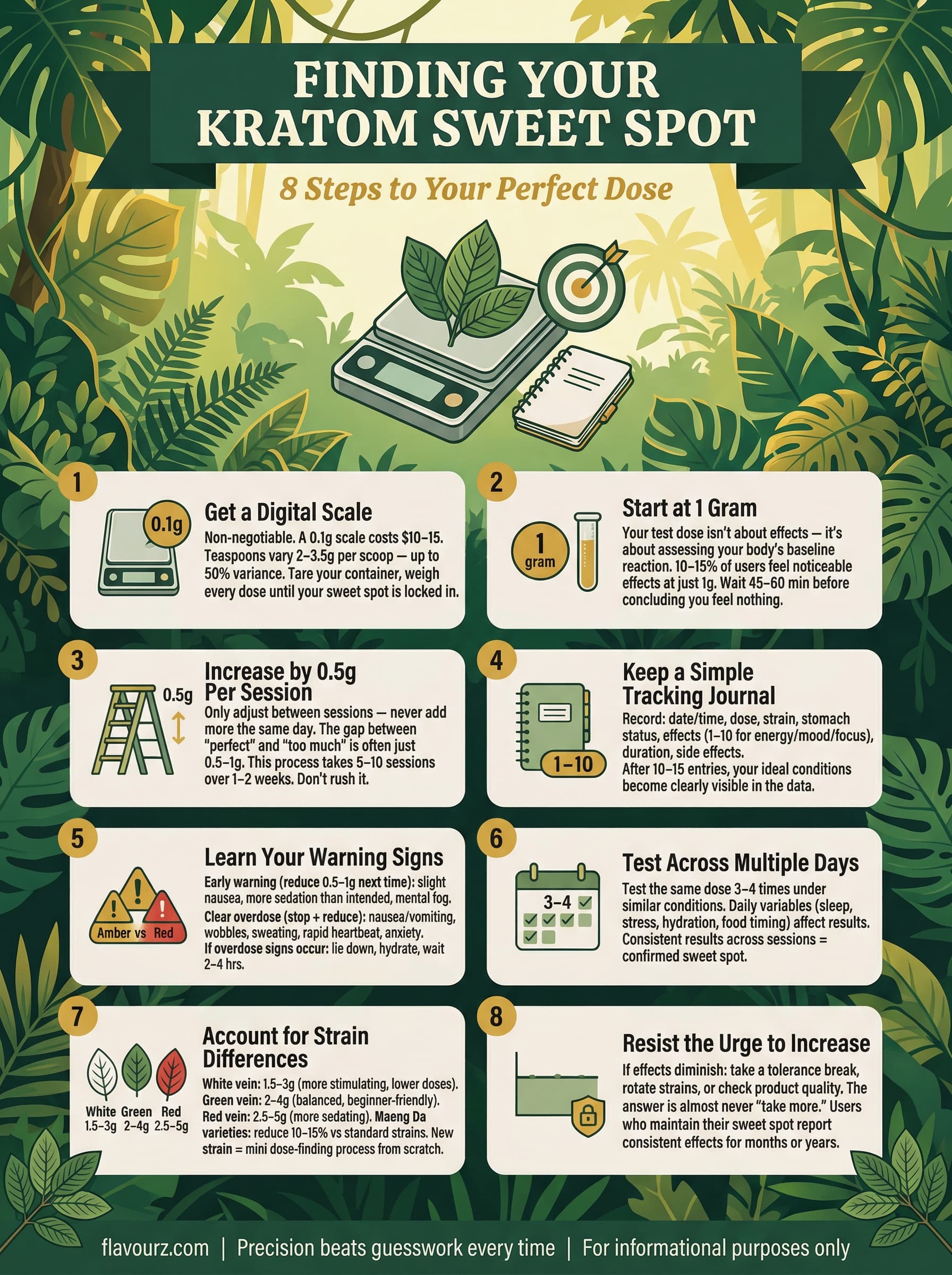
Step 1: Get a Digital Scale
This step is non-negotiable. A digital scale that measures to 0.1 grams costs $10-15 and transforms your kratom experience from guesswork to precision. The difference between 2 grams and 3 grams can shift effects from stimulating to sedating. You cannot eyeball this difference reliably.
Why teaspoons don't work: Kratom powder density varies significantly between strains and batches. One "teaspoon" can range from 2-3.5 grams depending on how finely ground the powder is and how tightly packed. Studies of household measurement show variance up to 30-50% with volume-based methods.
What to look for: Any scale with 0.1g precision works. Place it on a flat, stable surface. Use the tare function to zero out your container weight. Weigh every dose until you've found your sweet spot and can reliably replicate it.
Step 2: Start at 1 Gram (The Test Dose)
Your first dose should be 1 gram. Yes, this is low. That's the point. The test dose isn't about achieving effects; it's about assessing your body's baseline reaction to kratom without overwhelming it.
Why this matters: Some people are extremely sensitive to kratom. About 10-15% of users I've worked with feel noticeable effects at just 1 gram. These individuals would have an overwhelming experience if they started at 3-4 grams like some guides suggest.
What to observe:
- Any subtle mood or energy changes (even slight)
- Stomach comfort or discomfort
- Duration of any effects noticed
- Whether you want to feel more or if this was sufficient
Wait at least 45-60 minutes before concluding whether you feel anything. Kratom onset takes 15-45 minutes depending on stomach contents and form used.
Step 3: Increase by 0.5g Per Session
If your 1g test dose produced minimal effects, increase to 1.5g for your next session. Continue increasing by 0.5g increments until you reach your target effect range.
Critical rule: Only adjust dose between sessions, never during the same session. If you take 2g and don't feel much after an hour, do NOT add more that day. Wait until your next kratom day to try 2.5g.
Why 0.5g increments? Kratom has a narrow effective range for many people. The difference between "perfect" and "too much" might be just 0.5-1 gram. Larger jumps risk overshooting your sweet spot and having an unpleasant experience that could have been avoided.
Timeline: This process typically takes 5-10 sessions spread over 1-2 weeks. Don't rush it. Finding your sweet spot correctly saves you months of suboptimal experiences.
Step 4: Keep a Simple Tracking Journal
Write down what happens. This doesn't need to be elaborate. A notes app on your phone works fine. For each session, record:
- Date and time
- Dose amount (measured with scale)
- Strain used
- Stomach status (empty, light meal, full)
- Effects felt (1-10 scale for energy, mood, focus, comfort)
- Duration
- Any side effects
After 10-15 entries, patterns emerge clearly. You'll see exactly which dose with which strain under which conditions produces your best results. This data is worth its weight in gold when fine-tuning later.
Step 5: Learn Your Warning Signs
Recognizing when you've exceeded your sweet spot helps you dial back before problems worsen. Watch for these signals that your dose is too high:
Early warning signs (dial back 0.5-1g next time):
- Slight nausea or stomach unease
- More sedation than intended
- Mental fog instead of clarity
- Feeling "heavy" rather than comfortable
Clear overdose signs (stop, reduce dose significantly):
- Nausea or vomiting
- "Wobbles" (dizziness, eye focusing issues)
- Sweating or feeling overheated
- Rapid heartbeat
- Anxiety or agitation
If you experience the clear overdose signs, lie down, stay hydrated, and wait. Effects will pass within 2-4 hours. For your next session, reduce dose by at least 1-2 grams from whatever caused the problem.
Step 6: Test Across Multiple Days
Once you find a dose that seems to work, verify it's actually your sweet spot by testing it across multiple sessions. What feels perfect on one day might feel slightly different on another due to:
- Sleep quality the night before
- Food intake and timing
- Stress levels
- Hydration status
- Natural daily hormone fluctuations
The verification process: Use the same dose 3-4 times under similar conditions. If it consistently delivers good effects without side effects, you've found your sweet spot for that strain and purpose. If results vary significantly, you may need to adjust or tighten control of variables like stomach contents.
Step 7: Account for Strain Differences
Your sweet spot for one strain may not match another. Different strains have varying alkaloid profiles, which affects optimal dosing.
| Strain Type | Typical Sweet Spot | Notes |
|---|---|---|
| White vein (e.g., White Maeng Da) | 1.5-3g | More stimulating, lower doses needed |
| Green vein (e.g., Green Maeng Da) | 2-4g | Balanced, good for beginners |
| Red vein (e.g., Red Bali) | 2.5-5g | More sedating, often needs slightly higher dose |
| Maeng Da varieties | Reduce 10-15% | Higher potency, use less than standard strains |
When trying a new strain, start 0.5-1g lower than your established sweet spot and work up. Treat each new strain as a mini dose-finding process.
Step 8: Resist the Urge to Increase
Once you've found your sweet spot, stay there. The most common mistake long-term kratom users make is gradually increasing dose when effects seem to diminish. This creates a cycle: higher doses accelerate tolerance, requiring even higher doses.
If effects diminish, the solution is usually:
- Take a tolerance break (2-7 days off)
- Rotate strains (different alkaloid profiles prevent strain-specific tolerance)
- Extend time between doses (more hours between = better receptor recovery)
- Check product quality (weak batches happen; try a different source)
The solution is almost never "take more." Users who maintain their sweet spot dose for months or years report consistent effects. Users who chase effects by increasing dose end up needing 8-10+ grams daily with diminishing returns.
Common Sweet Spot Finding Mistakes
Mistake 1: Starting Too High
Starting at 3-5 grams because "that's what guides say" skips the assessment phase. You might have found your sweet spot at 2 grams, but you'll never know because you overshot. Worse, starting high and having a bad experience can turn people off kratom entirely when a lower dose would have been perfect.
Mistake 2: Increasing Too Fast
Jumping from 2g to 4g because 2g "wasn't enough" is dangerous. The right dose might have been 2.5g or 3g. Large jumps mean you can't pinpoint exactly where the sweet spot lies, and you risk overshooting directly into uncomfortable territory.
Mistake 3: Redosing the Same Day
Taking 2g, feeling nothing after 30 minutes, and adding another 2g is the most common cause of unpleasant kratom experiences. The first dose hasn't peaked yet. Now you have 4g hitting at once when 2.5g might have been perfect. Always wait until the next session to adjust.
Mistake 4: Not Tracking
Relying on memory to remember what worked three days ago is unreliable. Without written records, you end up guessing and repeating experiments you've already done. A simple note for each session saves time and frustration.
Mistake 5: Ignoring Variables
Taking 3g on an empty stomach one day and 3g after a large meal the next, then concluding "kratom is inconsistent" ignores the massive variable of stomach contents. Control one variable at a time. If you find a dose that works on empty stomach, keep testing on empty stomach until you've verified it.
Sweet Spots by Goal
Your sweet spot may vary depending on what you're trying to achieve. Here's how goals affect optimal dosing.
Energy and Focus
For stimulation, focus, and productivity, lower doses work better than higher ones. Taking more for energy actually backfires because higher doses shift toward sedation.
- Optimal range: 1-3 grams
- Best strains: White vein, green vein
- Timing: Morning or early afternoon, empty stomach for fastest onset
- Key insight: If 2g doesn't provide enough energy, try a different strain rather than increasing dose. Taking 4g for energy usually produces the opposite effect.
Mood Enhancement
Mood support typically falls in the low-to-moderate range. Both stimulating and relaxing strains can enhance mood, but through different mechanisms.
- Optimal range: 2-4 grams
- Best strains: Green vein (balanced), white vein (uplifting), red vein (calming)
- Timing: Flexible, depends on desired mood quality
Relaxation and Evening Use
For relaxation, winding down, or evening use, moderate doses of relaxing strains work best. Higher doses aren't necessarily better; they just increase sedation and side effect risk.
- Optimal range: 2.5-5 grams
- Best strains: Red vein varieties
- Timing: 2-3 hours before desired peak relaxation
Physical Comfort
Pain relief and physical comfort typically require slightly higher doses because more opioid receptor activation is needed. However, there's still a ceiling; exceeding it increases side effects without improving comfort.
- Optimal range: 3-6 grams
- Best strains: Red vein, Red Maeng Da
- Timing: As needed, with minimum 4-6 hours between doses
- Key insight: Consistent moderate doses often work better than sporadic high doses
Special Considerations
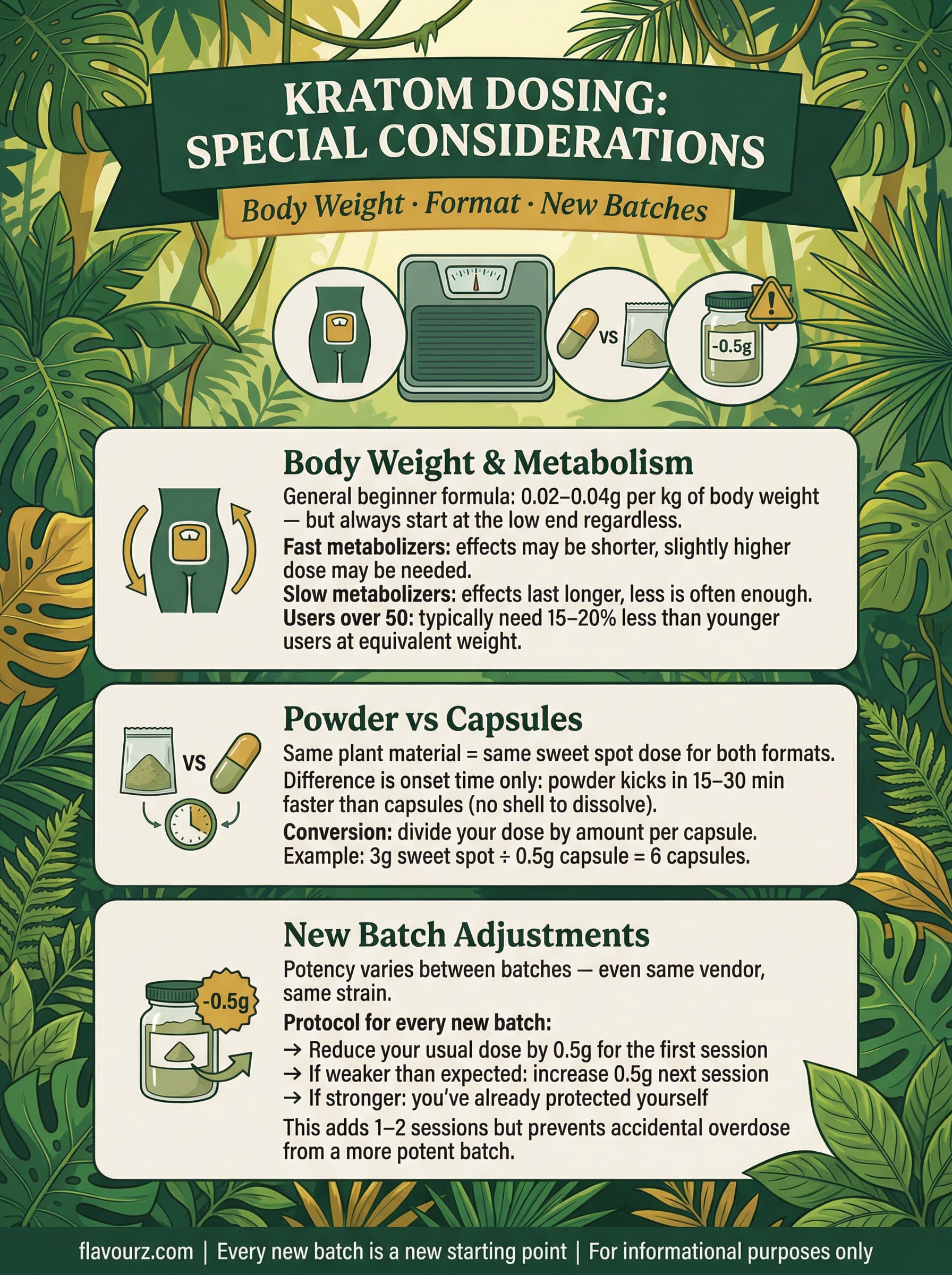
Body Weight and Metabolism
Body weight provides a rough starting point but isn't as predictive as you might expect. A general formula: 0.02-0.04 grams per kilogram of body weight for beginners. But sensitivity varies more than weight, so always start at the low end and adjust based on response.
Fast metabolizers may find effects shorter and potentially need slightly higher doses. Slow metabolizers may find effects last longer and require less. Age affects metabolism: users over 50 typically need 15-20% less than younger users at the same weight.
Powder vs. Capsules
Your sweet spot dose should be the same whether using powder or capsules, since both are the same plant material. The difference is onset time: powder kicks in 15-30 minutes faster because there's no capsule shell to dissolve.
Standard capsules contain 0.5-0.7g each. To convert your powder sweet spot to capsules: divide your dose by the amount per capsule. If your sweet spot is 3g and capsules are 0.5g each, you need 6 capsules.
New Batch Adjustments
Kratom potency varies between batches, even from the same vendor and strain. When starting a new batch:
- Reduce your usual dose by 0.5g for the first test
- If it feels weaker than expected, increase 0.5g next session
- If it feels stronger, you've already protected yourself by starting lower
This precaution takes 1-2 extra sessions but prevents accidentally overdoing it with a more potent batch.
Maintaining Your Sweet Spot Long-Term
Tolerance Prevention
The key to keeping your sweet spot effective long-term is preventing tolerance buildup. Tolerance occurs when receptors downregulate from frequent exposure, requiring higher doses for the same effects.
Prevention strategies:
- Rotate strains: Don't use the same strain more than 2 days in a row
- Take off days: At least 2 days per week without kratom
- Space doses: Minimum 4-6 hours between doses; longer is better
- Avoid daily use: If possible, limit to 3-4 days per week
When to Reassess
Your sweet spot may shift over time due to tolerance, health changes, or lifestyle factors. Reassess if:
- Effects feel noticeably weaker at your usual dose
- You experience effects you didn't used to (side effects appearing)
- Significant weight change (±15+ pounds)
- New medications (kratom can interact with some drugs)
- Major health changes
Reassessment means temporarily dropping dose by 0.5-1g and working back up systematically, just like finding your initial sweet spot.
Tolerance Resets
If you've lost your sweet spot due to tolerance, a reset works:
- 3-5 day break: Restores 30-40% of sensitivity
- 7-14 day break: Restores 60-80% of sensitivity
- 21-30 day break: Near-complete reset for most people
After a reset, start at 50-75% of your pre-break dose and work up. Your sweet spot is usually lower than before tolerance developed.
Sample Dose-Finding Timeline
Here's what a typical 2-week sweet spot finding process looks like:
| Day | Dose | Observation | Next Step |
|---|---|---|---|
| Day 1 | 1.0g | Very subtle effects, if any | Increase |
| Day 2 | Off day | Rest | - |
| Day 3 | 1.5g | Mild energy, slight mood lift | Increase |
| Day 4 | Off day | Rest | - |
| Day 5 | 2.0g | Noticeable energy, good mood | Continue testing |
| Day 6 | Off day | Rest | - |
| Day 7 | 2.5g | Strong effects, possibly too sedating | Sweet spot is ~2-2.5g |
| Days 8-14 | 2-2.5g | Verify consistency | Confirmed sweet spot |
This example shows finding a sweet spot of 2-2.5g over about 2 weeks. The off days prevent tolerance from confounding results and allow full receptor recovery between tests.
Frequently Asked Questions
Why is less sometimes more with kratom?
Kratom has biphasic effects: low doses (1-3g) stimulate while high doses (5+g) sedate. If you want energy but take too much, you won't get more energy; you'll get sedation instead. Additionally, higher doses increase nausea risk and accelerate tolerance. The lowest effective dose typically provides the cleanest, most sustainable experience.
What dose of kratom is right for me?
Your optimal dose depends on your body, goals, and the specific strain. Most users find their sweet spot between 2-4 grams. Start at 1g and work up by 0.5g increments. Those seeking energy typically do well at 1-3g; those seeking relaxation or comfort may need 3-5g. Body weight provides a rough guide (0.02-0.04g per kg), but individual sensitivity varies more than weight.
How long does it take to find optimal kratom dose?
Most people can identify their sweet spot within 1-2 weeks using the systematic approach of starting at 1g and increasing 0.5g per session. This typically takes 5-10 sessions. Rushing the process by making large jumps risks overshooting and missing where the sweet spot actually lies. Taking time to find it correctly saves months of suboptimal experiences.
Why do kratom effects vary so much?
Effects vary due to multiple factors: dose size (most important), strain differences, individual body chemistry, stomach contents, hydration, sleep quality, batch potency variation, and tolerance level. Controlling variables like stomach contents and timing helps produce more consistent results. Using a scale eliminates dose variability.
What is the kratom biphasic effect?
Kratom's biphasic effect means low and high doses produce qualitatively different effects, not just stronger versions of the same thing. At low doses (1-3g), kratom's alkaloids primarily produce stimulation, energy, and focus. At high doses (5+g), they produce sedation, relaxation, and pain relief. This happens because different doses activate different receptor pathways.
Should I increase my kratom dose if I don't feel anything?
Not immediately. Wait at least 45-60 minutes because kratom can take time to kick in, especially with food in your stomach. If you still feel nothing after an hour, do NOT add more that day. Instead, increase by 0.5g for your next session. Redosing the same day is the most common cause of taking too much accidentally.
Final Thoughts
Finding your kratom sweet spot requires patience, precision, and a willingness to start lower than you think you need. The users who have the best long-term kratom experiences are those who found their minimum effective dose and stayed there, rather than chasing stronger effects through higher doses.
The 8-step process works reliably: get a scale, start at 1 gram, increase by 0.5g per session, track everything, learn your warning signs, verify across multiple days, adjust for strains, and resist the urge to increase. In 1-2 weeks, you'll have a precise, reliable sweet spot that serves you well for years.
At Flavourz Kratom, we've helped customers find their sweet spots since 1999. The consistent pattern: those who invest the time upfront to find their optimal dose report better, more reliable experiences than those who guess or start high. If you have questions about the process, our dosage recommendations guide and beginner's guide provide additional context.
Disclaimer: These statements have not been evaluated by the FDA. Kratom is not intended to diagnose, treat, cure, or prevent any disease. Consult a healthcare professional before using kratom, especially if you have medical conditions or take medications. Must be 21+ to purchase. Not available in all states.

Leave a comment