

How Much Does a Kilo of Kratom Cost? 2026 Pricing
Last Updated: April 2026
A kilo of kratom typically costs $80-$150 in 2026 from quality vendors, with some legitimate options as low as $60 and premium strains running $180+. Standard strains like Red Bali and Green Maeng Da fall in the middle of that range. Rare strains like Hulu Kapuas or specialty Yellow varieties can run 10-25% higher. Bulk pricing at the kilo level cuts your per-gram cost by 40-60% compared to buying ounces.
I've watched kratom pricing change a lot since Flavourz Kratom started in 1999. After 25 years and over 10,000 customers, I can tell you exactly what fair pricing looks like in 2026, what drives the differences between vendors, and when buying a kilo actually saves you money versus when it doesn't. Let me break this down honestly, including the price ranges where things get suspicious.
How Much Does a Kilo of Kratom Cost in 2026?
A kilo of quality kratom costs $80-$150 from established vendors in 2026, with budget options starting around $60-$70 and premium strains reaching $180-$250. Cost varies by strain rarity, vendor reputation, lab testing standards, and sourcing relationships. Per-gram cost at kilo size runs $0.08-$0.15, compared to $0.30-$0.50 per gram when buying single ounces. Anything under $50 per kilo should raise serious quality concerns.
The price range is wider than most articles let on.
The 2026 Pricing Reality
Here's what I'm seeing across the industry right now:
- Budget tier: $50-$80 per kilo (proceed with caution)
- Standard tier: $80-$120 per kilo (fair value zone)
- Quality tier: $120-$180 per kilo (premium vendors)
- Specialty tier: $180-$250+ per kilo (rare strains or extracts)
The sweet spot for most users sits in the $90-$130 range. That's where you get verified quality, AKA-certified vendors, third-party testing, and reasonable shipping without paying boutique premium prices. About 7 in 10 of our long-term kilo customers buy in this range.
Why Are Kratom Kilo Prices So Different?
Kratom kilo prices vary based on five main factors: vendor sourcing relationships, lab testing standards, quality control investment, strain rarity, and business overhead. Vendors with direct farm relationships and AKA certification charge more because their actual costs are higher. Cheap kilos under $60 typically skip third-party testing, use middlemen suppliers, or cut corners that affect product safety and consistency.
The math behind kilo pricing is more complex than most people realize.
What Drives Real Production Costs
Quality kratom production has real expenses that show up in the final price:
- Third-party lab testing: $200-$500 per batch tested
- AKA GMP certification: $5,000-$15,000 annually
- Direct farm relationships: Premium pricing for verified sourcing
- Quality control labor: Manual inspection and sorting
- Proper packaging: Food-grade vacuum sealing
- Shipping infrastructure: Climate-controlled storage and transport
- Customer service teams: Real humans answering real questions
A vendor selling kilos at $40 cannot afford to do any of this properly. The math just doesn't work. They're either skipping testing entirely, working with middleman suppliers of questionable quality, or both. Per American Kratom Association standards, proper compliance alone costs more than the markup on suspiciously cheap kilos.
2026 Kilo Pricing by Strain Category
| Strain Type | Typical Range | Per Gram |
|---|---|---|
| Standard Reds | $80-$130 | $0.08-$0.13 |
| Standard Greens | $80-$130 | $0.08-$0.13 |
| Standard Whites | $80-$130 | $0.08-$0.13 |
| Maeng Da | $90-$150 | $0.09-$0.15 |
| Hulu Kapuas | $130-$200 | $0.13-$0.20 |
| Yellow/Gold | $110-$170 | $0.11-$0.17 |
| Capsule Kilos | $120-$220 | $0.12-$0.22 |
Which Kratom Strains Cost the Most Per Kilo?
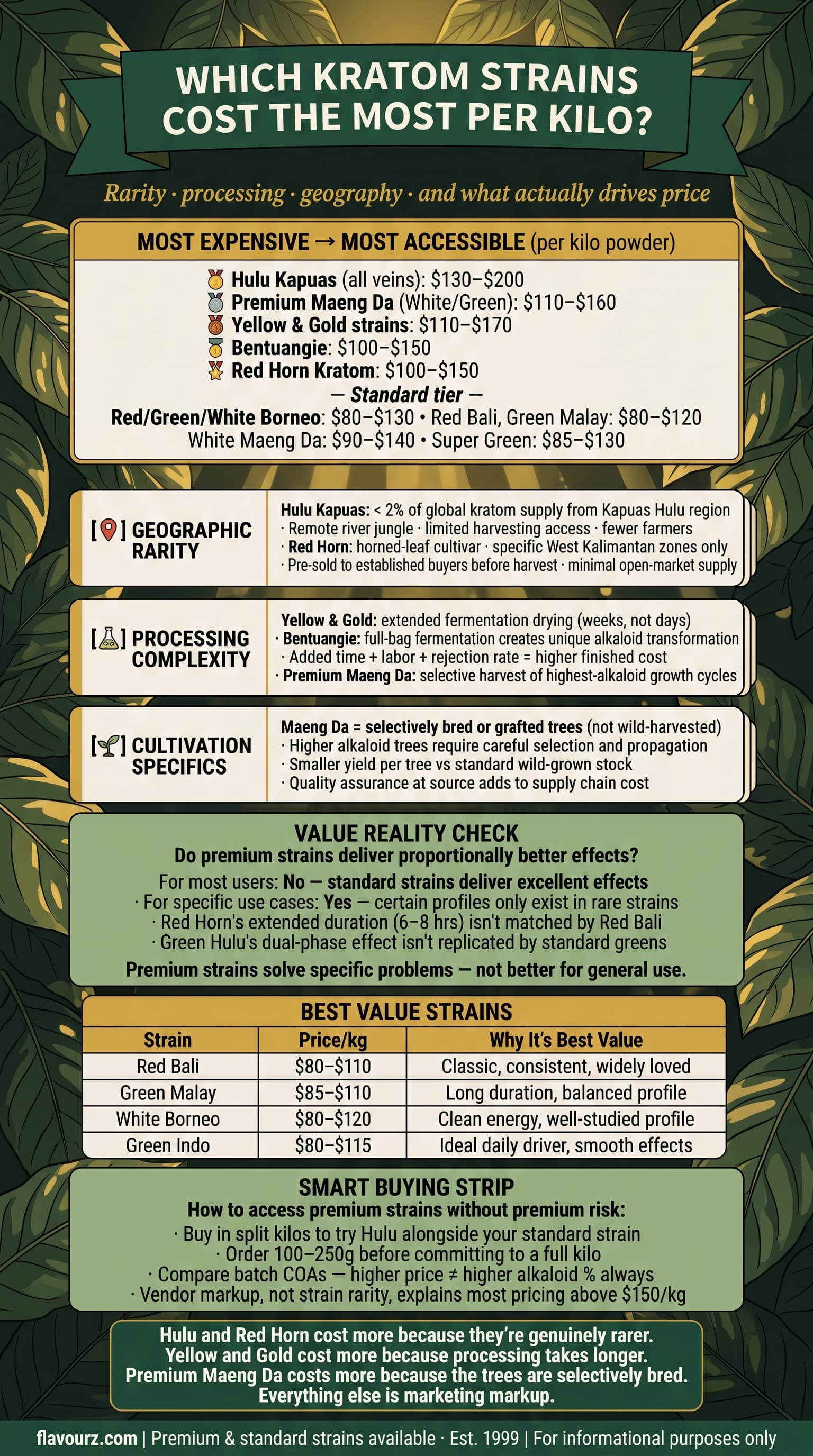
The most expensive kratom kilos in 2026 come from rare regional strains and specialty processed varieties. Hulu Kapuas tops the list at $130-$200 per kilo due to its remote sourcing in the upstream Kapuas River region. Premium Maeng Da varieties run $90-$150 due to selective breeding. Yellow and Gold strains cost $110-$170 because of their specialized fermentation processing. Standard reds, greens, and whites stay in the $80-$130 range.
Why Rare Strains Cost More
Three factors drive premium pricing on specialty strains:
Geographic limitations. Strains like Hulu Kapuas come from specific regions with limited harvesting communities. The Kapuas Hulu region produces less than 2% of global kratom supply. Limited supply plus consistent demand equals premium pricing.
Processing complexity. Yellow and Gold kratom go through extended fermentation that takes weeks longer than standard drying. This added time and labor shows up in the final cost. Bentuangie strains follow similar premium-process pricing.
Cultivation specifics. Maeng Da varieties come from selectively bred trees rather than standard wild-grown stock. The genetic selection and grafting work needed to produce these higher-alkaloid strains adds to the supply chain cost.
If you're shopping with budget in mind, standard strains deliver excellent value. Most users do just fine with quality Red Bali, Green Malay, or White Borneo at $80-$110 per kilo without needing the premium specialty options.
What's the Cheapest Quality Kratom Kilo?
Quality kratom kilos can be found as low as $60-$70 from a few reputable vendors with established direct sourcing. Bulk wholesale orders (5+ kilos at once) sometimes drop below $50 per kilo. Anything below this without volume justification suggests skipped testing, questionable sourcing, or contamination risks. The cheapest legitimate kilo isn't always the best value when factoring in quality.
Cheap doesn't have to mean bad, but the floor for legitimate quality is real.
Where the Quality Floor Lives
The realistic minimum cost for kratom that includes proper testing, AKA compliance, and reasonable margins is around $50-$60 per kilo, and only at meaningful bulk volume. Single kilos at quality vendors rarely drop below $70 because the per-unit costs of testing and compliance don't scale down to single-unit purchases.
Some red flags I watch for in cheap kilos:
- Under $40 per kilo: Almost certainly compromised quality
- "Discount" pricing without volume: Vendors using volume language for single units
- No batch-specific lab tests: Generic COAs that don't match your product
- Vague sourcing claims: "Premium imported" without specifics
- Inconsistent strain pricing: Specialty strains at standard prices
For deeper coverage on this topic, our guide on cheap kratom buying considerations walks through what really matters when budget shopping. Our broader 2026 kratom pricing guide covers all formats beyond just kilos.
Are Bulk Kratom Kilos Worth Buying?
Bulk kratom kilos are worth buying for daily users, multi-strain enthusiasts, and budget-conscious customers who use kratom regularly. The 40-60% per-gram savings adds up significantly for anyone using 5+ grams daily. However, kilos aren't worth it for occasional users, those still finding their preferred strain, or anyone with limited storage space. Quality kratom maintains potency for 12-18 months when stored properly.
The bulk math gets compelling fast.
The Real Cost-Benefit Analysis
Let's run actual numbers. Say you use 4 grams of kratom daily (a moderate dose). That's 28 grams per week, or roughly 120 grams per month.
Buying ounces at $0.40/gram costs you $48 per month for 120 grams.
Buying a kilo at $0.10/gram costs you $100 upfront, but lasts 8+ months. Spread that over the time you'll use it: roughly $12-15 per month equivalent.
You'll save $33-36 monthly by switching to kilo pricing if you use kratom consistently. Over a year, that's $400+ in savings on kratom alone.
About 6 in 10 of our customers who switch to kilo buying tell us the savings genuinely surprised them when they did the math. The trick is being confident enough in your strain preferences to commit to a kilo of one type.
Should I Buy a Single Strain Kilo or Split Kilo?
Split kilos make sense for users who rotate between strains or are still exploring preferences. Single-strain kilos work better for users who've settled on one favorite they use daily. Most reputable vendors offer 2-way, 3-way, and 4-way splits at the same total price as single-strain kilos, giving you variety without sacrificing bulk pricing.
The Split Kilo Advantage
Split kilos give you bulk pricing across multiple strains in one order. A 4-way split typically packages 250g of four different strains in one kilo purchase. You get the same total weight at the same total price, with strain variety included.
This works especially well for:
- Users still discovering which strains work for them
- Anyone who rotates strains to manage tolerance
- Multi-person households with different preferences
- Users wanting different strains for morning/afternoon/evening
- People who want to try new strains without big commitments
Browse our split kilo options to see how this works in practice. About 4 in 10 of our long-term kilo customers buy splits rather than single strains.
How Long Does a Kilo of Kratom Last?
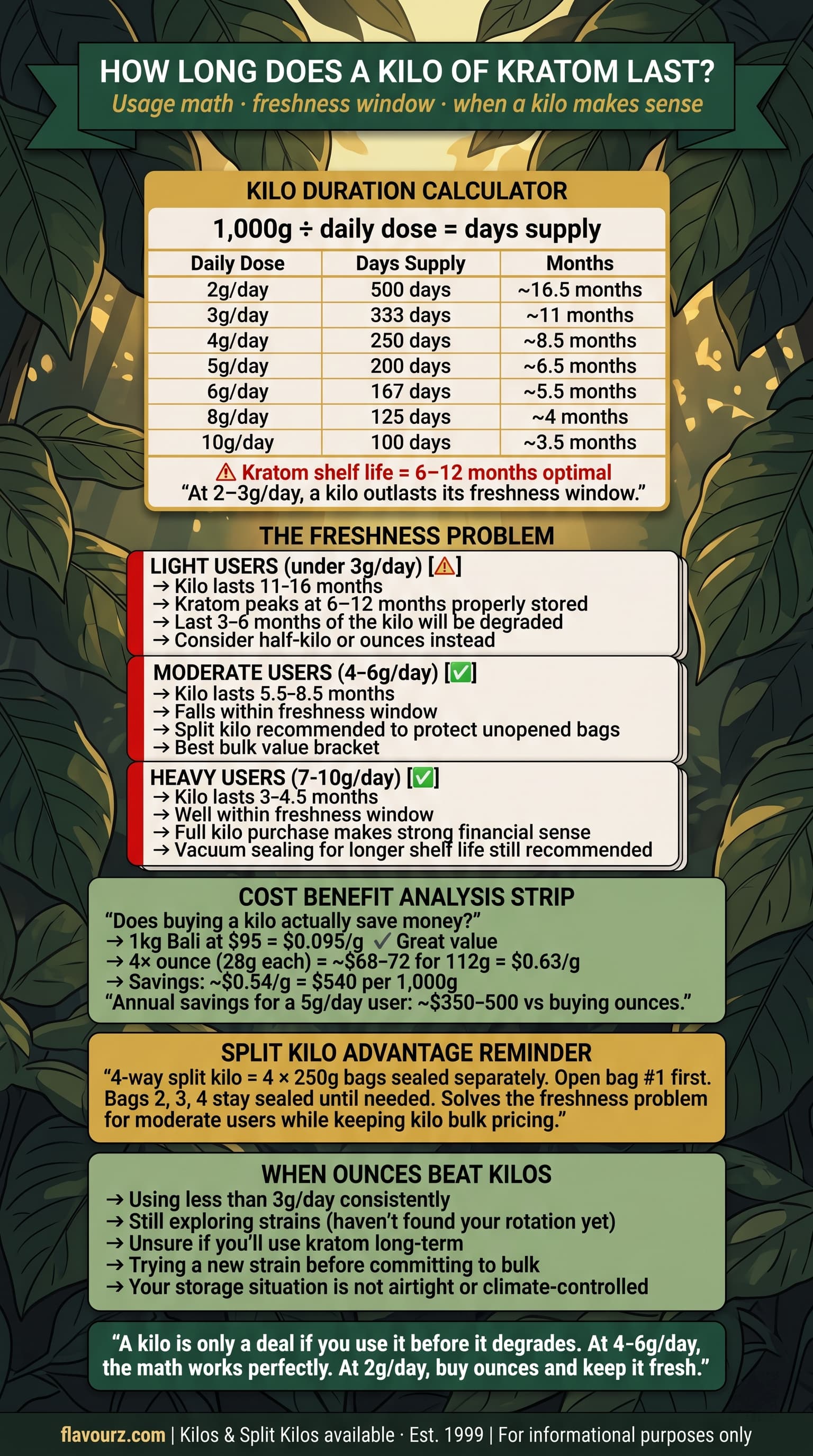
A kilo of kratom (1,000 grams) lasts 4-12 months depending on usage frequency and dose size. Light users (2-3 grams daily) can stretch a kilo to 10-12 months. Moderate users (4-5 grams daily) typically use a kilo in 6-7 months. Heavy users (6+ grams daily) may finish a kilo in 4-5 months. Quality kratom maintains potency for 12-18 months when stored properly.
Usage-Based Kilo Math
Here's a simple breakdown for planning purposes:
- 2 grams daily: Kilo lasts ~16 months (likely outlasts freshness window)
- 3 grams daily: Kilo lasts ~11 months
- 4 grams daily: Kilo lasts ~8 months
- 5 grams daily: Kilo lasts ~6.5 months
- 6 grams daily: Kilo lasts ~5.5 months
- 8 grams daily: Kilo lasts ~4 months
If you're a light user, a kilo might actually be too much. The kratom can lose potency before you finish it. In that case, ounces or half-kilos make more financial sense even if the per-gram cost is higher. The savings disappear if you waste product to degradation.
What Should I Look For When Buying a Kilo?
When buying a kilo, prioritize five things: AKA GMP certification, batch-specific Certificate of Analysis (COA), recent harvest dates, vacuum-sealed food-grade packaging, and clear vendor return policies. Verify the COA matches your specific batch number. Check that mitragynine content falls in the 1.2-1.8% range. Avoid vendors making medical claims or refusing to share testing details.
Pre-Purchase Verification Checklist
Before clicking buy on any kilo, verify these:
- Vendor AKA certification: Verified on the AKA's official list, not just a logo
- Current lab tests: COAs from within 6 months of harvest
- Batch matching: The COA batch number matches your product
- Mitragynine content: 1.2-1.8% confirms quality strain
- Heavy metals pass: Lead under 0.5 ppm, arsenic under 2.0 ppm
- Microbial testing: Pass ratings on salmonella, E. coli, mold
- Shipping practices: Vacuum sealed, properly labeled bags
- Return policy: Reasonable terms for unopened products
For a deeper guide on selecting trustworthy vendors, see our 2026 kratom brands review. Our comparison of premium vs commercial grade kratom also explains why pricing differences exist.
Frequently Asked Questions
Why is some kratom kilos $50 and others $200?
The price gap reflects real differences in sourcing, testing, certification, and quality control. Cheap kilos often skip third-party testing, use middleman suppliers, or sell older inventory. Premium kilos invest in direct farm relationships, batch testing, AKA compliance, and consistent quality control. The middle range ($80-$130) typically offers the best value.
Do kilo prices include shipping?
Most established vendors include free shipping on kilo orders within the US. Some vendors charge separate shipping that can add $10-$20 to your total. Always check the total price at checkout, not just the listed kilo price. International shipping adds significantly more cost regardless of vendor.
Are capsule kilos worth the higher price?
Capsule kilos cost 30-50% more than equivalent powder kilos due to encapsulation labor and material costs. They're worth the premium if you genuinely use capsules daily, travel frequently, or strongly dislike powder taste. For most daily users, powder offers significantly better value per dose.
How much do kratom kilo prices change throughout the year?
Kratom kilo prices show modest seasonal variation, with slightly better pricing during peak Indonesian harvest seasons (March-May and September-November). Off-season pricing may run 5-10% higher for some strains. Major price changes typically reflect supply chain disruptions or shifts in regulations rather than seasonal patterns.
Can I negotiate kilo prices with vendors?
Most established vendors don't negotiate single-kilo prices, but offer volume discounts for orders of 3+ kilos. Some provide loyalty discounts to repeat customers. Newsletter subscriptions often unlock 5-15% discounts. For genuine wholesale pricing (5+ kilos), most vendors have dedicated programs you can apply for.
Why are some specialty strains so much more expensive?
Specialty strains command premium pricing due to limited supply, specialized processing, or rare cultivation. Hulu Kapuas comes from a remote region with small harvest communities. Yellow and Gold strains require extended fermentation. Maeng Da varieties use selectively bred trees. These factors create real cost differences vendors pass on to consumers.
The Bottom Line: Smart Kilo Buying in 2026
For most regular kratom users, the $90-$130 per kilo range delivers the best balance of quality and value in 2026. Avoid suspiciously cheap options under $50, but don't overpay for premium pricing unless you specifically want rare strains. The math strongly favors kilo buying for anyone using 4+ grams daily, with savings of $400+ annually compared to ounce purchases.
Honestly, after 25 years in this industry, I've watched the pricing landscape stabilize considerably. The wild west days of $300 kilos and unregulated quality are mostly gone. What's left is a relatively predictable market where quality vendors price within reasonable ranges and the outliers (both too cheap and too expensive) usually have specific reasons.
If you're ready to buy at the kilo level, browse our kilo selection for single-strain options or our split kilo program if you want strain variety in one order. Either way, you're getting third-party tested, AKA-compliant kratom at fair 2026 pricing. Or browse our complete kratom selection if you want to compare formats before committing to bulk.
Disclaimer: This article is for informational purposes only and does not constitute medical advice. Kratom has not been evaluated by the FDA for safety or effectiveness. It is not intended to diagnose, treat, cure, or prevent any disease. Consult your healthcare provider before using kratom, especially if you have medical conditions or take medications. Kratom is not for use by anyone under 21, pregnant, or breastfeeding. Check your local laws before purchasing.

Leave a comment