
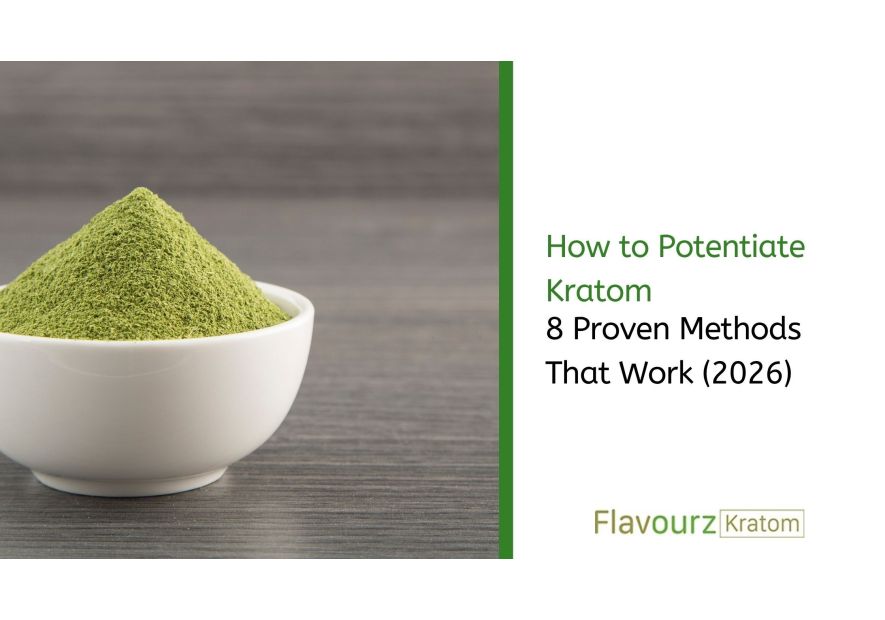
How to Potentiate Kratom: 8 Proven Methods That Work (2026)
Last Updated: April 2026
Kratom potentiation is the practice of enhancing kratom's effects without increasing your dose — and it's one of the most practically useful areas of kratom knowledge for anyone using it regularly. When kratom starts feeling less effective than it did six months ago, the instinct is to take more. The better approach is to understand why bioavailability drops, what compounds and techniques measurably improve it, and how to apply them systematically.
At Flavourz Kratom, we've been tracking the science and community experience around potentiation since before most vendors were even talking about it. This guide covers 8 methods with documented mechanisms — not folklore, not placebo claims, but techniques with biochemical rationales grounded in how kratom's alkaloids are absorbed and metabolized.
What Is Kratom Potentiation?
Kratom potentiation refers to any method that increases the bioavailability, absorption rate, or metabolic duration of kratom's active alkaloids — primarily mitragynine and 7-hydroxymitragynine — without changing the gram dose. The baseline oral bioavailability of kratom is estimated at approximately 30–40%, meaning the majority of the alkaloids in a typical dose are lost to incomplete absorption and first-pass liver metabolism before they reach systemic circulation.
Potentiation works through four primary mechanisms:
- >
Enzyme inhibition:
- Slowing the liver enzymes (primarily CYP3A4) responsible for metabolizing mitragynine, allowing more to remain active in the bloodstream for longer >
Absorption enhancement:
- Breaking down plant cell walls or improving alkaloid solubility to increase the percentage absorbed from the gastrointestinal tract >
Tolerance management:
- Blocking receptor tolerance pathways so that the same dose produces consistent effects over time rather than diminishing returns >
Synergistic complementation:
- Combining kratom with compounds that have complementary effects, extending or deepening the overall experience profile
Understanding which mechanism each potentiator uses lets you select the right approach for your specific goal — faster onset, longer duration, stronger peak effects, or tolerance prevention. The 8 methods below are organized by primary mechanism.
Method 1: Grapefruit Juice — The Most Potent Natural Potentiator
Grapefruit juice is the most well-documented and pharmacologically potent kratom potentiator available. It works through a specific mechanism: grapefruit contains furanocoumarins that create what scientists call "mechanism-based inhibition" of the CYP3A4 liver enzyme — the primary metabolic pathway responsible for breaking down mitragynine. According to Amazing Botanicals, this inhibition is irreversible at the enzyme level — the furanocoumarins bond covalently to the enzyme active site, permanently deactivating it. Your liver must produce entirely new CYP3A4 enzymes to restore normal function, a process that takes approximately 72 hours.
This means the potentiation effect from grapefruit juice extends well beyond the day you consume it. A single glass of white grapefruit juice inhibits CYP3A4 for up to three days, during which your body metabolizes mitragynine more slowly, keeping more of it active in your system for a longer duration.
Protocol:
- >Drink 8 oz of white grapefruit juice 30–45 minutes before your kratom dose >Use white grapefruit specifically — pink grapefruit has lower furanocoumarin content >Reduce your kratom dose by 20–30% when first using this method — the potentiation can be significant >Do not use grapefruit if you take prescription medications metabolized by CYP3A4 without consulting your doctor first — the same enzyme inhibition that enhances kratom applies to many pharmaceutical drugs >Frequency: 2–3 times per week maximum to avoid excessive enzyme suppression
Primary mechanism: CYP3A4 enzyme inhibition → extended mitragynine half-life → longer duration, stronger effects at same dose
Method 2: Black Pepper / Piperine — Best Bioavailability Booster
Black pepper's active compound piperine is one of the most studied bioavailability enhancers in natural medicine. It works by inhibiting CYP3A4 (the same enzyme as grapefruit) and by inhibiting P-glycoprotein, an intestinal drug efflux pump that actively ejects some alkaloids back out of intestinal cells before they can be absorbed. According to community research documented on kratom-specific forums, piperine can boost kratom's bioavailability by an additional 15–25% on top of the baseline 30–40% oral absorption rate.
The most common delivery form is BioPerine — a standardized 95% piperine extract — which is more consistent in concentration than whole black pepper. The research on piperine's bioavailability effects is more established than almost any other natural potentiator on this list.
Protocol:
- >Take 5–10mg of BioPerine (or 1/4 teaspoon of freshly ground black pepper) 15–30 minutes before kratom >Alternatively, mix black pepper directly into kratom tea or a smoothie with your dose >Consistent daily use produces better results than occasional use — piperine's bioavailability effects are cumulative >The piperine + turmeric (curcumin) stack is more effective than piperine alone — addressed in Method 3
Primary mechanism: CYP3A4 + P-glycoprotein inhibition → increased intestinal absorption → stronger effects at same dose
Method 3: Turmeric + Black Pepper — The Most Versatile Stack
Turmeric (curcumin) combined with black pepper (piperine) is one of the most consistently recommended kratom potentiation stacks in both experienced user communities and herbalism literature. Curcumin has its own CYP enzyme modulation properties and acts on some of the same receptor pathways as mitragynine. Piperine increases curcumin's own bioavailability by 2,000% — which means taking them together produces compounding effects rather than just additive ones.
The combination enhances both kratom's absorption and its receptor-level effects through separate but complementary mechanisms, which is why it produces more pronounced results than either compound alone. Our dedicated kratom and turmeric stack guide covers the full science, dosing ratios, and recipe protocols for this specific combination in detail.
Protocol:
- >Take 500–1,000mg of curcumin + 5–10mg of piperine (BioPerine), or use a pre-combined curcumin+BioPerine supplement capsule >Consume 45–60 minutes before your kratom dose for peak overlap >Add a small amount of fat (olive oil, coconut oil, or a fatty meal) — curcumin is fat-soluble and absorbs significantly better with dietary fat >Daily supplementation produces better baseline than taking only on kratom days
Primary mechanism: CYP enzyme modulation + receptor complementation + piperine bioavailability enhancement → stronger, longer effects
Method 4: Citrus Juice / Citric Acid — Best for Tea Brewing
Lemon juice and other citric acid sources are the most accessible and practical potentiator for regular kratom tea brewers. Citric acid serves a dual function: it breaks down the plant cell walls of kratom powder during brewing, releasing alkaloids more completely into the water, and it stabilizes mitragynine against heat degradation during the simmering process. Research cited by multiple kratom preparation sources suggests citrus incorporation can increase alkaloid absorption by up to 40% compared to plain-water extraction.
Unlike grapefruit's CYP3A4 inhibition mechanism, citric acid works at the preparation stage rather than the metabolic stage — it improves how much alkaloid gets into the tea in the first place, before any absorption or metabolism occurs. This makes it the most important preparation-stage potentiator for tea users specifically.
Protocol:
- >Add 1 teaspoon of fresh lemon juice per 8 oz of water before adding kratom to the brewing pot >For capsule or toss-and-wash users: take your dose with a small glass of lemon water rather than plain water for partial absorption benefit >Alternatively, mix 1/4 teaspoon of food-grade citric acid powder into brewing water — more consistent than fresh lemon and easier to batch-brew >Effect on taste: masks some of kratom's bitterness without adding strong flavor at the 1 tsp per 8 oz ratio
For the complete integration of citrus into kratom tea preparation, our kratom tea recipe guide covers five brewing methods with citric acid incorporated at each step.
Primary mechanism: Plant cell wall disruption + alkaloid stabilization → increased extraction yield from same gram dose
Method 5: Magnesium — Best for Tolerance Prevention
Magnesium is the only potentiator on this list that primarily works on tolerance rather than on acute bioavailability. It acts on NMDA (N-methyl-D-aspartate) receptors, which are involved in the tolerance formation process for opioid-pathway substances. By blocking the NMDA receptors that would otherwise adapt to repeated kratom use, magnesium supplementation slows the rate at which your standard dose loses effectiveness — effectively preserving your baseline sensitivity over time.
According to the ETHA Naturals founders in their Live Fully Podcast episode on kratom potentiators, magnesium is specifically discussed as working through NMDA receptor modulation rather than through the enzyme inhibition pathways that most other potentiators use. This makes it complementary to grapefruit and piperine rather than redundant with them. The preferred forms are magnesium glycinate and magnesium citrate — both absorb significantly better than magnesium oxide.
Protocol:
- >Take 200–400mg of magnesium glycinate or magnesium citrate daily — consistent supplementation is more effective than taking it only on kratom days >The tolerance prevention effect builds over weeks of consistent use, not after a single dose >Best combined with strain rotation — magnesium slows tolerance development but doesn't eliminate it; rotation is still the primary tolerance management strategy >Magnesium also reduces kratom-associated muscle tension and can improve sleep quality as a secondary benefit
Primary mechanism: NMDA receptor blockade → reduced opioid-pathway tolerance formation → preserved baseline dose effectiveness over time
Method 6: Lecithin (Phospholipids) — The Science-Backed Emerging Method
Lecithin, a phospholipid compound found in eggs and sunflower seeds, is one of the most underrated kratom potentiators and one of the most scientifically supported. A US patent (US20230364172A1) filed specifically for kratom-phospholipid formulations documents that mitragynine formulated with phospholipids shows "dramatically improved bioavailability" compared to standard extracts — the same mechanism that makes pharmaceutical liposomal drug delivery systems more effective than conventional oral delivery.
Phospholipids create a lipid envelope around fat-soluble compounds that dramatically improves their absorption through the gastrointestinal mucosa. Mitragynine has partial fat-solubility, which means phospholipid enhancement is pharmacologically relevant. This is newer to the kratom community than grapefruit or piperine, but the underlying mechanism has established scientific precedent in pharmaceutical drug delivery research.
Protocol:
- >Take 1,200–2,400mg of sunflower lecithin or soy lecithin with your kratom dose >Sunflower lecithin is preferred over soy lecithin for users with soy sensitivities >Best applied with
- products specifically, where the concentrated alkaloid content makes enhanced bioavailability most impactful >Can be added to kratom tea (lecithin granules dissolve in warm liquid) or taken as a softgel alongside your dose
Primary mechanism: Phospholipid encapsulation → improved GI mucosal absorption of fat-soluble alkaloids → higher systemic bioavailability per gram
Method 7: Empty Stomach + Proper Hydration — The Free Baseline Optimizers
Before investing in any supplement-based potentiator, two zero-cost protocol adjustments produce the most immediate and reliable improvement in kratom's effects for most users: taking kratom on a completely empty stomach, and maintaining adequate hydration. These two factors alone can shift experienced effects as dramatically as many supplement-based potentiators — and they cost nothing.
An empty stomach eliminates competition from food digestion for blood flow, enzyme activity, and intestinal absorption space. Kratom taken 2–3 hours after a meal in a fully empty stomach absorbs significantly faster and more completely than kratom taken after eating. The effect difference is most pronounced for users who've been habitually dosing with food — switching to an empty stomach protocol can feel like switching to a stronger strain.
Protocol:
- >
Empty stomach:
- Take kratom at minimum 2 hours after a meal; 3–4 hours is ideal for maximum effect; do not eat for at least 1 hour after dosing to allow absorption to complete >
Hydration:
- Drink 16–24 oz of water in the 30 minutes before your dose — dehydration slows gastric motility, which directly delays kratom onset and reduces peak absorption >
If empty stomach causes nausea:
- A small, fat-containing snack (handful of nuts, small amount of coconut oil) taken 30 minutes before dosing provides enough fat to reduce nausea without significantly impeding absorption — and the fat also mildly enhances fat-soluble alkaloid absorption >
Post-dose hydration:
- Continue drinking water for the hour after dosing — kratom is diuretic at higher doses and adequate hydration maintains alkaloid circulation
Primary mechanism: Optimized GI absorption conditions → faster onset, higher peak absorption, more consistent dosing outcomes
Method 8: Freeze-Thaw Cell Disruption — Best for Tea Brewers
The freeze-thaw method is a mechanical potentiation technique specifically for kratom powder users who brew tea. Freezing kratom powder before brewing causes ice crystals to form within the plant cell structure. When the powder thaws, those ice crystals expand and rupture cell walls from the inside, creating micro-fractures throughout the plant material. When the disrupted powder is then simmered in water with lemon juice, alkaloids release more completely from the ruptured cells than they would from intact cell walls.
This is the same principle used in herbal extraction chemistry — freeze-thaw cycles are a standard pre-treatment in laboratory-grade plant extraction protocols for improving yield. Applied to kratom home brewing, it's one of the most effective preparation-stage potentiators that costs nothing beyond the slight inconvenience of pre-freezing your powder.
Protocol:
- >Measure your desired kratom dose into a small sealable container or plastic bag >Add just enough water to cover the powder and mix into a thick slurry >Freeze for a minimum of 2 hours (overnight is better) >Thaw the slurry at room temperature or in warm water >Add the thawed slurry directly to your brewing pot with lemon juice and simmer as normal >The ruptured cell structure increases alkaloid extraction yield noticeably compared to non-frozen powder >Alternatively, freeze dry whole-leaf powder without water and grind again after thawing — cell disruption still occurs but the slurry method is more thorough
Primary mechanism: Physical cell wall disruption → increased alkaloid surface area contact with water → higher extraction yield per gram during brewing
Potentiator Comparison: All 8 Methods at a Glance
aption>Kratom Potentiation Methods: Mechanisms, Timing & Use Cases
| Method | Mechanism | Timing | Best For | Cost |
|---|---|---|---|---|
| Grapefruit juice | CYP3A4 inhibition (72-hr effect) | 30–45 min before dose | Longer duration | Low |
| Black pepper / piperine | CYP3A4 + P-glycoprotein inhibition | 15–30 min before dose | Stronger absorption | Very low |
| Turmeric + black pepper | CYP modulation + receptor synergy | 45–60 min before dose | Versatile full-profile enhancement | Low |
| Citrus / citric acid | Cell wall disruption + alkaloid stabilization | During brewing / with dose | Tea brewing extraction yield | Very low |
| Magnesium | NMDA receptor blockade | Daily supplementation | Tolerance prevention | Low |
| Lecithin / phospholipids | Lipid encapsulation → GI absorption | With dose | Extract users, maximum bioavailability | Low–moderate |
| Empty stomach + hydration | Optimized GI absorption conditions | 2–3 hrs post-meal | Baseline consistency, all users | Free |
| Freeze-thaw method | Physical cell wall rupture | Pre-brewing overnight | Tea brewers, extraction yield | Free |
Combination Protocols: Stacking Multiple Potentiators
The most significant potentiation results come from combining multiple methods that act on different mechanisms simultaneously. Because the 8 methods above operate through distinct pathways — enzyme inhibition, cell wall disruption, NMDA receptor blockade, phospholipid encapsulation — they are largely additive rather than redundant when stacked correctly.
Beginner starter stack (two methods, maximum safety):
- >Empty stomach protocol + citrus juice with dose >Zero additional cost, minimal interaction risk, produces immediate improvement in effect quality
Intermediate stack (three methods, moderate enhancement):
- >Magnesium glycinate 300mg daily + turmeric/black pepper 45 minutes before dosing + empty stomach protocol >Covers tolerance prevention + absorption enhancement + GI optimization simultaneously
Advanced stack (four methods, significant enhancement):
- >White grapefruit juice 30 min before dose + freeze-thaw prepared kratom tea with lemon juice + lecithin with dose + magnesium daily >Covers CYP3A4 enzyme inhibition + extraction yield + phospholipid absorption + tolerance prevention >Reduce kratom dose by 25–30% when running this full stack — the combined effect is substantially stronger than baseline
The fundamental rule for stacking: introduce one new potentiator at a time and observe for 3–5 sessions before adding the next. This makes it possible to attribute changes in effect to specific methods and catch any adverse reactions before they compound.
Safety Considerations and What to Avoid
Kratom potentiation carries genuine risks that deserve direct acknowledgment. The same mechanisms that make potentiators effective also make them capable of producing unexpectedly strong effects, drug interactions, and accelerated tolerance if misused.
- >
CYP3A4 inhibitors and prescription medications:
- Grapefruit juice and piperine both inhibit the same enzyme pathway that metabolizes dozens of prescription medications including statins, blood pressure medications, immunosuppressants, and certain antidepressants. If you take any prescription medication, check its CYP3A4 interaction profile before using grapefruit or piperine as kratom potentiators. >
Do not combine potentiators with extract products without reducing dose:
- Potentiating an already high-alkaloid extract dramatically amplifies both effects and overdose risk. Always start low when potentiating extracts. >
Potentiation does not substitute for quality:
- A poor-quality kratom product is not improved meaningfully by potentiators. The baseline quality of the kratom matters more than any potentiation method. Starting with lab-tested, AKA-certified
- is the prerequisite for effective potentiation. >
Avoid combining potentiators with alcohol or sedatives:
- CYP3A4 inhibition slows the metabolism of sedative compounds the same way it slows kratom metabolism — combining potentiated kratom with alcohol or benzodiazepines produces dangerously amplified sedation.
For a complete guide to managing the tolerance issue that makes potentiation necessary in the first place, our kratom tolerance guide covers reset protocols, rotation strategies, and long-term management approaches in detail. And for strain-specific dosing calibration, our kratom dosage guide gives you the baseline numbers to adjust when potentiation is in play.
Frequently Asked Questions
 Frequently Asked Questions.jpg)
What is the strongest kratom potentiator?
Grapefruit juice is the most pharmacologically potent single-agent kratom potentiator because of its irreversible 72-hour CYP3A4 enzyme inhibition. However, the strongest practical results come from the advanced combination stack: grapefruit juice + freeze-thaw extracted tea with lemon + lecithin + daily magnesium. Each method acts on a different mechanism, producing additive potentiation that substantially exceeds what any single potentiator delivers alone. Reduce dose by 25–30% when running the full stack.
Does turmeric really make kratom stronger?
Yes, through two documented mechanisms. Curcumin (turmeric's active compound) modulates CYP enzyme activity and interacts with some of the same receptor systems as kratom's alkaloids, producing complementary effects. Black pepper's piperine increases curcumin's own bioavailability by approximately 2,000% — meaning turmeric only delivers meaningful potentiation when taken with black pepper. Turmeric alone without piperine has limited bioavailability and limited potentiation effect.
Can I use kratom potentiators every day?
Magnesium, citrus juice, empty stomach protocol, and freeze-thaw preparation are all safe for daily use. Grapefruit juice should be limited to 2–3 times per week due to its 72-hour CYP3A4 inhibition duration — continuous daily use would effectively permanently suppress CYP3A4 function, which creates drug interaction risks and removes your body's normal metabolic regulation. Piperine and turmeric are safe for daily use with appropriate dosing.
Do kratom potentiators increase tolerance?
CYP3A4 inhibitors like grapefruit juice increase the effective dose delivered per gram of kratom, which means they can accelerate tolerance if used to take more effective kratom every day rather than to use less. Magnesium is the exception — it actively slows tolerance development through NMDA receptor blockade. The correct approach to potentiation for tolerance management: use potentiators to reduce your gram dose while maintaining effect quality, rather than using them to intensify effects at the same or higher dose.
Why has my regular kratom dose stopped working?
Reduced effectiveness at a previously reliable dose is almost always tolerance — your opioid receptors have adapted to consistent alkaloid stimulation and require more to produce the same response. The solutions in order of priority: first, take a 3–7 day break; second, rotate to a different strain upon return — and users who want to explore a specific white vein option as their rotation strain can read our guide on where to find white bali kratom for a detailed effects and sourcing breakdown; third, implement daily magnesium supplementation for ongoing tolerance prevention; fourth, apply absorption potentiators to restore effect quality at the same dose rather than escalating it. Our full kratom tolerance guide covers the reset process step by step.
Disclaimer: This article is for informational purposes only. Kratom is not FDA-approved and is not intended to diagnose, treat, cure, or prevent any disease or condition. Consult a qualified healthcare provider before using kratom potentiators, especially if you take prescription medications. Some potentiators affect the metabolism of pharmaceutical drugs through shared enzyme pathways.
Last Updated: April 2026 | Flavourz Kratom has served over 10,000 customers since 1999. Shop our full kratom selection here.

Leave a comment