
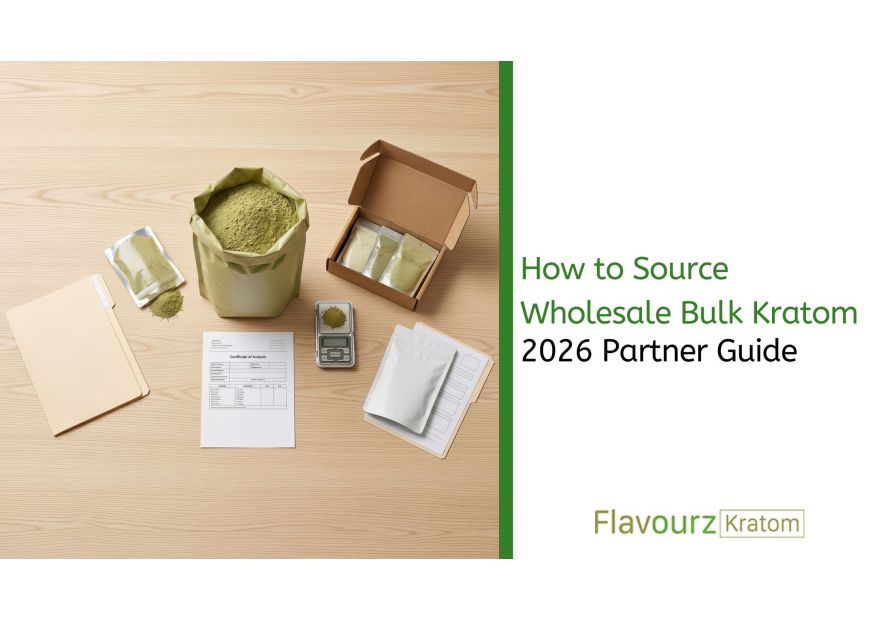
How to Source Wholesale Bulk Kratom: 2026 Partner Guide
Last Updated: April 2026
Sourcing wholesale bulk kratom requires more than finding the cheapest supplier. The wrong vendor partnership creates inventory headaches, customer complaints, compliance issues, and damaged brand reputation. The right partnership delivers consistent quality, predictable pricing, and the supply reliability your retail operation depends on. Wholesale kratom purchases can reduce costs 40-70% compared to retail prices, but only if you've built a relationship with the right supplier.
After 25 years at Flavourz Kratom, I've watched countless retailers chase the lowest prices and end up paying more in returns, complaints, and supplier turnover. This guide walks you through the complete process of evaluating, vetting, and partnering with wholesale kratom suppliers. Whether you're opening your first smoke shop or scaling an established online operation, the principles here will save you significant money and time.
Quick Answer: Wholesale Kratom Sourcing Process
Source wholesale bulk kratom through a 6-step process: (1) Define your business requirements, (2) Research AKA GMP-certified domestic suppliers, (3) Request samples and lab documentation, (4) Verify business credentials and references, (5) Negotiate pricing and payment terms, (6) Place small initial orders before scaling commitments. Most legitimate suppliers require business licenses and reseller permits.
Why Sourcing Strategy Matters
Kratom wholesale pricing typically falls between $35-$120 per kilogram in 2026. That's a 3.4x price spread for what often looks like identical product. The differences come down to factors that affect long-term partnership value:
- Quality verification: Third-party lab testing accountability
- Supply consistency: Can they maintain delivery during high-demand periods?
- Documentation depth: Batch COAs, GMP certifications, compliance records
- Operational reliability: On-time delivery, accurate orders, responsive support
- Brand reputation transfer: What does the supplier's reputation say about your products?
Higher prices aren't automatically better. Based on 2026 industry data, products priced above $150/kg show no measurable alkaloid advantage over $80/kg options from AKA-certified vendors. The premium pays for marketing and brand positioning rather than product superiority. Smart sourcing finds the sweet spot between quality verification and cost efficiency.
Step 1: Define Your Business Requirements
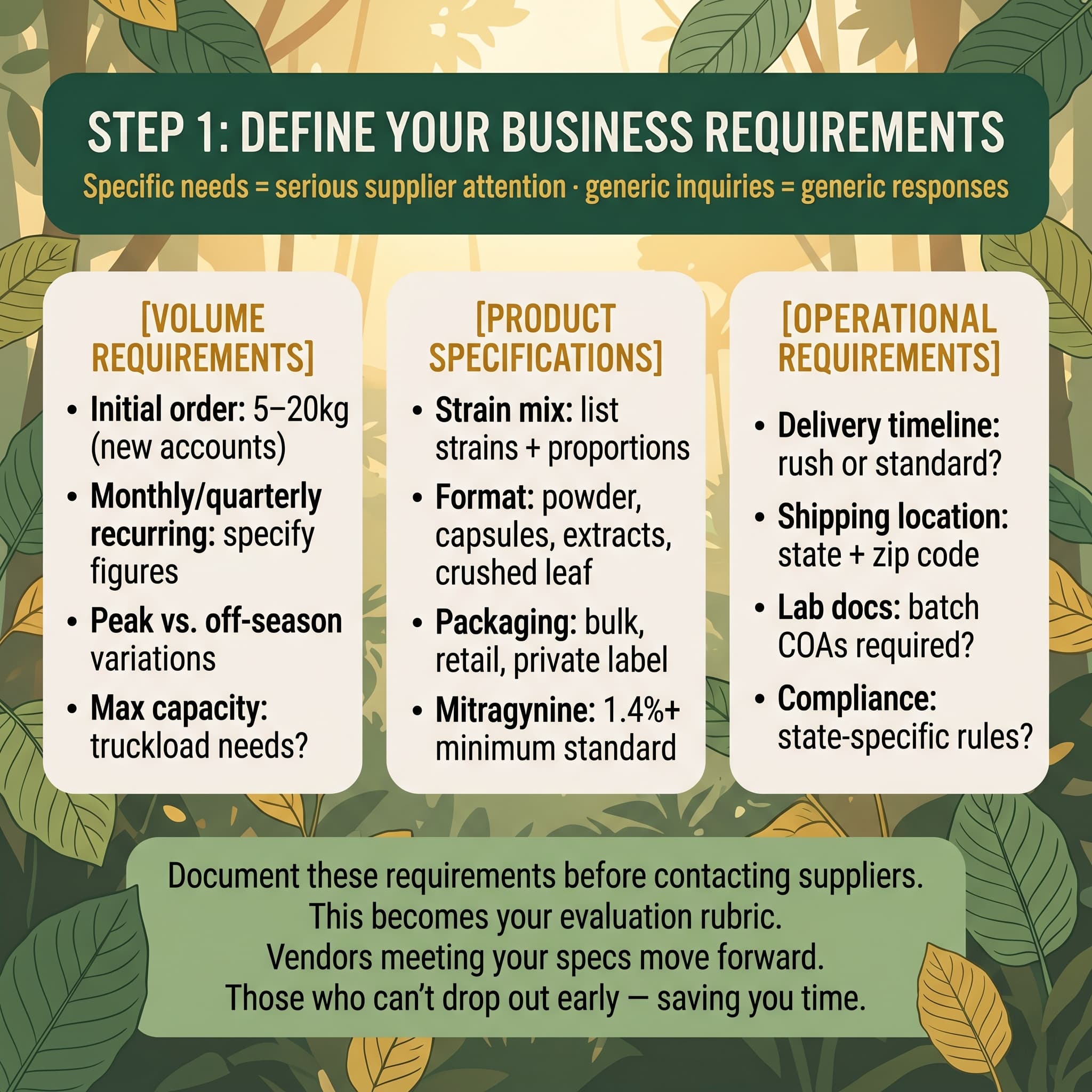
Before contacting any supplier, document your specific operational needs. Generic "I need wholesale kratom" inquiries get generic responses. Specific requirements get serious supplier attention.
Volume requirements:
- Initial order size (typically 5-20 kilos for new accounts)
- Monthly/quarterly recurring volume
- Peak season vs. off-season demand variation
- Maximum order capacity needs (truckload requirements)
Product specifications:
- Strain mix (which strains, in what proportions)
- Format requirements (powder, capsules, extracts, crushed leaf)
- Packaging preferences (bulk bags, retail packaging, private label)
- Mitragynine percentage requirements (1.4%+ is the standard threshold)
Operational requirements:
- Delivery timeline expectations
- Geographic shipping requirements
- Lab documentation needs (COA per batch, etc.)
- Compliance documentation (state-specific requirements)
This documentation becomes your supplier evaluation rubric. Vendors meeting your specifications move forward. Those who can't meet basic requirements save you time by dropping out early.
Step 2: Identify Qualified Suppliers
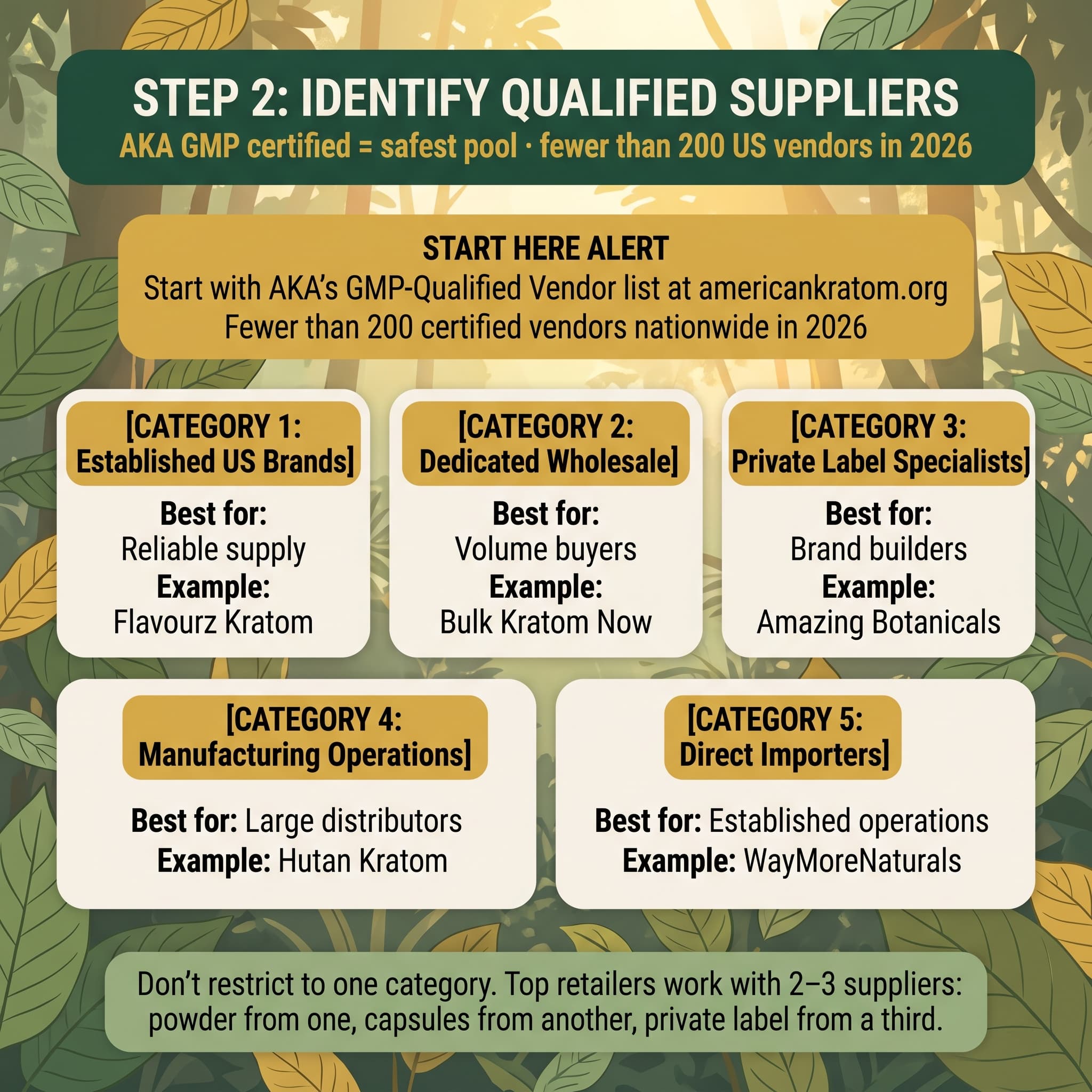
The American Kratom Association maintains a publicly accessible list of GMP-qualified vendors. Start there. Fewer than 200 US vendors hold AKA GMP certification in 2026, and this list represents your safest pool of potential partners.
Primary supplier categories:
| Category | Best For | Examples |
|---|---|---|
| Established US Brands | Reliable supply | Flavourz Kratom |
| Dedicated Wholesale | Volume buyers | Bulk Kratom Now |
| Private Label Specialists | Brand builders | Amazing Botanicals |
| Manufacturing Operations | Large distributors | Hutan Kratom |
| Direct Importers | Established operations | WayMoreNaturals |
Don't restrict your search to just one category. Established retail operations often work with 2-3 different suppliers for different product needs (powder from one, capsules from another, private label from a third). See our detailed wholesale supplier reviews for evaluation specifics.
Step 3: Conduct Supplier Due Diligence
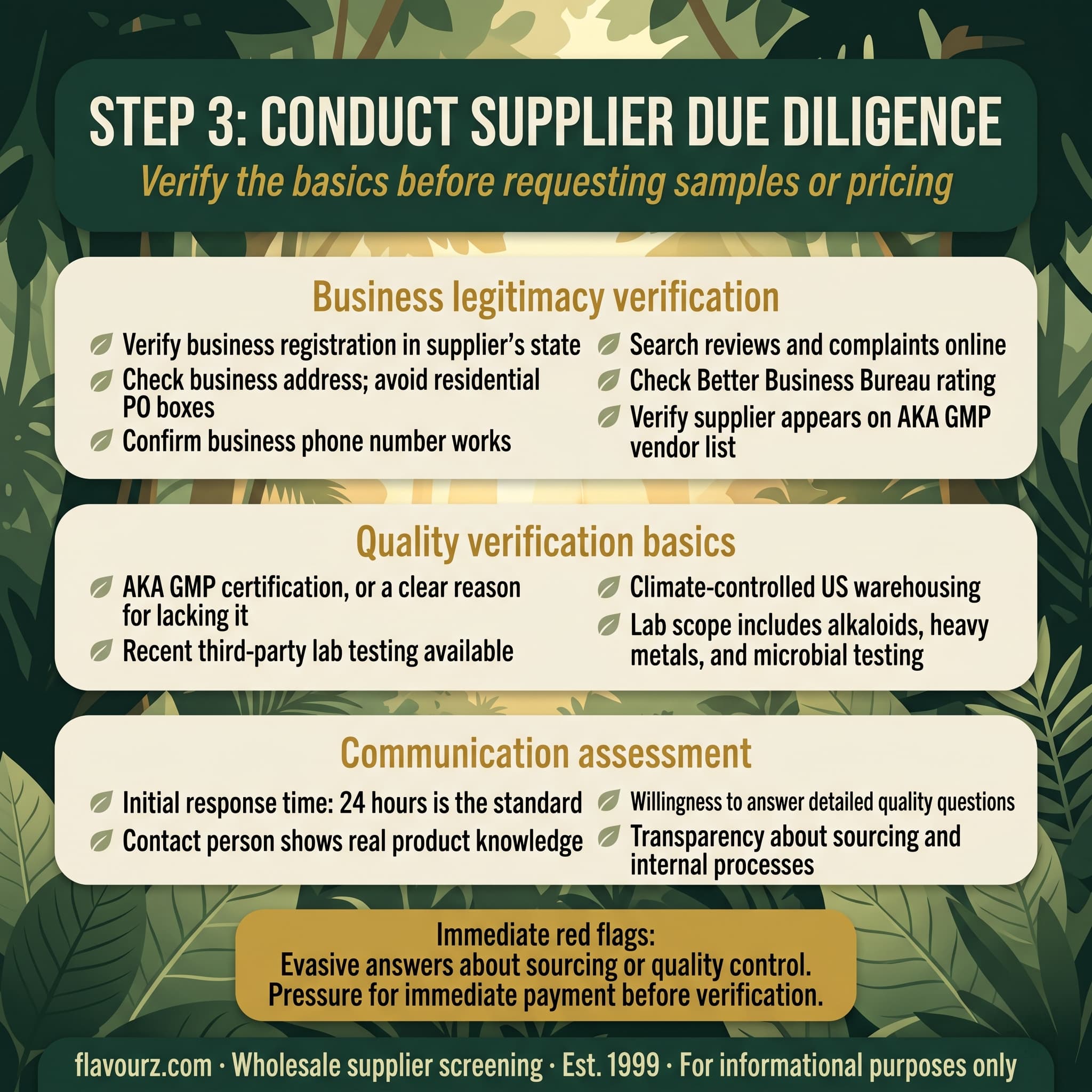
Before requesting samples or pricing, verify the basics. This filters out vendors who won't survive deeper evaluation.
Business legitimacy verification:
- Verify business registration in their state of operation
- Check business address (avoid residential PO boxes)
- Confirm business phone number functionality
- Search for online reviews and complaints
- Check Better Business Bureau ratings
- Verify supplier listing on AKA GMP qualified vendors database
Quality verification basics:
- AKA GMP certification (or specific reason for lacking it)
- Recent third-party lab testing availability
- Direct Indonesian sourcing relationships
- Climate-controlled US warehousing
- Lab testing scope (alkaloid content, heavy metals, microbial)
Communication assessment:
- Response time to initial inquiry (24 hours is the standard)
- Knowledge depth of contact person
- Willingness to answer detailed quality questions
- Transparency about sourcing and processes
Suppliers with evasive responses about sourcing or quality control are immediate red flags. Pressure tactics for immediate payment without verification are bigger red flags.
Step 4: Request and Evaluate Samples
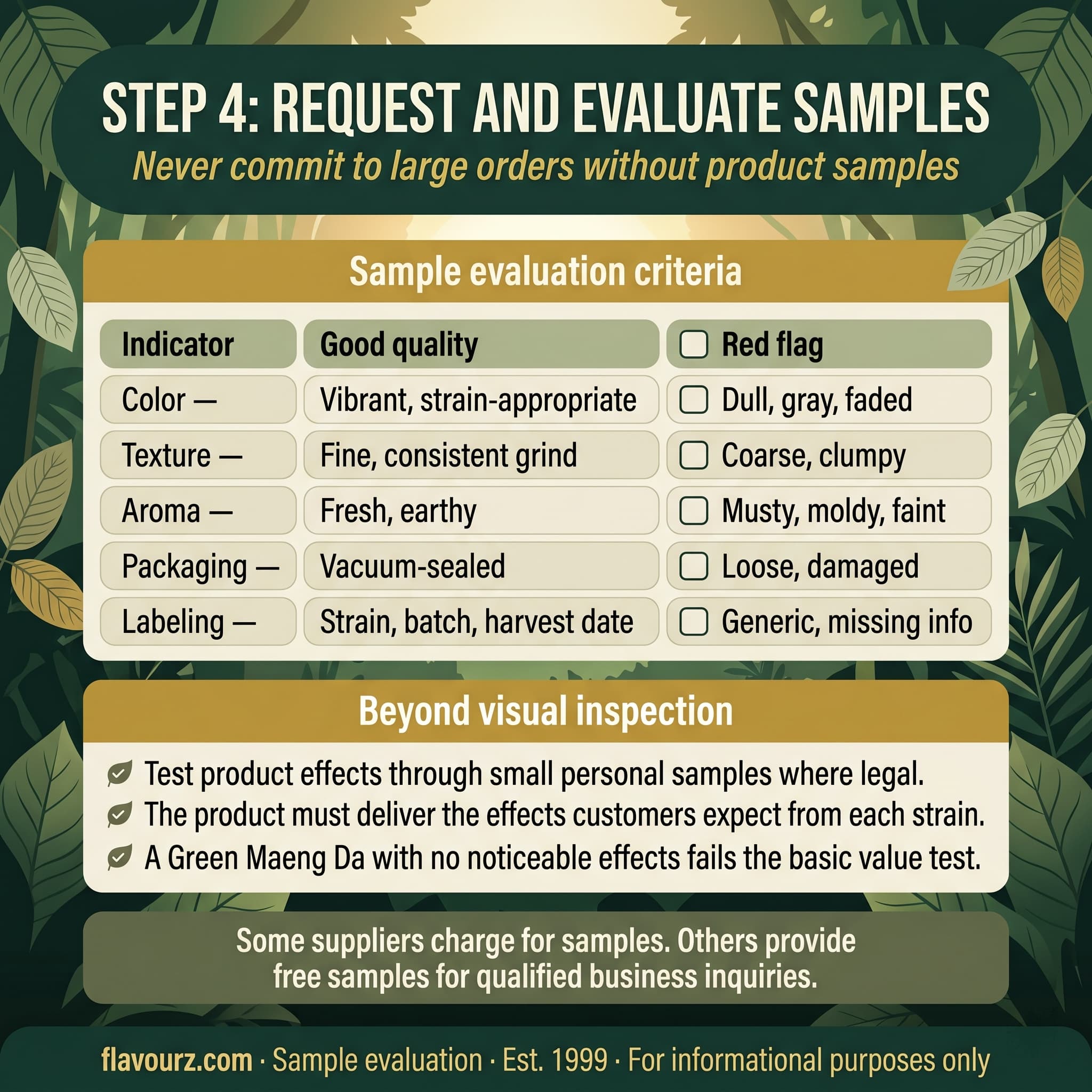
Never commit to large orders without product samples. Most legitimate suppliers offer sample packs for evaluation. Some charge for samples (typical) while others provide free samples for qualified business inquiries.
Sample evaluation criteria:
| Indicator | Good Quality | Red Flag |
|---|---|---|
| Color | Vibrant, strain-appropriate | Dull, gray, faded |
| Texture | Fine, consistent grind | Coarse, clumpy |
| Aroma | Fresh, earthy | Musty, moldy, faint |
| Packaging | Vacuum-sealed | Loose, damaged |
| Labeling | Strain, batch, harvest date | Generic, missing info |
Beyond visual inspection, test the product effects through small personal samples (where legal). The product needs to deliver the effects your customers expect from each strain. A "Green Maeng Da" that produces no noticeable effects fails the basic value test, regardless of how cheap the supplier is.
Step 5: Read Certificates of Analysis (COA) Properly
 Properly.jpg)
A Certificate of Analysis is the document that separates verified kratom from marketing claims. Knowing how to read one properly is essential for wholesale buyers.
Key COA components:
- Laboratory accreditation: ISO 17025 accreditation is the standard. Without it, the lab's results carry less weight.
- Batch identification: Specific batch number that matches the product you'll receive
- Testing date: Should be within the last 6 months for accurate results
- Alkaloid content: Mitragynine percentage (1.4%+ for Maeng Da grades)
- Heavy metals: Lead, arsenic, cadmium, mercury - all should pass
- Microbial testing: Yeast, mold, E. coli, Salmonella - all should pass
- Pass/fail indicators: Clear documentation of test results
Verification process:
- Compare vendor's stated alkaloid percentage against the lab results
- Verify less than 0.2% variation between batches of the same strain (reputable vendors maintain consistency)
- Confirm the testing laboratory is independent (not owned by the supplier)
- Check that all heavy metal and microbial tests show "pass" results
- Verify the COA matches the specific batch you'll receive
If a supplier can't provide batch-specific COAs, walk away. This is the single most important verification step.
Step 6: Verify Business Credentials
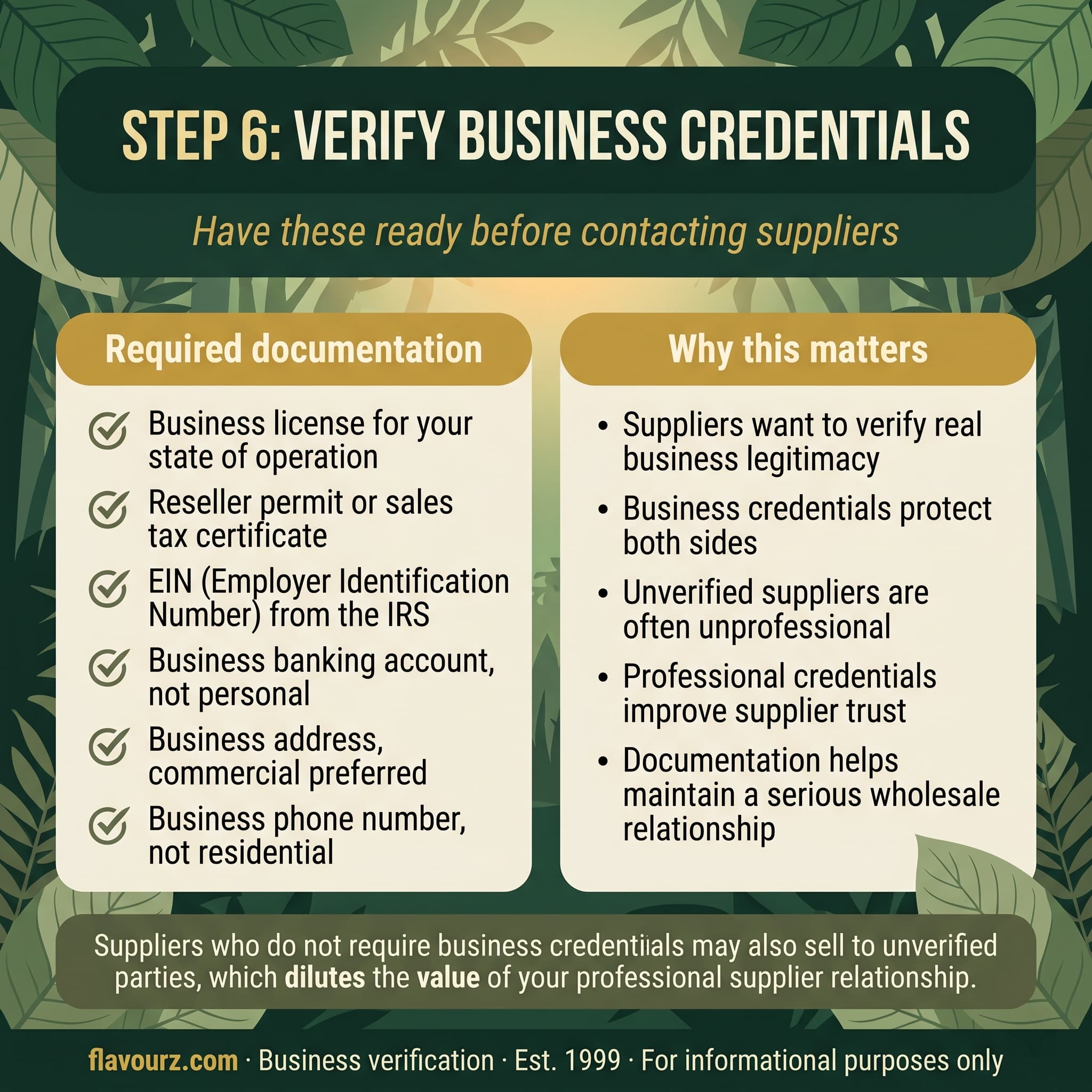
Most wholesale suppliers require documentation verifying your business legitimacy. Have these ready before contacting suppliers:
Required documentation:
- Business license for your state of operation
- Reseller permit or sales tax certificate (varies by state)
- EIN (Employer Identification Number) from the IRS
- Business banking account (not personal)
- Business address (commercial address preferred)
- Business phone number (not residential)
This documentation also protects you. Suppliers who don't require business credentials are likely also selling to unverified parties, which dilutes the value of your professional supplier relationship.
Step 7: Negotiate Pricing and Terms
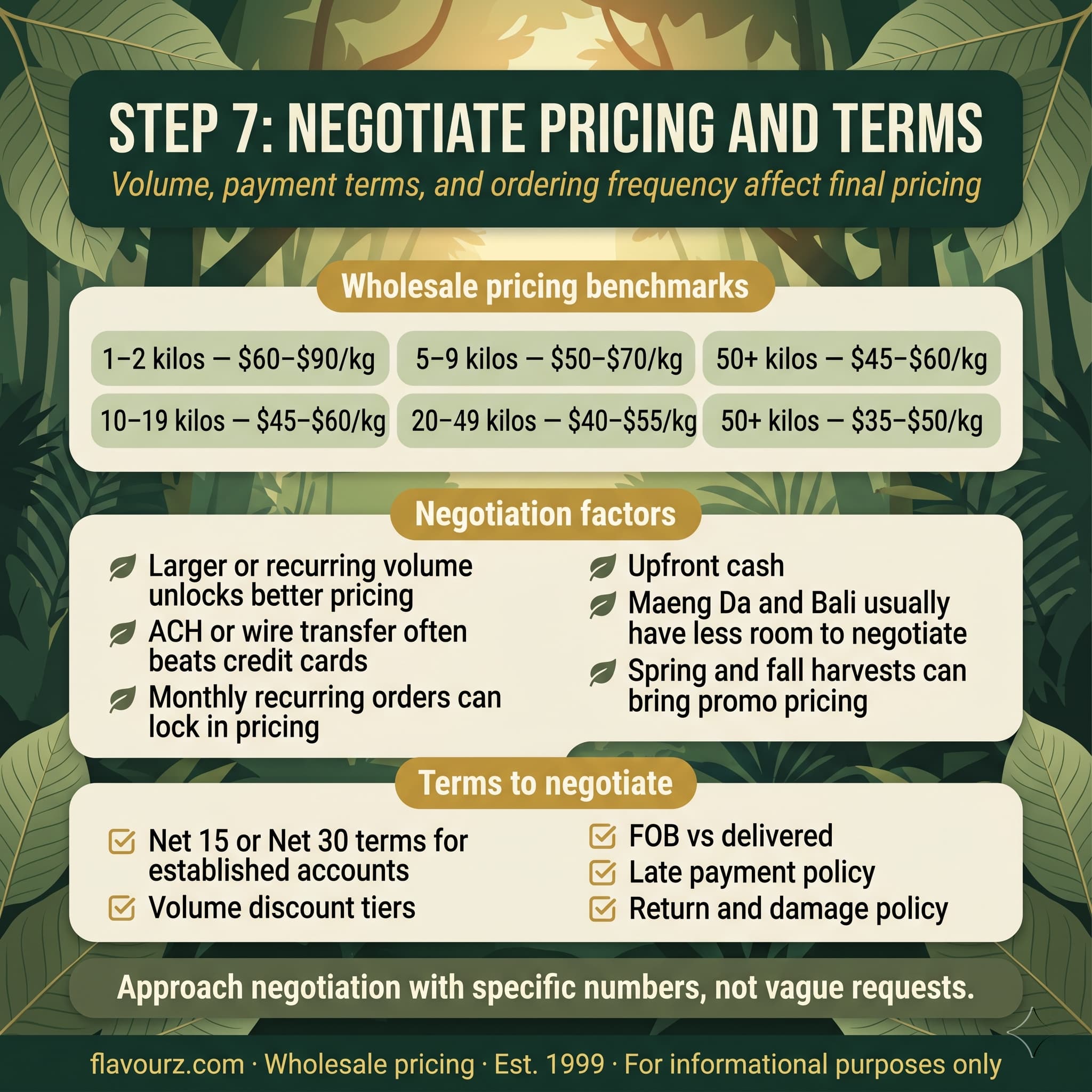
Pricing isn't fixed in wholesale kratom. Volume commitments, payment terms, and ordering frequency all affect final pricing. Approach negotiation with specific information rather than vague requests.
Wholesale pricing benchmarks:
| Order Size | Price/Kilo | Per Gram |
|---|---|---|
| 1-2 kilos | $60-$90 | $0.06-$0.09 |
| 5-9 kilos | $50-$70 | $0.05-$0.07 |
| 10-19 kilos | $45-$60 | $0.045-$0.06 |
| 20-49 kilos | $40-$55 | $0.04-$0.055 |
| 50+ kilos | $35-$50 | $0.035-$0.05 |
Negotiation factors that affect pricing:
- Volume commitments: Larger or recurring orders unlock better pricing
- Payment terms: ACH or wire transfer typically gets better pricing than credit cards
- Order frequency: Monthly recurring orders qualify for locked-in pricing
- Cash payment discounts: Some suppliers offer 2-3% for upfront payment
- Strain selection: Popular strains (Maeng Da, Bali) typically have less negotiation room than less common varieties
- Seasonality: Spring and fall harvests often bring promotional pricing
Payment terms to negotiate:
- Net 15 or Net 30 terms (for established accounts)
- Volume discount tiers
- Shipping cost arrangements (FOB vs delivered pricing)
- Late payment policies
- Return and damage policies
Step 8: Place a Small Initial Order
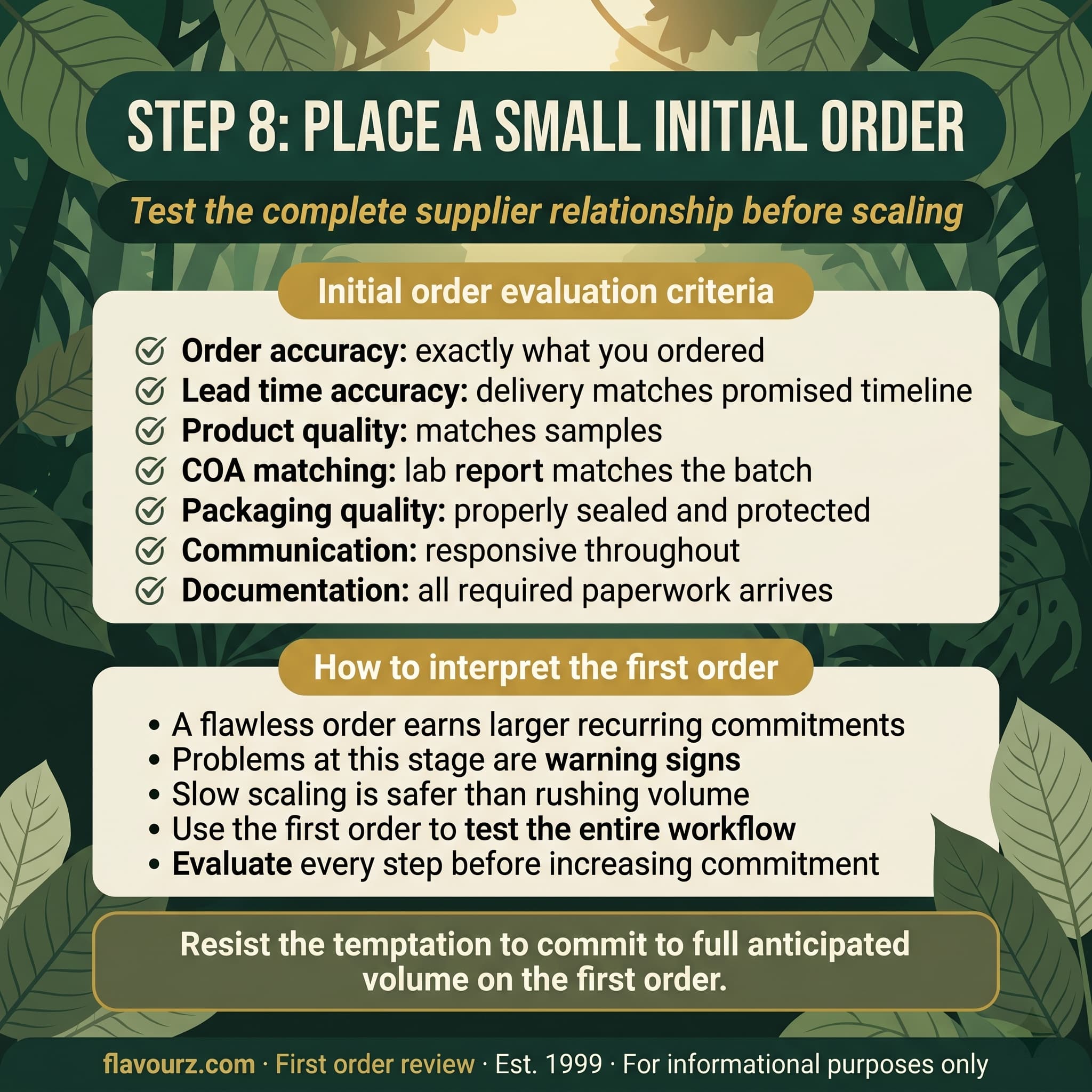
Resist the temptation to commit to your full anticipated volume on the first order. Place a small initial order that tests the complete supplier relationship without major financial exposure.
Initial order evaluation criteria:
- Order accuracy: Did you receive exactly what you ordered?
- Lead time accuracy: Did delivery match the promised timeline?
- Product quality: Does the delivered product match samples?
- COA matching: Does the lab report match the actual batch?
- Packaging quality: Is product properly sealed and protected?
- Communication: Was the supplier responsive throughout?
- Documentation: Did all required paperwork arrive?
A flawless initial order earns the supplier larger recurring commitments. Problems at this stage are warning signs that should slow your scaling decisions.
Step 9: Build Long-Term Partnerships
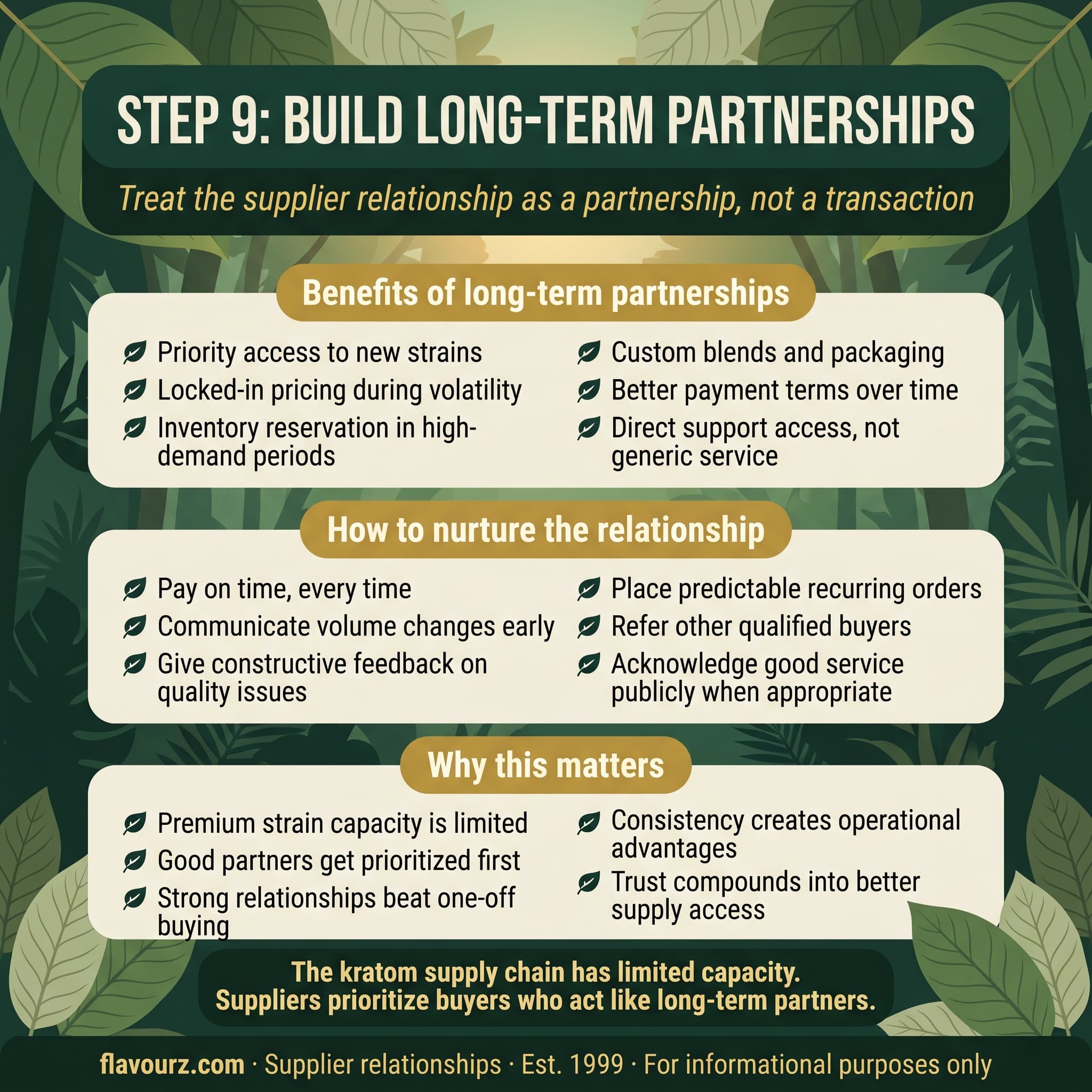
Established supplier relationships deliver value beyond pricing. Long-term partnerships create operational advantages that one-off purchases can't match.
Benefits of long-term partnerships:
- Priority access to new strains: First pick when limited harvests arrive
- Locked-in pricing: Protection from market volatility
- Inventory reservation: Guaranteed supply during high-demand periods
- Custom product development: Tailored blends and packaging
- Payment terms expansion: Better terms as trust develops
- Direct support access: Personal contact rather than generic customer service
How to nurture supplier relationships:
- Pay on time, every time
- Communicate volume changes early
- Provide constructive feedback on quality issues
- Place predictable, recurring orders
- Refer other qualified buyers
- Acknowledge good service publicly when appropriate
The kratom supply chain has limited capacity, especially for premium strains. Suppliers prioritize partners who treat the relationship as a partnership rather than a transaction.
Red Flags to Avoid
Some supplier behaviors indicate problems before you commit. Walk away when you see:
- Refusal to provide COAs: Without lab documentation, you can't verify quality
- No business credentials required: Indicates the supplier sells to anyone, including unqualified resellers
- Pressure tactics: "Limited time" or "buy now" pressure on bulk orders is suspicious
- Unclear sourcing: "Premium Asian kratom" without specific farm relationships
- Pricing too good to be true: Significantly below market rates often indicates quality compromises
- Poor communication: Delayed or evasive responses to detailed questions
- No physical address: Or only PO Box addresses
- No return policy: Confident suppliers offer reasonable return options
- Cash-only or crypto-only payment: Limits your legal recourse
- Inconsistent batch testing: Quality variation between batches indicates poor process control
Legal Compliance Requirements
Wholesale kratom operations must verify compliance at multiple levels:
Federal level:
- FDA notifications (kratom is not FDA-approved but is federally legal)
- Import/export documentation if dealing with international suppliers
- Proper labeling requirements per 21 CFR 111
State level:
- Verify kratom is legal in your operating state
- Six states currently restrict kratom: Alabama, Arkansas, Indiana, Rhode Island, Vermont, Wisconsin
- Some states have age restrictions (21+ standard)
- State-specific labeling requirements may apply
Local level:
- City and county regulations vary widely
- Some municipalities ban kratom while their state allows it
- Business license requirements specific to kratom retail
Consult our kratom legality by state guide for current regulatory information. Always verify local regulations with your business attorney before establishing operations.
Logistics and Shipping Considerations
Shipping logistics affect both cost and reliability. Understand these arrangements before finalizing supplier relationships:
Shipping options:
- UPS Ground: 3-5 day domestic delivery, standard for most orders
- UPS 2nd Day Air: 2-day delivery for time-sensitive orders
- UPS Next Day Air: Premium for emergency restocking
- USPS Priority: Often cheaper for smaller orders
- LTL Freight: Cost-effective for large orders (typically 250+ lbs)
- Full truckload: For maximum-volume operations
Shipping cost considerations:
- FOB pricing (you pay shipping) vs Delivered pricing (shipping included)
- Free shipping thresholds (typically $50-$100 minimum)
- Volume-based shipping discounts
- Geographic shipping restrictions or surcharges
- Insurance coverage on shipments
Inventory Management Best Practices
Once you've established supplier relationships, proper inventory management maximizes the value of wholesale purchasing:
Storage requirements:
- Cool, dry environment (avoid temperature extremes)
- Climate control to maintain consistent humidity
- Light protection (UV degrades alkaloids)
- Vacuum-sealed or properly sealed bags
- FIFO (First In, First Out) inventory rotation
Freshness windows:
- Properly stored kratom maintains potency 6-12 months
- Order quantities you'll move within this window
- Premium strains may have shorter freshness windows
- Track harvest dates and batch numbers
Strain rotation:
- Stock multiple strains to prevent customer tolerance buildup
- Maintain inventory in popular strains (60% of stock)
- Reserve 20% for emerging or rotating strains
- Keep 20% safety stock for supply disruptions
Building Brand Through Supplier Selection
Your supplier choices affect your brand positioning more than you might realize. Customers eventually figure out which retailers sell quality kratom and which don't.
Brand-building supplier characteristics:
- AKA GMP certified (verifiable quality marker)
- Transparent sourcing (Indonesian farm partnerships)
- Established track record (years in operation)
- Consistent batch testing
- Recognizable industry presence
Customer trust signals:
- Display supplier AKA certification information
- Provide batch COAs to customers upon request
- Maintain consistent strain quality across orders
- Train staff on strain effects and proper dosing
- Develop educational content about responsible use
Frequently Asked Questions
How do I find legitimate kratom wholesale suppliers?
Start with the AKA GMP Qualified Vendors database. Cross-reference suppliers across multiple platforms, check business credentials, verify lab testing, and request samples before committing to large orders.
What's the minimum order for wholesale kratom?
Most legitimate suppliers require 1-10 kilograms minimum. Higher volume tiers (50+ kilos) unlock the best pricing. Some suppliers offer flexible arrangements for established accounts.
Do I need a business license to buy wholesale kratom?
Yes. Most legitimate suppliers require a business license, reseller permit, EIN, and business banking account. Suppliers who don't verify business credentials are red flags.
How do I verify kratom quality before bulk purchasing?
Request batch-specific Certificates of Analysis (COAs) from ISO 17025-accredited labs. Verify alkaloid content, heavy metals, and microbial testing results. Always test samples before committing to large orders.
What payment terms can I expect from wholesale suppliers?
New accounts typically require payment upfront. Established accounts may qualify for Net 15 or Net 30 terms. ACH, wire transfers, and some credit cards are accepted. Crypto payment is offered by some suppliers.
How long do wholesale supplier relationships take to develop?
Quality relationships develop over 3-6 months of consistent ordering. Long-term partnerships (2+ years) unlock the best pricing, priority access, and custom services.
Should I work with multiple wholesale suppliers?
Yes. Most established retailers work with 2-3 suppliers for different needs. Primary supplier for core strains, secondary for specialty products, backup for supply disruptions.
How do I handle quality issues with wholesale orders?
Document issues immediately with photos and COA discrepancies. Contact the supplier within their stated return window (typically 30 days). Confident suppliers honor reasonable quality complaints.
Recommended Wholesale Partners
For established wholesale partnerships, Flavourz Kratom offers 25 years of Indonesian sourcing experience through our wholesale program. We support retailers across powder, capsules, and extracts with custom packaging and private label options.
For complete vendor comparisons, see our best kratom brands 2026 guide or Bulk Kratom Now wholesale review. For pricing benchmarks, check our 2026 kratom pricing guide.
Final Thoughts
Sourcing wholesale kratom successfully comes down to systematic process rather than luck. Define your requirements clearly, evaluate suppliers methodically, verify quality through documentation, place small initial orders, and build relationships over time. The retailers who follow this process consistently outperform those who chase the lowest prices.
The kratom industry's maturation has created legitimate wholesale opportunities at multiple price points. AKA certification, lab testing, and established Indonesian sourcing relationships are no longer rare. The information to evaluate suppliers is publicly available. The supplier diversity provides options for every operational scale.
Choose suppliers whose business practices align with how you want your retail operation to operate. The supplier relationships you build today determine the brand reputation you'll have in 3-5 years.
Disclaimer: Kratom is not FDA approved for any medical use. These statements have not been evaluated by the Food and Drug Administration. This product is not intended to diagnose, treat, cure, or prevent any disease. Consult a healthcare provider before use. Intended for adults 21 and older. Kratom is federally legal but restricted in Alabama, Arkansas, Indiana, Rhode Island, Vermont, and Wisconsin. Verify state and local laws, business licensing, and regulatory requirements before establishing wholesale operations.

Leave a comment