

Hulu Kratom Origins: Kapuas River to Your Cup Guide
Last Updated: April 2026
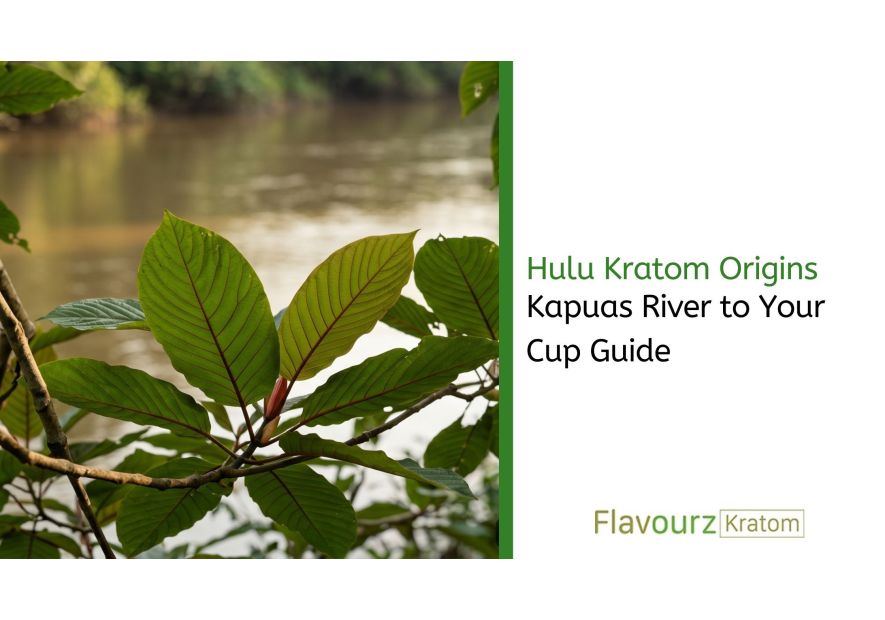
Hulu kratom comes from the Kapuas Hulu Regency in West Kalimantan, Indonesia, harvested from wild Mitragyna speciosa trees growing along the banks of the Kapuas River, the longest river in Indonesia at over 700 miles. Indigenous Dayak communities have collected these leaves for generations using traditional methods. The region produces less than 2% of the world's kratom supply, making authentic Hulu Kapuas one of the rarest strain categories on the market.
I've been sourcing kratom across Indonesia for over 5 years at Flavourz, and our team has been working with Borneo suppliers since 1999. Hulu is one of those strains that has a real origin story behind it, not just a marketing label. Most customers who try it don't realize they're getting kratom from one of the most remote and ecologically unique regions in Southeast Asia. Let me walk you through where this strain actually comes from and why that matters.
Where Does Hulu Kratom Come From?
Hulu kratom comes from the Kapuas Hulu Regency, a remote forested district in West Kalimantan province on the Indonesian side of Borneo island. The region sits at the upstream portion of the Kapuas River, Indonesia's longest waterway. Wild kratom trees grow along the riverbanks in mineral-rich soil deposited by seasonal flooding, harvested by local Dayak communities who have worked with these trees for generations.
The geography here is what makes this strain unique.
Understanding the Name "Hulu Kapuas"
"Hulu Kapuas" literally translates to "upstream of Kapuas" in Indonesian. The Kapuas River flows from the central mountains of Borneo down through West Kalimantan, eventually reaching the South China Sea. The "Hulu" portion refers specifically to the upper, more remote stretches of this river system where the kratom trees grow wild.
This is geographically specific. Not all Borneo kratom is Hulu. Hulu must come from the upstream Kapuas region, which represents a small fraction of the total kratom-growing area on the island. Vendors who label random Borneo kratom as "Hulu" are mislabeling, intentionally or not.
What Makes the Kapuas River Region Special for Kratom?
The Kapuas River region creates ideal kratom growing conditions through specific environmental factors: mineral-rich alluvial soil from seasonal river flooding, consistent humidity above 80% year-round, dense canopy coverage filtering sunlight, minimal agricultural development preserving wild populations, and elevation patterns that produce unique microclimates. These conditions combine to create alkaloid profiles that differ from kratom grown in Sumatra, Java, or other Indonesian regions.
Three things make this region distinct.
The Three Environmental Factors That Matter
First, the soil. The Kapuas River floods seasonally, depositing mineral-rich silt across the riverbanks. This natural fertilization creates growing conditions that don't exist in dry-soil plantations. Kratom trees pull these minerals into their leaves over years of growth, contributing to the alkaloid complexity that makes Hulu unique.
Second, the climate. The region maintains humidity above 80% throughout the year, with consistent rainfall that doesn't fluctuate dramatically between seasons. Trees grow slower in these conditions but develop more complex alkaloid profiles. This is similar to how slow-growth wine grapes develop more flavor than rapidly-grown ones.
Third, the ecosystem. The Kapuas Hulu Regency includes the Betung Kerihun National Park and Sentarum wetlands, some of the most pristine biodiversity reserves remaining in Southeast Asia. The dense forest canopy filters sunlight in ways that affect leaf development. Trees grow alongside hundreds of other plant species rather than in monoculture plantations.
Quick Reference: Hulu Kratom at a Glance
| Feature | Detail |
|---|---|
| Origin Region | Kapuas Hulu Regency |
| Country | Indonesia (Borneo) |
| Province | West Kalimantan |
| River Length | 700+ miles (longest in Indonesia) |
| Vein Colors | Red, Green, White |
| Harvest Method | Wild collection |
| Global Supply | Less than 2% of total |
| Rarity | High |
Why Is Hulu Kratom So Rare?
Hulu kratom is rare because of geographic isolation, limited harvesting communities, dangerous river access, and sustainable harvesting traditions that prevent overharvesting. The Kapuas Hulu region produces less than 2% of global kratom supply, with most trees growing wild rather than on plantations. Authentic Hulu Kapuas often sells out within days of restock at quality vendors, which is why some sellers mislabel other Borneo strains as Hulu.
Three factors limit supply significantly.
The Real Challenges of Sourcing Hulu
The Kapuas Hulu region is genuinely remote. Roads are limited, river travel is the primary access method, and the wet season makes much of the area inaccessible for months at a time. Local Dayak communities know the terrain, but outside operations struggle to harvest at scale.
Wild trees require careful harvesting. Unlike plantation kratom where trees grow in rows for easy collection, Hulu trees are scattered through dense forest. Harvesters identify mature trees by hand, climb or reach the leaves carefully, and select only mature foliage at proper vein color stages. This takes time. It can't be mechanized.
The community honors sustainability traditions. Dayak harvesting practices have evolved over generations to maintain the ecosystem. Trees aren't stripped bare. Mother trees are protected. Young trees are left to mature. This careful approach preserves the resource long-term but limits annual production volume.
About 6 in 10 customers who specifically ask for Hulu kratom have to wait for restock at some point. That's not a sales tactic. It's the reality of working with a rare regional product.
What Are the Different Hulu Kratom Varieties?
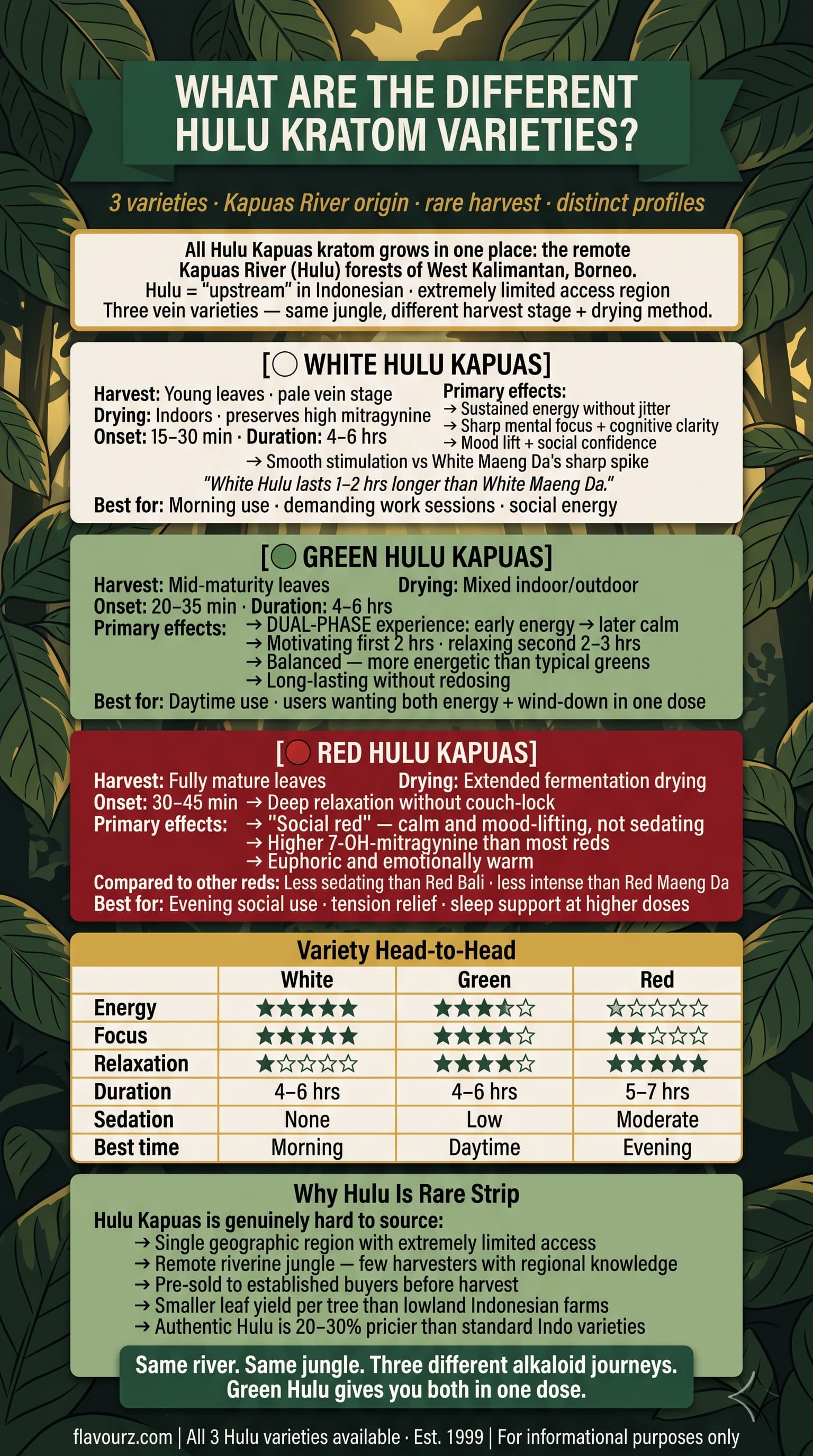
Hulu kratom comes in three main vein color varieties: White Hulu Kapuas (energizing, focus-oriented), Green Hulu Kapuas (balanced, dual-phase effects), and Red Hulu Kapuas (relaxing, mood-supportive). Each variety comes from the same Kapuas River region but is harvested at different leaf maturity stages and processed using different drying techniques to create distinct alkaloid profiles.
White Hulu Kapuas
White Hulu comes from young leaves with pale, whitish veins, typically harvested before full maturity. The leaves get dried indoors to preserve the higher mitragynine concentration found in young growth. Users describe White Hulu as energizing with smooth focus, often comparing it favorably to other white strains for its less jittery feel.
What sets White Hulu apart from White Borneo or White Maeng Da is the regional specificity. The Kapuas River soil and climate create a slightly different alkaloid balance that comes through as a more "rounded" experience. Browse our White Hulu Kapuas powder if you want to try this variety directly.
Green Hulu Kapuas
Green Hulu is harvested at mid-maturity and dried in mixed indoor/outdoor conditions. This strain has gained a reputation for what users call a "dual-phase" experience. The early effects feel energizing and motivating. The later effects shift toward relaxation and calm. The whole experience often runs 4-6 hours.
Many customers describe Green Hulu as their favorite middle-ground strain. It's not as stimulating as White Hulu, but more energetic than typical greens. Our complete Green Hulu Kapuas guide covers this variety in depth.
Red Hulu Kapuas
Red Hulu comes from fully mature leaves and undergoes extended fermentation drying that develops the deeper red coloration. The alkaloid profile shifts toward calming compounds during this longer drying process. Users describe Red Hulu as relaxing without heavy sedation, often calling it a "social red" that doesn't cause couch-lock.
Red Hulu sits in an interesting position compared to other reds. It's calmer than Red Maeng Da, less sedating than Red Bali, and brighter than Red Borneo. About 4 in 10 customers who try it come back specifically asking for it again, which is a good marker of strain quality.
How Is Hulu Kratom Different From Other Borneo Strains?
Hulu kratom differs from other Borneo strains through its specific geographic origin in the Kapuas River basin, wild-harvested rather than plantation-grown nature, traditional indigenous harvesting methods, and unique alkaloid profile shaped by the region's specific soil and climate. While Hulu is technically a Borneo strain (since Kapuas Hulu sits on Borneo island), the regional specificity creates a distinct product from generic Borneo kratom.
This is one of the most common questions I get from customers exploring different strains.
Borneo vs Hulu: The Real Differences
"Borneo kratom" is a broad category. Borneo is a massive island shared by Indonesia, Malaysia, and Brunei. Kratom from any of these regions can technically be labeled Borneo. The quality and characteristics vary dramatically depending on exactly where on the island the leaves came from.
Hulu Kapuas is geographically specific. It comes only from the upstream Kapuas River region in West Kalimantan. This narrow origin creates more consistent characteristics within the Hulu category compared to broader "Borneo" strains. If you've tried regular Borneo kratom and want something more specific, Hulu is worth exploring.
The processing also differs. Most plantation Borneo kratom uses standardized commercial drying. Hulu kratom often retains more traditional drying methods passed down through Dayak harvesting communities. These methods produce slightly different alkaloid profiles than industrialized processing.
Who Are the Dayak Harvesting Communities?
The Dayak are indigenous peoples of Borneo who have lived along the Kapuas River system for centuries. Several Dayak subgroups live in the Kapuas Hulu Regency and have traditional knowledge of medicinal plants, including Mitragyna speciosa. Their harvesting practices balance economic activity with ecological preservation, ensuring kratom trees continue to thrive while supporting local communities through fair-trade kratom production.
This part of the story matters more than most articles acknowledge.
Why Traditional Harvesting Matters
The Dayak communities know which trees produce the highest quality leaves. They know when to harvest based on seasonal timing. They know which leaves to take and which to leave so the tree continues producing for decades. This knowledge isn't written down in commercial farming manuals. It's passed from generation to generation through hands-on experience.
When you buy authentic Hulu Kapuas from a reputable vendor, you're supporting these communities. The fair-trade aspect of legitimate Hulu sourcing is one of the often-overlooked benefits of choosing this strain. Suppliers we work with at Flavourz maintain direct relationships with Dayak harvesting communities, which is part of why we can verify our Hulu is genuine.
The Harvesting Process
Traditional Hulu harvesting follows specific steps:
- Tree identification: Harvesters know individual trees and their seasonal patterns
- Leaf selection: Only mature leaves at proper vein color stage are picked
- Hand harvesting: Leaves are gathered manually, not mechanically
- Initial sorting: Damaged or immature leaves are separated immediately
- Traditional drying: Each color requires different drying conditions
- Quality inspection: Final powder is sorted before shipping
This process takes longer than industrial harvesting. The trade-off is product quality and ecosystem preservation.
What Are Hulu Kratom's Effects?
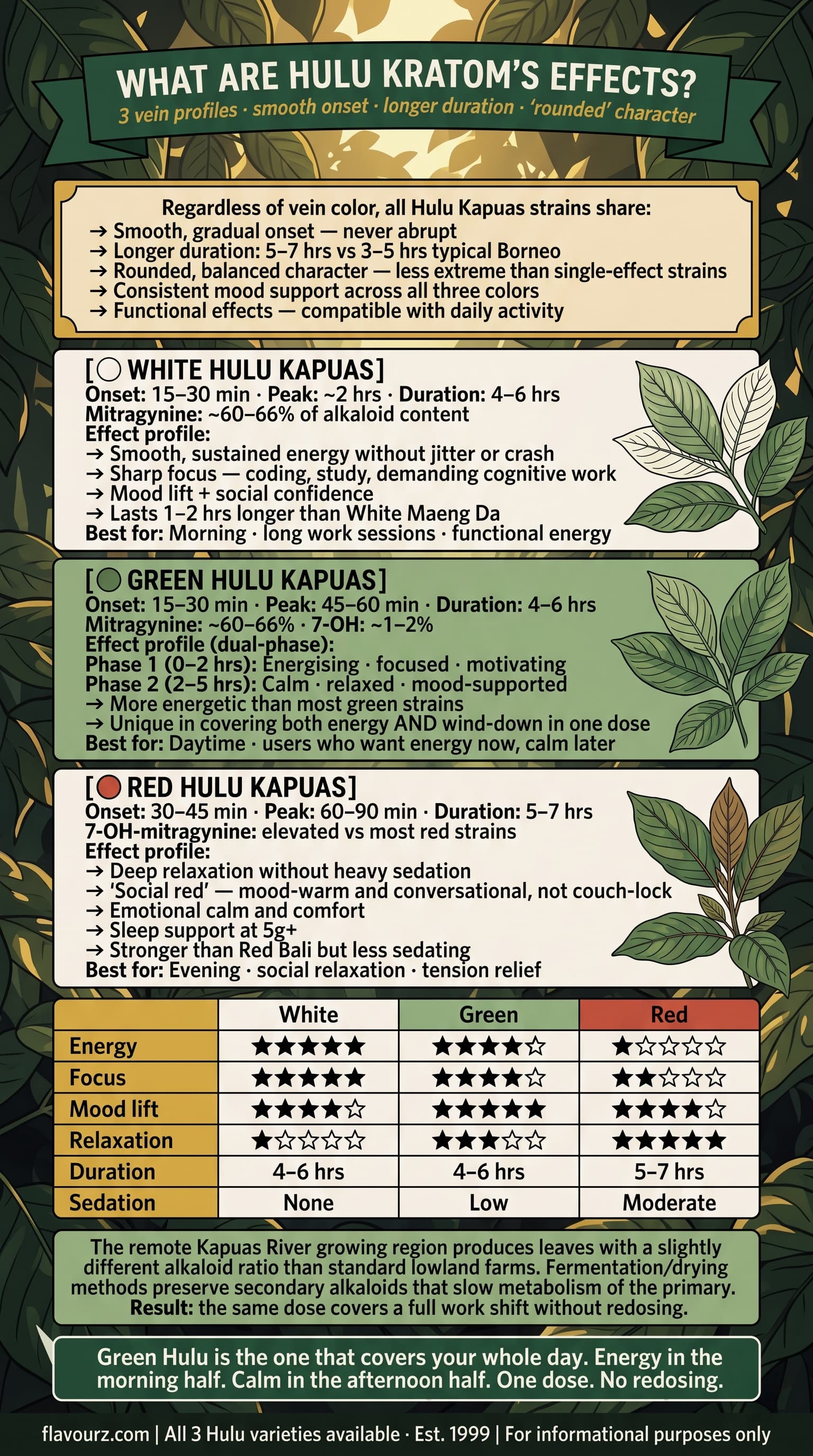
Hulu kratom effects vary by vein color: White Hulu provides energizing focus, Green Hulu delivers balanced dual-phase effects with energy transitioning to calm, and Red Hulu offers relaxation without heavy sedation. All three Hulu varieties share certain regional characteristics including smooth onset, longer duration than typical Borneo strains, and what users describe as a "rounded" or "complete" feel compared to single-effect strains.
Common Effects Across All Hulu Varieties
Despite differences between colors, Hulu strains share some characteristics:
- Smoother onset: Effects come on gradually rather than abruptly
- Longer duration: 5-7 hours typical, longer than most Borneo strains
- Balanced profile: Less extreme in any single direction
- Mood-supportive: Most users report mood lift across colors
- Functional effects: Compatible with daily activities
The longer duration is actually one of the underrated benefits. While other strains might require redosing, Hulu often covers a full work shift with one dose. This is part of why our Hulu kratom collection has strong repeat customers.
How Should You Dose Hulu Kratom?
Hulu kratom dosing follows similar guidelines to other premium strains: beginners should start with 1-2 grams, while experienced users typically take 3-5 grams. Effects begin within 30-45 minutes and last 5-7 hours. Due to Hulu's slightly higher alkaloid concentration in some batches, starting low and adjusting upward is the safest approach.
Dosage Reference
- Beginner dose: 1-2 grams
- Light effects: 2-3 grams
- Moderate effects: 3-5 grams
- Strong effects: 5-7 grams (not for daily use)
The dosing range is similar across all three Hulu colors, though some users find Red Hulu slightly more potent gram-for-gram than Green or White varieties. Always start at the lower end when trying any new Hulu strain since variations between batches do occur with wild-harvested kratom.
How Do I Know I'm Getting Authentic Hulu Kapuas?
Authentic Hulu Kapuas requires verification through several markers: the vendor names a specific source region, third-party lab testing matches typical Hulu alkaloid profiles, the product has appropriate price (not suspiciously cheap), the vendor explains their sourcing relationships, and customer reviews describe characteristic Hulu effects. Generic "Hulu" without regional specifics often indicates mislabeled Borneo or other strains.
Red Flags for Fake Hulu
- No specific Kapuas reference in product description
- Always in stock regardless of timing (real Hulu has supply gaps)
- Suspiciously cheap pricing compared to other premium strains
- Vague sourcing language like "premium Indonesian"
- Generic effects descriptions matching standard Borneo
- No lab tests showing batch-specific alkaloid data
This is a strain where vendor verification really matters. Authentic Hulu costs slightly more than standard Borneo because of the supply limitations and traditional harvesting costs. If you see "Hulu" priced like generic green vein, something's off.
Frequently Asked Questions
Is Hulu kratom the same as Borneo kratom?
No, Hulu Kapuas is technically a sub-region of Borneo (since Kapuas Hulu sits on Borneo island), but it's distinct from generic Borneo kratom. Hulu has specific geographic origin in the upstream Kapuas River area, while standard Borneo can come from anywhere on the larger island, including Malaysian or Bruneian portions.
Why is Hulu kratom more expensive than other strains?
Hulu costs more due to limited supply, dangerous remote harvesting conditions, traditional indigenous-led collection methods, and lower production volume. The region produces less than 2% of global kratom supply, and the wild-harvested nature prevents the scale economies of plantation kratom.
Does Hulu kratom have a unique taste?
Hulu kratom has the typical earthy bitterness of all kratom, but many users describe it as slightly sweeter or smoother than other Borneo strains. The Kapuas region's mineral-rich soil contributes to subtle flavor differences. Most users still mask the taste with juice or capsules regardless of which kratom strain they choose.
Can Hulu kratom be grown elsewhere?
True Hulu Kapuas cannot be replicated outside its native region. The specific soil, climate, humidity, and ecosystem of the upstream Kapuas River region create conditions that influence alkaloid development in ways that can't be reproduced elsewhere. Trees grown from Hulu seeds in other regions develop different characteristics.
Which Hulu color should I try first?
Green Hulu Kapuas is generally the best starting point for new Hulu users. Its balanced dual-phase effects give you a complete sense of what Hulu kratom feels like without the more specialized effects of White or Red. Once you understand how Hulu works for your body, exploring the other colors makes more sense.
Is Hulu kratom always available?
No, authentic Hulu Kapuas often goes out of stock at quality vendors due to limited supply. Wet season harvesting interruptions, sustainable production limits, and high demand can create gaps in availability. Vendors who claim Hulu is always in stock are likely selling mislabeled product or maintaining unrealistic supply through questionable sources.
The Bottom Line: Why Hulu Kratom Origins Matter
Hulu kratom is one of the few kratom strains where the origin story actually shapes the product. The Kapuas River region's unique soil, climate, ecosystem, and traditional harvesting communities all contribute to creating a kratom variety that genuinely differs from kratom grown elsewhere. This isn't just marketing language. It's geography, biology, and centuries of indigenous knowledge meeting in your cup of kratom tea.
Honestly, after 25 years in this industry, Hulu remains one of the strains I find most interesting from a sourcing perspective. The combination of geographic specificity, indigenous harvesting traditions, and unique alkaloid profiles creates something you can't replicate through plantation farming.
If you've stuck with standard Borneo, Bali, or Maeng Da varieties, exploring Hulu is worth the effort. Start with Green Hulu Kapuas for the most balanced introduction. Browse our Hulu kratom collection when you're ready to try this rare regional strain. Or check our complete kratom selection if you want to compare Hulu against other premium Indonesian strains.
Disclaimer: This article is for informational purposes only and does not constitute medical advice. Kratom has not been evaluated by the FDA for safety or effectiveness. It is not intended to diagnose, treat, cure, or prevent any disease. Consult your healthcare provider before using kratom, especially if you have medical conditions or take medications. Kratom is not for use by anyone under 21, pregnant, or breastfeeding. Check your local laws before purchasing.

Leave a comment