

Kratom Banned States List 2026: Complete Legal Guide
Last Updated: April 2026
Kratom's legal status in the United States is a moving target right now, and April 2026 is one of the more significant moments in that story. Rhode Island just reversed a decade-long ban. Connecticut added itself to the banned list in February. Louisiana's 2025 prohibition is still being challenged in court. If you've been trying to keep track of what's legal where, this guide has everything updated as of this month.
At Flavourz Kratom, we've been monitoring state-level kratom legislation since 1999. We've seen this plant go from zero legal scrutiny to 30+ states having formal regulations. The picture right now is genuinely complicated, so let's break it down clearly.
What States Have Banned Kratom in 2026?
As of April 2026, kratom is fully banned in six states: Alabama, Arkansas, Indiana, Louisiana, Vermont, and Wisconsin. Washington D.C. also prohibits kratom. Connecticut designated kratom as a Schedule I controlled substance in February 2026, making it the seventh jurisdiction to impose a full ban. Rhode Island reversed its ban as of April 1, 2026 under the new Rhode Island Kratom Act.
In these jurisdictions, possessing, selling, or distributing kratom can result in criminal charges comparable to other controlled substances. Louisiana's ban, which took effect August 1, 2025, carries among the harshest penalties: up to five years in prison and $50,000 in fines for distribution.
Complete State-by-State Kratom Legal Status (April 2026)
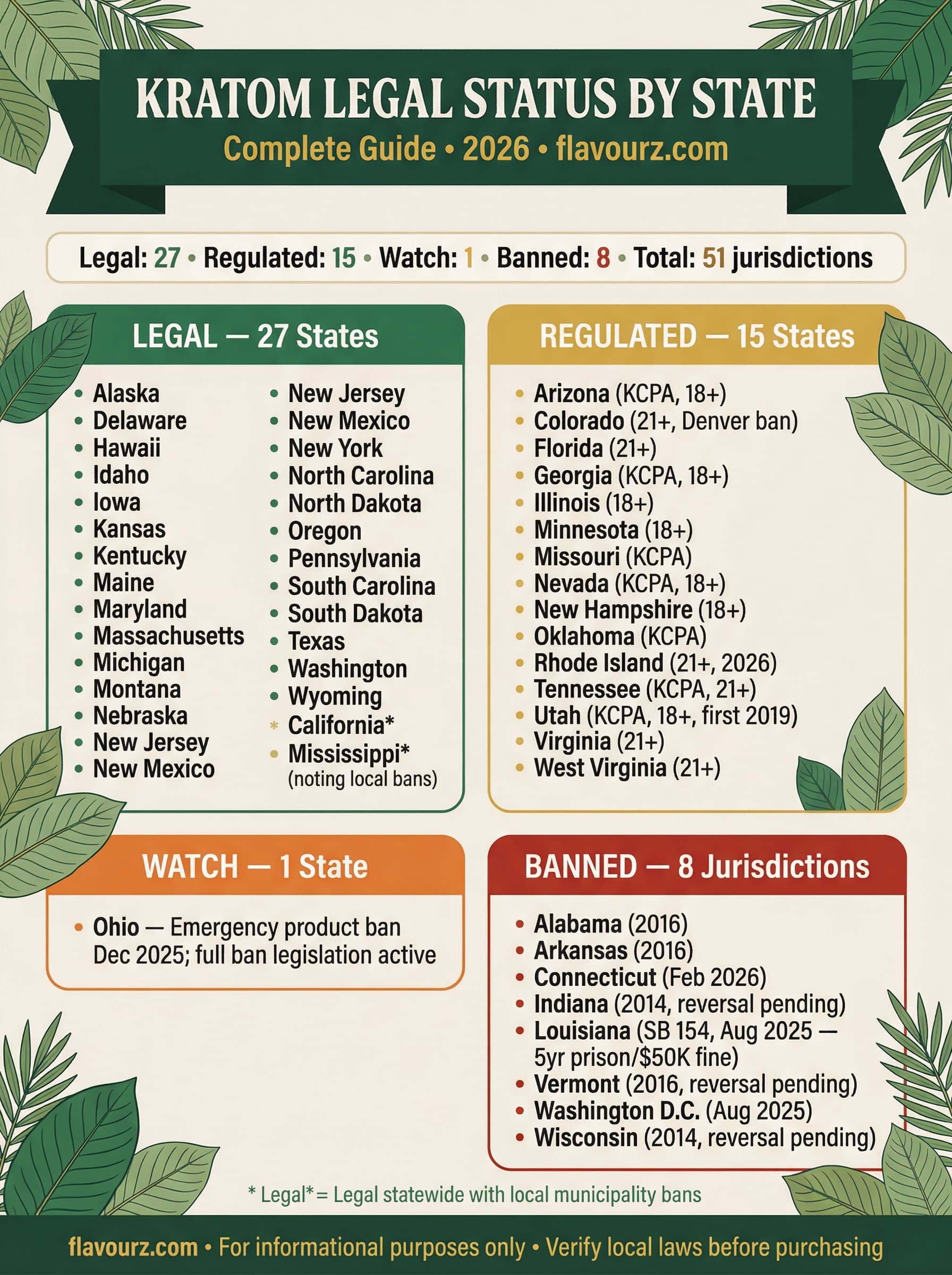
The table below reflects the most current legal status for all 50 states based on available legislative data. "Regulated" means kratom is legal with age restrictions and/or product standards in place. "Legal" means no specific kratom law exists but possession and sale are permitted. "Banned" means possession, sale, or use is a criminal offense.
| State | Status | Key Notes |
|---|---|---|
| Alabama | Banned | Banned since 2016; alkaloids listed as Schedule I |
| Alaska | Legal | No statewide restrictions |
| Arizona | Regulated | KCPA enacted; legal 18+; 7-OH capped at <2% |
| Arkansas | Banned | Schedule I controlled substance since 2016 |
| California | Legal* | Legal statewide; banned locally in San Diego & Oceanside |
| Colorado | Regulated | Legal 21+; banned for human consumption in Denver |
| Connecticut | Banned | Designated Schedule I in February 2026 |
| Delaware | Legal | No specific kratom legislation |
| Florida | Regulated | Legal 21+; banned in Sarasota County |
| Georgia | Regulated | KCPA enacted; legal 18+ |
| Hawaii | Legal | No specific kratom legislation |
| Idaho | Legal | No specific kratom legislation |
| Illinois | Regulated | Legal 18+; banned in Jerseyville |
| Indiana | Banned | Banned since 2014 as synthetic controlled substance; reversal bill pending |
| Iowa | Legal | Ban bill did not pass |
| Kansas | Legal | No specific kratom legislation |
| Kentucky | Legal | No statewide ban |
| Louisiana | Banned | Banned August 1, 2025 (SB 154); up to 5 years prison, $50K fine |
| Maine | Legal | No specific kratom legislation |
| Maryland | Legal | Regulation bill under review |
| Massachusetts | Legal | No specific kratom legislation |
| Michigan | Legal | Regulation bill under review |
| Minnesota | Regulated | Legal 18+ |
| Mississippi | Legal* | Legal statewide; banned in Union County |
| Missouri | Regulated | KCPA enacted |
| Montana | Legal | No specific kratom legislation |
| Nebraska | Legal | No specific kratom legislation |
| Nevada | Regulated | KCPA enacted; legal 18+ |
| New Hampshire | Regulated | Legal 18+ |
| New Jersey | Legal | No specific kratom legislation |
| New Mexico | Legal | No specific kratom legislation |
| New York | Legal | Legal statewide; local discussions ongoing |
| North Carolina | Legal | No specific kratom legislation |
| North Dakota | Legal | No specific kratom legislation |
| Ohio | Watch | 180-day emergency ban on certain products issued Dec. 2025; full ban legislation active |
| Oklahoma | Regulated | KCPA enacted |
| Oregon | Legal | No specific kratom legislation |
| Pennsylvania | Legal | Regulation bill under review |
| Rhode Island | Regulated | Ban reversed April 1, 2026 via RI Kratom Act; legal 21+ |
| South Carolina | Legal | No specific kratom legislation |
| South Dakota | Legal | No specific kratom legislation |
| Tennessee | Regulated | KCPA enacted; legal 21+ |
| Texas | Legal | No statewide ban |
| Utah | Regulated | KCPA enacted; legal 18+; first state to pass KCPA (2019) |
| Vermont | Banned | Banned since 2016; reversal bill pending |
| Virginia | Regulated | Legal 21+ |
| Washington | Legal | No specific kratom legislation |
| Washington D.C. | Banned | Banned August 2025 |
| West Virginia | Regulated | Legal 21+ |
| Wisconsin | Banned | Banned since 2014; reversal bill pending |
| Wyoming | Legal | No specific kratom legislation |
*Local restrictions may apply. Always verify county and city ordinances before purchasing.
States Where Kratom Is Fully Banned (April 2026)
Here's the current banned list at a glance. These are jurisdictions where kratom possession, sale, and use can result in criminal charges:
- Alabama — Banned since 2016; kratom alkaloids classified as Schedule I
- Arkansas — Banned since 2016; listed as Schedule I controlled substance
- Connecticut — Newly banned in February 2026; seventh jurisdiction to impose full ban
- Indiana — Banned since 2014 as a synthetic controlled substance; reversal bill currently pending
- Louisiana — Banned August 1, 2025 (SB 154); harshest penalties in the country
- Vermont — Banned since 2016; reversal bill pending
- Wisconsin — Banned since 2014; reversal bill pending
- Washington D.C. — Banned August 2025
If you're in one of these states, purchasing, possessing, or using kratom puts you at legal risk. Ordering kratom online for delivery to a banned state is also illegal, regardless of where the vendor is located.
For specific guidance on two of the longest-running bans, read our detailed breakdowns on kratom in Arkansas and kratom legal status in Indiana.
The Big Story: Rhode Island Reverses Its Ban
Rhode Island made history in 2025 by becoming the first U.S. state to reverse a kratom ban. The state's governor signed the Rhode Island Kratom Act in July 2025 after kratom had been classified as a Schedule I substance since 2017. The new law took effect April 1, 2026 and regulates rather than prohibits kratom, with sales restricted to adults 21 and older.
This is significant because it's the first proof of concept for kratom ban reversal in the United States. Indiana, Vermont, and Wisconsin all have active reversal bills in their legislatures right now, and advocates are pointing to Rhode Island as a model. The American Kratom Association (AKA) has been instrumental in supporting these legislative efforts and continues to push for KCPA adoption nationwide.
Is Kratom Legal at the Federal Level?
Yes, kratom is legal at the federal level in the United States as of April 2026. The DEA proposed scheduling kratom as a Schedule I substance in 2016 but withdrew the proposal after significant public opposition. The DEA currently lists kratom as a "substance of concern" but has not scheduled it under the Controlled Substances Act. State laws govern kratom legality independently.
The FDA maintains that kratom is not lawfully marketed as a drug, dietary supplement, or food additive, which is why kratom cannot be sold with health claims. But the FDA has not criminalized possession or purchase, leaving enforcement to state and local governments. That federal ambiguity is exactly why the patchwork of state laws exists.
What Is the Kratom Consumer Protection Act?
The Kratom Consumer Protection Act (KCPA) is a model legislation framework developed by the American Kratom Association that regulates kratom rather than banning it. States that pass the KCPA set age limits (usually 18 or 21), require product labeling with alkaloid content, ban adulterated or synthetic kratom, and mandate third-party lab testing.
As of April 2026, states with active KCPA laws include Utah (the first, since 2019), Arizona, Georgia, Nevada, Oklahoma, Missouri, and others. Tennessee, Virginia, and Colorado have age-restriction laws that follow similar principles even without a formal KCPA label. The KCPA approach is gaining ground because it addresses the legitimate safety concerns about product quality without criminalizing users.
According to the Legislative Analysis and Public Policy Association (LAPPA), as of January 2026, 30 states and the District of Columbia have some form of kratom regulation, a significant increase from just a few years ago when most states had no kratom-specific laws at all.
States With Local Kratom Bans (Legal Statewide But Restricted Locally)
Even in states where kratom is legal, some cities and counties have imposed their own local bans. Always check local ordinances, not just state law, before buying or traveling with kratom.
- California: Legal statewide; banned in San Diego and Oceanside
- Colorado: Legal statewide 21+; banned for human consumption in Denver
- Florida: Legal statewide 21+; banned in Sarasota County
- Illinois: Legal statewide 18+; banned in Jerseyville
- Mississippi: Legal statewide; banned in Union County
For state-specific deep dives, see our guides on is kratom legal in California, is kratom legal in Florida, and is kratom legal in New York.
States to Watch in 2026
Several states have active legislation that could change their kratom status before the end of 2026. These are the ones worth keeping an eye on:
- Ohio: A 180-day emergency ban on certain kratom-related products was issued in December 2025, with a full ban bill currently moving through the legislature
- Indiana: An active bill to reverse the 2014 ban is under legislative consideration
- Vermont: A reversal bill is pending, inspired by Rhode Island's successful KCPA passage
- Wisconsin: Similar reversal efforts are underway, with advocacy groups citing Rhode Island as precedent
- Michigan, Maryland, Pennsylvania: All three have regulation bills under review that could bring KCPA-style laws into effect
Can You Travel Between States With Kratom?
Traveling with kratom across state lines is legal if you're moving between legal states, but crossing into a banned state with kratom in your possession is a criminal offense in that destination state. The origin state's laws don't protect you once you enter a jurisdiction where kratom is banned. If you're driving through a banned state, even in transit, possession can technically result in charges.
The safest approach when traveling is to check every state you'll pass through, not just your destination. If your route takes you through Arkansas, Alabama, Indiana, or any other banned state, leave your kratom at home or ship it separately to your destination if that destination state is legal. When traveling with kratom in legal states, keeping it in its original, labeled packaging helps demonstrate it's a legitimate product.
If you're in a state where kratom is fully legal and want to explore our full lineup, you can buy kratom directly from Flavourz Kratom with confidence. We've been operating since 1999 and only ship to states where kratom is legally permitted.
Frequently Asked Questions
Is kratom a Schedule I drug in the United States?
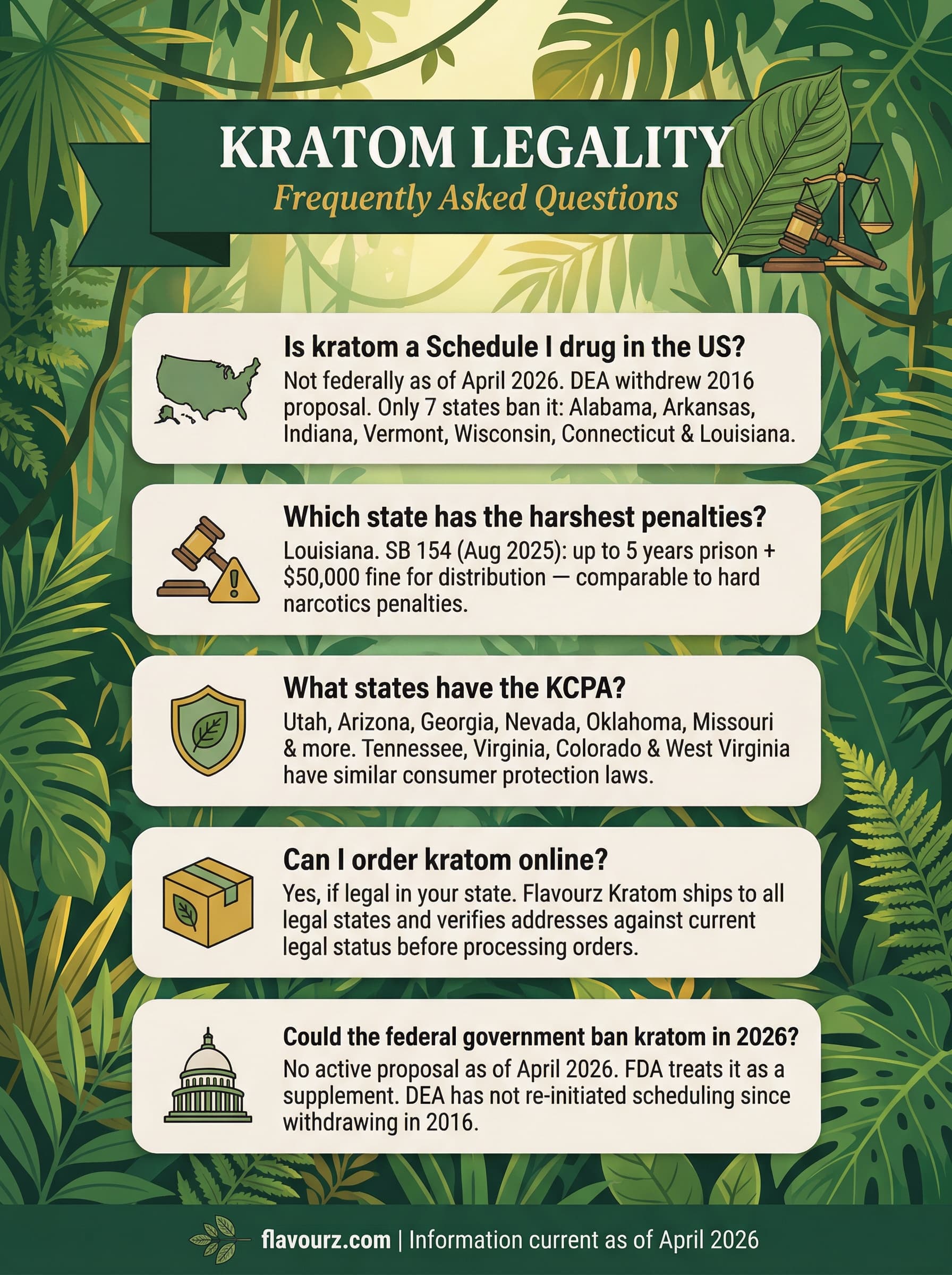
No, kratom is not federally scheduled in the United States as of April 2026. The DEA proposed scheduling it in 2016 but withdrew after public opposition. At the state level, Alabama, Arkansas, Connecticut, Indiana, Louisiana, Vermont, and Wisconsin classify kratom's active alkaloids as Schedule I controlled substances. Most states do not.
Which state has the harshest kratom penalties?
Louisiana currently has the harshest kratom penalties in the U.S. Under SB 154, which took effect August 1, 2025, distribution of kratom carries penalties up to five years in prison and $50,000 in fines. This makes Louisiana's kratom law comparable to penalties for hard narcotics in many other states.
What states have the Kratom Consumer Protection Act?
As of April 2026, states with active KCPA laws include Utah, Arizona, Georgia, Nevada, Oklahoma, Missouri, and others. Tennessee, Virginia, Colorado, West Virginia, and several additional states have age-restriction and product regulation laws following similar principles. The AKA continues to work with legislators to expand KCPA adoption nationwide.
Is it legal to order kratom online and have it shipped to my state?
Yes, if you live in a state where kratom is legal. Online vendors, including Flavourz Kratom, ship to all states where kratom possession and purchase is permitted. Ordering to a banned state is illegal regardless of where the vendor is based. We verify shipping addresses against current legal status before processing orders.
Could the federal government ban kratom in 2026?
There is no active federal scheduling proposal as of April 2026. The FDA continues to regulate kratom as a food/supplement issue rather than a controlled substance issue, and the DEA has not re-initiated scheduling proceedings since withdrawing in 2016. Federal action is possible but not currently imminent based on available legislative signals.
Disclaimer: This article is for informational purposes only and does not constitute legal advice. Kratom laws change frequently. Always verify your state and local laws before purchasing or possessing kratom. Kratom is not FDA-approved and is not intended to diagnose, treat, cure, or prevent any disease or condition.
Last Updated: April 2026 | Flavourz Kratom has served over 10,000 customers since 1999. Shop our full kratom selection here.

Leave a comment