

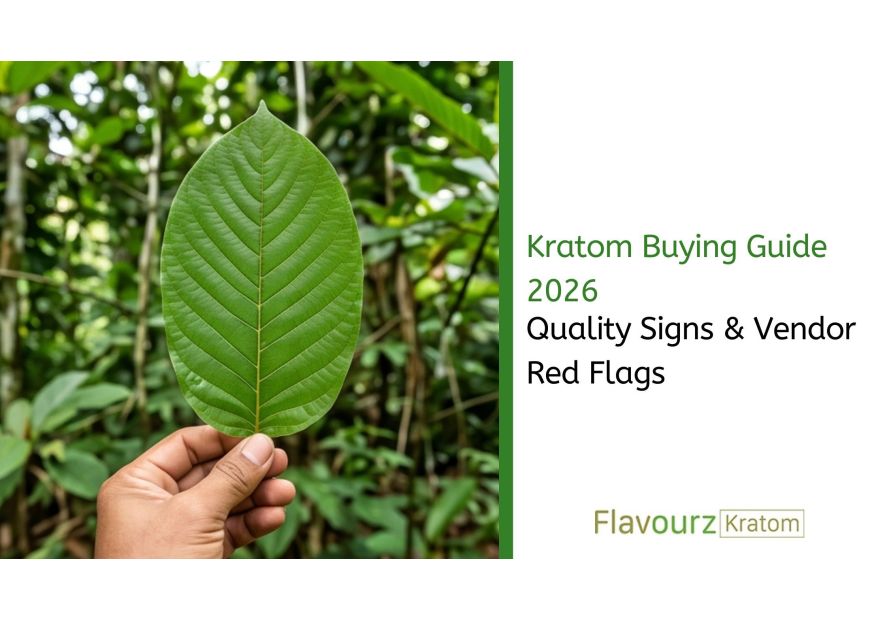
Kratom Buying Guide 2026: Quality Signs & Vendor Red Flags
Last Updated: April 2026
Quality kratom comes from vendors with AKA GMP certification, third-party batch testing, transparent sourcing, published Certificates of Analysis (COAs), and clear customer service. Red flags include suspiciously low prices (under $60/kg), missing lab reports, vague potency claims like "ultra strong," gas station availability, and refusal to share specific test results. Less than 30% of kratom vendors hold AKA certification in 2026, making vendor verification essential before any purchase.
I've watched this industry change a lot since Flavourz Kratom started in 1999. After 25 years and over 10,000 customers, I can tell you with confidence: where you buy your kratom matters more than which strain you pick. A premium strain from a sketchy vendor will disappoint you. An average strain from a reputable vendor with proper testing will work consistently. Let me break down what actually separates quality from junk in 2026.
What Should I Look for When Buying Kratom?
When buying kratom, prioritize five things: AKA GMP certification, current third-party lab testing with batch-specific COAs, transparent sourcing information, mitragynine content between 1.2-1.8%, and responsive customer service. Quality vendors publish lab results openly, explain their sourcing relationships, and stand behind their products with satisfaction guarantees. Skip any vendor missing more than one of these elements.
This isn't a checklist meant to make things harder. It's literally what separates safe kratom from contaminated kratom.
The Five Non-Negotiables
Here's what I tell every customer who asks how to evaluate a new vendor:
- AKA GMP certification: Verified through the American Kratom Association's official list, not just a logo on the website
- Current lab tests: Batch-specific COAs from independent labs, accessible without requesting
- Transparent sourcing: The vendor knows where their leaves came from
- Reasonable pricing: Quality kilos run $80-$150, not $40
- Real customer service: They respond to questions and stand behind orders
Miss any one of these and you're rolling the dice. Miss two or more and you're almost guaranteed to have problems.
How Can I Tell If Kratom Is High Quality?
High-quality kratom shows specific verifiable traits: mitragynine content of 1.2-1.8% on lab reports, fresh green color (not brown or yellowed), fine consistent powder texture, characteristic earthy-bitter smell without mustiness, and recent harvest dates. Lab reports should show heavy metals below safety thresholds, no salmonella or E. coli detection, and consistent alkaloid levels across batches. Quality kratom rarely costs less than $0.10 per gram in bulk.
The visual and physical signs matter, but lab data tells the real story.
Quality Indicators You Can Actually Verify
Per American Kratom Association standards, quality kratom should test within these ranges:
- Mitragynine content: 1.2-1.8% (some premium strains hit 2.0%+)
- Heavy metals: Lead below 0.5 ppm, arsenic below 2.0 ppm
- Microbial safety: "Pass" rating on salmonella, E. coli, mold, and yeast
- Moisture content: Below 12% (higher levels promote spoilage)
- Color: Fresh green to slightly olive, not brown or yellowed
- Texture: Fine, consistent powder without clumping or grit
If a vendor's lab report shows different numbers or skips any of these tests, ask why. A reputable vendor will explain their testing protocol and provide the missing data. A sketchy vendor will give you the runaround.
What Are the Biggest Red Flags When Buying Kratom?
The biggest red flags include vendors selling kratom under $0.05/gram in bulk, no third-party lab testing or hidden COAs, vague potency labels like "ultra premium" without alkaloid percentages, gas station or smoke shop products, sketchy customer service response times, and websites making medical claims. Any single red flag should cause pause. Multiple red flags mean the vendor is almost certainly cutting corners that affect your safety.
I've seen all of these in 25 years of watching this industry. Some vendors come and go fast. Others stick around because customers don't know what to look for.
The Top 10 Red Flags I Watch For
Here's my honest list, built from years of seeing customers come to us after bad experiences elsewhere:
- Suspiciously low prices. A kilo for $40 isn't a deal, it's a warning. Quality kratom costs $80-$150/kg minimum.
- No lab reports posted. If you have to dig or ask, that's intentional friction.
- Generic potency claims. "10x strength" or "ultra premium" with no mitragynine number means nothing.
- Old or generic COAs. Lab dates from 2 years ago apply to old batches, not current product.
- In-house testing only. Self-testing isn't third-party verification.
- Gas station or smoke shop products. These have repeatedly failed contamination tests.
- Medical or therapeutic claims. Reputable vendors don't claim kratom treats diseases.
- No physical address listed. Quality vendors have real businesses with real locations.
- Refusal to take returns. Confidence in product means standing behind orders.
- Stock photos for products. Real vendors photograph their actual product.
Spot two or more of these on a vendor's site, and walk away. There are too many good options to risk it.
What Is AKA GMP Certification and Why Does It Matter?
AKA GMP certification is third-party verification from the American Kratom Association that a vendor follows Good Manufacturing Practices. Certified vendors pass independent facility audits, document their entire production process, and submit to ongoing testing requirements. Less than 30% of kratom vendors hold this certification in 2026, making it the most reliable quality indicator currently available in the unregulated kratom market.
This is the closest thing to federal regulation kratom has right now.
What AKA Certification Actually Requires
The certification isn't a logo you can buy. It involves:
- Independent facility audits conducted by accredited third-party auditors
- Documented manufacturing procedures from raw material intake through packaging
- Third-party batch testing for alkaloids, heavy metals, and contaminants
- Proper labeling standards with accurate alkaloid disclosures
- Ongoing compliance verification with periodic re-audits
- Adverse event reporting protocols and customer safety systems
Anyone can put an AKA logo on their website. Verifying actual certification means checking the AKA's official GMP Qualified Vendor list directly. Some less-honest vendors display the logo without holding active certification. Always cross-reference. For more on what separates quality vendors, our 2026 vendor review covers the brands actually meeting these standards.
Quick Reference: Quality Signs vs Red Flags
| Category | Quality Sign | Red Flag |
|---|---|---|
| Pricing | $80-$150/kg | Under $60/kg |
| Testing | Batch-specific COAs | No or generic COAs |
| Certification | Verified AKA GMP | Logo without verification |
| Sourcing | Named regions/farms | "Premium imported" |
| Labels | Specific mg of alkaloids | "10x strength" claims |
| Service | Real customer support | Slow or no responses |
| Returns | Satisfaction guarantee | No returns accepted |
How Do I Read a Kratom Lab Report (COA)?
A kratom Certificate of Analysis (COA) shows test results for alkaloid content, heavy metals, microbial contamination, and product identity. Look for batch numbers matching your product, recent dates within 6 months, mitragynine percentage between 1.2-1.8%, "Pass" ratings on safety tests, and the testing lab's name and accreditation. Reputable vendors post these openly. Skip any vendor that won't show you a current batch report.
Most customers I talk to have never actually read a COA. Once you know what to look for, it's surprisingly straightforward.
Key Sections of a COA
A proper kratom lab report has these sections:
- Sample identification: Strain name, batch number, harvest date
- Alkaloid panel: Mitragynine %, secondary alkaloid percentages
- Heavy metals: Lead, arsenic, cadmium, mercury (all should pass)
- Microbiological tests: Salmonella, E. coli, mold, yeast (all "Not Detected")
- Pesticide screening: Common pesticides tested at safety thresholds
- Lab information: Testing facility name, accreditation, signature
The batch number on the COA should match the batch number on your product packaging. If they don't match, the vendor is showing you a generic report that doesn't apply to what they're selling you. That's a major red flag.
Is Gas Station and Smoke Shop Kratom Safe?
Gas station and smoke shop kratom is generally not recommended due to documented safety issues including salmonella outbreaks, contamination with synthetic substances, old stock with degraded alkaloids, and inflated pricing. The FDA has issued multiple warnings about products from these channels. Online vendors with AKA certification provide safer, fresher, and more affordable options.
Look, I get it. Sometimes you want kratom right now and the gas station is convenient.
Why I Strongly Recommend Avoiding It
Over the years, several major kratom contamination incidents traced back to gas station and smoke shop products. According to FDA reports, multiple salmonella outbreaks have been linked to retail kratom sold through these channels. Some products tested positive for contamination with substances that have nothing to do with kratom at all.
The problems are predictable:
- No supply chain tracking: Stores rarely know who manufactured the product
- Old inventory: Slow turnover means kratom sits for months losing potency
- No batch testing: Distributors prioritize cheap product over verified safety
- Questionable storage: Heat, light, and humidity in retail spaces degrade quality
- Inflated pricing: Often 2-3x the price of equivalent online quality
- Generic packaging: No batch numbers or lab references to verify
Buy online from a verified vendor instead. Shipping takes 2-5 days, costs less, and you actually know what you're getting.
What's a Reasonable Price for Quality Kratom?
Quality kratom typically costs $0.30-$0.50 per gram in retail sizes (1-2 oz bags), $0.20-$0.30 per gram in 250g sizes, and $0.08-$0.15 per gram at kilo bulk pricing. Premium strains like Maeng Da run slightly higher. Prices significantly below these ranges suggest poor quality, while prices well above usually indicate retail markup rather than premium quality.
Quality kratom isn't cheap to produce. Quality kratom isn't expensive either, when you buy from the right places.
Where the Money Goes
Real production costs include third-party lab testing ($200-$500 per batch), AKA certification compliance ($5,000-$15,000 annually), proper sourcing relationships with vetted farmers, and proper storage and packaging. A vendor selling kilos for $40 cannot afford to do any of this properly. The math just doesn't work.
For a deeper dive on pricing, our 2026 pricing guide breaks down what real costs look like across all formats. Our premium vs commercial-grade comparison also covers the quality differences that justify price differences.
Where Should You Actually Buy Kratom?
The safest place to buy kratom is from established online vendors with AKA GMP certification, transparent batch testing, and at least 5+ years of operating history. Avoid gas stations, smoke shops, and Amazon (which prohibits kratom sales). Established online vendors offer better pricing, fresher product, more strain options, and verifiable quality compared to physical retail channels.
The Smart Buying Process
Here's the workflow I recommend to every new customer:
- Verify AKA certification directly on the American Kratom Association's website
- Check independent reviews on Reddit and Trustpilot, not the vendor's own site
- Read at least 2 current batch COAs for the strains you're considering
- Start with a small order (1-2 ounces) to test quality before committing
- Contact customer service with a question to test responsiveness
- Compare pricing across 2-3 vendors at similar quality levels
- Build a relationship with one or two trusted vendors over time
This process takes maybe 30 minutes total but saves you from wasted money and potential safety issues. About 6 in 10 of the customers I've talked to over the years skipped this process for their first vendor and regretted it.
How Do I Know If Kratom Has Gone Bad?
Bad kratom shows specific signs: brownish or yellowed color instead of green, musty or stale smell, clumping or moisture exposure, weak or absent effects despite proper dosing, and dates exceeding 18 months from harvest. Properly stored quality kratom maintains potency for 12-18 months in airtight containers kept cool, dark, and dry.
Storage and Freshness Tips
Even quality kratom degrades with poor storage. Here's what works:
- Airtight containers: Original sealed bags or food-grade jars
- Cool storage: Closet or pantry, away from heat sources
- Dark location: UV light degrades alkaloids over time
- Low humidity: Bathroom and kitchen are bad locations
- Vacuum sealing: Optional for long-term bulk storage
- Avoid refrigeration: Condensation creates mold risk
For larger quantities, splitting your purchase into multiple sealed bags helps maintain freshness. Open one bag at a time. Keep the rest sealed until needed.
Frequently Asked Questions
Should I trust kratom reviews on the vendor's own website?
No, vendor-hosted reviews are easily manipulated and rarely show negative feedback. Check independent platforms like Reddit's r/kratom community, Trustpilot, and dedicated kratom review sites. Look for consistent patterns across multiple sources rather than relying on any single review platform.
Why do some kratom vendors not have AKA certification?
Some vendors skip AKA certification due to costs (annual fees plus audit expenses) or administrative requirements. A few quality vendors operate without formal certification but follow equivalent practices. When in doubt, AKA-certified vendors offer the most reliable quality verification available in the current market.
What's the difference between in-house and third-party lab testing?
Third-party testing is conducted by independent labs with no financial relationship to the vendor, providing unbiased results. In-house testing is done by the vendor themselves, which creates obvious conflict of interest. Always prioritize third-party tests from accredited laboratories.
Can I trust new kratom vendors without long track records?
New vendors can be trustworthy if they meet other quality criteria: AKA certification, transparent testing, good customer service, and reasonable pricing. However, established vendors with 5+ years of consistent quality offer lower risk for important purchases. Try new vendors with small orders before committing to bulk purchases.
How often should kratom lab reports be updated?
Quality vendors test every batch, with new COAs typically every 30-90 days as new product arrives. Lab reports older than 6 months for actively-sold products are concerning. The COA date should be reasonably close to your purchase date and match the specific batch you're receiving.
Are organic kratom claims meaningful?
Organic kratom claims are largely unregulated since most kratom isn't formally USDA-certified organic. The relevant quality indicators are pesticide testing on COAs and direct sourcing from farms following organic-equivalent practices. Verified pesticide-free testing matters more than organic labels.
The Bottom Line: Smart Kratom Buying in 2026
Buying quality kratom in 2026 comes down to vendor verification, not strain selection or price hunting. Choose AKA-certified vendors with current batch testing and transparent operations. Skip the gas stations, suspiciously cheap deals, and vague potency claims. Spend a little time on due diligence upfront and you'll save money, get better effects, and avoid the contamination risks that plague the unregulated portion of this market.
Honestly, the kratom industry has matured a lot since we started in 1999, but it still has a long way to go. The good news is that quality vendors do exist and they're easier to identify than ever using the framework above.
If you're new to kratom and not sure where to start, our beginner's guide covers everything from strain selection to dosing. For experienced users wanting to upgrade their vendor situation, see what makes a vendor truly stand out in this market. Ready to shop directly? Browse our complete kratom selection where every batch goes through the testing standards described in this guide before reaching customers.
Disclaimer: This article is for informational purposes only and does not constitute medical advice. Kratom has not been evaluated by the FDA for safety or effectiveness. It is not intended to diagnose, treat, cure, or prevent any disease. Consult your healthcare provider before using kratom, especially if you have medical conditions or take medications. Kratom is not for use by anyone under 21, pregnant, or breastfeeding. Check your local laws before purchasing.

Leave a comment