
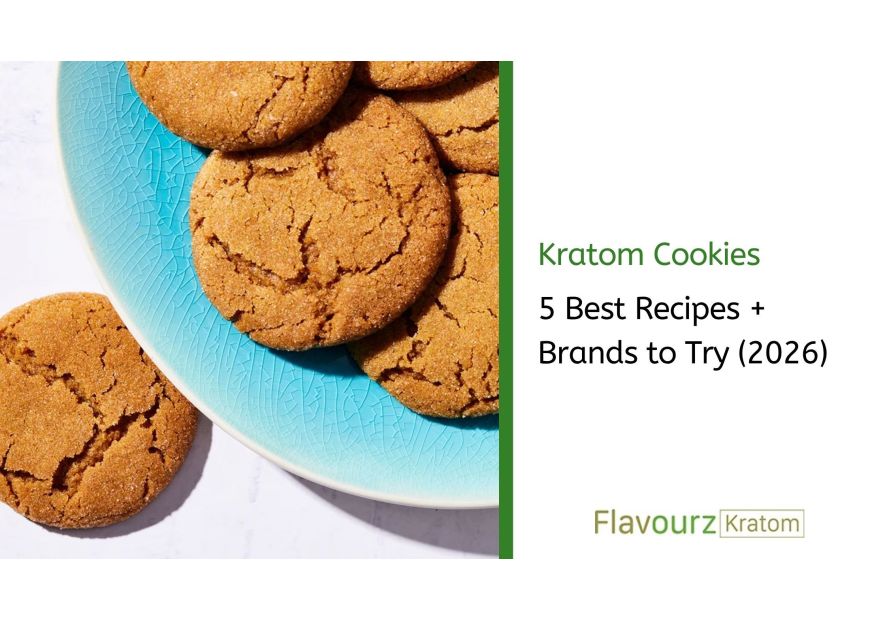
Kratom Cookies: 5 Best Recipes + Brands to Try (2026)
Last Updated: April 2026
Kratom cookies are one of the most practical and genuinely enjoyable ways to consume kratom — but they're also one of the most misunderstood. The two biggest concerns most people bring to kratom baking are reasonable: does heat destroy the alkaloids, and how do you dose accurately in a baked good? Both questions have clear, science-grounded answers. Yes, high heat affects kratom's alkaloid profile — but at standard cookie baking temperatures and durations, the degradation is manageable and the result is a fully effective product. Dosing is straightforward once you understand how to fold kratom into dough rather than cook it.
At Flavourz Kratom, we get asked about kratom baking recipes regularly, and the honest answer is that a well-made kratom cookie can be one of the most pleasant, accessible, and discreet formats available especially for users who find kratom's bitter taste a barrier in other preparations. For those seeking lighter alternatives to baked goods, our comprehensive kratom seltzer review guide covers refreshing beverage options. This guide covers the heat stability science every kratom baker needs to understand, five tested cookie recipes across different flavor profiles, dosing protocols for edibles, and the commercial kratom edible brands worth knowing in 2026.
Does Heat Destroy Kratom Alkaloids? The Science Explained
This is the most important question in kratom baking, and it deserves a direct, evidence-based answer rather than the vague warnings most sources offer. The short version: heat does degrade kratom alkaloids, but the rate and extent depend on temperature, duration, and pH — and standard cookie baking conditions fall within a window where meaningful alkaloid retention is achievable with the right technique.
A 2020 study published in PubMed examining the temperature and pH-dependent stability of Mitragyna alkaloids documents that mitragynine undergoes measurable degradation at elevated temperatures, with the rate increasing significantly at higher heat and in acidic or alkaline conditions. Critically, the study confirms that degradation is temperature-dependent — meaning shorter exposures at moderate baking temperatures preserve more alkaloid content than longer exposures at high temperatures.
The second key finding comes from Amazing Botanicals' documented analysis of heat effects on kratom: 7-hydroxymitragynine degrades faster than mitragynine at elevated temperatures. This is the most potent alkaloid in the kratom profile, and it breaks down first. The practical implication for baking is that high heat and long baking times specifically deplete the most potent alkaloid, shifting the overall effect profile toward the less potent mitragynine fraction — producing a milder, more sustained experience rather than the full-spectrum profile of fresh powder.
The practical rules that follow from this science:
- Maximum safe baking temperature: 360–375°F (180–190°C). Most cookie recipes fall within this range. Baking above 375°F accelerates alkaloid degradation beyond the acceptable window.
- Maximum safe baking duration: 15–20 minutes. Short bake times at moderate temperatures preserve significantly more alkaloid content than extended baking. Recipes requiring longer than 20 minutes at high heat are not ideal for kratom integration.
- Do not add kratom to hot liquid. Mixing kratom directly into actively boiling butter, hot syrup, or hot liquid causes direct thermal degradation before baking even begins. Always fold kratom into room-temperature dough after other ingredients have been mixed and cooled.
- Acidic ingredients stabilize mitragynine. The PubMed stability study confirms pH effects on mitragynine — lemon zest, citric acid, or cream of tartar in the dough creates a slightly acidic environment that stabilizes mitragynine during baking, producing better alkaloid retention compared to neutral-pH doughs.
- Dose up 20–30% for baking losses. Even with optimal technique, heat degradation will reduce the effective dose compared to the same powder consumed directly. Increase your standard dose by 20–30% when incorporating it into baked goods to compensate for baking losses.
How to Dose Kratom in Cookies
Kratom dosing in baked goods is straightforward in principle — the challenge is batch uniformity. If you add 10g of kratom to a batch of 20 cookies, each cookie should contain approximately 0.5g of kratom. In practice, kratom powder doesn't distribute with perfect uniformity throughout dough, so some cookies will be slightly more or less potent than others. Here are the techniques that produce the most consistent dosing per cookie:
- Pre-portion your kratom dose per cookie: Rather than mixing a large quantity into the full batch, measure your individual dose (e.g., 2g per cookie), divide the total needed across the batch, and mix the full batch quantity into the dough. This ensures the math is right even if distribution isn't perfect.
- Use a consistent dough ball size: Size variation between cookies means alkaloid variation between cookies. Use a kitchen scale or a cookie scoop that measures consistent volume. When cookies are the same size, dose variation is minimized.
- Mix kratom in as the final dry ingredient: Add kratom powder after all other dry ingredients have been combined and just before adding wet ingredients. This maximizes even distribution through the dough.
- Start at 1g per cookie for first-time kratom edibles: The delayed onset of any ingested kratom — typically 30–60 minutes, longer than powder or tea — means edibles carry a higher accidental over-consumption risk for new users. One gram per cookie at your standard dose level is the right starting point, with 45 minutes minimum before deciding whether to eat another.
For reference on standard dose ranges across experience levels, our kratom dosage guide covers gram-based dosing protocols for every vein type and user experience level. The same gram amounts apply to edibles — just add 20–30% to account for baking losses and fold that total into your batch.
Which Kratom Strain Works Best for Baking?
Not all kratom strains are equally suited to baking. The heat degradation of 7-OH means strains with high 7-OH fractions (primarily red veins) lose their most distinctive properties during baking and produce a flatter effect profile than when consumed fresh. Green veins, with their more balanced alkaloid profiles dominated by mitragynine, hold up better through the baking process and maintain a recognizable effect character.
- Best for cookies: Green Maeng Da, Green Bali, Green Indo — mitragynine-dominant profiles with moderate 7-OH content retain their character better through baking and produce a consistent energy-plus-focus effect from the baked good
- Good for cookies: White veins — predominantly mitragynine-based, minimal 7-OH loss, produces energy-focused baked effect; slightly more bitter than greens
- Less ideal for cookies: Red veins — the sedating, analgesic properties that define red vein character come primarily from 7-OH and oxidized alkaloids that degrade fastest at baking temperatures; red cookies taste more bitter and deliver a flatter, less characteristic effect than fresh red powder, so users drawn to strains like Red Kali for evening relaxation are better off consuming them as powder or tea, and can gain insights into Red Kali's relaxing benefits to decide on the right format
Our Green Maeng Da kratom powder is our top recommendation for cookie baking — its balanced alkaloid profile, well-documented quality, and moderate bitterness make it both the most effect-stable and most taste-compatible option for sweet cookie bases. For full context on how different vein types compare, our kratom strains guide maps the full spectrum in one reference.
5 Best Kratom Cookie Recipes
The five recipes below cover the most popular kratom cookie bases, organized from most beginner-friendly to most complex. Each recipe is designed around the three baking rules that matter most for alkaloid retention: temperature at or below 375°F, baking duration under 20 minutes, and kratom added as a final fold-in after all heat-exposed mixing steps are complete. All recipes assume a batch of approximately 20 cookies using quality lab-tested kratom powder.
Recipe 1: Classic Peanut Butter Kratom Cookies (No-Bake Option)
Peanut butter cookies are the single best kratom vehicle in the cookie category for two reasons: the high fat content of peanut butter directly enhances mitragynine absorption (the same phospholipid bioavailability principle that makes lecithin a potentiator), and the strong nutty-sweet flavor profile masks kratom's bitterness more effectively than any other common cookie base. The no-bake variation eliminates heat degradation entirely for maximum alkaloid retention.
Makes: ~20 cookies | Dose per cookie: 1–2g (adjust batch total to your target) | Bake temp: 360°F (or no-bake)
Ingredients:
- 1 cup peanut butter (natural, no added sugar preferred)
- 1 cup white or coconut sugar
- 6 tablespoons almond milk or oat milk (room temperature)
- 1 teaspoon vanilla extract
- ½ cup all-purpose flour (omit for no-bake version)
- Total kratom dose for batch (e.g., 20–40g for 20 cookies at 1–2g each)
- Pinch of salt
- Optional: ½ teaspoon lemon zest (stabilizes mitragynine during baking)
Instructions:
- Combine peanut butter, sugar, almond milk, and vanilla extract in a bowl. Mix until smooth and fully incorporated. Do not heat this mixture.
- If baking: sift in flour, salt, and lemon zest (if using). Mix until a firm dough forms.
- Add your pre-weighed kratom powder as the final step. Fold gently into the dough with a spatula — do not over-mix, as this can cause uneven distribution. Mix until the powder is no longer visible as distinct streaks.
- No-bake version: Refrigerate dough for 30 minutes. Scoop into uniform balls using a tablespoon or cookie scoop. Place on parchment paper and press gently flat. Refrigerate for 1 hour until firm. Store in the fridge for up to 5 days.
- Baked version: Preheat oven to 360°F. Scoop dough into uniform balls, place on parchment-lined baking sheet at least 2 inches apart, and flatten slightly. Bake 15 minutes. Do not exceed 20 minutes. Remove and cool completely before eating — kratom effects are activated by body metabolism, not by the cookie temperature.
Kratom potentiation tip: The peanut butter fat content already acts as a natural bioavailability enhancer for mitragynine. Add ½ teaspoon of ground black pepper (piperine) to the dough for additional CYP3A4 inhibition potentiation without affecting the flavor profile noticeably. Full details on this mechanism in our kratom potentiation guide.
Recipe 2: Soft Chocolate Chip Kratom Cookies
Chocolate chip cookies are the most universally appealing base for kratom baking, and the cornstarch addition in this recipe — borrowed from Kratom Spot's documented sweet kratom recipes — produces a softer, chewier texture that better incorporates kratom powder without the grainy texture that can occur in firmer cookie bases. Chocolate's natural bitterness also complements kratom's earthy notes rather than competing with them.
Makes: ~20 cookies | Dose per cookie: 1–2g | Bake temp: 360°F
Ingredients:
- 1⅓ cups all-purpose flour
- 2 tablespoons cornstarch (produces soft, chewy texture)
- ½ teaspoon baking soda
- ½ cup salted butter, melted and cooled to room temperature
- ⅔ cup granulated sugar
- ½ cup light brown sugar, packed
- 1 large egg
- 1½ teaspoon pure vanilla extract
- ¾ cup semi-sweet or dark chocolate chips
- Total kratom dose for batch
- Optional: ½ teaspoon lemon zest
Instructions:
- Ensure melted butter has cooled to room temperature before using — this is the most important step for alkaloid preservation. Hot butter added to the dough will begin to degrade kratom before baking even starts.
- Whisk together flour, cornstarch, baking soda, and salt in one bowl. Set aside.
- In a separate bowl, beat cooled butter, granulated sugar, and brown sugar until smooth. Add egg and vanilla extract; mix until combined.
- Gradually incorporate the flour mixture into the wet ingredients. Mix until just combined — do not over-mix.
- Fold in chocolate chips.
- Add kratom powder as the final fold-in, distributing evenly through the dough. Add lemon zest at this stage if using.
- Cover and refrigerate dough for 30 minutes — this improves cookie shape and gives the dough time to fully incorporate the kratom distribution.
- Preheat oven to 360°F. Scoop uniform dough balls onto parchment-lined baking sheet, 2 inches apart.
- Bake 12–15 minutes until edges are set and centers look slightly underdone. Cookies continue cooking on the hot pan after removal. Remove at 12 minutes for maximum softness.
- Cool completely on the baking sheet before eating. Allow 45–60 minutes after eating before evaluating the dose.
Recipe 3: Tahini Kratom Cookies (Vegan + Sesame)
Tahini (sesame paste) is an underrated kratom cookie base with two practical advantages: it's naturally vegan, and its distinctive, slightly bitter sesame flavor profile is one of the few bases where kratom's earthy bitterness integrates seamlessly rather than needing to be masked. The fat content of tahini mirrors peanut butter's bioavailability benefits. This recipe is based on the GRH Kratom documented tahini cookie method.
Makes: ~18 cookies | Dose per cookie: 1–2g | Bake temp: 360°F
Ingredients:
- 1 cup tahini (well-stirred)
- ½ cup white sugar
- ¾ cup brown sugar
- 1 egg (or flax egg: 1 tbsp ground flaxseed + 3 tbsp water, rested 5 minutes)
- 1¼ cups all-purpose flour
- ½ teaspoon baking soda
- Pinch of salt
- ½ cup melted butter or vegetable oil, cooled to room temperature
- Total kratom dose for batch
Instructions:
- Mix all dry ingredients (flour, baking soda, salt) in one large bowl.
- In a separate bowl, combine tahini, cooled butter or oil, sugars, and egg. Mix until smooth.
- Combine wet and dry mixtures. Mix until a cohesive dough forms.
- Add kratom powder as the final fold-in. Stir gently until evenly distributed.
- Place dough in the refrigerator for 30 minutes.
- Preheat oven to 360°F. Line a baking sheet with parchment paper.
- Form uniform balls from the chilled dough using a tablespoon or cookie scoop. Place on baking sheet.
- Bake 15–18 minutes until golden at the edges. Do not overbake — tahini cookies dry out quickly past the 18-minute mark.
- Cool on the pan for 10 minutes before removing to a rack.
Recipe 4: Lemon Kratom Shortbread Cookies
Lemon shortbread is the ideal recipe for users who want maximum alkaloid stability during baking. Lemon juice and lemon zest create the mildly acidic dough environment that the 2020 PubMed stability study confirms preserves mitragynine best during thermal processing. The buttery, crumbly shortbread base is also low in competing flavors, making the lemon-kratom combination clean and easy to dose accurately.
Makes: ~24 cookies | Dose per cookie: 1–1.5g | Bake temp: 325°F (lower temp for higher alkaloid retention)
Ingredients:
- 1 cup (2 sticks) unsalted butter, softened to room temperature (not melted)
- ½ cup powdered sugar
- Zest of 2 lemons
- 2 tablespoons fresh lemon juice
- 2 cups all-purpose flour
- ¼ teaspoon salt
- Total kratom dose for batch
Instructions:
- Beat softened butter (not melted — room temperature butter does not heat-stress the kratom) and powdered sugar together until light and fluffy.
- Add lemon zest and lemon juice. Mix until combined.
- Gradually stir in flour and salt until a soft dough forms.
- Add kratom powder as the final fold-in. The lemon juice in the dough creates the acidic stabilizing environment for mitragynine. Distribute kratom evenly.
- Roll dough into a log shape approximately 2 inches in diameter, wrap in plastic wrap, and refrigerate for 1 hour until firm.
- Preheat oven to 325°F — the lower temperature used here is deliberate. Shortbread bakes well at 325°F and the lower heat produces better alkaloid retention than the 360–375°F range used for soft cookies.
- Slice chilled dough log into rounds approximately ¼ inch thick. Place on parchment-lined baking sheet.
- Bake 15–18 minutes until edges are just barely golden. Remove while centers still look slightly underdone.
- Cool completely before eating. The lemon flavor intensifies as the cookies cool, and the alkaloids are fully bioavailable once the cookie reaches body temperature during digestion.
Recipe 5: Ginger Molasses Kratom Cookies
Ginger molasses cookies are the best recipe for users who want to incorporate an additional natural potentiator into the baked good itself. Ginger contains 6-gingerol and shogaol compounds that modestly enhance gastrointestinal motility and absorption, and molasses contains magnesium — both elements that mildly support kratom's absorption and tolerance profile as documented in our potentiation research. The spiced flavor profile is assertive enough to mask kratom completely even at higher doses per cookie.
Makes: ~22 cookies | Dose per cookie: 1–2g | Bake temp: 350°F
Ingredients:
- ¾ cup (1½ sticks) unsalted butter, softened to room temperature
- 1 cup brown sugar, packed
- 1 large egg
- ¼ cup blackstrap molasses
- 2¼ cups all-purpose flour
- 2 teaspoons ground ginger
- 1½ teaspoons ground cinnamon
- ¼ teaspoon ground cloves
- 1 teaspoon baking soda
- ¼ teaspoon salt
- Total kratom dose for batch
- Granulated sugar for rolling
Instructions:
- Cream softened butter and brown sugar together until fluffy. Add egg and molasses; beat until smooth.
- Sift together flour, ginger, cinnamon, cloves, baking soda, and salt in a separate bowl.
- Add the dry spice mixture to the wet ingredients and stir until a cohesive dough forms.
- Add kratom powder as the final fold-in step. The molasses and spice base is highly effective at concealing kratom's flavor — even at 2g per cookie, the ginger and clove notes dominate completely.
- Cover dough with plastic wrap and refrigerate for 1 hour.
- Preheat oven to 350°F. Roll chilled dough into uniform 1-inch balls, then roll each ball in granulated sugar until coated.
- Place on parchment-lined baking sheet 2 inches apart. Do not flatten — these cookies spread naturally during baking.
- Bake 10–12 minutes until tops are cracked and set. Remove while centers still look slightly soft.
- Cool on pan 5 minutes before transferring. The ginger heat in the cookies provides a pleasant complementary warming sensation alongside kratom's effects.
Commercial Kratom Edible Brands Worth Knowing in 2026
Commercial kratom cookies as a distinct product category do not currently exist at scale — no major AKA-certified vendor produces a commercially packaged kratom cookie as of April 2026. The commercial kratom edible market has developed primarily around kratom gummies as the shelf-stable, precisely dosed, commercially viable edible format. For users who want the edible experience without home baking, these are the brands delivering the best quality kratom edible products:
- Kraken Kratom Gummies: 30mg mitragynine per gummy, lime/orange/raspberry flavors, GMP-certified facility, AKA qualified. The highest-verified mass-market gummy product with the best quality documentation in the commercial edible category.
- KRATOMade Strawberry Gummies: 25mg mitragynine per gummy, known specifically for flavor quality. Best-tasting commercial kratom gummy on the market according to consistent user feedback across multiple third-party reviews.
- Kats Botanicals Gummies: Triple-purified kratom extract, GMP + NSF certified, available in multiple flavors and potency tiers. Best purity standard in the commercial edible category — the same purification that makes their capsules low-nausea applies to their gummy line.
- Super Speciosa Gummies: AKA GMP + NSF certified, extract-based, published COA per batch. The most rigorously verified commercial edible product available from a dual-certified vendor.
- Happy Hippo Gummies: Extract-based, AKA GMP certified, multiple flavor profiles, same-day shipping. Consistent community feedback on potency accuracy and flavor quality.
For a complete overview of these vendors' full product ranges beyond the edible category, our best kratom brands 2026 guide covers the complete vendor landscape with quality rankings across all formats.
Kratom Cookie Storage and Shelf Life
Kratom cookies should be stored with the same attention to kratom alkaloid preservation that applies to kratom powder storage. Light, heat, and humidity all degrade mitragynine over time, so baked kratom cookies are best stored in an airtight container away from direct sunlight at room temperature for up to 5 days, or in the refrigerator for up to 10 days. For longer storage, individually wrap cooled cookies in plastic wrap, freeze flat on a baking sheet until solid, then transfer to a sealed freezer bag. Frozen kratom cookies retain their alkaloid content for up to 3 months — the freeze-thaw cycle, as documented in our potentiation guide, does not further degrade mitragynine at freezer temperatures.
Label stored kratom cookies clearly and store them separately from non-kratom baked goods. Because kratom cookies look identical to standard cookies, accidental consumption by someone who doesn't know the ingredients is a genuine risk — especially for children or pets. Keep them in a clearly labeled, secured container.
Baking Tips Comparison by Recipe
| Recipe | Bake Temp | Bake Time | Alkaloid Retention | Kratom Taste Masking | Best For |
|---|---|---|---|---|---|
| Peanut Butter (no-bake) | None | 0 min | Maximum (no heat) | Excellent | Beginners, fat potentiation |
| Chocolate Chip | 360°F | 12–15 min | Good | Excellent (chocolate) | Most popular flavor profile |
| Tahini (vegan) | 360°F | 15–18 min | Good | Good (sesame complements) | Vegan users |
| Lemon Shortbread | 325°F | 15–18 min | Best baked option (acid + low temp) | Very good (lemon zest) | Maximum alkaloid preservation |
| Ginger Molasses | 350°F | 10–12 min | Very good (short bake time) | Best (spice profile dominates) | High-dose users, potentiation |
Frequently Asked Questions
 Frequently Asked Questions.jpg)
Does baking destroy kratom?
Baking partially degrades kratom's alkaloids — it does not destroy them entirely. The degradation is temperature-dependent and time-dependent. At 325–375°F for 10–20 minutes, meaningful alkaloid content is preserved, though the most potent alkaloid (7-hydroxymitragynine) degrades faster than mitragynine. A 2020 PubMed study on temperature and pH-dependent stability of Mitragyna alkaloids confirms this differential degradation pattern. Compensating with a 20–30% dose increase above your standard dose accounts for baking losses and produces a fully effective end product.
How much kratom do I put in cookies?
Calculate your standard dose per serving (e.g., 2g), multiply by the number of cookies in your batch (e.g., 20), then add 20–30% for baking losses (2g × 20 × 1.25 = 50g total for the batch). Divide this evenly through the full batch. For beginners trying kratom edibles for the first time, use 1g per cookie — the delayed onset of edibles (45–60+ minutes) means over-consumption from eating multiple cookies before the first one takes effect is the most common adverse event. Start with one cookie, wait a full hour, and assess before eating more. Our dosage guide covers baseline gram recommendations by experience level.
Can I use kratom extract in cookies instead of powder?
Yes, with an important caveat: kratom extract is significantly more potent per gram than whole-leaf powder, so dose calculations require adjustment. If your standard dose is 3g of powder and the extract you're using has a 2:1 concentration ratio, use 1.5g of extract per cookie dose — then add the standard 20–30% baking compensation on top of that. Extract also mixes into dough more uniformly than coarser powder because of its finer particle size, which can improve dose consistency per cookie. Use our kratom extract for a more potent, more uniformly distributed baking ingredient.
What is the best way to mask kratom taste in cookies?
The most effective kratom taste-masking combinations in descending order of effectiveness: (1) ginger molasses — the assertive spice profile completely dominates kratom's earthy notes at any reasonable dose; (2) dark or semi-sweet chocolate chips — chocolate bitterness is complementary, not competing; (3) peanut butter — high fat content absorbs and mutes the alkaloid bitterness while adding a strong competing flavor; (4) lemon — citrus brightness cuts through bitterness effectively. Vanilla alone does not effectively mask kratom — its mild flavor is not assertive enough to compete. Adding an extra teaspoon of vanilla to any recipe as the sole masking strategy produces a kratom-flavored cookie with vanilla notes rather than a vanilla cookie.
How long do kratom cookies take to work?
Kratom edibles have a longer onset than any other format because the alkaloids must pass through the entire digestive process before reaching systemic circulation. Onset typically begins 45–90 minutes after eating a kratom cookie, compared to 15–30 minutes for powder tea and 30–45 minutes for hard capsules. Peak effects arrive at approximately 90–120 minutes. This delayed timeline is the most important thing new kratom edible users need to understand — eating a second cookie at 30 minutes because you "don't feel anything yet" is extremely common and results in a very strong delayed double-dose effect. Eat one cookie, wait a full 90 minutes, and only then assess.
Disclaimer: This article is for informational purposes only. Kratom is not FDA-approved and is not intended to diagnose, treat, cure, or prevent any disease or condition. Always consult a qualified healthcare provider before use. Store all kratom-containing foods in clearly labeled, secured containers away from children and pets.
Last Updated: April 2026 | Flavourz Kratom has served over 10,000 customers since 1999. Shop our full kratom selection here.

Leave a comment