


Kratom Cycling: 5 Schedules to Maintain Effects
Last Updated: April 2026
Kratom cycling is the practice of rotating strains and scheduling regular breaks to prevent tolerance buildup and maintain consistent effects long-term. The most effective cycling schedules include the 3-on-2-off weekly cycle, daily strain rotation, the 5-day work week protocol, the pulse cycle (2-3 weeks on, 1 week off), and the minimalist every-other-day approach. Many users benefit from comparing what strains work better for sleep between red or gold kratom within their cycling schedule. At Flavourz Kratom, we've helped customers maintain their ideal kratom experience for years using these exact strategies, and proper cycling is the difference between sustainable use and chasing diminishing effects.
If you've been using kratom for a while, you know the feeling. That same dose that used to work perfectly starts feeling weaker. You're tempted to add another gram, then another. Within weeks, you're taking twice what you started with and still not getting the results you want. This is tolerance, and it's the most common frustration among long-term kratom users.
The good news is that tolerance isn't inevitable. With strategic cycling, you can maintain your original dose and effects for months or even years. Over my 5 years of personal use and conversations with thousands of customers, I've identified which cycling approaches actually work and which are just wishful thinking. This guide gives you 5 proven schedules to choose from based on your goals and lifestyle.
What Is Kratom Cycling and Why Does It Matter?
Kratom cycling refers to two interconnected strategies: rotating between different strains to vary your alkaloid exposure, and scheduling regular breaks to let your body reset. Both work together to prevent the tolerance buildup that reduces kratom's effectiveness over time.
How Tolerance Develops
Kratom's primary alkaloids, mitragynine and 7-hydroxymitragynine, interact with receptors in your brain. With repeated exposure, these receptors become less sensitive. They adapt to expect the presence of these compounds and respond with diminishing intensity. This is called receptor downregulation, and it's why the same dose stops working as well.
Studies on mitragynine pharmacokinetics show an average elimination half-life of about 3.5 hours. This means after roughly 7 hours, most of a dose has cleared your system. But receptor adaptation happens on a longer timeline. Daily use for 3-8 weeks typically produces noticeable tolerance for most people, though individual variation is significant.
What Stagnant Strain Syndrome Is
Stagnant Strain Syndrome (SSS) is what happens when you use the same one or two strains continuously. Your body becomes specifically adapted to that exact alkaloid profile. Each kratom strain has a unique fingerprint of alkaloid ratios. When you only expose your receptors to one combination, they adapt to it precisely.
SSS explains why switching strains can restore effects even without a full break. By introducing a different alkaloid combination, you're working with receptors that haven't adapted to that specific profile. This is why rotation is such an effective tolerance management tool.
Why Cycling Works
Cycling works on two levels. Strain rotation varies the alkaloid combinations hitting your receptors, preventing them from adapting to any single profile. Scheduled breaks give your receptors time to upregulate (become sensitive again) by removing kratom's presence entirely.
Users who practice consistent cycling report maintaining their original dose for years, while those who use the same strain daily often need to increase within weeks. The difference is dramatic, and it comes down to how you structure your use rather than some inherent limitation of kratom.
Quick Reference: 5 Kratom Cycling Schedules
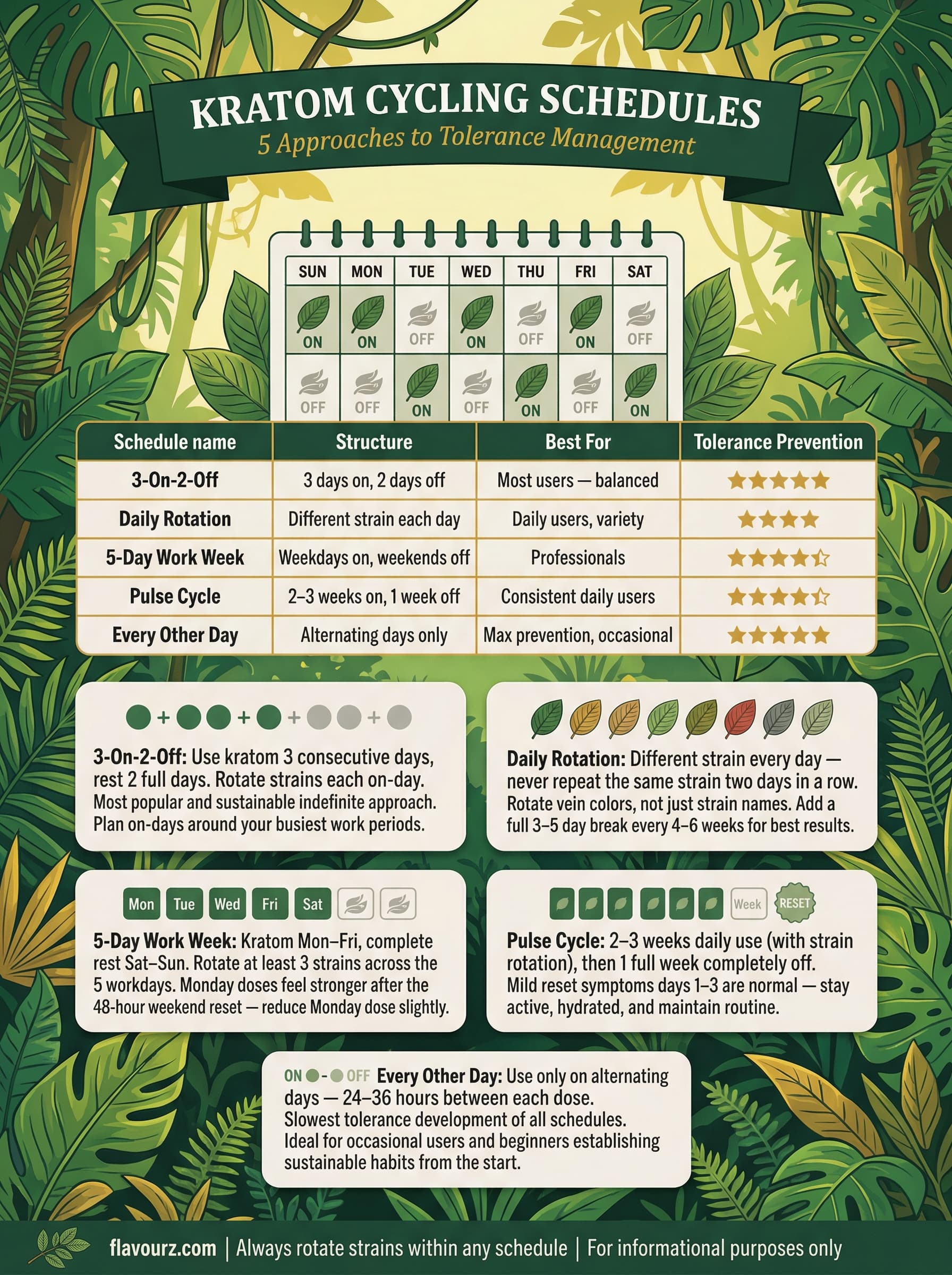
| Schedule | Structure | Best For | Tolerance Prevention |
|---|---|---|---|
| 3-On-2-Off | 3 days kratom, 2 days off | Most users, balanced approach | Excellent |
| Daily Rotation | Different strain each day | Daily users, variety seekers | Good |
| 5-Day Work Week | Weekdays on, weekends off | Professionals, productivity focus | Very Good |
| Pulse Cycle | 2-3 weeks on, 1 week off | Consistent daily needs, periodic reset | Very Good |
| Every Other Day | Use only on alternating days | Maximum prevention, occasional users | Excellent |
Schedule 1: The 3-On-2-Off Cycle
The 3-on-2-off cycle is the most popular and balanced approach to kratom cycling. You use kratom powder for three consecutive days, then take two full days off. This provides consistent kratom benefits during your "on" days while giving your receptors regular reset time.
How It Works
Three days of use is short enough that significant tolerance doesn't accumulate. Two days off allows partial receptor upregulation. The cycle repeats indefinitely, preventing the continuous exposure that drives tolerance development.
Sample 3-On-2-Off Weekly Schedule
| Day | Status | Strain Example |
|---|---|---|
| Monday | ON | Green Maeng Da |
| Tuesday | ON | White Borneo |
| Wednesday | ON | Red Bali |
| Thursday | OFF | No kratom |
| Friday | OFF | No kratom |
| Saturday | ON | Green Malay |
| Sunday | ON | White Thai |
Notice the strain rotation even on consecutive "on" days. This combines the 3-on-2-off structure with strain rotation for maximum tolerance prevention.
Who This Schedule Works Best For
- People who want regular kratom benefits but prioritize long-term effectiveness
- Those who've noticed tolerance building with daily use
- Anyone who wants a sustainable, indefinite-use approach
- Users who can plan their kratom days around their schedule
Tips for Success
Plan your "on" days strategically. If you use kratom for work productivity, schedule your on days for your busiest work periods.
Rotate strains within the cycle. Don't use the same strain all three on days. Use a different one each day for maximum benefit.
Stay consistent with off days. The temptation to "just use a little" on off days undermines the entire schedule. Complete breaks are essential.
Schedule 2: The Daily Strain Rotation
Daily strain rotation means using kratom every day but never using the same strain two days in a row. This approach suits people who prefer or need daily kratom but want to minimize tolerance through alkaloid variation.
How It Works
Each kratom strain has a slightly different alkaloid profile. By exposing your receptors to different combinations daily, you prevent them from adapting to any single profile as quickly. This slows tolerance development compared to using one strain continuously.
Sample 7-Day Rotation Schedule
| Day | Vein Color | Strain | Primary Use |
|---|---|---|---|
| Monday | Green | Green Maeng Da | Balanced focus |
| Tuesday | White | White Maeng Da | Energy, motivation |
| Wednesday | Red | Red Bali | Relaxation |
| Thursday | Green | Green Malay | All-day energy |
| Friday | White | White Borneo | Clean energy |
| Saturday | Red | Red Borneo | Deep relaxation |
| Sunday | Yellow | Yellow Vietnam | Mood + balance |
Important Limitation
Daily rotation slows tolerance but doesn't prevent it completely. Without scheduled breaks, some tolerance will still develop over months. Research and user experience confirm that rotation alone doesn't fully prevent tolerance. It significantly slows progression, but combining rotation with periodic breaks provides the most sustainable approach.
Who This Schedule Works Best For
- People who benefit from daily kratom but find same-strain use loses effectiveness
- Those who enjoy variety in their kratom experience
- Users who will add periodic complete breaks (recommended every 4-6 weeks)
- Anyone transitioning from single-strain daily use who isn't ready for off days
Tips for Success
Rotate vein colors, not just strains. Using Green Maeng Da Monday and Green Malay Tuesday provides less variation than Green Maeng Da Monday and White Maeng Da Tuesday. Vein colors have more distinct alkaloid differences than strains within the same vein.
Keep at least 4-5 strains in rotation. More variety means more alkaloid variation and slower tolerance.
Add periodic full breaks. Even with perfect rotation, take a complete 3-5 day break every 4-6 weeks for optimal long-term maintenance.
Schedule 3: The 5-Day Work Week Protocol
The 5-day work week protocol aligns kratom use with typical work schedules: kratom Monday through Friday, complete rest on weekends. This provides consistent benefits during productive weekdays while ensuring 48+ hours of receptor reset each week.
How It Works
Five consecutive days of use build some tolerance, but two consecutive off days (48+ hours) provide significant receptor recovery. The weekly pattern is sustainable indefinitely for most users when combined with strain rotation.
Sample Work Week Schedule
| Day | Status | Strain | Purpose |
|---|---|---|---|
| Monday | ON | Green Maeng Da | Start week strong |
| Tuesday | ON | White Borneo | Energy boost |
| Wednesday | ON | Green Malay | Midweek endurance |
| Thursday | ON | White Maeng Da | Push through |
| Friday | ON | Green Borneo | Finish week |
| Saturday | OFF | No kratom | Reset begins |
| Sunday | OFF | No kratom | Reset completes |
Who This Schedule Works Best For
- Professionals who use kratom for work productivity
- Anyone who doesn't need or want kratom effects on weekends
- People who prefer a predictable, calendar-aligned routine
- Those who find weekend breaks naturally easier to maintain
Tips for Success
Rotate strains across the five days. Using the same strain Monday through Friday defeats the purpose. Use at least 3 different strains across the work week.
Monday mornings feel extra effective. After 48+ hours off, Monday's dose typically hits harder. You may want to reduce your Monday dose slightly.
Don't "catch up" on weekends. The temptation to use kratom for weekend activities undermines the reset. Keep weekends completely free.
Schedule 4: The Pulse Cycle
The pulse cycle involves longer periods of consistent use followed by a complete week off. Typical structure: 2-3 weeks of daily use, then 1 full week of complete abstinence. This suits people who need consistent daily benefits but are willing to take periodic extended breaks.
How It Works
During the "on" weeks, you use kratom daily (with strain rotation). Some tolerance accumulates. The full week off allows substantial receptor upregulation, essentially resetting your tolerance each month. When you return to kratom after the break week, effects feel restored.
Sample Pulse Cycle Structure
Weeks 1-3 (ON): Daily use with strain rotation. Different strain each day or every 2-3 days. Maintain consistent, moderate doses.
Week 4 (OFF): Complete abstinence. No kratom at all. Expect mild withdrawal-like effects (fatigue, irritability) for days 1-3, improving by day 4-5.
Repeat: Return to daily use at your original dose. Effects should feel significantly restored.
What to Expect During the Off Week
After 2-3 weeks of daily use, your body has adapted to kratom's presence. During the off week, you may experience:
- Days 1-3: Mild restlessness, irritability, reduced energy, trouble sleeping
- Days 4-5: Symptoms diminish significantly
- Days 6-7: Feeling mostly normal, receptors upregulating
These effects are temporary and indicate your body is resetting. Stay hydrated, exercise, get sunlight, and maintain normal routines. The discomfort severity correlates with prior usage frequency and dose.
Who This Schedule Works Best For
- People who need consistent daily effects for specific purposes
- Those willing to accept temporary discomfort for long-term maintenance
- Users who can plan their off weeks around less demanding periods
- Anyone who's tried rotation alone but still notices tolerance climbing
Tips for Success
Plan your off week strategically. Schedule it during vacation, lighter work periods, or times when peak performance isn't critical.
Stay active during the off week. Exercise, social activities, and routine maintenance help minimize discomfort and distract from cravings.
Don't extend on weeks indefinitely. Sticking to 2-3 weeks on prevents tolerance from building to the point where a single week off can't reset it.
Schedule 5: The Every-Other-Day Approach
The every-other-day approach is the most conservative cycling schedule. You only use kratom on alternating days, ensuring at least 24-36 hours between each dose. This provides maximum tolerance prevention for those who don't need daily effects.
How It Works
With a full day between each use, your receptors get substantial recovery time. Kratom's half-life means most alkaloids clear within 24 hours, and the off day allows significant receptor upregulation. Tolerance develops very slowly with this approach, if at all.
Sample Every-Other-Day Schedule
| Week 1 | Mon | Tue | Wed | Thu | Fri | Sat | Sun |
|---|---|---|---|---|---|---|---|
| Status | ON | OFF | ON | OFF | ON | OFF | ON |
The pattern shifts week to week, so some weeks you'll have 3 kratom days and some you'll have 4. This irregularity actually helps prevent your body from anticipating kratom, which further reduces adaptation.
Who This Schedule Works Best For
- Occasional users who want to stay occasional
- Those who've experienced tolerance problems and want maximum prevention
- People who only need kratom benefits for specific activities (workouts, social events, etc.)
- New users who want to establish sustainable habits from the start
Tips for Success
Vary your "on" days based on needs. If you need kratom more for Monday productivity than Tuesday, adjust the schedule around your actual requirements.
Still rotate strains. Even with every-other-day use, don't use the same strain every time. Variation helps.
This schedule rarely needs tolerance breaks. With built-in recovery every 24-36 hours, most users can maintain this indefinitely without additional breaks.
Building Your Strain Rotation
Effective cycling requires having multiple strains available. Here's how to build a rotation that maximizes alkaloid variation.
The Minimum Rotation: 3 Strains
At minimum, keep three strains from different vein colors:
- One white strain for energy (White Maeng Da, White Borneo)
- One green strain for balance (Green Maeng Da, Green Malay)
- One red strain for relaxation (Red Bali, Red Borneo)
This provides meaningful alkaloid variation between uses.
The Optimal Rotation: 5-7 Strains
For best results, maintain 5-7 strains:
- Two white strains (different origins)
- Two green strains (different origins)
- Two red strains (different origins)
- One yellow or gold strain (optional)
More variety means your receptors never see the same exact combination repeatedly, maximizing tolerance prevention.
How to Rotate Effectively
Never use the same strain two days in a row. This is the most important rule. Consecutive same-strain use is the fastest path to strain-specific tolerance.
Rotate vein colors, not just names. Green Maeng Da followed by Green Malay is better than Green Maeng Da followed by Green Maeng Da, but Green Maeng Da followed by White Borneo is best. Vein colors have more distinct alkaloid profiles than strains within a vein.
Track what you use. Keep a simple log of which strain you used each day. This prevents accidental repetition and helps you notice patterns in what works best for you.
Tolerance Reset Protocol
If you've already developed tolerance and need to reset before starting a cycling schedule, here's how.
Tolerance Reset Timeline
| Break Duration | Expected Sensitivity Recovery | Best For |
|---|---|---|
| 3-5 days | 30-40% recovery | Mild tolerance, recent buildup |
| 7-14 days | 60-80% recovery | Moderate tolerance, most users |
| 21-30 days | Near complete reset | Severe tolerance, long-term heavy use |
Most users find that 7-14 days provides sufficient reset to return to their original effective dose. Longer breaks may be needed if tolerance has been building for many months.
What to Expect During Reset
Days 1-3: Peak discomfort. Common effects include restlessness, irritability, anxiety, disrupted sleep, reduced energy. Kratom's half-life means alkaloids clear within 24-48 hours, but receptor adaptation takes longer.
Days 4-7: Symptoms diminish significantly. Sleep normalizes. Energy levels begin recovering. Receptor upregulation accelerates.
Days 8-14: Most people feel mostly normal. Continued receptor recovery and sensitivity restoration.
Supplements That May Help
Some users report that certain supplements help during tolerance management:
Magnesium glycinate: May help slow tolerance development by interacting with NMDA receptors involved in tolerance formation. Take 200-400mg daily. Some users take it 30 minutes before kratom to potentially enhance effects.
Stem and vein kratom: Contains a different alkaloid profile than leaf powder. Some users substitute stem and vein for regular kratom during break periods to ease the transition while still allowing receptor reset from the primary alkaloids.
Agmatine: Some users report it helps with tolerance management, though research is limited. Typical dose: 500-1000mg before kratom.
These supplements aren't magic solutions, but they may provide modest support alongside proper cycling.
Signs You Need to Adjust Your Cycle
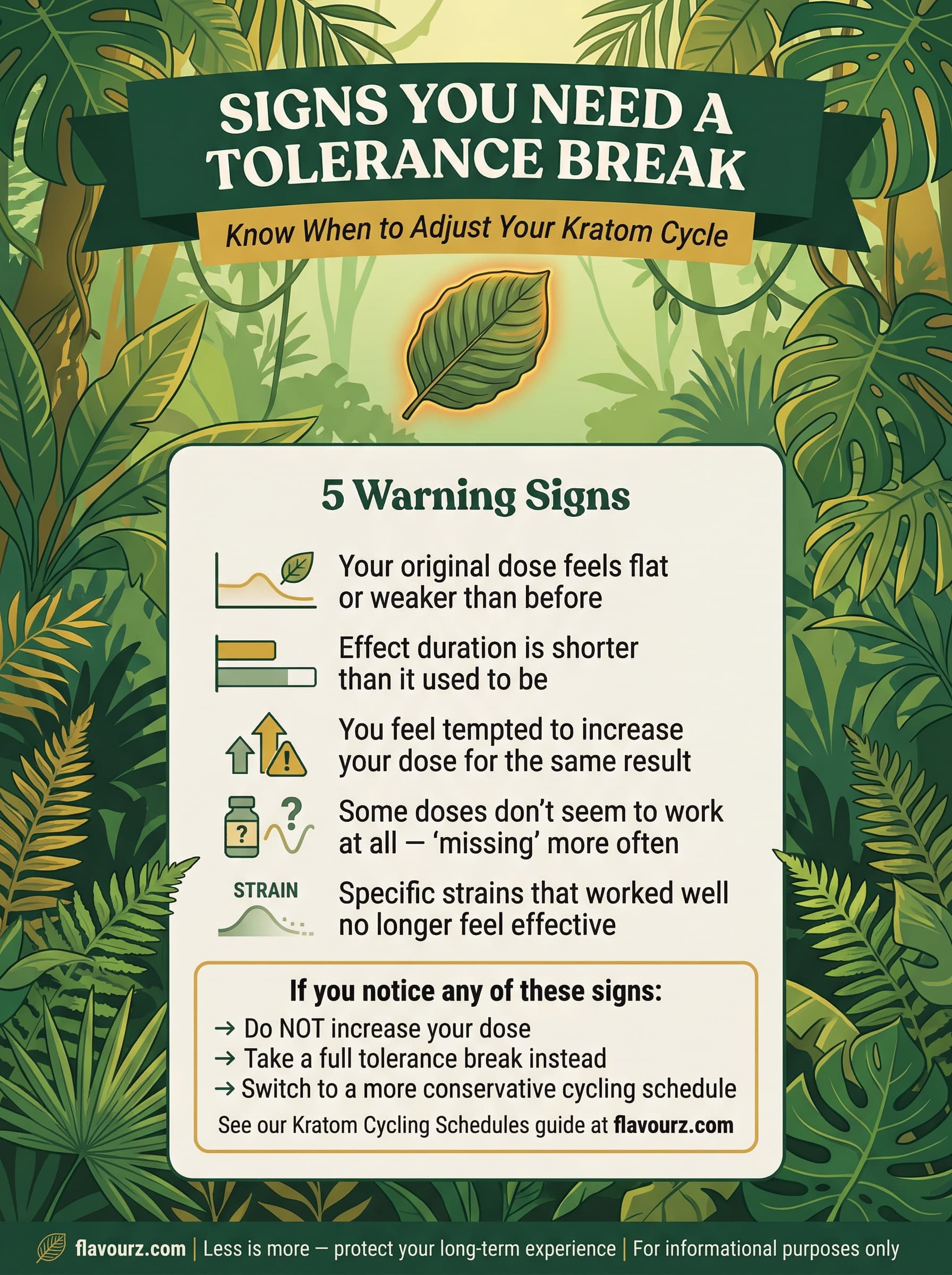
Even with a cycling schedule, pay attention to these warning signs that indicate tolerance is developing:
- Your original dose feels "flat" or produces weaker effects than before
- Effect duration is shorter than it used to be
- You're tempted to increase your dose to get the same results
- You're "missing" more often, meaning some doses don't seem to work at all
- Specific strains that worked well no longer seem effective
If you notice these signs, don't increase your dose. Instead, consider taking a full tolerance break or switching to a more conservative cycling schedule.
Common Cycling Mistakes
Mistake 1: Using "Different Strains" That Are Actually Similar
Using Green Maeng Da and Green Malay on alternate days provides less variation than using Green Maeng Da and White Borneo. Strains within the same vein color have more similar alkaloid profiles. For maximum benefit, rotate across vein colors, not just strain names.
Mistake 2: Cheating on Off Days
"Just a small dose" on scheduled off days undermines the entire cycling strategy. Your receptors need complete breaks to upregulate. Even small doses maintain some receptor occupation and slow recovery.
Mistake 3: Using Extracts or Enhanced Products
Kratom extracts and enhanced products contain concentrated alkaloids that accelerate tolerance dramatically. Users who start with extracts or high-potency products often develop tolerance within 1-2 weeks rather than 3-8 weeks. Stick to plain leaf powder for sustainable long-term use.
Mistake 4: Increasing Dose Instead of Adjusting Schedule
When effects diminish, the temptation is to add more kratom. This creates a vicious cycle: higher doses accelerate tolerance, requiring even higher doses. The solution is almost never more kratom. It's better scheduling, more rotation, or a reset break.
Mistake 5: Erratic, Inconsistent Scheduling
Taking kratom randomly without a plan leads to unpredictable tolerance patterns. Even if you don't follow a strict schedule, having some structure helps. Know your weekly maximum days, track your strains, and take breaks intentionally rather than randomly.
Choosing the Right Schedule for You
Here's a decision framework for selecting your cycling schedule:
Choose 3-On-2-Off if: You want maximum tolerance prevention while still using kratom regularly. You can plan your kratom days around your schedule.
Choose Daily Rotation if: You need daily kratom benefits and are willing to add periodic full breaks. You enjoy variety and have access to multiple strains.
Choose 5-Day Work Week if: You use kratom primarily for work productivity. Weekends naturally work as your off days.
Choose Pulse Cycle if: You need consistent daily effects and are willing to take a full week off monthly. You can plan off weeks during less demanding periods.
Choose Every-Other-Day if: You only need kratom occasionally. Maximum tolerance prevention is your priority. You're new to kratom and want to establish sustainable habits.
Frequently Asked Questions
How do you cycle kratom to avoid tolerance?
Cycle kratom by rotating between different strains (never the same strain two days in a row) and scheduling regular off days. Popular schedules include 3 days on/2 days off, daily use with weekly breaks, or every-other-day use. Combining strain rotation with scheduled breaks provides the best tolerance prevention.
How often should you rotate kratom strains?
Rotate strains every day for best results. Never use the same strain two days consecutively. Rotate across vein colors (white, green, red) rather than just strain names within the same vein for maximum alkaloid variation.
How long does a kratom tolerance break take?
A 7-14 day break restores 60-80% of original sensitivity for most users. A 3-5 day break provides 30-40% recovery for mild tolerance. Severe tolerance from long-term heavy use may require 21-30 days for near-complete reset.
What is stagnant strain syndrome?
Stagnant strain syndrome (SSS) is tolerance that develops from using the same one or two strains continuously. Your receptors adapt specifically to that strain's alkaloid profile. Switching strains can restore effects even without a full break because the new strain has a different alkaloid combination.
Can you take kratom every day without building tolerance?
Daily use typically produces noticeable tolerance within 3-8 weeks, even with strain rotation. Rotation slows tolerance but doesn't prevent it completely without breaks. For sustainable daily use, combine rotation with periodic complete breaks (pulse cycle) or accept some tolerance development over time.
How many days off from kratom to reset tolerance?
Seven days off provides significant reset for most users. Tolerance begins reversing within 3-5 days. For mild tolerance, 3-5 days may suffice. For severe tolerance from months of daily use, 2-3 weeks provides more complete reset.
Does rotating strains prevent kratom tolerance?
Rotating strains significantly slows tolerance development but doesn't fully prevent it. Research and user experience confirm that rotation combined with scheduled breaks provides the most sustainable approach. Rotation alone works better than single-strain use but isn't a complete solution without periodic off time.
What supplements help with kratom tolerance?
Magnesium glycinate (200-400mg daily) may help slow tolerance development by interacting with NMDA receptors. Stem and vein kratom can ease transitions during break periods. Agmatine (500-1000mg) is reported by some users to help. These supplements provide modest support alongside proper cycling but aren't substitutes for breaks and rotation.
Final Thoughts
Kratom cycling is the difference between sustainable, long-term use and constantly chasing diminishing effects. The users I've seen maintain their original dose for years all have one thing in common: they take cycling seriously. They rotate strains, they take breaks, and they resist the temptation to increase when effects weaken.
Choose a schedule that fits your lifestyle and commit to it. Whether you go with the 3-on-2-off approach, daily rotation with periodic breaks, or any of the other schedules in this guide, consistency is key. Track what you use, stick to your off days, and adjust your schedule if you notice tolerance creeping in.
At Flavourz Kratom, we've helped customers build sustainable kratom routines since 1999. If you need help selecting strains for your rotation or have questions about cycling, reach out. Getting this right means enjoying kratom's benefits for years rather than months.
Disclaimer: These statements have not been evaluated by the FDA. Kratom is not intended to diagnose, treat, cure, or prevent any disease. Consult a healthcare professional before using kratom, especially if you have medical conditions or take medications. Must be 21+ to purchase. Not available in all states.

Leave a comment