


Kratom Drug Test Detection 2026: Does It Show Up? Guide
Last Updated: April 2026
Standard drug tests do not detect kratom. The typical 5-panel and 10-panel urine screens used by most employers test for marijuana, cocaine, amphetamines, opioids, and PCP, but kratom's alkaloids (mitragynine and its secondary compound) have different molecular structures that these tests don't recognize. However, specialized kratom-specific tests do exist and can detect use for 1-9 days in urine depending on usage patterns. For accurate testing information about your specific products, you should buy kratom from reputable vendors who provide detailed alkaloid content and sourcing documentation. Knowing when and where these tests are used can help you make informed decisions.
After 5+ years working with kratom at Flavourz Kratom and answering this question from thousands of customers, I've learned the details matter. The military explicitly banned kratom in September 2025. Some treatment centers and probation offices now test specifically for it. And there's a documented risk of false positives for methadone with certain immunoassay tests. This guide covers everything you need to know.
Does Kratom Show Up on Standard Drug Tests?
No. Kratom does not appear on standard employment drug screenings. The most common workplace tests are 5-panel urine screens that check for five drug classes: marijuana (THC), cocaine, amphetamines/methamphetamines, opioids (codeine, morphine, heroin), and phencyclidine (PCP). Kratom alkaloids are chemically distinct from all of these and will not trigger a positive result.
Even extended panels don't typically include kratom:
- 5-panel: THC, cocaine, amphetamines, opioids, PCP (no kratom)
- 7-panel: Adds benzodiazepines and barbiturates (no kratom)
- 10-panel: Adds methadone, propoxyphene, methaqualone (no kratom)
- 12-panel: Adds tramadol, buprenorphine (no kratom)
Labcorp, Quest Diagnostics, and other major testing laboratories confirm that kratom is not included in any standard urine drug panel. Organizations that want kratom tested must order a specialized test (such as Labcorp's test code 791750) and pay extra for it.
The reason is simple: kratom is not federally scheduled. The DEA considered classifying it in 2016 but reversed course after public backlash. Without federal scheduling, laboratories have no regulatory mandate to include it in standard panels.
Who Actually Tests for Kratom?
While most employers don't test for kratom, certain organizations and situations do require specialized screening:
Military
The Department of Defense issued a memorandum in September 2025 explicitly banning kratom use among service members. While kratom is not part of routine military urinalysis panels, the DoD and individual service branches can order targeted testing if kratom use is suspected. Many military labs have validated LC-MS/MS assays to detect mitragynine at ng/mL concentrations.
Service members caught using kratom face potential administrative or disciplinary action under UCMJ Article 15 (non-judicial punishment), even if it wasn't detected through routine testing.
Treatment Centers and Recovery Programs
Addiction treatment facilities and recovery programs frequently test for kratom because some patients use it as a substitute for opioids. This can interfere with treatment goals and medication-assisted therapy. Quest Diagnostics recommends that clinicians consider kratom panels where use is suspected, and Aegis Laboratories actively markets kratom testing to treatment providers.
Probation and Parole
Probation officers in some jurisdictions now include kratom in their testing protocols, particularly in states where kratom is banned or heavily restricted. A positive kratom test might be treated as a violation even in areas where kratom is technically legal, depending on the specific terms of supervision.
Certain Employers
Some employers in safety-sensitive industries include kratom testing, especially in:
- Transportation (though standard DOT panels do not include kratom)
- Healthcare settings
- Construction
- Manufacturing
- Aviation
Companies can legally conduct specialized tests for kratom if they choose. The Drug-Free Workplace Act of 1988 allows federal contractors to implement zero-tolerance policies for psychoactive substances, which some interpret to include kratom.
Kratom Detection Times by Test Type
If a specialized kratom test is ordered, detection windows vary based on the testing method and individual factors:
| Test Type | Detection Window | Common Use |
|---|---|---|
| Urine | 1-9 days | Most common for specialized kratom testing |
| Blood | 24-48 hours | Rare; used for recent use verification |
| Saliva | 24-48 hours | Treatment center intake assessments |
| Hair | Up to 90 days | Forensic contexts; rarely used for kratom |
Factors That Affect Detection Time
Individual biology significantly impacts how long kratom remains detectable:
- Usage frequency: Occasional users (once weekly or less) typically clear kratom within 2-3 days. Daily heavy users may test positive for 7-9 days or longer.
- Dosage: Higher doses produce longer detection windows. Someone taking 8+ grams daily will retain metabolites longer than someone taking 2-3 grams occasionally.
- Metabolism: Faster metabolisms eliminate kratom more quickly. Age, activity level, and overall health all factor in.
- Body composition: Kratom alkaloids are lipophilic (fat-soluble). Higher body fat percentages may extend detection times.
- Liver function: The liver metabolizes kratom alkaloids. Impaired liver function can slow elimination.
- Hydration: Adequate water intake supports elimination through urine.
Half-Life Data
Understanding kratom's half-life helps predict detection windows. Human pharmacokinetic studies show:
- Mitragynine: Terminal half-life of approximately 23-24 hours after single doses, extending to approximately 68 hours at steady state with regular use
- Secondary alkaloid: Half-life of approximately 25 hours after multiple doses
This means the body takes roughly 1 day to eliminate half the mitragynine present after occasional use, but 2.8 days to eliminate half after regular daily use. Full clearance takes approximately 5-6 half-lives, which is why chronic users may test positive for over a week.
How Kratom Drug Tests Work
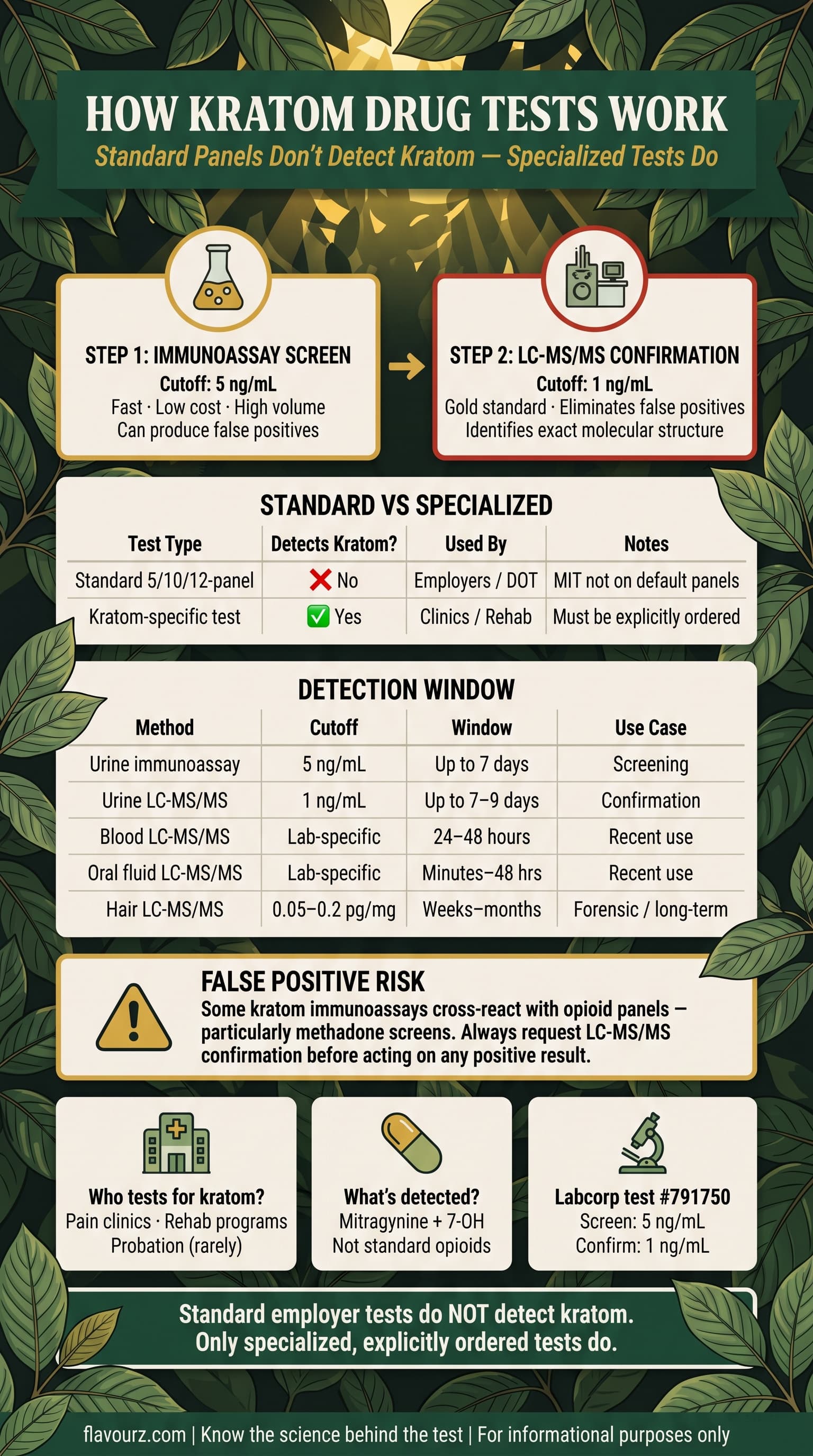
Specialized kratom tests use two main methods:
Immunoassay Screening
The initial screening uses immunoassay technology with antibodies designed to detect kratom alkaloids. Labcorp and MedTox screen at a cutoff of 5 ng/mL. This is a relatively low threshold, meaning even moderate use can be detected.
Immunoassay screens are fast and relatively inexpensive, making them practical for high-volume testing. However, they can produce false positives, so positive results typically require confirmation.
Confirmatory Testing (LC-MS/MS)
Positive immunoassay results are confirmed using liquid chromatography-tandem mass spectrometry (LC-MS/MS) or gas chromatography-mass spectrometry (GC-MS). These methods identify and quantify specific alkaloids with high accuracy.
Labcorp confirms at 1 ng/mL by LC-MS/MS, meaning even low-level use can be verified when specifically tested. This confirmation step eliminates false positives by identifying the exact molecular structure of detected compounds.
Can Kratom Cause False Positives?
Kratom does not typically cause false positives on standard opioid panels. Despite activating similar receptors, mitragynine's molecular structure is chemically distinct from morphine, codeine, and other opioids these tests detect.
However, there is one documented exception:
Methadone False Positives
Research published in the American Journal of Clinical Pathology found that a kratom metabolite can cause false positive results on the Thermo Scientific CEDIA Methadone Metabolite (EDDP) immunoassay. In the documented case, a patient tested positive for EDDP (a methadone metabolite) on the immunoassay screen, but confirmatory mass spectrometry testing was negative for both methadone and EDDP. The patient had been using kratom powder.
This cross-reactivity appears to be specific to certain immunoassay platforms. It's uncommon but documented. If you use kratom and receive an unexpected positive result for methadone, request confirmatory testing with mass spectrometry.
What to Do If You Get a False Positive
- Request confirmatory testing: GC-MS or LC-MS/MS will definitively identify whether methadone or kratom metabolites are present
- Disclose kratom use: Inform the testing authority or Medical Review Officer (MRO) that you use kratom
- Provide documentation: If you purchase from reputable vendors with lab testing, Certificates of Analysis (COAs) can demonstrate you're using pure kratom products
DOT Drug Testing and Kratom
The Department of Transportation (DOT) regulates drug testing for safety-sensitive transportation employees including truck drivers, pilots, train operators, and others. The standard DOT 5-panel test screens for:
- Marijuana (THC)
- Cocaine
- Amphetamines/Methamphetamines
- Opioids (codeine, morphine, heroin, hydrocodone, hydromorphone, oxycodone, oxymorphone)
- Phencyclidine (PCP)
Kratom is not included in standard DOT testing. Quest Diagnostics confirms that their DOT 5-drug panel does not screen for kratom analytes.
However, employers in DOT-regulated industries can implement additional testing policies beyond the federal minimum. Some companies with strict substance policies may add kratom to their testing panels as an extended test. Check your specific employer's drug policy rather than assuming DOT minimums apply.
Kratom and Employment Drug Tests
For most employment situations, kratom use will not affect your drug test results. The vast majority of employers use standard 5-panel or 10-panel tests that don't detect kratom.
Questions to consider:
- Does your employer have a specific kratom policy? Some companies prohibit kratom even if they don't test for it. Read your employee handbook.
- Is your state one where kratom is banned? If kratom is illegal in your state (Alabama, Arkansas, Connecticut, Indiana, Louisiana, Vermont, Wisconsin), employers may be more likely to test for it.
- Do you work in a safety-sensitive role? Jobs involving heavy machinery, transportation, healthcare, or childcare may have stricter testing requirements.
In states where kratom is legal, most employers cannot take action for legal substance use outside of work unless it affects job performance. However, employers can prohibit kratom under workplace safety policies if they choose.
Kratom Detection: Urine vs Blood vs Hair
| Method | Detection Window | Advantages | Limitations |
|---|---|---|---|
| Urine | 1-9 days | Most validated; good detection window | Requires specialized test |
| Blood | 24-48 hours | Shows recent use and amount | Short window; invasive collection |
| Saliva | 24-48 hours | Non-invasive; good for recent use | Very short detection window |
| Hair | Up to 90 days | Documents long-term use patterns | Less validated for kratom; expensive |
Urine Testing Details
Urine is the most common matrix for specialized kratom testing. Mitragynine and its metabolites appear in urine approximately 6 hours after ingestion and can be detected for up to 9 days in heavy users. Clinical lab guidance typically cites 5 days for occasional users.
ARUP Laboratories offers a kratom (mitragynine) screen with reflex to confirmation that detects the presence of kratom alkaloids. The test identifies mitragynine, the primary mood-altering opioid receptor agonist in kratom.
Blood Testing Details
Blood tests show both presence and concentration of kratom alkaloids, making them useful for determining recent use and approximate dosage. Mitragynine is detectable in blood within 1-2 hours of ingestion but clears within 24-48 hours in most cases.
Blood testing for kratom is uncommon in employment contexts due to the short detection window and invasive collection requirements. It's more often used in clinical, forensic, or emergency medicine settings.
Hair Testing Details
Hair testing can theoretically detect kratom for up to 90 days, as alkaloids deposit in growing hair follicles. Validated LC-MS/MS methods achieve detection limits as low as 0.05 pg/mg for mitragynine.
However, hair testing for kratom is rarely used outside forensic contexts. According to Keystone Labs, research on reliable kratom hair testing is still ongoing. Most standard hair drug panels don't include kratom.
How to Pass a Kratom Drug Test
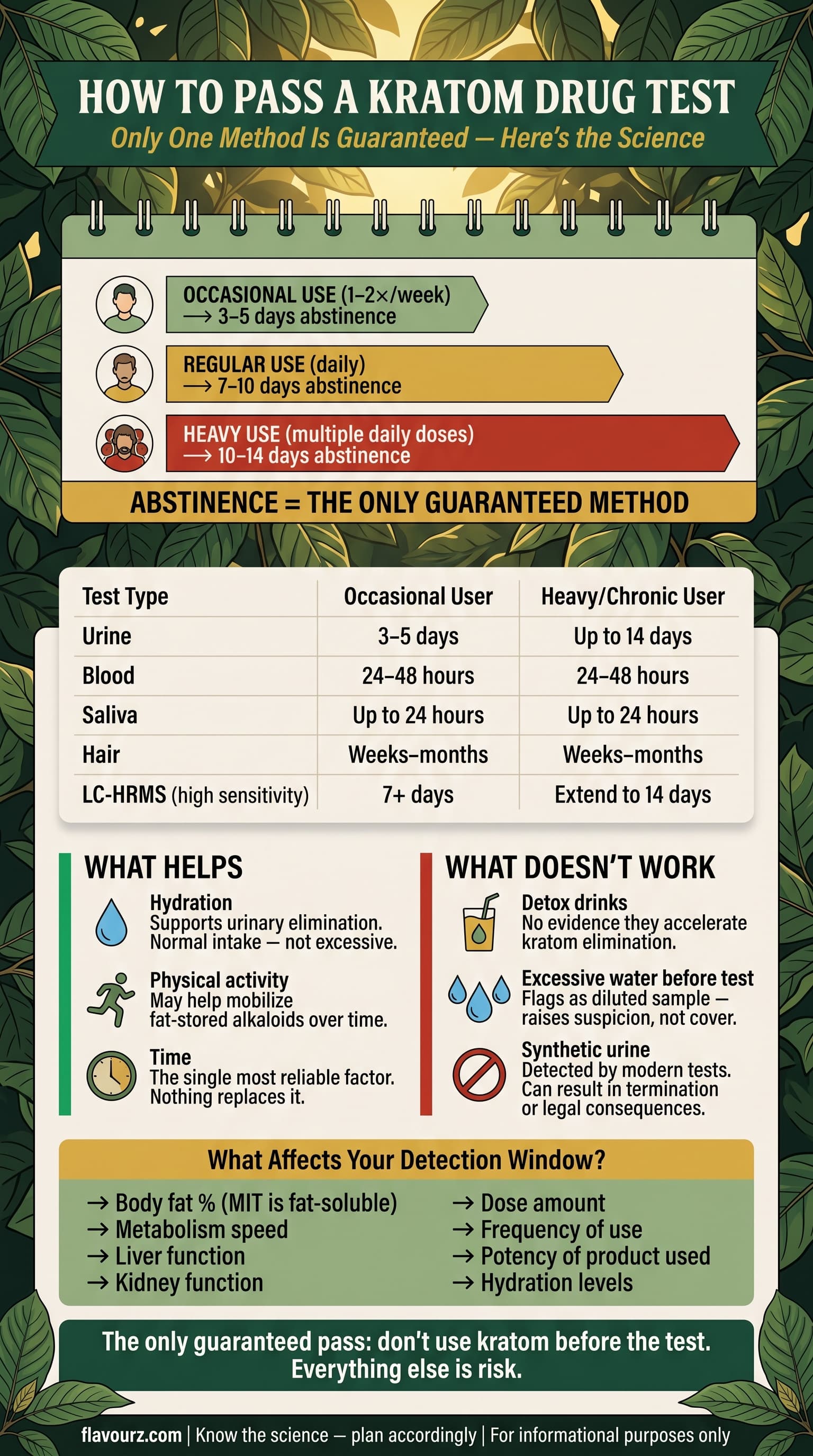
The only guaranteed way to pass a kratom-specific drug test is to not use kratom for a sufficient period before testing. Based on detection window data:
- Occasional users (1-2 times weekly): 3-5 days abstinence typically sufficient
- Regular users (daily): 7-10 days abstinence recommended
- Heavy users (multiple daily doses): 10-14 days may be needed
Factors that may help elimination:
- Adequate hydration (supports urinary elimination)
- Physical activity (may help mobilize fat-stored alkaloids)
- Time (the most reliable factor)
What doesn't work:
- Detox drinks and supplements (no evidence they accelerate kratom elimination)
- Excessive water consumption immediately before testing (may flag as diluted sample)
- Synthetic urine (easily detected by modern testing; can result in termination or legal consequences)
If you're facing a known kratom-specific test, the practical approach is abstinence for an appropriate period based on your usage pattern.
Buying Quality Kratom: Avoiding Contamination Issues
One often-overlooked testing concern: contaminated kratom products. The American Kratom Association warns that some kratom products have been found adulterated with actual opioids including fentanyl, heroin, buprenorphine, and morphine. Using contaminated products could cause a genuine positive result for opioids on standard drug tests.
To minimize this risk:
- Buy from vendors with third-party lab testing
- Look for AKA GMP certification
- Request Certificates of Analysis (COAs) for specific batches
- Avoid gas station or convenience store kratom products
- Be skeptical of unusually cheap kratom
At Flavourz Kratom, every batch undergoes third-party testing. We've been serving customers since 1999 and understand that product purity matters for many reasons beyond effects. Browse our selection of kratom powder, capsules, and extracts.
Frequently Asked Questions
Will kratom show up on a 5-panel drug test?
No. Standard 5-panel drug tests screen for marijuana, cocaine, amphetamines, opioids, and PCP. Kratom's alkaloids are chemically distinct and not detected by these tests.
Will kratom show up on a 10-panel drug test?
No. The 10-panel test adds barbiturates, benzodiazepines, methadone, propoxyphene, and methaqualone to the 5-panel substances. Kratom is still not included unless specifically ordered as a separate test.
How long does kratom stay in urine?
Kratom metabolites are detectable in urine for 1-9 days depending on usage frequency. Occasional users typically clear it within 2-3 days, while daily heavy users may test positive for 7-9 days.
Does the military test for kratom?
Routine military urinalysis does not include kratom nationwide. However, the Department of Defense banned kratom in September 2025, and targeted testing can be ordered if kratom use is suspected. Service members face disciplinary action for kratom use.
Does DOT test for kratom?
No. The standard DOT 5-panel drug test does not include kratom. However, individual employers in DOT-regulated industries may add kratom to their testing policies as an extended test.
Can kratom cause a false positive for opioids?
Generally no. Kratom does not cross-react with standard opioid immunoassays. However, research has documented false positives for methadone metabolites (EDDP) on certain Thermo Scientific immunoassay platforms. Confirmatory mass spectrometry testing resolves this.
What should I do if I fail a drug test for kratom?
Request confirmatory testing to verify the result. If you're in a jurisdiction where kratom is legal and your employer doesn't specifically prohibit it, discuss the result with the Medical Review Officer (MRO). Policies vary by employer and jurisdiction.
How do I know if my employer tests for kratom?
Review your employee handbook or ask HR about your company's drug testing policy. Most standard employment drug tests don't include kratom unless specifically requested. Safety-sensitive industries and companies in states where kratom is banned are more likely to test.
Is there a way to speed up kratom elimination?
Time is the primary factor. Staying hydrated supports urinary elimination, and physical activity may help mobilize alkaloids stored in fat tissue. There's no proven "detox" method that significantly accelerates kratom clearance beyond these basics.
The Bottom Line
Standard drug tests do not detect kratom. The 5-panel and 10-panel urine screens used by most employers test for completely different substances. You can use kratom without worrying about failing a routine employment drug test.
However, specialized kratom tests exist and are used by military branches, treatment centers, some probation offices, and certain employers. These tests can detect kratom for 1-9 days in urine depending on usage patterns. If you're in a situation where kratom-specific testing is possible, plan accordingly.
The key takeaways:
- Standard drug tests (5-panel, 10-panel) don't detect kratom
- Specialized tests must be specifically ordered and paid for
- Military personnel should not use kratom (banned September 2025)
- False positives for methadone are rare but documented
- Detection windows vary from 1-9 days in urine based on usage
- Buy quality products to avoid contamination with actual opioids
For more information on kratom basics, read our complete kratom guide and beginner's guide. Learn about kratom legality by state and explore the effects of different kratom strains.
Disclaimer: This article provides general information about drug testing and does not constitute legal or medical advice. Drug testing policies vary by employer, jurisdiction, and circumstance. Consult with your employer's HR department or a legal professional for questions specific to your situation. Kratom is not FDA-approved for any medical use and may be illegal in some states.

Leave a comment