

Kratom Illegal States 2026: Complete Legal Map by State
Last Updated: April 2026
Seven states have completely banned kratom as of April 2026: Alabama, Arkansas, Connecticut, Indiana, Louisiana, Vermont, and Wisconsin. Washington D.C. also prohibits kratom. California has implemented a statewide enforcement campaign that effectively bans retail sales, though no statute exists. Meanwhile, Rhode Island became the first state in U.S. history to reverse a kratom ban, with legal regulated sales beginning April 1, 2026. In legal states, knowing where to safely buy kratom online ensures you get compliant products that meet local regulations.
After working with Flavourz Kratom for over 5 years and helping customers across all 50 states, I've watched this legal landscape shift dramatically. We've had to stop shipping to Louisiana in August 2025 and Connecticut in March 2026. But we've also seen progress: 17+ states now have Kratom Consumer Protection Acts that regulate rather than prohibit. This guide breaks down exactly where kratom stands in every state so you know what's legal in your area.
States Where Kratom Is Completely Banned
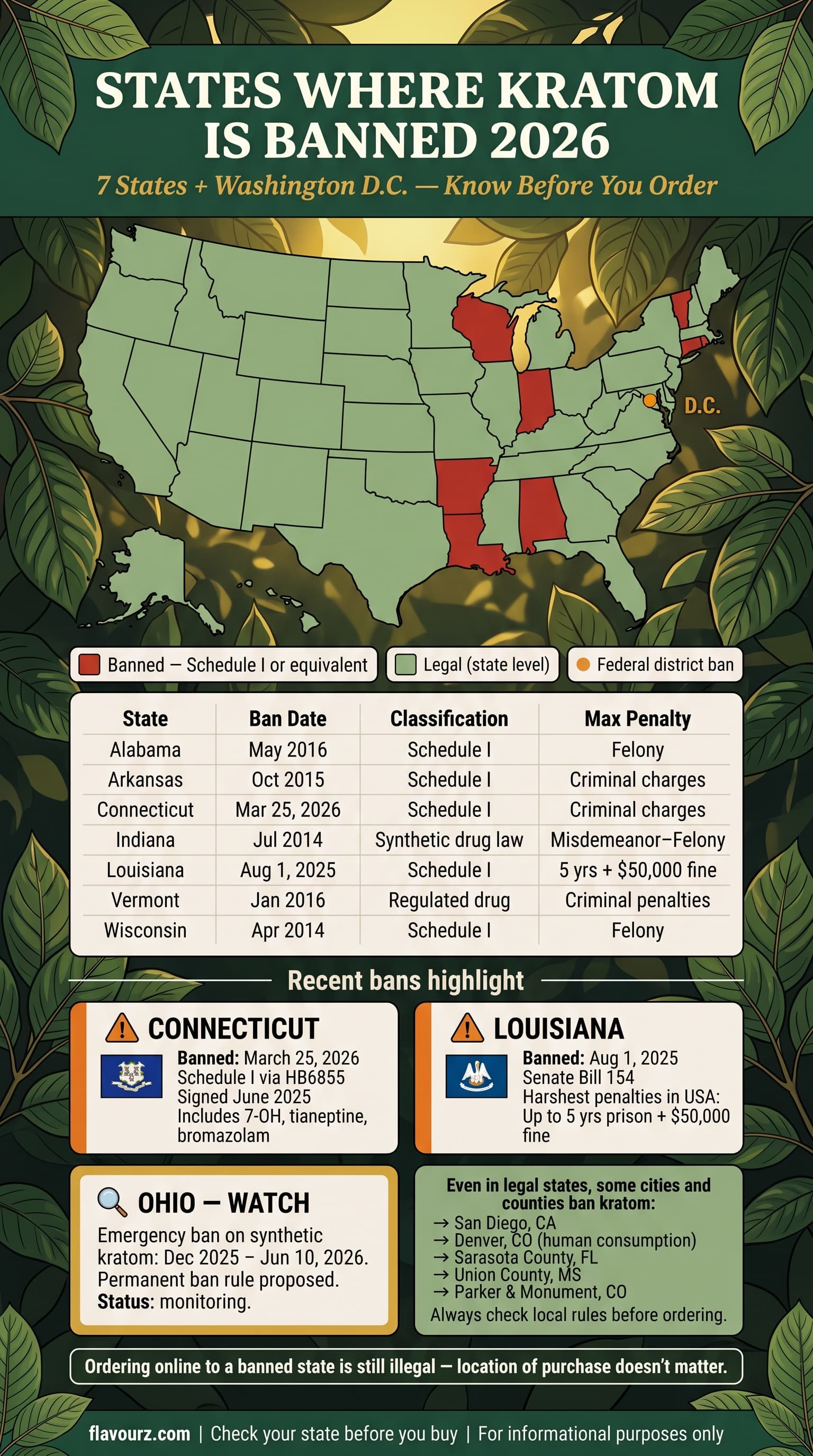
Seven states classify kratom or its alkaloids as Schedule I controlled substances, making possession, sale, and distribution illegal. Penalties vary but can include criminal charges, fines, and imprisonment.
| State | Ban Date | Classification | Penalties |
|---|---|---|---|
| Alabama | May 2016 | Schedule I | Felony charges possible |
| Arkansas | October 2015 | Schedule I | Criminal penalties |
| Connecticut | March 25, 2026 | Schedule I | Criminal charges |
| Indiana | July 2014 | Synthetic drug law | Misdemeanor to felony |
| Louisiana | August 1, 2025 | Schedule I | Up to 5 years, $50,000 fine |
| Vermont | January 2016 | Regulated drug | Criminal penalties |
| Wisconsin | April 2014 | Schedule I | Felony charges possible |
Washington D.C. also banned kratom in August 2025, though it's a federal district rather than a state.
Connecticut: The Most Recent Ban
Connecticut became the eighth jurisdiction to ban kratom when it classified the substance as Schedule I effective March 25, 2026. The Connecticut Department of Consumer Protection and Attorney General William Tong announced that kratom, along with tianeptine (often called "gas station heroin"), bromazolam, and several other substances, are now illegal to possess, manufacture, sell, or distribute.
Businesses were required to remove all kratom products from shelves immediately. Products had to be destroyed or returned to wholesalers before the March 25 deadline. The ban was included in HB6855, a hemp regulation bill signed by Governor Ned Lamont in June 2025.
Louisiana: Steep Penalties
Louisiana's ban carries some of the harshest penalties in the country. Effective August 1, 2025, violations can result in up to 5 years imprisonment and fines up to $50,000. The state classified kratom alkaloids as Schedule I controlled dangerous substances through Senate Bill 154.
California: Effective Ban Without Statute
California presents a unique situation. While no state law explicitly bans kratom, the California Department of Public Health (CDPH) declared in October 2025 that kratom products cannot legally be sold as food, dietary supplements, or drugs under existing state and federal law. Enforcement began in January 2026.
Key enforcement actions:
- Over $5 million in kratom products seized statewide
- 2,600+ retail locations visited by ABC agents
- 95% compliance rate achieved by March 2026 according to Governor Newsom's office
- Consumer reporting hotline established: (800) 495-3232
Penalties for retailers include daily fines up to $1,000 and license revocation. While personal possession hasn't been criminalized, purchasing kratom within California is essentially impossible through legal channels.
Two bills are working through the legislature that could change the landscape: Assembly Bill 1088 would restrict sales to those 21+ with labeling requirements, while Senate Bill 758 would make selling synthetic concentrated alkaloids a misdemeanor.
Rhode Island: First State to Reverse a Ban
In a historic move, Rhode Island became the first U.S. state to reverse a kratom ban. Governor Dan McKee signed the Rhode Island Kratom Act in July 2025, and legal regulated sales began April 1, 2026. The state had banned kratom since 2017.
Rhode Island's regulatory framework includes:
- 21+ age requirement for purchases
- Licensing system for retailers
- Mandatory product testing standards
- Labeling requirements (serving size, ingredients, manufacturer info)
- Ban on adulterated products and synthetic alkaloid concentrates
- Limits on concentrated alkaloid content (no more than 0.5mg per gram or 1mg per serving)
This reversal marks a significant shift in the national conversation around kratom regulation. The American Kratom Association called it "a monumental milestone for the entire kratom community."
States With Kratom Consumer Protection Acts (KCPA)
Over 17 states have adopted Kratom Consumer Protection Acts or similar regulatory frameworks. These laws regulate kratom rather than ban it, establishing safety standards while preserving consumer access.
| State | Year Enacted | Age Limit | Notes |
|---|---|---|---|
| Arizona | 2019 | 18+ | First KCPA state |
| Colorado | 2022 | 21+ | Bans candy/vape forms |
| Florida | 2023 | 21+ | Synthetic concentrates banned Aug 2025 |
| Georgia | 2019/2025 | 21+ | Behind-counter requirement |
| Kentucky | 2024 | 21+ | Additional 2025-2026 legislation pending |
| Maryland | 2024 | 21+ | Labeling requirements |
| Mississippi | 2025 | 21+ | Local bans still exist |
| Nebraska | 2025 | 21+ | Signed May 2025 |
| Nevada | 2019 | 18+ | Labeling requirements |
| Oklahoma | 2021 | 18+ | Testing requirements |
| Oregon | 2022 | 21+ | Synthetic ban included |
| Rhode Island | 2025 (eff. 2026) | 21+ | First ban reversal |
| South Carolina | 2025 | 21+ | Recent addition |
| South Dakota | 2024 | 21+ | Testing requirements |
| Texas | 2023 | 18+ | HSC Chapter 444 |
| Utah | 2019 | 18+ | First state to pass KCPA |
| Virginia | 2022 | 21+ | Labeling requirements |
| West Virginia | 2023 | 21+ | Testing requirements |
KCPA laws typically require: age verification (usually 21+), prohibition on adulterated or synthetic products, mandatory labeling and testing, retailer registration, and bans on products marketed to children.
States With Local Bans or Restrictions
Even in states where kratom is legal, some cities and counties have enacted their own restrictions. Always check local ordinances before purchasing.
California Local Bans (Pre-Statewide Enforcement)
- San Diego: Banned since 2016 (Ordinance 20657)
- Oceanside: Complete ban
- Newport Beach: Complete ban since 2024
- Los Angeles County: Active product seizures
Colorado Local Restrictions
- Denver: Requires consumer advisory warning labels
- Parker: Banned for sale (possession allowed)
- Monument: Banned for sale (possession allowed)
- Greenwood Village: Local ban
- Castle Rock: 18+ age requirement
Florida
- Sarasota County: Local ban since 2014 (only exception to state KCPA)
Illinois
- Jerseyville: Complete ban
- Alton: Complete ban
- Edwardsville: Complete ban
- Naperville: 21+ age requirement
Mississippi
Despite the state KCPA signed April 2025, numerous cities and counties maintain local bans.
New Hampshire
- Franklin: Local restrictions
Complete State-by-State Legal Status
| State | Status | Notes |
|---|---|---|
| Alabama | BANNED | Schedule I since 2016 |
| Alaska | Legal | No restrictions |
| Arizona | KCPA | 18+ age limit |
| Arkansas | BANNED | Schedule I since 2015 |
| California | Restricted | CDPH enforcement campaign |
| Colorado | KCPA | 21+, local bans exist |
| Connecticut | BANNED | Schedule I as of March 25, 2026 |
| Delaware | Legal | No restrictions |
| Florida | KCPA | 21+, synthetic concentrates banned |
| Georgia | KCPA | 21+, behind-counter sales |
| Hawaii | Legal | No restrictions |
| Idaho | Legal | No restrictions |
| Illinois | Legal | Local bans exist |
| Indiana | BANNED | Synthetic drug law since 2014 |
| Iowa | Legal | Ban bill under consideration |
| Kansas | Legal | KCPA bill under consideration |
| Kentucky | KCPA | Signed April 2024 |
| Louisiana | BANNED | Schedule I as of August 2025 |
| Maine | Legal | No restrictions |
| Maryland | KCPA | Signed 2024 |
| Massachusetts | Legal | Ban and KCPA bills filed 2026 |
| Michigan | Legal | No restrictions |
| Minnesota | Legal | Some seizures, local bans proposed |
| Mississippi | KCPA | Signed April 2025, local bans exist |
| Missouri | Legal | KCPA under consideration 2026 |
| Montana | Legal | KCPA and ban bills likely 2026 |
| Nebraska | KCPA | Signed May 2025 |
| Nevada | KCPA | Passed 2019 |
| New Hampshire | Legal | Local restrictions in Franklin |
| New Jersey | Legal | No restrictions |
| New Mexico | Legal | No restrictions |
| New York | Legal | No restrictions |
| North Carolina | Legal | No restrictions |
| North Dakota | Legal | No restrictions |
| Ohio | Restricted | Emergency ban on concentrates; natural leaf legal |
| Oklahoma | KCPA | Passed 2021 |
| Oregon | KCPA | 21+, synthetic ban |
| Pennsylvania | Legal | No restrictions |
| Rhode Island | KCPA | Legal as of April 1, 2026 |
| South Carolina | KCPA | Passed 2025 |
| South Dakota | KCPA | Passed 2024 |
| Tennessee | Legal | 21+, HB 1649 ban bill advancing |
| Texas | KCPA | HSC Chapter 444 |
| Utah | KCPA | First KCPA state (2019) |
| Vermont | BANNED | Regulated drug since 2016 |
| Virginia | KCPA | Passed 2022 |
| Washington | Legal | No restrictions |
| West Virginia | KCPA | Passed 2023 |
| Wisconsin | BANNED | Schedule I since 2014 |
| Wyoming | Legal | No restrictions |
| Washington D.C. | BANNED | Banned August 2025 |
Why States Are Banning Kratom
The push for kratom bans stems from several factors:
Concentrated synthetic products: Many recent bans specifically target products containing unnaturally high levels of concentrated alkaloids. These synthetically concentrated products act more like powerful opioids and carry higher risks of addiction and adverse effects. Florida, Ohio, and Colorado have all implemented targeted bans on these concentrates while keeping natural leaf legal.
FDA warnings: The FDA has issued multiple consumer advisories citing adverse event reports including seizures, hospitalizations, and deaths. The agency has not approved kratom for any medical use.
Poison control data: California cited year-over-year increases in kratom-related poison control calls as justification for enforcement action. Laboratory testing also revealed heavy metals, bacterial contaminants, and undisclosed synthetic opioids in certain unregulated products.
Lack of federal regulation: Without federal scheduling or FDA approval, individual states have become the battleground for kratom policy. This creates a confusing patchwork where kratom might be legal in one state but banned in the next.
The Case Against Bans
The American Kratom Association and advocacy groups argue that regulation, not prohibition, is the better approach:
- Survey data: A 2025 Johns Hopkins study found that nearly half (49.1%) of kratom users meet criteria for chronic pain, with most reporting substantial relief
- Low abuse potential: The same research found that subjective "drug liking" scores never reached statistical significance compared to placebo at typical doses
- Consumer access: An estimated 10-16 million Americans use kratom regularly
- Harm reduction: Many users report using kratom as a substitute for opioids or alcohol
Rhode Island's reversal demonstrates that states can transition from prohibition to regulated access. The KCPA model provides consumer protections (age limits, testing, labeling) without eliminating access entirely.
What to Do If Kratom Is Banned in Your State
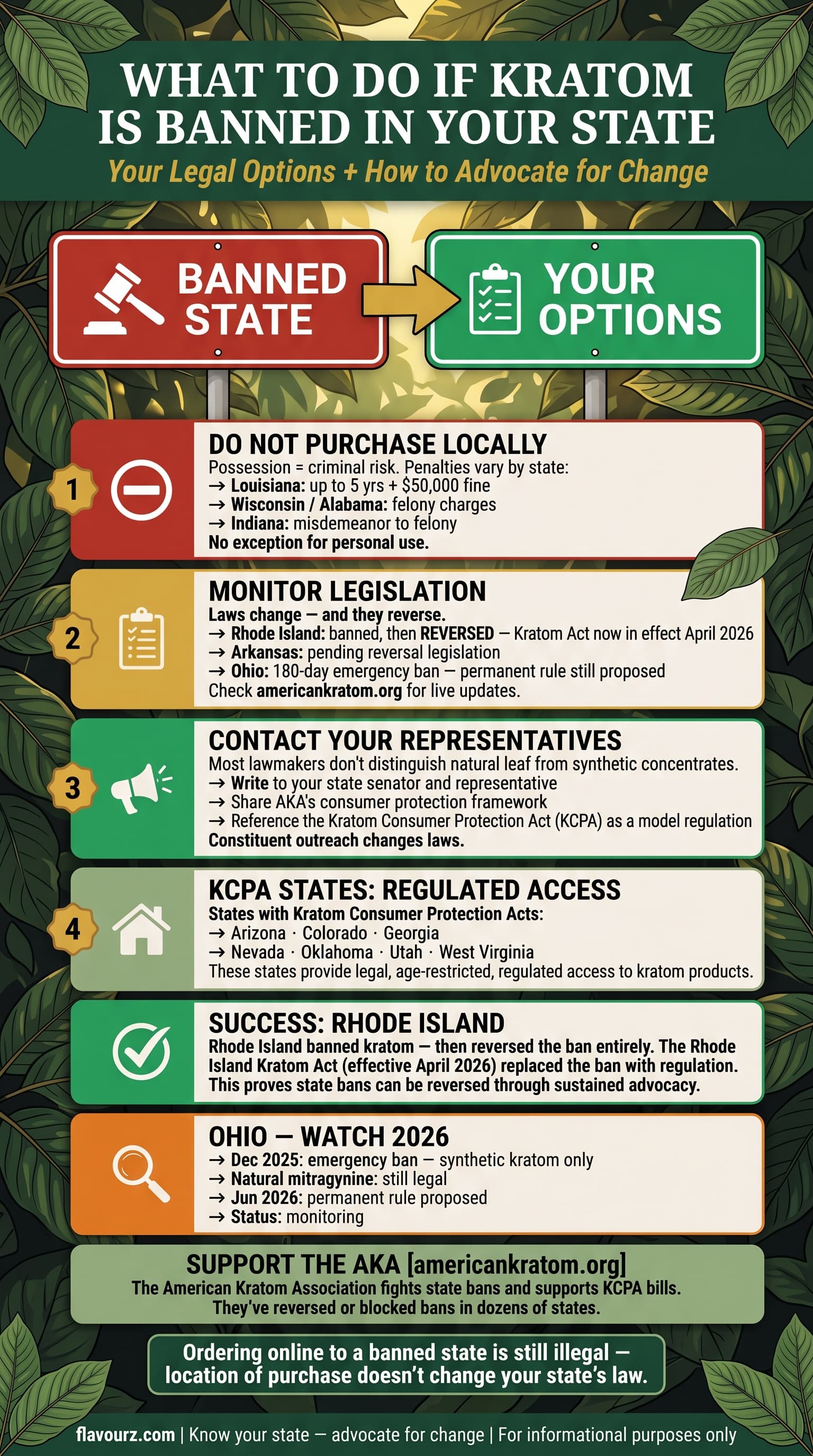
If you live in a banned state, here are your options:
Do NOT attempt to purchase locally. Possession can result in criminal charges, fines, and imprisonment depending on your state's penalties.
Stay informed about legislation. Laws change. Arkansas, for example, has pending legislation that could potentially reverse its ban. Monitor your state legislature and support advocacy organizations like the American Kratom Association if you want to see change.
Contact your representatives. Many lawmakers aren't familiar with kratom or the difference between natural leaf and synthetic concentrates. Constituent outreach matters.
Consider relocation if kratom is essential to your wellness routine. This is obviously a major decision, but some people have moved to KCPA states for consistent access to regulated products.
Buying Kratom in Legal States
If you're in a state where kratom is legal, quality matters more than ever. With the crackdown on problematic products driving enforcement actions, buying from reputable vendors protects both you and the broader kratom community.
Look for:
- AKA GMP certification
- Third-party lab testing with accessible COAs
- Age verification at checkout
- Clear labeling with ingredients and manufacturer info
- Established vendors with track records
At Flavourz Kratom, we've been serving customers since 1999 and ship to all legal states. We verify your state's legal status before processing orders and will not ship to banned jurisdictions. Browse our selection of kratom powder, capsules, and extracts.
Frequently Asked Questions
Is kratom legal in the United States federally?
Yes. Kratom is not scheduled as a controlled substance at the federal level. The DEA attempted to temporarily classify kratom as Schedule I in 2016 but reversed course after unprecedented public pushback. This means states set their own kratom policies.
Which states have banned kratom in 2026?
Seven states have complete bans: Alabama, Arkansas, Connecticut (March 2026), Indiana, Louisiana (August 2025), Vermont, and Wisconsin. Washington D.C. also prohibits kratom. California has an active enforcement campaign that effectively bans retail sales.
Can I travel with kratom to a banned state?
No. Possessing kratom in a banned state is illegal regardless of where you purchased it or where you live. This includes traveling through banned states. If you're flying, check both departure and arrival state laws.
What is the Kratom Consumer Protection Act?
The KCPA is model legislation that regulates kratom rather than banning it. It typically includes age restrictions (usually 21+), prohibitions on adulterated or synthetic products, mandatory labeling and testing, and retailer registration. Over 17 states have adopted KCPA or similar frameworks.
Will my state ban kratom?
Impossible to predict with certainty. Monitor your state legislature for pending bills. States considering bans include Iowa, Massachusetts, Montana, and Tennessee. States considering KCPA include Kansas, Missouri, and Michigan.
Is kratom legal in California?
Technically no state statute bans kratom, but the California Department of Public Health has declared kratom products illegal to sell under existing food and drug law. Enforcement began January 2026. Over $5 million in products have been seized statewide.
What happened in Rhode Island?
Rhode Island became the first U.S. state to reverse a kratom ban. The state had banned kratom since 2017, but Governor Dan McKee signed the Rhode Island Kratom Act in July 2025. Legal regulated sales began April 1, 2026.
Can cities ban kratom even if the state allows it?
Yes. Local municipalities can enact their own ordinances. Notable examples include San Diego and Oceanside in California, Denver in Colorado, Sarasota County in Florida, and several Illinois cities. Always check local laws in addition to state laws.
Stay Updated
Kratom laws change frequently. This guide reflects the legal landscape as of April 2026, but new legislation can pass at any time. For the most current information:
- Check the American Kratom Association's legal status page
- Search your state legislature's website for pending kratom bills
- Contact your local city clerk's office for municipal ordinances
- Consult a local attorney if you have specific legal questions
For more information on kratom basics, read our complete kratom guide and beginner's guide. Learn about different kratom strains and explore our selection of red vein, green vein, and white vein kratom.
Disclaimer: This article provides general information about kratom's legal status and does not constitute legal advice. Laws change frequently. Always verify current laws in your specific state, county, and city before purchasing or possessing kratom. Consult a local attorney for legal questions specific to your situation. Kratom has not been approved by the FDA for any medical use.

Leave a comment