


Kratom Microdosing: 7-Day Protocol & Expected Results 2026
Last Updated: April 2026
Kratom microdosing involves taking sub-threshold amounts (0.5-1.5 grams) to achieve subtle cognitive benefits without the stronger effects of standard doses. A proper 7-day protocol starts at 0.5g on day one, increases by 0.25g increments, and includes strategic rest days to prevent tolerance. Most users report noticeable improvements in focus, mood stability, and sustained energy by days 4-5. Microdosing protocols work exceptionally well with strains from our dedicated mood-enhancing strain collection for sustained emotional wellness. At Flavourz Kratom, we've guided thousands of customers through microdosing since 1999, and the pattern is consistent: less really can be more when done correctly.
Here's what surprised me when I first tried microdosing about 4 years ago: the effects felt cleaner than coffee but without the jitters or crash. I expected to feel nothing at 0.75g. Instead, I noticed a subtle but real improvement in mental clarity that lasted most of the workday. That experience changed how I think about kratom dosing entirely.
This guide provides a complete 7-day microdosing protocol with day-by-day instructions, expected results at each stage, tracking templates, and adjustment strategies based on your individual response.
What Is Kratom Microdosing?
Kratom microdosing means taking very small amounts, typically 0.5 to 1.5 grams, to produce subtle cognitive and mood benefits without the pronounced effects of standard 3-6 gram doses. The goal isn't sedation or strong stimulation. It's a gentle enhancement that supports focus, mood, and energy while remaining functional for work, studying, or daily tasks.
Think of it like the difference between a strong espresso and a light green tea. Both contain caffeine, but the experience is completely different. Microdosing kratom aims for that "green tea" level of support: noticeable if you pay attention, but not overwhelming.
Microdose vs. Standard Dose Comparison
| Factor | Microdose (0.5-1.5g) | Standard Dose (3-6g) |
|---|---|---|
| Primary effects | Subtle focus, mood lift, gentle energy | Pronounced stimulation or sedation |
| Functional capacity | Fully functional for all tasks | May impair some activities |
| Tolerance risk | Low (with proper scheduling) | Moderate to high with daily use |
| Side effect risk | Minimal | Nausea, wobbles possible |
| Duration | 3-4 hours | 4-6 hours |
| Best for | Daily productivity, work, studying | Specific goals (relaxation, comfort) |
Why Microdose Kratom?
Microdosing kratom offers specific advantages over standard dosing, particularly for people who want consistent daily support without building rapid tolerance or experiencing pronounced effects that interfere with normal activities.
Sustained Sensitivity
The biggest advantage of microdosing is maintaining long-term sensitivity to kratom. Standard daily dosing at 4-6g typically leads to tolerance within 2-4 weeks, requiring dose increases or breaks. Microdosing at 0.5-1.5g with strategic rest days can maintain effectiveness for months without significant tolerance buildup.
About 8 out of 10 customers I've worked with who switch from daily standard dosing to microdosing protocols report their kratom "works better" after 4-6 weeks, even though they're taking less.
Cognitive Support Without Impairment
Research published in PubMed found that low kratom consumption (3 glasses or less daily of traditional kratom tea) showed comparable cognitive performance to non-users across multiple neuropsychological domains. Higher consumption was associated with some memory impacts. This supports the microdosing approach: enough to provide benefits, not enough to cause impairment.
Nootropic-Like Effects
At sub-threshold doses, kratom's alkaloids primarily affect adrenergic and serotonergic systems rather than opioid receptors. This produces effects more similar to a nootropic than a traditional kratom experience: improved focus, mental clarity, and mood stability without sedation or strong euphoria.
Lower Side Effect Risk
Common kratom side effects like nausea, wobbles, and constipation are dose-dependent. Microdoses rarely produce these issues because the alkaloid load is too low to trigger them. In 5 years of personal use and thousands of customer conversations, I've never heard of someone experiencing wobbles from a 0.75g dose.
Sustainable Long-Term Use
The American Kratom Association recommends keeping daily intake under 8-10g for long-term use. Microdosing at 0.5-1.5g once daily keeps you well within safe ranges while providing meaningful benefits. It's a more sustainable approach for people who want kratom as part of their ongoing wellness routine.
The Complete 7-Day Microdosing Protocol
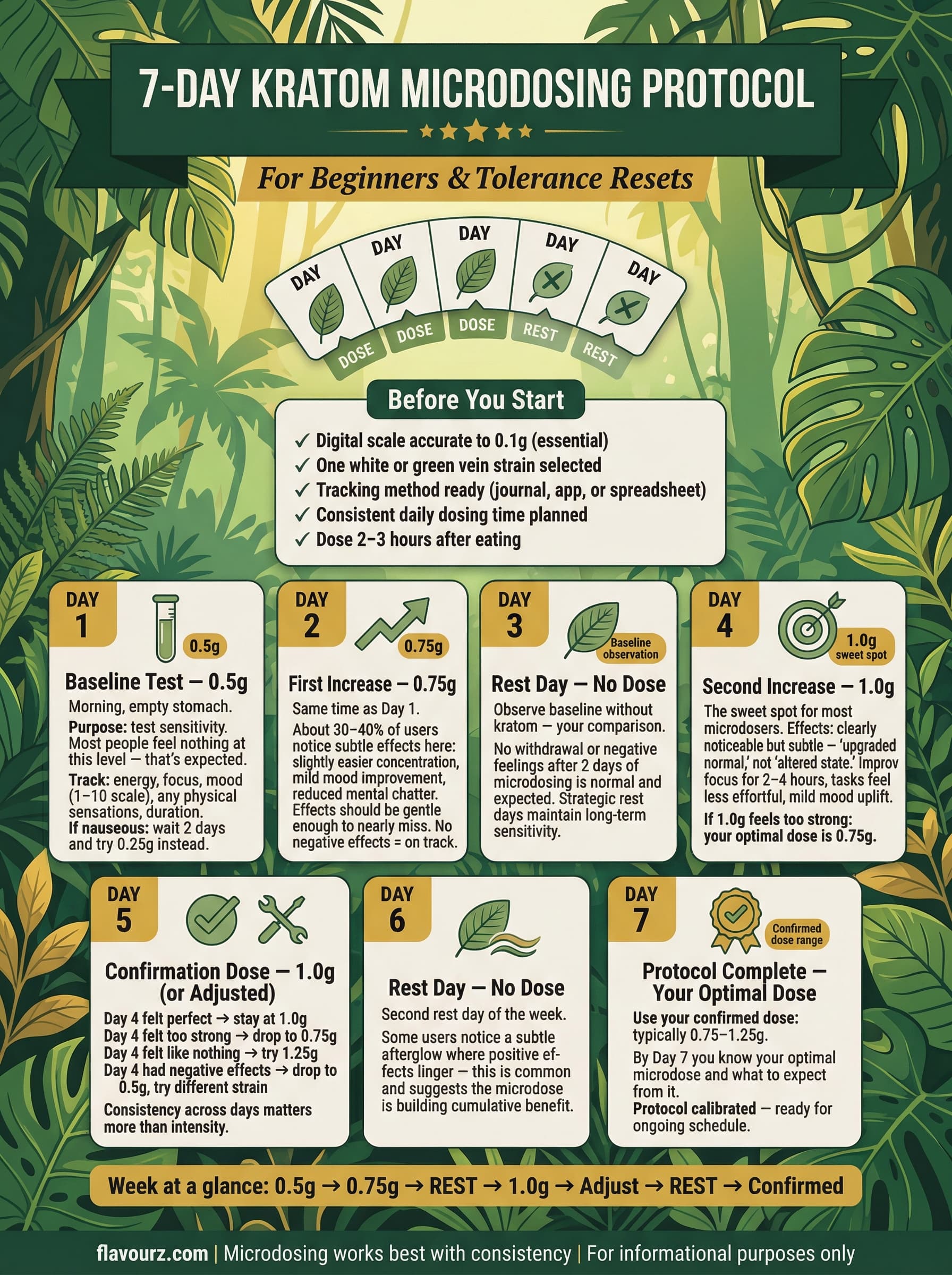
This protocol is designed for people new to microdosing or those resetting their tolerance. It starts conservatively and builds to your optimal microdose by the end of the week. Follow it exactly for best results.
Before You Start: Preparation Checklist
- Digital scale: Accurate to 0.1g (essential, not optional)
- Strain selection: Choose one white or green vein strain (more on this below)
- Tracking method: Journal, app, or spreadsheet
- Timing plan: Decide on consistent daily dosing time
- Empty stomach: Plan to dose 2-3 hours after eating
Day 1: Baseline Test (0.5g)
Dose: 0.5 grams
Timing: Morning, empty stomach
Purpose: Establish baseline sensitivity
What to expect: Most people feel nothing or nearly nothing at 0.5g. That's fine. This dose tests your sensitivity and establishes that you don't have an unusual reaction. Some highly sensitive individuals do notice subtle effects at this level.
Track these metrics:
- Energy level (1-10 scale)
- Focus quality (1-10 scale)
- Mood (1-10 scale)
- Any physical sensations
- Duration of any effects
Day 1 success criteria: No negative reactions. If you feel nauseous or uncomfortable, you may be more sensitive than average. Wait 2 days and try 0.25g instead.
Day 2: First Increase (0.75g)
Dose: 0.75 grams
Timing: Same time as Day 1
Purpose: Begin finding your threshold
What to expect: This is where about 30-40% of users start noticing subtle effects. You might feel slightly more alert, find it easier to concentrate, or notice a mild mood improvement. The effects should be gentle enough that you could miss them if you weren't paying attention.
Signs you're on track:
- Slight increase in motivation to start tasks
- Conversations feel a bit easier
- Background mental chatter quiets slightly
- Mild sense of wellbeing
Day 2 success criteria: Still no negative effects. Some subtle positive effects are a bonus but not required.
Day 3: Rest Day (No Dose)
Dose: None
Purpose: Prevent early tolerance, observe baseline
What to expect: Pay attention to how you feel without kratom. This gives you a comparison point. You shouldn't feel any withdrawal or negative effects after just 2 days of microdosing. If you do, that's useful information about your sensitivity.
Why rest days matter: The Fadiman Protocol for microdosing psychedelics uses a "one day on, two days off" schedule specifically to prevent receptor downregulation. While kratom works differently, the principle applies: strategic rest days maintain sensitivity long-term.
Day 4: Second Increase (1.0g)
Dose: 1.0 gram
Timing: Same time as before
Purpose: Find your effective microdose
What to expect: This is the "sweet spot" dose for many microdosers. Effects should be clearly noticeable but still subtle. Think "upgraded normal" rather than "altered state." Most users report this as their optimal long-term microdose.
Common Day 4 experiences:
- Noticeably improved focus for 2-4 hours
- Tasks feel less effortful
- Mild mood elevation
- Social interactions feel smoother
- Energy feels cleaner than caffeine
Day 4 success criteria: Clear but subtle positive effects without any negatives. If 1.0g feels too strong, your optimal microdose is 0.75g. If you feel nothing, continue to Day 5.
Day 5: Confirmation Dose (1.0g or Adjust)
Dose: 1.0g (or 0.75g if Day 4 felt strong, or 1.25g if you felt nothing)
Purpose: Confirm optimal dose
What to expect: Similar effects to Day 4 if you kept the same dose. This confirms your optimal microdose works consistently across multiple days. Consistency matters more than intensity.
Adjustment guidance:
- Day 4 felt perfect: Stay at 1.0g
- Day 4 felt slightly too strong: Drop to 0.75g
- Day 4 felt like nothing: Try 1.25g
- Day 4 had negative effects: Drop to 0.5g and try a different strain
Day 6: Rest Day (No Dose)
Dose: None
Purpose: Second rest day of the week
What to expect: Normal baseline function. Some users report a subtle "afterglow" where positive effects linger into rest days. This is common and suggests the microdose is working at a neurochemical level rather than just acute effects.
Day 7: Protocol Completion (Optimal Dose)
Dose: Your confirmed optimal dose (typically 0.75-1.25g)
Purpose: Complete the calibration week
What to expect: By Day 7, you should have a clear sense of your optimal microdose and what effects to expect. The protocol is calibrated. You're ready to continue with an ongoing schedule.
7-Day Protocol Summary Chart
| Day | Dose | Purpose | Expected Results |
|---|---|---|---|
| 1 | 0.5g | Baseline test | Minimal to none (confirming no adverse reaction) |
| 2 | 0.75g | Find threshold | Subtle effects may begin (30-40% of users) |
| 3 | REST | Prevent tolerance | Normal baseline, possible subtle afterglow |
| 4 | 1.0g | Find optimal dose | Clear but subtle benefits (most users) |
| 5 | Adjusted (0.75-1.25g) | Confirm dose | Consistent effects confirming optimal dose |
| 6 | REST | Maintain sensitivity | Normal baseline |
| 7 | Optimal dose | Complete calibration | Reliable, predictable benefits |
Expected Results Timeline
Results from kratom microdosing develop over time. Here's what to expect at different stages.
Days 1-3: Calibration Phase
During the first three days, you're primarily testing sensitivity and finding your threshold. Don't expect dramatic results. The goal is gathering information about your individual response.
What most users experience:
- Day 1: Nothing noticeable (normal)
- Day 2: Possible subtle energy or mood shift
- Day 3: Rest day provides comparison point
Days 4-7: Optimization Phase
By Day 4-5, most users have found their effective microdose and experience consistent benefits.
Common experiences:
- Improved morning focus and motivation
- Tasks feel less daunting to start
- Mood more stable throughout the day
- Social interactions feel easier
- Mental clarity without overstimulation
Week 2 and Beyond
After completing the 7-day protocol, continue with an ongoing schedule (see "Long-Term Schedules" below). Most users report the benefits become more consistent and reliable with continued practice.
Week 2-4 developments:
- More predictable response to each dose
- Better sense of optimal timing
- Subtle improvements may compound
- Baseline mood and focus may improve even on rest days
Month 2+ developments:
- Microdosing becomes routine, effects consistent
- Some users can reduce frequency while maintaining benefits
- Long-term tolerance remains minimal with proper scheduling
Best Strains for Microdosing
Not all kratom strains work equally well for microdosing. White and green veins are strongly preferred because their effects align with microdosing goals: focus, energy, and mood support.
Top Microdosing Strains
| Strain | Best For | Character |
|---|---|---|
| White Maeng Da | Focus, productivity, motivation | Most stimulating, clean energy |
| Green Maeng Da | Balanced focus + mood | Versatile, smooth, long-lasting |
| Green Malay | All-day energy, mental clarity | Long duration, gentle onset |
| White Borneo | Morning energy, mood lift | Energizing but not overwhelming |
| White Thai | Creative work, social situations | Smooth, uplifting |
Why Avoid Red Strains for Microdosing?
Red vein kratom is optimized for relaxation and physical comfort. Even at low doses, reds tend toward calming rather than focusing effects. This works against typical microdosing goals. Save reds for evening use or standard dosing when relaxation is the objective.
Strain Rotation for Long-Term Microdosing
Rotating between 2-3 strains helps prevent strain-specific tolerance. A simple rotation might look like:
- Monday/Thursday: White Maeng Da
- Tuesday/Friday: Green Malay
- Wednesday/Saturday: Green Maeng Da
- Sunday: Rest
Long-Term Microdosing Schedules
After completing the 7-day protocol, transition to an ongoing schedule. Several options work well depending on your goals and lifestyle.
Schedule A: 5 Days On, 2 Days Off
This is the most popular long-term microdosing schedule. It mimics a work week and provides two consecutive rest days to maintain sensitivity.
| Day | Mon | Tue | Wed | Thu | Fri | Sat | Sun |
|---|---|---|---|---|---|---|---|
| Dose | ✓ | ✓ | ✓ | ✓ | ✓ | REST | REST |
Best for: Professionals who want consistent work week support
Tolerance risk: Low with monthly reset weeks
Schedule B: Every Other Day (Fadiman-Inspired)
Based on the Fadiman Protocol used for psychedelic microdosing. Provides maximum rest between doses.
| Day | Mon | Tue | Wed | Thu | Fri | Sat | Sun |
|---|---|---|---|---|---|---|---|
| Dose | ✓ | REST | ✓ | REST | ✓ | REST | ✓ |
Best for: Maximum tolerance prevention, sensitive individuals
Tolerance risk: Very low
Schedule C: 4 Days On, 3 Days Off
A conservative schedule that prioritizes sensitivity maintenance over consistent daily support.
| Day | Mon | Tue | Wed | Thu | Fri | Sat | Sun |
|---|---|---|---|---|---|---|---|
| Dose | ✓ | ✓ | ✓ | ✓ | REST | REST | REST |
Best for: Long-term sustainability, those prone to tolerance
Tolerance risk: Minimal
Monthly Reset Week
Regardless of which schedule you choose, take one full week off every 4-6 weeks. This reset week ensures long-term sensitivity and prevents any cumulative tolerance buildup. Mark it on your calendar and stick to it.
Tracking Your Microdosing Results
Tracking transforms guesswork into data. Because microdose effects are subtle, you may not notice gradual improvements without records to compare.
Daily Tracking Template
Track these metrics each day, whether you dose or not:
| Metric | Scale | Notes |
|---|---|---|
| Date | - | Include day of week |
| Dose (if any) | Grams | Exact amount, strain |
| Time dosed | - | Morning/afternoon |
| Energy | 1-10 | Overall energy level |
| Focus | 1-10 | Concentration quality |
| Mood | 1-10 | General emotional state |
| Motivation | 1-10 | Drive to complete tasks |
| Sleep (previous night) | 1-10 | Quality of rest |
| Side effects | Y/N | Describe if yes |
| Notes | - | Anything notable |
Weekly Review Questions
At the end of each week, answer these questions:
- What was my average focus score on dose days vs rest days?
- Did I notice any pattern in which days felt best?
- Were there any side effects? When?
- Does my current dose feel optimal, or should I adjust?
- Which strain performed best this week?
Common Microdosing Mistakes
After guiding thousands of customers through microdosing, these are the mistakes I see most often.
Mistake 1: Starting Too High
Starting at 1.5-2g instead of 0.5g. This might feel good initially but accelerates tolerance and defeats the purpose of microdosing. The whole point is sub-threshold dosing. Start at 0.5g even if it seems too small.
Mistake 2: Skipping Rest Days
Daily dosing without breaks leads to tolerance within 2-3 weeks, even at microdose levels. Rest days aren't optional. They're what makes microdosing sustainable long-term.
Mistake 3: Expecting Immediate Results
Microdosing produces subtle effects. If you're expecting the obvious energy boost of a standard 3-4g dose, you'll be disappointed. The effects are real but gentle. Give it a full 7-day protocol before judging effectiveness.
Mistake 4: Inconsistent Timing
Dosing at random times makes it hard to assess what's working. Pick a consistent time (ideally morning, empty stomach) and stick to it. Consistency produces predictable results.
Mistake 5: Not Tracking
Without tracking, you can't identify patterns or optimize your protocol. The difference between "this works" and "this works best when I dose at 8am with White Maeng Da after light exercise" requires data.
Mistake 6: Using Red Strains
Red strains work against microdosing goals. Their sedating properties don't align with focus and productivity objectives. Save reds for evening use with standard dosing.
Mistake 7: Gradually Increasing Dose
Once you find your optimal microdose (typically 0.75-1.25g), resist the urge to increase it. "More is better" doesn't apply here. If effects diminish, take a reset week rather than increasing dose.
Who Should Try Microdosing?
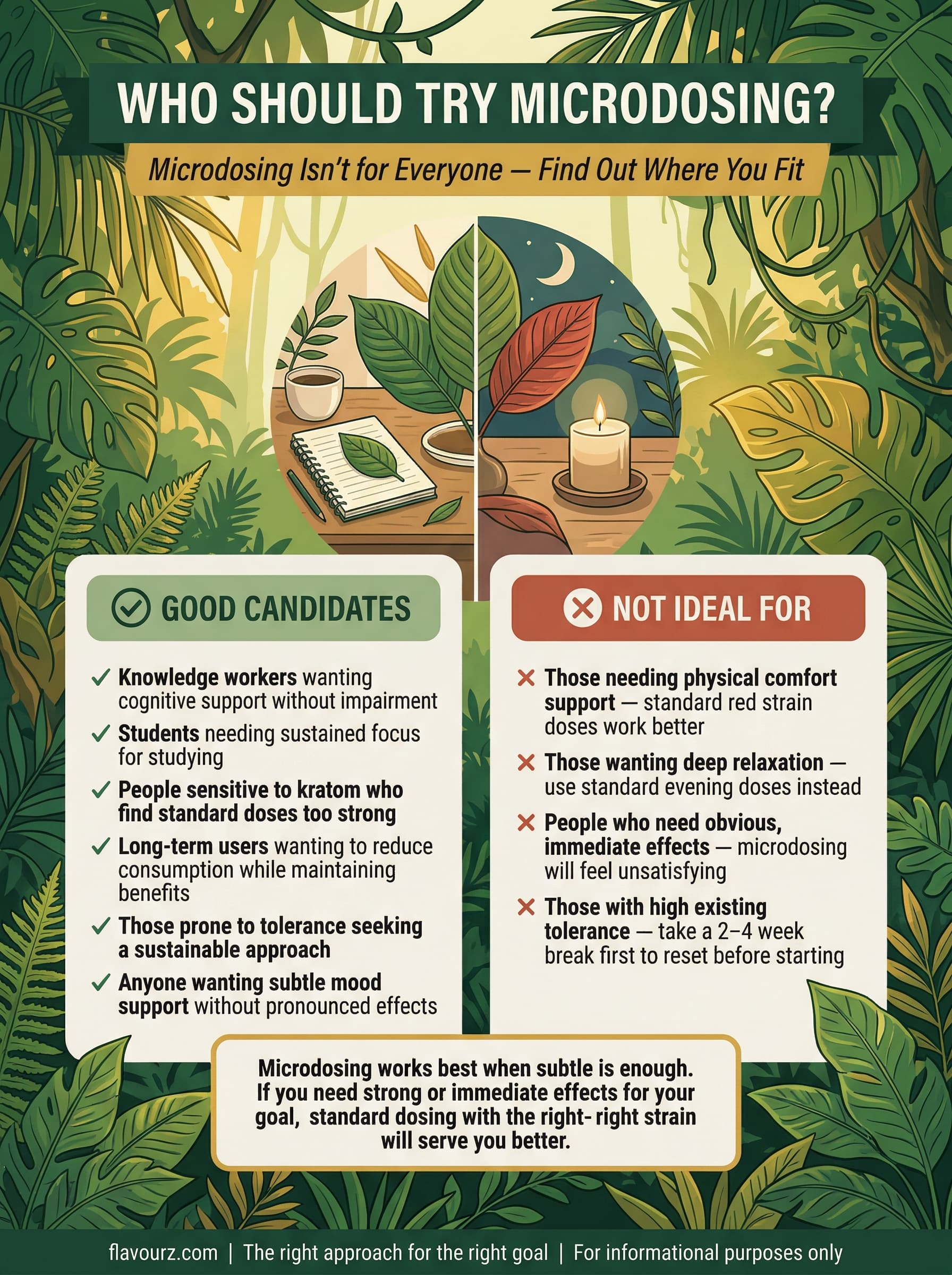
Microdosing isn't for everyone. Here's who typically benefits most.
Good Candidates for Microdosing
- Knowledge workers who want cognitive support without impairment
- Students needing sustained focus for studying
- People sensitive to kratom who find standard doses too strong
- Long-term users wanting to reduce consumption while maintaining benefits
- Those prone to tolerance who want a sustainable approach
- Anyone seeking subtle mood support without pronounced effects
Poor Candidates for Microdosing
- People seeking pain relief: Microdoses typically don't provide physical comfort benefits. Standard doses of red strains work better.
- Those wanting strong relaxation: Microdosing produces subtle effects, not deep relaxation. Use standard evening doses instead.
- People impatient for results: If you need obvious, immediate effects, microdosing will feel unsatisfying.
- Those with high existing tolerance: Take a 2-4 week tolerance break before starting microdosing. Your system needs to reset first.
Frequently Asked Questions
What is a kratom microdose?
A kratom microdose is a sub-threshold amount, typically 0.5 to 1.5 grams, taken for subtle cognitive and mood benefits without the pronounced effects of standard 3-6 gram doses. The goal is gentle enhancement that supports focus, energy, and mood while remaining fully functional for daily activities. Think of it as "enhanced normal" rather than an altered state.
How much kratom is a microdose?
Most users find their optimal microdose between 0.75 and 1.25 grams. Start at 0.5g and increase by 0.25g increments until you notice subtle effects without any negatives. The ceiling for microdosing is around 1.5g. Anything above that enters low-dose territory with more pronounced effects.
What are the benefits of microdosing kratom?
Primary benefits include improved focus and concentration, subtle mood elevation, gentle sustained energy without jitters, reduced tolerance buildup compared to standard dosing, and minimal side effect risk. Many users describe it as "cleaner than coffee" with longer-lasting effects. The benefits are subtle but consistent.
How often should you microdose kratom?
Most effective schedules include rest days: 5 days on/2 days off, every other day, or 4 days on/3 days off. Daily microdosing without breaks leads to tolerance within weeks. Strategic rest days maintain long-term sensitivity. Take a full reset week off every 4-6 weeks regardless of which schedule you use.
Can you microdose kratom daily?
Daily microdosing without breaks is not recommended. Even at sub-threshold doses, consistent daily use can build tolerance over 2-4 weeks. Include at least 2 rest days per week and take a full week off every 4-6 weeks to maintain effectiveness long-term. The schedule is what makes microdosing sustainable.
What's the best strain for microdosing kratom?
White and green vein strains work best for microdosing. White Maeng Da is popular for focus and productivity. Green Maeng Da and Green Malay offer balanced focus with mood support. Avoid red strains for microdosing because their sedating properties work against focus and energy goals.
Does microdosing kratom build tolerance?
Microdosing builds tolerance much more slowly than standard dosing, especially with proper scheduling. Including 2+ rest days per week and monthly reset weeks keeps tolerance minimal. Some users maintain the same effective microdose for months or even years with proper scheduling, while standard dosing typically requires increases within weeks.
How long until you feel effects from microdosing kratom?
Individual doses typically take 15-30 minutes to kick in on an empty stomach. However, noticing the cumulative benefits of microdosing often takes 4-7 days. The first few doses establish your threshold. By days 4-5, most users report consistent, recognizable effects. Give the full 7-day protocol before judging effectiveness.
Final Thoughts
Kratom microdosing offers a sustainable approach to cognitive and mood support that sidesteps the tolerance issues of standard daily dosing. The 7-day protocol outlined here gives you a structured way to find your optimal dose and establish a long-term schedule that works.
The key insights from 25 years of helping customers and 5 years of personal microdosing experience: start lower than you think necessary (0.5g), include rest days from the beginning, track your results, and resist the urge to increase dose when effects seem to diminish. A reset week beats a dose increase every time.
Microdosing isn't about feeling kratom working. It's about feeling better without noticing why. When your focus sharpens, your mood stabilizes, and your energy flows smoothly throughout the day, that's microdosing working exactly as intended.
For more on kratom for focus, explore our dosage recommendations guide and beginner's guide.
Disclaimer: These statements have not been evaluated by the FDA. Kratom is not intended to diagnose, treat, cure, or prevent any disease. Consult a healthcare professional before using kratom, especially if you have medical conditions or take medications. Must be 21+ to purchase. Not available in all states.

Leave a comment