
Kratom Tincture Making Guide: DIY Recipe vs Commercial
Last Updated: April 2026
Making kratom tincture at home requires kratom powder, high-proof alcohol (90-95% ethanol or Everclear), citric acid for pH adjustment, and 1-3 weeks of steeping time. The basic ratio is 4 ounces of kratom per 1 liter of alcohol. DIY tinctures cost $40-$80 to make a 16oz batch versus $100-$200 for equivalent commercial product, but quality control is harder. Commercial tinctures offer lab-tested consistency that DIY methods can't easily match.
I've been working with both DIY and commercial kratom tinctures for over 5 years at Flavourz Kratom. After 25 years in this industry, I'll be honest about both approaches. There are real reasons to make your own. There are also real reasons to buy commercial. Let me walk you through the actual process, the cost math, and how to decide which makes sense for your situation.
What Is Kratom Tincture?
Kratom tincture is a concentrated liquid form of kratom made by soaking kratom powder in high-proof alcohol with citric acid. The alcohol extracts the active alkaloids from the plant material, creating a potent liquid that delivers kratom effects in much smaller volumes than traditional powder. Tinctures are typically dosed in milliliters using a dropper, with most homemade tinctures running 5-15x the potency of equivalent powder weight.
The concept is straightforward, even if the execution takes practice.
Full-Spectrum vs Isolated Tinctures
Two main types of kratom tincture exist:
Full-spectrum tincture: Contains all the natural alkaloids from the kratom leaf, just concentrated. The DIY methods most people use produce full-spectrum tinctures by default. The finished product has a similar effect profile to the original strain, just stronger per volume.
Isolated tincture: Contains only specific alkaloids, separated through more complex extraction methods. These require lab equipment and chemistry knowledge most home brewers don't have. Most commercial high-end tinctures fall into this category.
For DIY purposes, you're essentially always making full-spectrum tincture. That's actually fine. Full-spectrum maintains the natural alkaloid balance most users actually want. About 8 in 10 customers I talk to prefer full-spectrum over isolated extracts anyway because the effects feel more balanced.
How Do You Make Kratom Tincture at Home?
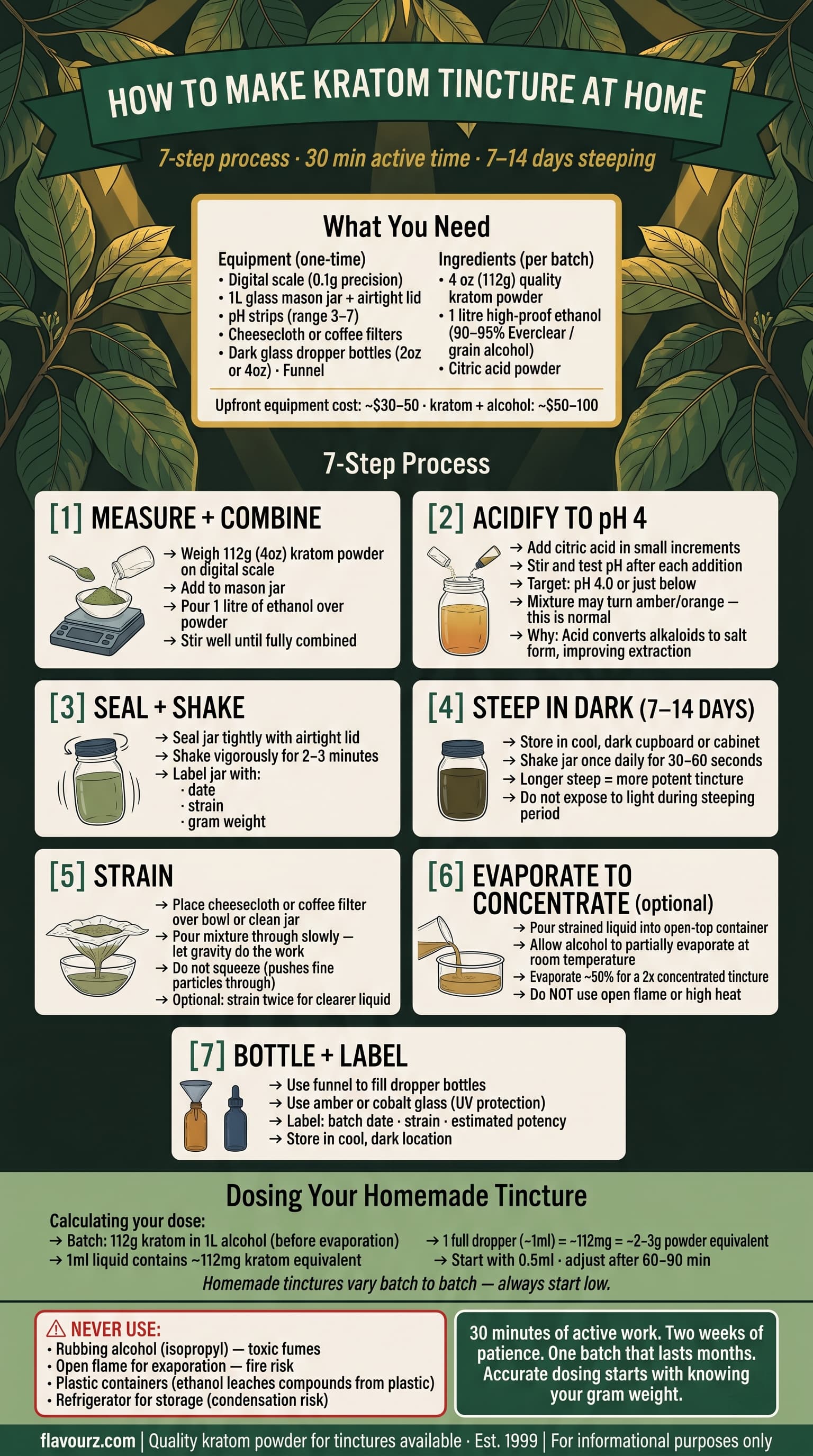
Making kratom tincture at home requires combining kratom powder with high-proof alcohol in a 1:4 ratio (by weight or volume), adding citric acid until the pH reaches 4.0, sealing in a glass jar, and steeping in a dark place for 1-3 weeks while shaking daily. After steeping, strain through cheesecloth and store in dark glass dropper bottles. The total active time is about 30 minutes spread across the steeping period.
The actual process is simpler than most people expect. The challenge is in the details.
Ingredients and Equipment Needed
Here's what you'll need before starting:
- Quality kratom powder: 4-8 ounces (lab-tested from a reputable vendor)
- High-proof alcohol: 90-95% ethanol (Everclear or 190-proof grain alcohol)
- Citric acid powder: Available in canning sections of grocery stores
- Glass mason jars: Quart or half-gallon sized
- Digital scale: Accurate to 0.1 grams
- pH test strips: Range 3-7 or similar
- Cheesecloth or coffee filters: For straining
- Dark glass dropper bottles: Amber or cobalt blue, 2oz or 4oz
- Funnel: For transferring strained liquid
The total upfront equipment cost runs $30-$50 if you don't have these items already. The kratom powder and alcohol add another $50-$100 depending on quality and quantity.
Step-by-Step DIY Kratom Tincture Recipe
The standard DIY kratom tincture recipe uses 4 ounces (113 grams) of kratom powder, 1 liter of high-proof alcohol, and citric acid to adjust pH to 4.0. Steep for 1-3 weeks in a dark place, shaking daily. Strain through cheesecloth, optionally evaporate to concentrate, and store in dark glass dropper bottles. Total batch yields approximately 800-900ml of finished tincture.
The Complete 8-Step Process
Here's the actual recipe I use when making test batches:
- Measure your kratom: Weigh exactly 4 ounces (113 grams) of kratom powder. Write this number down for later dose calculations.
- Combine in jar: Place powder in a quart mason jar. Add 1 liter of high-proof alcohol. Stir thoroughly to a mud-like consistency.
- Adjust pH: Add citric acid in small increments (start with 1/4 teaspoon). Stir, then test with pH strips. Continue until pH reaches 4.0. The mixture often turns slightly orange.
- Seal and shake: Tightly seal the jar. Shake vigorously for 2-3 minutes to ensure thorough mixing.
- Steep in darkness: Store in a dark, cool location. A pantry or closet works well. Shake the jar once daily for at least 7 days, ideally 14-21 days.
- Strain the liquid: Pour through cheesecloth or coffee filter into another clean jar. Squeeze cloth gently to extract remaining liquid. Discard the spent powder.
- Optional evaporation: Pour into a shallow dish in a well-ventilated area for 24-48 hours to reduce volume and increase potency. Skip this if you want a less concentrated tincture.
- Bottle and label: Use a funnel to transfer to dark glass dropper bottles. Label with date, kratom amount used, final volume, and strain.
The first time you make tincture, expect minor mistakes. The second batch will be noticeably better. By the third batch, you'll have your process dialed in.
Quick Reference: DIY vs Commercial Comparison
| Factor | DIY Tincture | Commercial |
|---|---|---|
| Cost (16oz) | $40-$80 | $100-$200 |
| Time Required | 1-3 weeks | Ready immediately |
| Lab Testing | No | Yes (quality vendors) |
| Consistency | Variable | Standardized |
| Strain Choice | Any strain | Limited options |
| Dosing Precision | Estimated | Listed in mg |
| Shelf Life | 2+ years | 2+ years |
Is It Cheaper to Make or Buy Kratom Tincture?
DIY kratom tincture is significantly cheaper than commercial options on a per-volume basis. A homemade 16oz tincture costs $40-$80 to produce versus $100-$200 for equivalent commercial product. However, the cost gap narrows when factoring in your time, equipment investment, learning curve, and the inability to verify alkaloid content without lab testing. For one-time experimenters, the savings rarely justify the effort.
The cost math depends heavily on how you value your time.
Real Cost Breakdown
Here's the actual math for a typical DIY batch:
- 4oz quality kratom powder: $20-$35
- 1 liter Everclear or grain alcohol: $25-$40
- Citric acid powder: $3-$5
- Bottles and supplies: $5-$10 (one-time investment)
- Total ingredients: $48-$80 per batch
- Yield: Approximately 800-900ml finished tincture
Compare that to commercial 30ml tinctures at $25-$50 each. To get 800ml of commercial tincture, you'd spend $400-$1,000+. The DIY savings are real, especially if you make multiple batches and amortize the equipment cost over time.
That said, commercial tinctures from quality vendors include lab testing, batch consistency, and specific alkaloid content listed on the label. You can't easily replicate that at home. Browse our commercial tincture options if quality verification matters more than maximum savings.
What's the Best Kratom for Making Tincture?
Quality matters more than specific strain when making kratom tincture. Use lab-tested powder with mitragynine content of 1.2-1.8%, fresh harvest dates, and AKA-certified sourcing. Maeng Da varieties produce stronger tinctures due to higher alkaloid content. Bali and Borneo strains create gentler, more balanced tinctures. The strain you choose determines the effect profile of your finished tincture, just concentrated.
Strain Selection Guide for Tinctures
For different effect profiles:
- Maximum potency: Use Maeng Da varieties in any color
- Balanced effects: Green Bali or Green Malay
- Energy focus: White Maeng Da or White Borneo
- Relaxation: Red Bali or Red Borneo
- All-day use: Green Hulu Kapuas or Yellow Vietnam
The key is matching the strain to your intended use. A relaxing Red Bali tincture won't suddenly become energizing just because you concentrated it. The alkaloid profile of the source powder determines the final tincture's effects, just stronger per drop.
How Do You Dose Homemade Kratom Tincture?
Homemade kratom tincture dosing requires careful estimation since you can't easily measure exact alkaloid content. Start with 0.5ml (about 10-15 drops) and wait 30-45 minutes before considering more. A 1ml dose typically equals 2-3 grams of the original kratom powder used. Most users find their effective dose between 0.5ml and 2ml depending on the source powder potency and personal sensitivity.
Calculating Your Tincture Dose
Here's the math for estimating doses:
If you used 113g (4oz) of kratom in your tincture and ended up with 800ml finished product, each ml contains roughly 0.14g of kratom-equivalent alkaloids (113 ÷ 800 = 0.14g/ml). However, alcohol extracts about 80-90% of the alkaloids, so the effective concentration is usually 0.10-0.13g equivalent per ml.
For practical dosing:
- 0.5ml: Equivalent to ~1-1.5g powder (light effects)
- 1ml: Equivalent to ~2-3g powder (moderate effects)
- 1.5ml: Equivalent to ~3-4.5g powder (strong effects)
- 2ml: Equivalent to ~4-6g powder (heavy effects)
Always start lower than you think necessary. Tinctures absorb faster than powder, especially when taken sublingually (under the tongue), so effects come on quickly. The faster onset can feel more intense even when the alkaloid content is similar.
How Long Does Homemade Kratom Tincture Last?
Properly stored homemade kratom tincture lasts 2-3 years thanks to the alcohol's natural preservative properties. Store in dark glass bottles in a cool, dry location away from direct sunlight. Unlike kratom powder which loses potency in 12-18 months, alcohol-based tinctures maintain alkaloid stability much longer. Check periodically for any cloudiness or off-smells, which indicate spoilage.
Storage Best Practices
To maximize tincture shelf life:
- Use dark glass: Amber or cobalt blue blocks light-induced degradation
- Cool storage: Pantry, closet, or cabinet away from heat sources
- Avoid sunlight: UV light degrades alkaloids over time
- Tight seals: Prevent alcohol evaporation that would concentrate tincture unevenly
- Label everything: Date, strain, batch info for tracking
- Keep dropper clean: Avoid contamination from unclean droppers
Tincture stability is one of its biggest advantages over powder. You can make a batch and use it gradually over years without significant potency loss. This makes DIY tincture economical even for occasional users.
What Are the Risks of Making DIY Kratom Tincture?
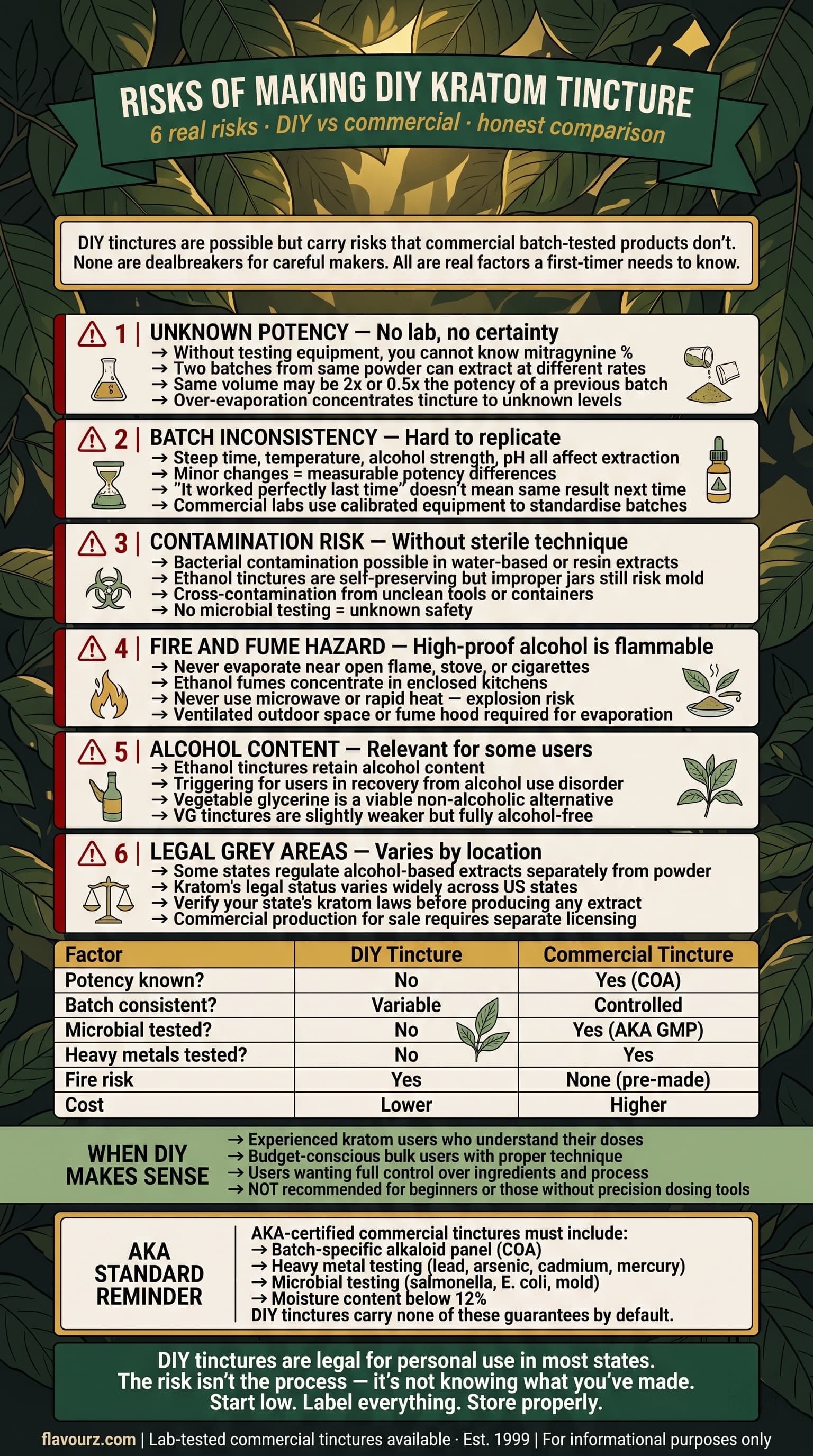
DIY kratom tincture risks include inconsistent alkaloid concentration, unknown final potency without lab testing, accidental over-concentration during evaporation, contamination from improper sanitization, and difficulty replicating successful batches. Quality concerns are real since you can't verify what you've actually made. Commercial tinctures from AKA-certified vendors include batch testing that home methods can't match.
The Honest Limitations
I tell every customer who asks about DIY tinctures the same things:
- You won't know exact potency: Without lab testing, you're guessing on doses
- Batch consistency is hard: Each batch may produce different results
- Contamination is possible: Improper technique can introduce bacteria
- Concentration mistakes happen: Over-evaporation creates dangerously potent tinctures
- Storage matters: Improper handling reduces shelf life significantly
- Legal considerations vary: Some states regulate alcohol-based extracts
None of these risks are dealbreakers for careful DIY makers. They're just real considerations that don't apply to commercial products. Per American Kratom Association guidance, lab-tested products provide safety verification that home methods can't easily replicate.
Should You Make Your Own or Buy Commercial?
Make your own tincture if you're cost-conscious, want strain customization, enjoy the DIY process, and use enough kratom to justify the effort. Buy commercial tinctures if you want lab-verified potency, immediate availability, consistent dosing, and don't want to manage the production process. Many experienced users do both: DIY for daily use, commercial for verified-potency situations.
Decision Framework
Make your own when:
- You use kratom tinctures regularly (worth the time investment)
- Cost matters more than verified potency
- You want strains not commercially available as tincture
- You enjoy hands-on production processes
- You have proper storage space and equipment
Buy commercial when:
- You want guaranteed alkaloid content
- You're new to tinctures and unsure about doses
- You don't have time for the production process
- Travel or convenience matters most
- You're using tinctures occasionally rather than regularly
Honestly, about half of our long-term tincture customers make their own for daily use and buy commercial for specific situations or when they want a particular strain commercially formulated. There's no wrong choice here. For more on commercial options, see our simpler tincture guide or browse our tincture collection directly.
Frequently Asked Questions
Can I use vodka instead of Everclear for kratom tincture?
Yes, but extraction will be less efficient. Vodka (40% alcohol) extracts roughly 50-70% of available alkaloids versus 80-95% with high-proof ethanol. The resulting tincture will be weaker per volume. If you use vodka, expect to need larger doses and shorter shelf life due to higher water content.
Why does my kratom tincture taste so harsh?
The harsh taste comes from concentrated alcohol and natural plant bitterness. Adding vegetable glycerin (10-20% of total volume) softens the flavor without affecting potency. Sublingual dosing for 30-60 seconds also reduces taste exposure compared to swallowing directly.
Is making kratom tincture legal?
In states where kratom is legal, making tincture for personal use is generally legal. However, selling homemade tinctures violates federal regulations regardless of state kratom laws. Always check your local laws before making or sharing kratom products. Federal regulations on alcohol-based extracts may also apply.
Can I make kratom tincture without alcohol?
Yes, but with significant limitations. Glycerin-based tinctures extract fewer alkaloids and have shorter shelf life (3-6 months versus 2+ years). Water-based "tinctures" are technically extracts and degrade quickly. For maximum potency and shelf life, alcohol-based tinctures remain the standard method.
How concentrated should my kratom tincture be?
Most home tinctures end up 5-15x more concentrated than the original powder, depending on how much you evaporate during the final step. For first-time makers, skip the evaporation step entirely. You can always concentrate later if needed, but over-concentrated tinctures are difficult to dose safely.
What strain works best for tincture making?
Higher-potency strains produce stronger tinctures. Maeng Da varieties (any color) typically yield the most concentrated results due to their higher alkaloid content. Standard strains work fine but produce gentler tinctures. The strain's effect profile carries through to the finished tincture, just amplified.
The Bottom Line: DIY or Commercial?
DIY kratom tincture makes sense for cost-conscious regular users who want strain customization and don't mind the time investment. Commercial tinctures make sense for users who prioritize lab-verified consistency, immediate availability, and dosing precision. Both options have legitimate use cases, and many experienced users keep both available for different situations.
Honestly, after 25 years in this industry, I think the DIY versus commercial debate gets too binary. Quality vendors and quality home production both have their place. The real question is matching the right approach to your specific situation, not picking one as universally better.
If you want to start with commercial to understand what proper tincture should feel like, browse our kratom tincture collection. If you want to dive into DIY, start with quality lab-tested powder from our complete kratom selection. Either way, the end goal is the same: getting kratom in a format that fits your routine.
Disclaimer: This article is for informational purposes only and does not constitute medical advice. Kratom has not been evaluated by the FDA for safety or effectiveness. It is not intended to diagnose, treat, cure, or prevent any disease. Consult your healthcare provider before using kratom, especially if you have medical conditions or take medications. Kratom is not for use by anyone under 21, pregnant, or breastfeeding. Check your local laws before purchasing.

Leave a comment