

Kratom Workplace Drug Test: Complete Employee Guide 2026
Last Updated: April 2026
Standard workplace drug tests do not detect kratom. The 5-panel, 10-panel, and 12-panel tests used for pre-employment and random testing screen for marijuana, cocaine, amphetamines, opioids, and PCP. Kratom's alkaloids (mitragynine and 7-hydroxymitragynine) are not included. However, employers in safety-sensitive industries may add specialized kratom testing, and at-will employment laws mean you can potentially be fired for using legal substances like kratom. For detailed strain comparisons, check Flavourz's what is better for sleep red or gold kratom analysis before your next drug test consideration.
After 5 years working with kratom and helping over 10,000 customers at Flavourz Kratom since 1999, I've heard from employees in every industry. The questions are always similar: Will I pass my pre-employment screen? Can my boss fire me for using kratom on my own time? What if I work with heavy machinery?
This guide covers everything employees need to know about kratom and workplace drug testing in 2026, including your rights, which industries are most likely to test, and what to do if you're facing a screen.
Will Kratom Show Up on My Pre-Employment Drug Test?
No. Standard pre-employment drug tests do not detect kratom. Here's exactly what these tests screen for:
| Panel Type | Substances Detected | Kratom Included? |
|---|---|---|
| 5-Panel (Most Common) | Marijuana, cocaine, amphetamines, opioids, PCP | No |
| 10-Panel | Above + benzodiazepines, barbiturates, methadone, propoxyphene, quaaludes | No |
| 12-Panel | Above + extended opioids, MDMA | No |
| DOT 5-Panel | Marijuana, cocaine, amphetamines, opioids, PCP | No |
In January 2025, HHS and SAMHSA published updated authorized drug testing panels for federal workplace programs (effective July 7, 2025). Kratom was not included. Even when fentanyl was added to federal testing panels in 2025, kratom remained excluded.
This means the vast majority of pre-employment drug screens will not detect kratom use. The test simply isn't looking for it.
Why Isn't Kratom on Standard Drug Tests?
Standard workplace drug panels align with federal guidance that focuses on scheduled controlled substances. Kratom remains unscheduled at the federal level. Here's why that matters:
- SAMHSA guidelines: Set the standard for workplace testing, focusing on Schedule I and II substances
- DOT requirements: Follow SAMHSA-certified laboratory protocols, excluding kratom
- Cost considerations: Employers pay per panel. Adding kratom requires separately ordering specialized testing
- Legal status: Without federal scheduling, there's no regulatory pressure to include kratom
For more on whether kratom shows on various drug tests, see our complete guide: Does Kratom Show on Drug Tests? 10 Facts You Need to Know.
Can My Employer Fire Me for Using Kratom?
Yes, potentially. This is where it gets complicated. Even though kratom is legal and standard tests don't detect it, employers can still take action against kratom use.
At-Will Employment: The Key Factor
Most states have at-will employment laws. This means employers can terminate employees for any reason that isn't specifically protected by law, including:
- Using legal substances they disapprove of
- Violating workplace policies (even if the substance is legal)
- Perceived impairment on the job
The critical difference from marijuana: Over 23 states have enacted employment-specific protections that prohibit firing employees solely for off-duty marijuana use. Kratom has NO such protections. Your employer has more discretion to act on kratom use than on marijuana use in many states.
What This Means Practically
- If your employer doesn't test for kratom: They likely won't know you use it, and it won't appear on standard screens.
- If your employer has a substance policy that includes kratom: They could take action if they learn of your use, even without a positive test.
- If you're impaired at work: Employers can take action based on observed impairment, regardless of which substance causes it.
Which Industries Are Most Likely to Test for Kratom?
While most employers stick to standard panels, certain industries are more likely to add specialized kratom testing:
| Industry | Likelihood of Kratom Testing | Reason |
|---|---|---|
| Healthcare | Moderate to High | Patient safety, medication interactions |
| Transportation | Low to Moderate | DOT doesn't require it, but some add it |
| Construction | Low to Moderate | Heavy machinery, injury liability |
| Manufacturing | Low to Moderate | Safety-sensitive operations |
| Federal Government | Low | Follows SAMHSA panels |
| Standard Office Jobs | Very Low | Cost not justified |
The DISA Study: A Warning for Safety-Sensitive Workers
A 2025 study by DISA (a workplace drug testing company) found alarming results when they tested safety-sensitive employee samples for kratom:
- 0.89% of safety-sensitive samples tested positive for 7-hydroxymitragynine (7-OH)
- This is 3x higher than opioid positives (0.28%) in the same samples
- And 2x higher than fentanyl positives (0.44%)
This data may push more safety-sensitive employers toward kratom testing. If you work in healthcare, transportation, construction, or manufacturing, be aware that your employer may be more likely to add kratom to their panels in the future.
DOT Jobs: What You Need to Know
If you're in a DOT-regulated position (trucking, aviation, rail, transit, pipeline, maritime), here's the good news: DOT drug tests do NOT include kratom.
What DOT tests screen for:
- Marijuana
- Cocaine
- Amphetamines (including methamphetamine and MDMA)
- Opioids (codeine, morphine, heroin, hydrocodone, hydromorphone, oxycodone, oxymorphone)
- Phencyclidine (PCP)
- Fentanyl (added in 2026)
Kratom is not on this list. However, your employer can conduct separate non-DOT testing that includes kratom if their company policy requires it. This would be a separate test from your DOT-mandated screening.
Your Rights as an Employee
Understanding your rights helps you navigate drug testing situations. Here's what federal and state laws protect:
Before Testing: FCRA Requirements
If your employer uses a third-party testing service, the Fair Credit Reporting Act (FCRA) requires:
- Written notice: You must receive written notice that a drug test will be conducted
- Written consent: You must provide written permission before testing
- Adverse action process: If you're not hired based on test results, you must be notified and given a chance to dispute
Your Testing Rights
Employees and job candidates generally have these rights:
- Right to refuse: You can refuse a drug test, though this may result in termination or rescinded job offer
- Confidentiality: Test results must be kept confidential
- Certified testing: Tests must be conducted by certified laboratories
- Right to dispute: You can dispute results, especially if you believe a medication caused a false positive
- Request a retest: In most cases, you can request confirmatory testing
- Equal treatment: Testing must be applied equally (no discrimination based on protected classes)
Medical Review Officer (MRO) Process
If you test positive for any substance, a Medical Review Officer (MRO) reviews the results before they're sent to your employer. The MRO can:
- Verify that a positive result is due to a legitimate prescription
- Review explanations for unexpected results
- Overturn results when appropriate
If you receive an unexpected positive result, you have the right to speak with the MRO before the result goes to your employer.
How to Find Out What Your Employer Tests For
If you're concerned about drug testing at your workplace, here's how to find out what's actually being tested:
Review Your Documentation
- Employee handbook: Check your company's substance use policy
- Job offer letter: May specify testing requirements
- Employment contract: May detail drug testing provisions
- Union agreement: If applicable, may include testing protocols
Ask Directly
You have the right to know what substances you're being tested for. You can ask:
- HR department
- The testing administrator
- Your supervisor (though HR is better for privacy)
Frame it professionally: "Can you tell me what substances are included in the standard testing panel?" This is a reasonable question that doesn't raise suspicion.
Check the Consent Form
Before any drug test, you'll sign a consent form. This form typically lists the substances being tested. Read it carefully before signing.
Kratom Detection Timeline: What If You're Facing a Test?
If you're facing a specialized test that does include kratom, here's what you need to know about detection windows:
| Test Type | Occasional User | Regular User |
|---|---|---|
| Urine | 3-5 days | 5-9 days |
| Blood | 24-48 hours | 24-48 hours |
| Saliva | 24-48 hours | 24-48 hours |
| Hair | Up to 90 days | Up to 90 days |
For a complete breakdown of factors affecting detection time, see: Kratom Detection Timeline: 7 Factors That Affect How Long It Stays in Your System.
State Laws That Affect Kratom and Employment
Your state's laws affect both kratom legality and your employment protections:
States Where Kratom Is Banned
If you're in one of these states, kratom possession itself is illegal, and employers have clear grounds to test and take action:
- Alabama
- Arkansas
- Indiana
- Vermont
- Wisconsin
Some cities and counties also have local bans. Check our state-by-state guide: Is Kratom Legal Where I Live?
States With Kratom Consumer Protection Acts
Several states have passed Kratom Consumer Protection Acts (KCPA) that regulate kratom sales but don't provide employment protections. These include:
- Arizona
- Georgia
- Nevada
- Utah
- Colorado
- Oregon
- Rhode Island (as of April 1, 2026)
KCPA laws regulate product quality and age restrictions but do NOT protect employees from workplace drug testing or termination.
What to Do If You Test Positive for Kratom
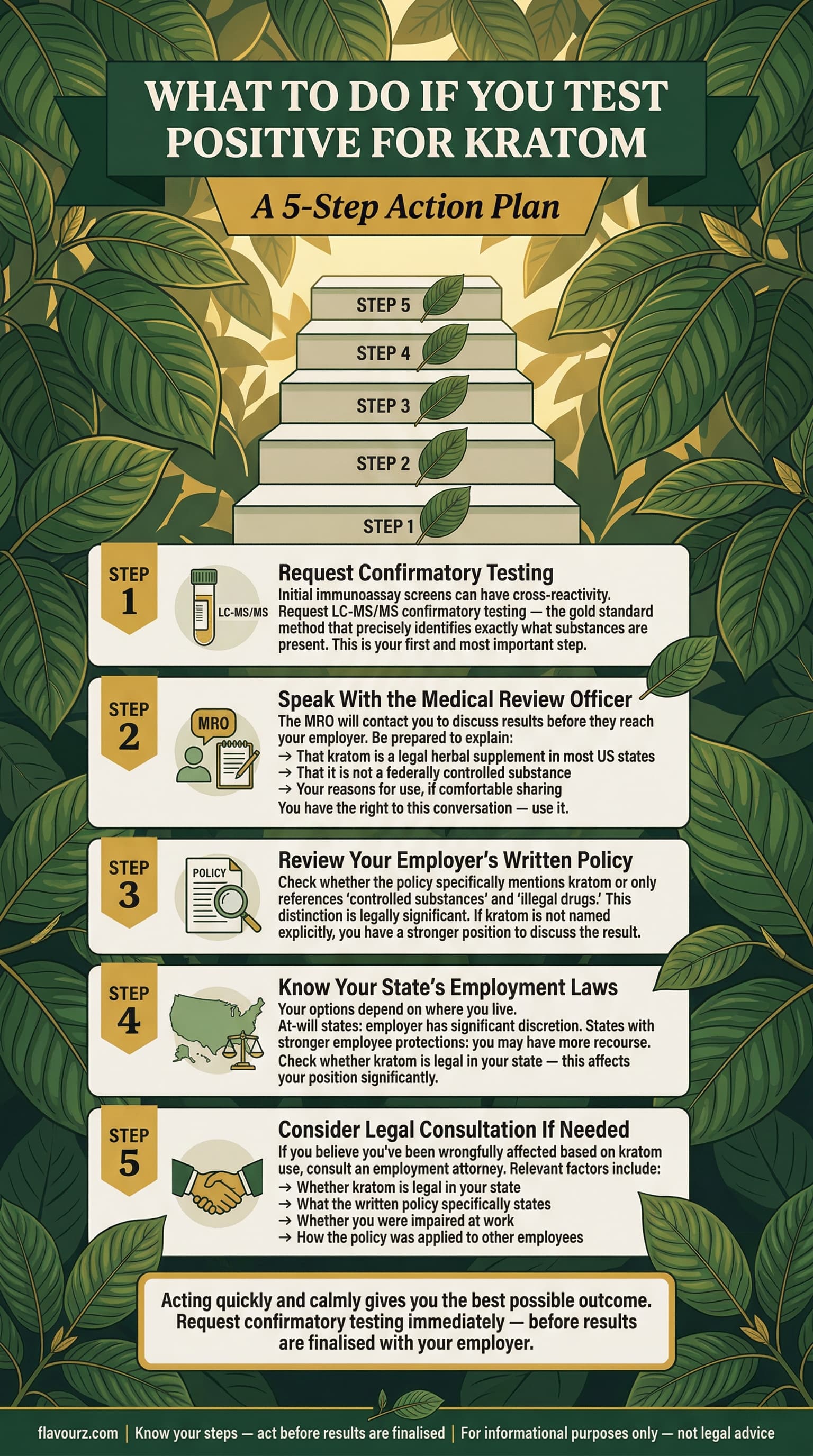
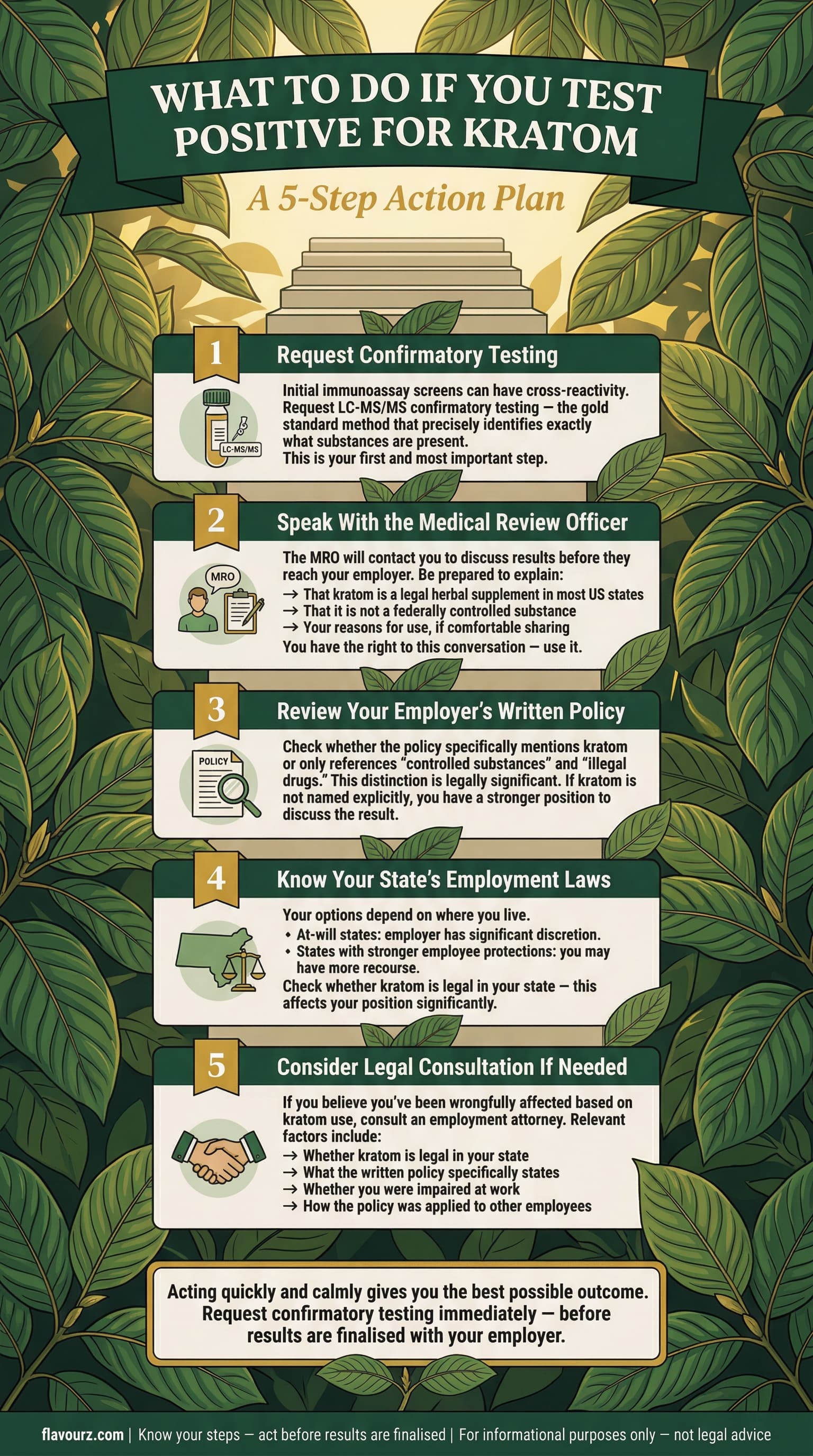
If you receive a positive result on a specialized kratom test, here's your action plan:
Step 1: Request Confirmatory Testing
Initial immunoassay screens can have cross-reactivity. Request LC-MS/MS confirmatory testing, which is the gold standard and will precisely identify what substances are present.
Step 2: Speak with the MRO
The Medical Review Officer will contact you to discuss the results. Be honest and prepared to explain:
- That kratom is a legal herbal supplement (in most states)
- That it's not a controlled substance under federal law
- Your reasons for use (if comfortable sharing)
Step 3: Review Company Policy
Check whether your employer's substance policy specifically mentions kratom or only references "controlled substances" or "illegal drugs." This distinction matters.
Step 4: Know Your State's Laws
Your options depend on your state's employment laws. In at-will states, your employer has significant discretion. In states with stronger employee protections, you may have more recourse.
Step 5: Consider Legal Consultation
If you believe you've been wrongfully terminated based on kratom use, consult an employment attorney. Relevant factors include:
- Whether kratom is legal in your state
- What your employer's written policy states
- Whether you were impaired on the job
- How the policy was applied to other employees
Product Quality and Testing Risks
One often-overlooked risk: contaminated kratom products. This can cause real positive results for substances you never intentionally used.
Contamination Risks
FDA and independent lab analyses have found some kratom products adulterated with:
- Pharmaceutical opioids (fentanyl, tramadol, hydrocodone)
- Synthetic cannabinoids
- Heavy metals
- Undisclosed additives
If you test positive for opioids or other controlled substances after using kratom from an unreliable source, the test may be detecting actual contaminants, not kratom itself.
How to Protect Yourself
- Browse kratom for sale only from vendors who provide third-party lab testing (Certificates of Analysis)
- Choose vendors following American Kratom Association (AKA) GMP standards
- Avoid gas station or convenience store products
- Keep records of your purchases
Quality matters more than ever when your job is on the line. For guidance on reliable vendors, see: Best Kratom Brands 2026.
Practical Tips for Kratom Users in the Workplace
Based on conversations with thousands of working professionals who use kratom, here's practical guidance:
If You're Job Hunting
- Standard pre-employment screens won't detect kratom
- Research the company's industry (safety-sensitive roles have higher testing likelihood)
- Review the job posting for drug testing language
- Ask about testing during the interview process if appropriate
If You're Currently Employed
- Know your company's substance use policy
- Understand what type of testing your employer conducts
- Never use kratom at work or be impaired on the job
- Keep your kratom use private and professional
If You're in a Safety-Sensitive Role
- Your employer has more incentive to test beyond standard panels
- Impairment of any kind is a serious liability
- Consider timing of kratom use to minimize any effects during work hours
- Be aware that your industry may move toward kratom testing
Frequently Asked Questions
Does kratom show up on a pre-employment drug test?
No. Standard pre-employment drug tests (5-panel, 10-panel, 12-panel) do not detect kratom. Only specialized tests that specifically target mitragynine and 7-hydroxymitragynine can detect it, and these must be separately ordered and paid for by the employer.
Can I be fired for using kratom?
Potentially, yes. Most states have at-will employment laws that allow termination for any reason not specifically protected. Unlike marijuana (which has employment protections in over 23 states), kratom has no employment protections. Your employer can take action if kratom violates their substance policy.
Do employers test for kratom?
Most employers do not test for kratom because it's not included in standard panels and adds cost. However, employers in safety-sensitive industries (healthcare, transportation, construction, manufacturing) are more likely to add specialized kratom testing, especially after workplace incidents or in areas with high kratom use.
Does DOT test for kratom?
No. DOT-mandated drug tests do not include kratom. They screen for marijuana, cocaine, amphetamines, opioids, PCP, and fentanyl (added 2026). However, employers can conduct separate non-DOT testing that includes kratom if their company policy requires it.
What jobs test for kratom?
Safety-sensitive jobs are most likely to test for kratom, including healthcare positions, transportation (beyond DOT requirements), construction, manufacturing, and heavy machinery operation. Some pain management clinics and addiction treatment programs also test. Standard office jobs rarely test for kratom.
What are my rights if I fail a drug test for kratom?
You have the right to request confirmatory testing, speak with the Medical Review Officer (MRO), review what substances were tested, and dispute results you believe are incorrect. If terminated, you may consult an employment attorney, especially if kratom is legal in your state and you weren't impaired at work.
Is kratom legal at work?
Kratom is legal in most states, but legal status doesn't guarantee workplace protection. Employers can prohibit legal substances through company policy. Being impaired at work (by any substance) can be grounds for discipline. Your employer's policy determines what's allowed.
How can I find out if my employer tests for kratom?
Review your employee handbook and substance use policy, check your employment contract, read the drug test consent form carefully, or ask HR directly what substances are included in your testing panel. You have the right to know what you're being tested for.
The Bottom Line for Employees
For most employees, kratom and workplace drug testing isn't a concern:
- Standard tests don't detect kratom. The 5-panel, 10-panel, and 12-panel tests used for most employment screening don't include kratom alkaloids.
- Most employers don't add kratom testing. It costs extra and isn't required by federal guidelines.
- But there are no employment protections. Unlike marijuana, kratom has no job protections. Your employer can potentially terminate you for kratom use.
- Safety-sensitive industries are the exception. Healthcare, transportation, construction, and manufacturing may be more likely to test.
- Product quality matters. Contaminated products can cause positive results for other substances.
If you're new to kratom, check out our beginner's guide. And when you want quality kratom from a vendor serving customers since 1999, browse our kratom powder collection.
Disclaimer: This information is for educational purposes only and is not legal advice. Employment laws vary by state and are subject to change. These statements have not been evaluated by the FDA. Kratom is not intended to diagnose, treat, cure, or prevent any disease. Consult an employment attorney for advice specific to your situation. Must be 21+ to purchase. Not available in all states.

Leave a comment