
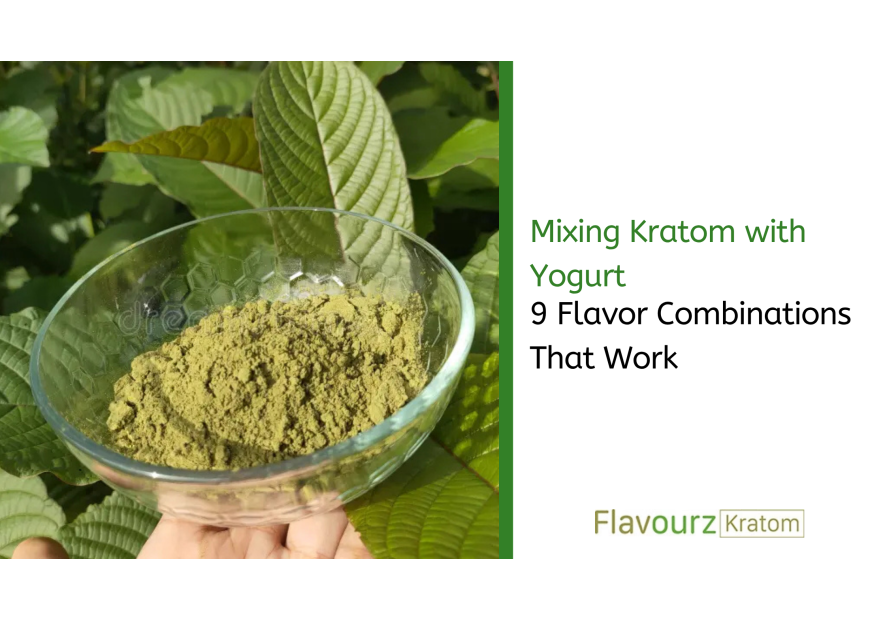
Mixing Kratom with Yogurt: 9 Flavor Combinations That Work
Last Updated: April 2026
Mixing kratom with yogurt is one of the most recommended consumption methods in the kratom community — and it works better than most other masking approaches for two independent reasons that most guides explain separately rather than together. The first reason is sensory: yogurt's creamy, dense, mildly tangy flavor profile creates a matrix that physically coats the palate before kratom bitterness registers, while its smooth texture distributes kratom powder evenly enough that no single bite delivers a bitter spike. The second reason is pharmacological: yogurt's fat content makes it a lipid carrier for mitragynine — a compound that pharmaceutical research has classified as a Class II drug with low water solubility, meaning fat-mediated delivery directly improves absorption in a way that water-based mixing cannot achieve. For powder quality considerations, consult our detailed brand quality analysis covering sourcing and testing standards.
At Flavourz Kratom, we approach consumption method education with the same precision we apply to sourcing and testing. This guide covers the pharmacology of why yogurt specifically outperforms other masking foods, which yogurt types deliver the most bioavailability advantage, and all 9 flavor combinations ranked from beginner-accessible to advanced — with specific ingredient quantities, preparation steps, and the taste science behind why each combination works.
Why Yogurt Works Better Than Other Carriers: The Class II Drug Science
Most kratom taste guides recommend yogurt the same way they recommend orange juice — as a flavor masker that happens to work well. That framing misses the more important pharmacological reason yogurt is specifically superior to non-fat liquid carriers.
A 2015 PMC study on mitragynine's physicochemical properties confirmed that the compound is a "weak base with intermediate lipophilicity, poorly soluble in water and basic media, highly soluble in acidic media, but acid degradable" — and explicitly concluded that "incorporation of mitragynine into a lipid carrier is essential" to improve its solubility, stability, and oral absorption uniformity. A 2019 pharmacokinetics systematic review in ScienceDirect confirmed that mitragynine is a "lipophilic weak base absorbed through the intestinal wall passively" with an estimated oral bioavailability of approximately 21% — a figure the physicochemical study attributes primarily to acid degradation in the stomach and poor water solubility in the intestine where lipophilic absorption actually occurs.
This science has a direct commercial application: a 2023 US patent for kratom formulation specifically classifies mitragynine as a "Class II Drug according to the Biopharmaceutical Classification System" — a classification for compounds with low solubility but high membrane permeability, where fat-mediated delivery directly addresses the primary rate-limiting absorption step. The patent proposes phospholipid formulation to achieve "dramatically improved bioavailability" — essentially engineering a synthetic lipid carrier to do what full-fat yogurt does naturally.
The practical implication: Full-fat Greek yogurt (5–10g fat per serving) and full-fat coconut yogurt (6–12g fat per serving) are genuine lipid carriers for mitragynine, not just taste preferences. Zero-fat yogurt provides the taste masking but not the bioavailability advantage — for buyers choosing between yogurt types specifically for kratom delivery, fat content is the most pharmacologically relevant selection criterion.
Yogurt Type Fat Content and Bioavailability Ranking
| Yogurt Type | Fat per Serving | Bioavailability Advantage | Texture for Mixing | Best For |
|---|---|---|---|---|
| Full-fat Greek yogurt | 5–10g | Highest — optimal lipid carrier density | Thick, creamy — best powder suspension | Maximum bioavailability; savory and fruit pairings |
| Full-fat coconut yogurt | 6–12g | Highest — coconut fat (MCTs) absorbed rapidly | Smooth, slightly sweet baseline | Tropical combinations; dairy-free buyers |
| Regular full-fat yogurt | 3–8g | High — good lipid carrier | Thinner than Greek — stir thoroughly | Everyday use; all flavor combinations |
| Low-fat Greek yogurt | 0–3g | Moderate — some lipid advantage | Good — thicker than regular low-fat | Taste masking without full-fat preference |
| Non-fat / 0% yogurt | < 0.5g | Minimal — taste masking only | Thinner — powder may clump | Taste masking priority over bioavailability |
The 9 Kratom Yogurt Flavor Combinations
Combination 1: Vanilla Greek Yogurt + Honey + Cinnamon — The Beginner Standard
This is the most widely documented and community-recommended kratom yogurt combination — and for good reason. It stacks three independent bitterness suppression mechanisms simultaneously: vanilla's aromatic compounds compete with bitter receptors in the olfactory-retronasal pathway, honey's sweetness activates sweet taste receptors that specifically suppress bitter receptor activation, and cinnamon's warm spice notes redirect taste attention away from the earthy-bitter kratom register. As KratomIt's 2026 taste masking guide confirms, honey specifically "partially block[s] bitter taste receptors" — making it the single most pharmacologically effective sweetener for kratom bitter suppression.
Ingredients:
- 1 cup full-fat vanilla Greek yogurt
- 1–2 teaspoons raw honey
- ¼ teaspoon ground cinnamon
- Your kratom dose
Method: Stir honey into yogurt first until fully incorporated. Add kratom powder and fold in with a spoon — do not stir vigorously; folding creates a more even distribution with less air introduction. Add cinnamon last and fold once more. The vanilla fragrance should dominate before the first bite.
Taste result: Sweet, warm, and creamy — kratom's bitterness registers as a mild background note at most. The combination the Live Fully Kratom Podcast hosts specifically tested and confirmed as effective for taste-sensitive users.
- Fat content: 5–10g (full-fat Greek) — high bioavailability advantage
- Best kratom strains: Green or white vein — cinnamon's warmth complements their energetic, herbal profiles better than red vein's earthier notes
- Best for: Beginners; daily users; anyone transitioning away from toss-and-wash
Combination 2: Tropical Coconut Yogurt + Mango + Pineapple — Maximum Flavor Coverage
The tropical combination leverages two of the strongest kratom bitterness maskers available — pineapple's bright acidity and mango's dense sweetness — in a coconut yogurt base that adds both fat content and a complementary creamy-tropical baseline. As Bedrock Botanicals' flavor guide documents, "the orange and slightly tangy taste of pineapple juice complements Kratom, while the semi-sweet and thick texture of mango puree goes well" — the two fruits work synergistically rather than independently because pineapple's acidity contrasts the sweet mango, creating a layered flavor that leaves no taste bandwidth for kratom's bitterness to occupy.
Ingredients:
- 1 cup full-fat coconut yogurt
- ¼ cup fresh or frozen mango chunks
- ¼ cup fresh or frozen pineapple chunks
- 1 tablespoon coconut milk (for thinner consistency)
- Your kratom dose
Method: Blend mango and pineapple chunks into a puree before mixing into yogurt — puree integration creates more uniform flavor distribution than chunk toppings, which deliver inconsistent flavor per spoonful. Stir kratom into the yogurt before adding the puree layer so the yogurt matrix surrounds the powder before the fruit flavor is introduced.
Taste result: Bright, tropical, sweet-tart — one of the most complete bitterness eliminations of any combination in this guide. The fruit flavor is dominant at every bite.
- Fat content: 6–12g (coconut yogurt) + additional fat from coconut milk — highest fat content in the guide
- Best kratom strains: Any — tropical flavor profile is strong enough to mask all vein types including robust red vein earthy notes
- Best for: Users with strong taste sensitivity; dairy-free buyers; summer use
Combination 3: Mixed Berry Yogurt + Granola + Banana — The Breakfast Bowl
The breakfast bowl combination is the most practical daily-use format in this guide — structured as a complete meal rather than a standalone kratom delivery vehicle, which produces natural portion distribution across multiple bites rather than front-loading all the kratom flavor into the first spoonful. As My Kratom Club's recipe guide confirms: "Yogurt masks the bitterness of kratom and blends seamlessly, making it a perfect breakfast or snack" — with the granola and fruit toppings serving as both nutritional additions and layered flavor elements that keep each bite different.
Ingredients:
- 1 cup full-fat berry yogurt (strawberry, blueberry, or mixed berry)
- ¼ cup granola
- ½ banana, sliced
- Small handful of fresh or frozen blueberries or strawberries
- Your kratom dose
Method: Mix kratom thoroughly into the plain yogurt before adding any toppings — ensure complete and even distribution. Layer granola as a top layer rather than mixing in, to preserve texture contrast. Add banana slices and berries over the granola. The crunchy-creamy-fruit sequence in each spoonful keeps the flavor profile varied enough that the kratom bitterness never becomes the dominant note.
Taste result: Fresh, fruity, balanced — the berries' natural tartness and the banana's sweetness bracket kratom's bitterness on both ends of the flavor spectrum. The granola's toasted crunch provides a textural interruption that resets the palate between bites.
- Fat content: 3–8g (regular or Greek berry yogurt) + granola fats — moderate bioavailability advantage
- Best kratom strains: Green vein — berry and banana's freshness pairs most naturally with green vein's lighter, more herbal character
- Best for: Morning dose; users who prefer a full meal format; beginners who find the yogurt-only approach insufficiently filling
Combination 4: Chocolate Cocoa Yogurt + Dark Chocolate Chips — The Complementary Bitterness Method
This combination uses a counterintuitive masking principle: instead of contrasting kratom's bitterness with sweetness, it adds a complementary bitter note — cocoa — that the brain interprets as a unified "chocolate bitterness" rather than detecting kratom bitterness as a separate, unwelcome note. Dark chocolate and kratom share a similar bitterness register at the taste receptor level, meaning the combination produces a richer, more complex chocolate-forward flavor rather than a "kratom + chocolate" two-note profile. Hydromit7's 2025 kratom recipe guide confirms that cocoa "blends bitterness" rather than fighting it.
Ingredients:
- 1 cup full-fat Greek yogurt (plain or vanilla)
- 1 tablespoon unsweetened cocoa powder
- 1–2 teaspoons honey or maple syrup
- 1 tablespoon dark chocolate chips (70%+ cacao)
- Your kratom dose
Method: Mix cocoa powder into yogurt first — dry cocoa needs vigorous stirring to fully incorporate without lumps. Add sweetener and stir until dissolved. Fold in kratom powder. Top with dark chocolate chips rather than mixing them in, so each bite includes a chip's concentrated sweetness that offsets the cocoa-kratom bitterness beneath it.
Taste result: Dark chocolate dessert — rich and slightly bitter but in a way that reads as intentional chocolate flavor. One of the most surprising combinations in this guide for users who expect fruit-forward flavor profiles to be the only effective kratom maskers.
- Fat content: 5–10g (full-fat Greek) + cocoa fat + chocolate chip fat — high bioavailability advantage, highest fat total of the non-nut combinations
- Best kratom strains: Red vein — red vein's deeper, earthier alkaloid profile harmonizes better with dark chocolate's intensity than lighter green or white vein strains
- Best for: Users who enjoy dark chocolate; evening use; anyone who has found sweet-fruit combinations insufficient for taste masking
Combination 5: Lemon-Honey Yogurt + Citrus Zest — Triple-Mechanism Sweet-Sour-Fat
The lemon-honey combination is the most pharmacologically layered masking approach in this guide, stacking three independent mechanisms simultaneously: honey's bitter receptor suppression, lemon juice's acidity shifting the flavor register to sour (which outcompetes bitter in sensory prioritization), and the yogurt fat matrix's lipid carrier advantage for absorption. KratomIt's 2026 taste masking guide specifically lists "Lemon + honey" as a "Balanced sweet & sour" combination that is "Easy" difficulty and effective for "Tea drinkers" — the same lemon-honey pairing that makes kratom tea more palatable, adapted to yogurt's thicker delivery format.
Lemon juice in the yogurt mixture also lowers the pH of the carrier — which the physicochemical properties study confirms increases mitragynine's solubility. The slightly more acidic environment created by lemon juice in yogurt improves the rate at which kratom alkaloids dissolve into the lipid carrier matrix before consumption.
Ingredients:
- 1 cup plain full-fat Greek yogurt
- 1 tablespoon fresh lemon juice
- 1 teaspoon lemon zest
- 1–2 teaspoons raw honey
- Your kratom dose
Method: Combine lemon juice and honey into yogurt and stir until completely integrated — the yogurt will thin slightly from the lemon juice addition and may be more pourable than spoonable at this point. Fold in kratom powder. Add lemon zest on top. The citrus aroma from the zest activates the retronasal pathway before the first bite, pre-loading the sensory register with lemon rather than kratom.
Taste result: Bright, citrus-forward, lightly sweet — one of the lightest tasting combinations in the guide, with very low residual bitterness perception.
- Fat content: 5–10g (full-fat Greek) — high bioavailability advantage
- Best kratom strains: White or green vein — citrus freshness pairs naturally with lighter vein types' energetic profiles
- Best for: Morning use; kratom tea drinkers transitioning to yogurt format; users who specifically dislike the earthiness of darker combinations
Combination 6: Turmeric-Ginger Yogurt + Black Pepper — The Earthy-Complementary Method
Like the chocolate combination, the turmeric-ginger approach uses complementary rather than contrasting flavor masking — turmeric's earthy, slightly bitter warmth exists in the same flavor register as kratom's earthiness, so the brain integrates them as a unified "herbal-spice" profile rather than parsing kratom bitterness as a separate unwelcome note. Joe's Botanicals' 2025 recipe guide specifically notes that "turmeric's earthy flavor actually complements kratom's profile rather than fighting it." The black pepper addition is pharmacologically functional: piperine in black pepper inhibits glucuronidation metabolism pathways, extending alkaloid availability — the same mechanism documented in turmeric bioavailability research where black pepper extends curcumin's metabolic half-life by 2,000%.
Ingredients:
- 1 cup plain full-fat Greek yogurt
- ¼ teaspoon ground turmeric
- ¼ teaspoon fresh grated ginger (or ⅛ teaspoon ground)
- Pinch of black pepper
- 1 teaspoon honey (to offset the spice warmth)
- Your kratom dose
Method: Combine all spices with honey into yogurt and stir until color is uniform (the turmeric will tint the yogurt golden). Fold in kratom. The golden color of the finished yogurt visually signals the turmeric's dominance — use as a visual cue that the spice-to-yogurt ratio is correct.
Taste result: Warm, earthy, and mildly spiced — this combination does not eliminate kratom's flavor so much as it contextualizes it within a herbal-spice framework where it belongs. Users who enjoy chai, turmeric lattes, or ginger tea consistently rate this combination highly.
- Fat content: 5–10g (full-fat Greek) — high bioavailability advantage; piperine from black pepper adds metabolic duration extension
- Best kratom strains: Red vein — red vein's depth and warmth is the best complement to the spice profile of this combination
- Best for: Evening use; users who prefer herbal flavors over fruit-forward profiles; anti-inflammatory wellness stacking
Combination 7: Peanut Butter Yogurt + Banana — Highest Total Fat, CYP Synergy
This is the highest-fat combination in the guide and the only one that adds a documented CYP enzyme metabolic component beyond flavor masking. Peanut butter contains resveratrol and other polyphenols that have been documented to inhibit CYP3A4 and CYP2D6 — the same hepatic enzymes that metabolize mitragynine. This means peanut butter functions as both a fat carrier (improving dissolution bioavailability) and a metabolic potentiator (extending alkaloid duration by slowing first-pass metabolism) — the same dual mechanism that makes grapefruit juice a potentiation reference in our kratom potentiation guide. Banana adds natural sweetness and a creamy texture that smooths the peanut butter's density and completely masks any residual bitterness.
Ingredients:
- 1 cup plain or vanilla full-fat Greek yogurt
- 1–2 tablespoons natural peanut butter (not sweetened commercial brands)
- ½ banana, mashed
- Optional: 1 teaspoon honey
- Your kratom dose
Method: Mash banana thoroughly with a fork before mixing — unmashed banana chunks create inconsistent flavor per spoonful. Incorporate peanut butter into yogurt by stirring vigorously (it doesn't incorporate as easily as liquid additions — ensure complete distribution before adding kratom). Fold kratom in last. Honey is optional — banana sweetness typically provides sufficient masking without it.
Taste result: Peanut butter banana — one of the most satisfying and complete flavor experiences in the guide; virtually no detectable kratom bitterness at moderate doses.
- Fat content: 5–10g (Greek yogurt) + 8–16g (peanut butter) = 13–26g total — highest of all combinations
- Best kratom strains: Any — flavor coverage is complete; also ideal for kratom extract products where higher-density alkaloid content would be more detectable in lighter combinations
- Best for: Maximum bioavailability and duration; users who are also using kratom for workout energy or recovery; anyone who has found other combinations insufficient for masking at higher doses
- Dosing note: The combined fat load and CYP inhibition may extend effects by 20–40% — reduce dose and extend time between doses accordingly. See our kratom dosage guide for recalibration methodology
Combination 8: Mango-Cardamom Yogurt — Tropical Warmth Profile
Mango-cardamom is the most culinarily sophisticated combination in this guide — a flavor pairing from South and Southeast Asian culinary traditions that applies to kratom because cardamom's floral, warming complexity occupies the same aromatic bandwidth as kratom's herbal notes while mango's dense tropical sweetness handles the bitterness suppression. Bedrock Botanicals' flavor guide confirms mango puree's "semi-sweet and thick texture goes well" with kratom specifically — the thickness is a functional property, creating a puree-dense yogurt matrix that coats the palate more completely than thin fruit juice and holds flavor saturation longer per bite.
Ingredients:
- 1 cup full-fat plain or coconut yogurt
- 3 tablespoons mango puree (fresh blended or commercial)
- ⅛ teaspoon ground cardamom
- Optional: 1 teaspoon honey
- Your kratom dose
Method: Blend fresh mango to a smooth puree before incorporating — chunky mango creates inconsistent flavor coverage. Stir cardamom into the mango puree first (the flavor distributes more evenly through a liquid medium than through thick yogurt). Combine mango-cardamom puree into yogurt and stir well. Fold in kratom last.
Taste result: Tropical, aromatic, and distinctly South Asian-flavored — the cardamom's perfume transforms this from a simple fruit yogurt into a layered flavor experience. Kratom bitterness is imperceptible.
- Fat content: 5–12g depending on yogurt type — high bioavailability advantage with coconut yogurt
- Best kratom strains: Green Malay or Green Maeng Da — their balanced alkaloid profiles complement the cardamom's complexity without overwhelming it
- Best for: Users who enjoy global flavor profiles; afternoon use; a more culinarily interesting alternative to standard tropical combinations
Combination 9: Matcha Green Yogurt + Honey — Earthy-Complementary Advanced Option
Matcha is kratom's closest flavor parallel in the mainstream food market — both are powdered plant materials with vegetal, earthy, slightly bitter notes that register in the same sensory register. The matcha combination works for the same reason as the chocolate and turmeric combinations: it uses complementary flavor unification rather than contrast suppression. A matcha-kratom-yogurt combination reads as "intensely matcha" rather than "matcha plus kratom," because the brain receives a single unified vegetal-bitter-earthy signal rather than two separate competing ones. Honey is the essential sweetness bridge that keeps the combined bitterness within a pleasant rather than overwhelming range.
Ingredients:
- 1 cup plain full-fat Greek yogurt
- 1 teaspoon ceremonial-grade matcha powder
- 1–2 teaspoons raw honey
- Optional: 1 tablespoon oat milk to thin if consistency is too dense
- Your kratom dose
Method: Sift matcha through a fine mesh strainer before adding to yogurt — matcha clumps aggressively in cold dairy and an uneven distribution creates bitter matcha patches alongside bland yogurt patches. Stir sifted matcha and honey into yogurt until color is uniform pale green. Fold in kratom. The finished color — a deeper green than plain yogurt — confirms the matcha is evenly distributed.
Taste result: Matcha-dominant, vegetal, lightly sweet — this is the combination most likely to appeal to users who enjoy green tea, ceremonial matcha, or functional wellness beverages. It doesn't eliminate kratom's flavor so much as absorb it into a framework where it belongs.
- Fat content: 5–10g (full-fat Greek) — high bioavailability advantage; L-theanine in matcha adds a calming-focus compound that pairs well with white vein kratom's stimulating alkaloid profile
- Best kratom strains: White vein — white vein's lighter, more cerebral character pairs most naturally with matcha's clarity and focus notes; red vein's earthy depth can overwhelm the matcha nuance
- Best for: Matcha enthusiasts; functional wellness users; morning focus routines combining both matcha's L-theanine and white vein kratom's stimulating profile
All 9 Combinations at a Glance
| Combination | Masking Mechanism | Fat Content | Best Strain | Best For |
|---|---|---|---|---|
| 1. Vanilla + Honey + Cinnamon | Receptor suppression (honey) + aromatic competition (vanilla, cinnamon) | 5–10g | Green, White | Beginners; daily standard |
| 2. Tropical Coconut + Mango + Pineapple | Flavor dominance (pineapple acid + mango sweet) | 6–12g | All strains | Taste-sensitive; dairy-free |
| 3. Berry + Granola + Banana | Flavor layering; dose distribution across bites | 3–8g | Green | Breakfast bowl; morning dose |
| 4. Chocolate Cocoa + Dark Chips | Complementary bitterness unification | 7–13g | Red | Evening; chocolate lovers |
| 5. Lemon-Honey + Citrus Zest | Sweet receptor + sour competition + pH shift | 5–10g | White, Green | Morning; tea drinkers |
| 6. Turmeric-Ginger + Black Pepper | Earthy complementary + piperine metabolic extension | 5–10g | Red | Evening; herbal flavor preference |
| 7. Peanut Butter + Banana | Maximum fat carrier + CYP inhibition + sweetness | 13–26g | All strains + extracts | Max bioavailability; higher doses |
| 8. Mango-Cardamom | Dense puree coating + aromatic unification | 5–12g | Green Maeng Da, Green Malay | Afternoon; global flavor profile |
| 9. Matcha + Honey | Vegetal register complementary + honey suppression | 5–10g | White | Morning focus; matcha enthusiasts |
Universal Mixing Technique: How to Avoid Clumping
The most common preparation failure with kratom yogurt is uneven powder distribution — dry clumps of kratom that deliver sudden intense bitterness in isolated bites, despite the surrounding yogurt being well-masked. The solution is mixing technique rather than ingredient change.
- Pre-mix kratom into a small amount of liquid first: Add 1–2 teaspoons of the most liquid ingredient in your combination (lemon juice, honey, oat milk, fruit puree) to the kratom dose in a small separate bowl, stir into a smooth paste, then incorporate the paste into the yogurt. The paste distributes far more evenly than dry powder added directly to thick yogurt
- Fold, don't stir vigorously: Vigorous stirring in thick yogurt creates air pockets that trap dry powder. Folding — using a slow, wide circular motion that draws yogurt over the powder from the bottom up — distributes powder without creating air pockets or leaving unmixed pockets near the container walls
- Use room temperature yogurt: Cold yogurt fresh from the refrigerator is stiffer and distributes kratom less evenly than yogurt at room temperature. Allow yogurt to sit for 5–10 minutes before adding kratom for best distribution
- Consume promptly: Kratom powder in yogurt will begin to settle toward the bottom within 10–15 minutes of mixing. Consume within 5 minutes of final mixing for the most consistent distribution per spoonful, or stir again immediately before consumption if it has sat
Frequently Asked Questions
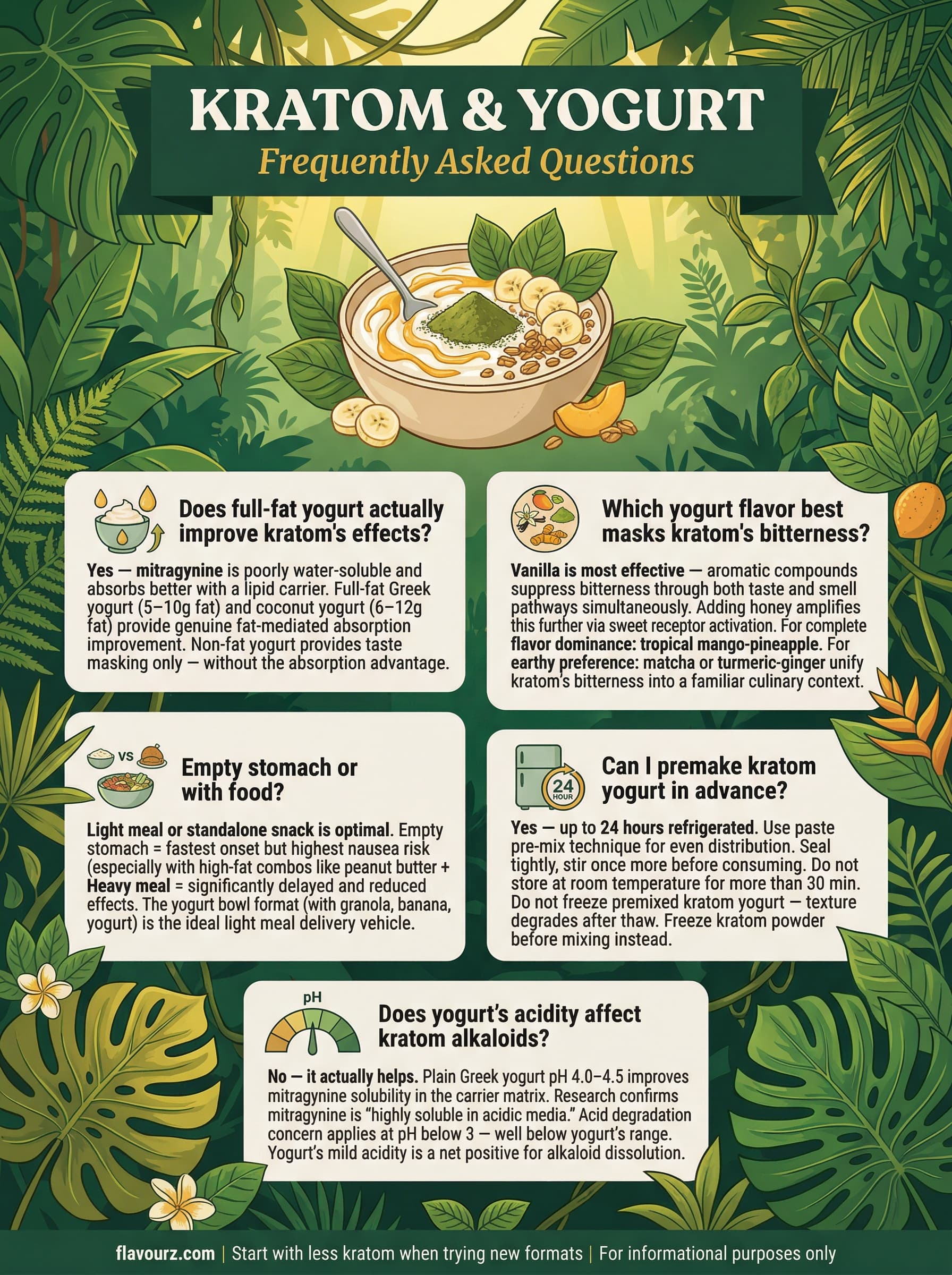
Does full-fat yogurt actually improve kratom's effects?
Yes — and the mechanism is documented pharmaceutical science rather than community speculation. A 2015 PMC study on mitragynine's physicochemical properties confirmed that the compound is poorly water-soluble and requires a lipid carrier for optimal absorption, specifically concluding that \
Which yogurt flavor best masks kratom's bitterness?
The single most effective base flavor for kratom bitter suppression is vanilla, because vanilla's aromatic compounds compete with bitter perception in both the direct taste pathway and the retronasal olfactory pathway simultaneously — producing a two-channel masking effect that plain yogurt cannot match. Honey added to vanilla yogurt adds a third mechanism: sweet receptor activation that specifically suppresses bitter receptor firing. For users who need complete flavor elimination rather than suppression, the tropical mango-pineapple combination (Combination 2) delivers the most complete domin
Should I take kratom yogurt on an empty stomach or with food?
With a light meal or as a standalone complete snack is the optimal approach — and the yogurt combinations in this guide are designed to make that straightforward. A completely empty stomach produces the fastest kratom onset but the highest nausea risk, particularly with the higher-fat combinations (peanut butter + banana) where the fat load on an empty stomach can itself cause nausea independently of kratom. A heavy full meal significantly delays onset and reduces effect intensity by slowing gastric emptying. The yogurt bowl format (Combination 3) is the most practical \
Can I premake kratom yogurt in advance?
Yes, for up to 24 hours refrigerated — with one technique modification. If premixing in advance, use the paste pre-mix technique described above (mix kratom into a liquid ingredient before incorporating into yogurt) to ensure maximum initial distribution, then seal the container tightly before refrigerating. Stir or fold once more immediately before consuming, as settling occurs over refrigeration time. Do not store kratom yogurt at room temperature for more than 30 minutes — the yogurt medium promotes bacterial growth more rapidly than the ambient temperature kratom powder used in normal cons
Does the yogurt's acidity affect kratom's alkaloids?
Plain Greek yogurt has a pH of approximately 4.0–4.5 — mildly acidic. The 2015 physicochemical properties study specifically confirmed that mitragynine is \
How much kratom should I mix with yogurt?
The standard kratom serving for yogurt mixing follows the same guidelines as other consumption methods, with beginners starting at 1–2 grams, moderate users at 2–4 grams, and experienced users at 4–6 grams per serving. For the high-fat peanut butter combination (Combination 7), reduce your normal dose by 20–30% because the combined fat carrier and CYP enzyme inhibition can extend effects by 20–40% beyond standard mixing methods. Use a digital scale to measure your kratom accurately rather than estimating with spoons, since spoon measurements can vary by 30–50% based on powder density. Always wait 45–60 minutes before considering additional servings, as the lipid carrier effect may delay full onset compared to water-based methods.
How long does it take for kratom yogurt to kick in?
Kratom yogurt typically takes 30–60 minutes to kick in, which is slightly longer than toss-and-wash powder but produces a smoother, more sustained onset due to the lipid-mediated absorption pathway. The fat content in full-fat Greek or coconut yogurt slows initial absorption but improves overall bioavailability, meaning peak effects often last longer than water-based methods. Higher-fat combinations like peanut butter + banana (Combination 7) may take 45–75 minutes for full onset but extend duration by 20–40%. Taking kratom yogurt as a light snack rather than on a completely empty stomach produces the most predictable timing while reducing the chance of nausea.
Can I use flavored yogurt instead of plain yogurt for mixing kratom?
Yes, flavored yogurt works well for kratom mixing and can enhance the masking effect, with vanilla, berry, and tropical flavors being the most popular choices. However, plain full-fat yogurt provides the most flexibility for adding your own ingredients and controlling sweetness levels, especially for combinations involving spices like turmeric or cardamom. Be aware that many commercial flavored yogurts contain added sugars and artificial flavors that may not pair as well with kratom's earthy profile as natural ingredients like honey, fresh fruit, or spices. For best results, choose flavored yogurts with simple ingredient lists and natural flavoring, or use plain full-fat Greek yogurt as a base and customize the flavors yourself.
Disclaimer: This article is for informational purposes only. Kratom is not FDA-approved and is not intended to diagnose, treat, cure, or prevent any disease or condition. Always consult a qualified healthcare provider before use, especially if you take prescription medications or have existing health conditions.
Last Updated: April 2026 | Flavourz Kratom has served over 10,000 customers since 1999. Shop our full kratom selection here.

Leave a comment