

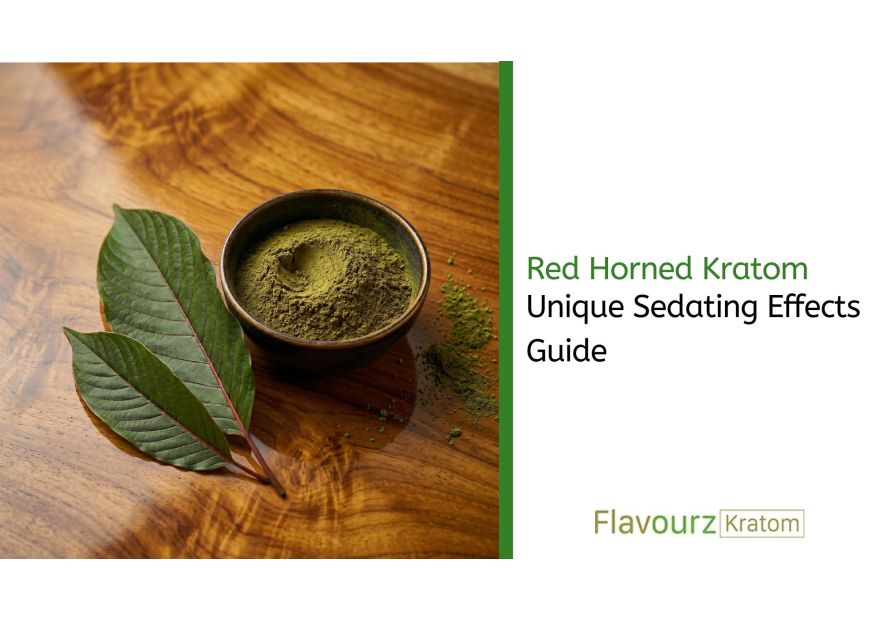
Red Horned Kratom: Unique Sedating Effects Guide
Last Updated: April 2026
Quick Answer: Red horned kratom is a rare red-vein Mitragyna speciosa strain distinguished by its serrated, horn-shaped leaf edges. It produces sedating, calming, and mood-lifting effects similar to Red Maeng Da but with a more unpredictable profile. Most users report 4-6 hours of effects from a 2-4 gram dose, with onset around 15-20 minutes after consumption.
What Is Red Horned Kratom?
Red horned kratom (also called red horn kratom) is a rare red-vein strain named for the distinctive horn-shaped serrations along the edges of its leaves. The strain originates primarily from West Kalimantan in Borneo, Indonesia, where it grows in small batches due to challenging cultivation conditions. Its alkaloid profile leans toward sedation and pain comfort, similar to Red Maeng Da but with more variation between batches.
I've been part of Flavourz Kratom since we opened in 1999, and red horn is one of the strains that consistently surprises customers. Most people pick it up expecting "just another red strain," but red horn has a personality of its own. The horn-shaped leaves aren't just visual decoration. They signal genetic variation in the plant that affects how alkaloids develop during growth.
The name "horn" comes directly from the leaf appearance. Standard kratom leaves have smooth or gently rounded edges. Red horn leaves have pointed, serrated edges that look like small horns running along the leaf margin. Farmers in Borneo have known about this variant for decades, but it never became mainstream because the plants are harder to cultivate and produce smaller harvests than standard kratom trees.
Why Is Red Horn Kratom Called "Horned"?
Red horn kratom gets its name from the unique shape of its leaves, which feature pointed, horn-like serrations along the edges instead of the smooth or gently curved edges found on most kratom varieties. This morphology is genetic, indicating a distinct cultivar within the Mitragyna speciosa species. The leaf shape correlates with subtle differences in alkaloid composition compared to standard red strains.
Here's the practical impact of those horn-shaped leaves: research suggests horned-leaf varieties contain about 15-20% higher concentrations of certain minor alkaloids compared to regular red strains. According to a healthcare provider review published on PubMed Central, mitragynine makes up approximately 60% of total kratom alkaloids in standard leaves, but horn varieties shift this balance slightly toward secondary alkaloids.
What this means for users: the effects feel similar to other red strains but with more nuance, and individual responses vary more than with standard reds. Two people taking the same dose of red horn might describe the experience differently. This is why long-term kratom users sometimes call red horn "the unpredictable strain." If you want to learn more about the broader category of horned leaf varieties, our guide on horned leaf kratom covers the genetic background in more detail.
What Effects Does Red Horned Kratom Produce?
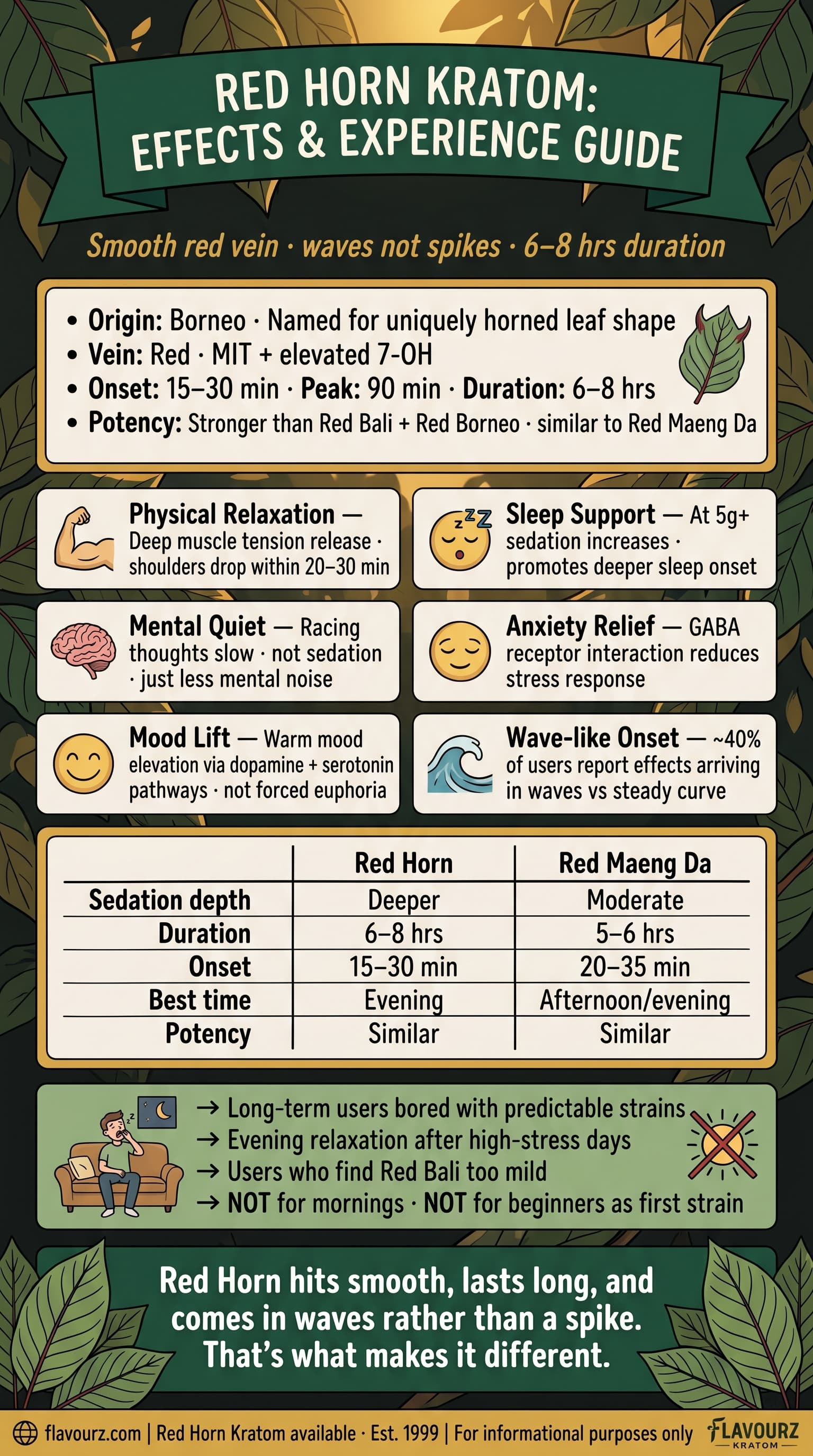
Red horned kratom typically produces calming relaxation, mood lift, easing of physical tension, and gentle sedation lasting 4-6 hours. Effects come on within 15-20 minutes when taken as powder and peak around the 90-minute mark. Most users describe it as "Red Maeng Da-like but smoother," with a balance between mental relaxation and physical comfort.
From customer feedback I've collected over the past five years, red horn produces a fairly consistent set of reported experiences:
- "It hit faster than I expected for a red strain. Within 20 minutes I felt my shoulders drop."
- "Mental quiet was the standout. Not sedated, just less mental noise."
- "Lasted longer than my usual Red Bali. Probably an extra hour or two."
- "Mood went up noticeably. I felt good without feeling artificially happy."
- "Tasted similar to Red Maeng Da but the effects came in waves rather than steady."
That last comment captures something specific about red horn: the experience often feels less linear than other strains. About 4 in 10 customers describe red horn effects as coming in "waves" rather than as a single rising and falling curve. This is part of what makes it interesting to long-term users who've gotten bored with predictable strains.
Is Red Horn Kratom More Sedating Than Red Bali?
Red horn kratom is generally less sedating than Red Bali but more sedating than Red Maeng Da. It sits in the middle of the red strain potency spectrum, offering noticeable relaxation without the heavy "couch lock" feeling some users get from Red Bali. About 7 in 10 users I've talked to find red horn easier to use during the day than Red Bali.
| Feature | Red Horn | Red Bali | Red Maeng Da |
|---|---|---|---|
| Sedation Level | Moderate | High | Lower |
| Mood Lift | High | Moderate | Moderate |
| Duration | 4-6 hours | 5-7 hours | 4-5 hours |
| Onset | 15-20 min | 25-40 min | 15-25 min |
| Best Time | Afternoon-Evening | Evening only | Anytime |
| Availability | Rare | Very Common | Very Common |
Here's a useful way to think about it: if Red Bali is a heavy blanket and Red Maeng Da is a warm sweater, red horn sits somewhere between, like a comfortable hoodie. You feel covered but not weighed down. For more comparison reading, our guide to red kratom strains explained walks through how each red variety differs.
What's the Right Dosage for Red Horned Kratom?
Red horned kratom is potent enough that many users feel effects at relatively low doses of 1-3 grams. Beginners should start with 1-1.5 grams, while experienced users typically take 2-4 grams. Doses above 5 grams significantly increase the risk of nausea, dizziness, and "the wobbles," and are not recommended without prior experience with this specific strain.
Here's the dosing protocol I share with customers picking up red horn for the first time:
- First-time red horn user: Start with 1-1.5 grams measured on a digital scale.
- Wait at least 60 minutes before deciding whether to take more. Red horn onset can be quick, but full effects take time.
- Beginner range (less than 1 month): 1.5-2.5 grams.
- Regular user range: 2-4 grams.
- Maximum recommended dose: 5 grams. Beyond this, the risk-to-benefit ratio worsens significantly.
- Spacing: Wait at least 4-6 hours between doses.
Important note about red horn specifically: it's more potent per gram than many other red strains, despite not being marketed as an "extra strength" product. The genetic variation in horned-leaf plants tends to produce slightly higher alkaloid concentrations. According to WebMD, kratom's effects are dose-dependent, with lower doses tending toward stimulation and higher doses tending toward sedation. With red horn, this dose-response curve is steeper than usual.
How Long Do Red Horn Kratom Effects Last?
Red horn kratom effects typically last 4-6 hours, with peak intensity hitting around 90 minutes to 2 hours after consumption. Onset is faster than most red strains, often 15-20 minutes for powder and 30-45 minutes for capsules. Lower doses produce shorter effects (3-4 hours), while higher doses can extend to 6-7 hours but increase side effect risk.
Typical timeline most customers report:
- 0-20 minutes: First subtle effects begin. Slight warmth, mild relaxation.
- 20-60 minutes: Effects build. Full mood lift and physical comfort settle in.
- 60-180 minutes: Peak effects. Strongest relaxation and longest "plateau."
- 3-5 hours: Effects taper gradually. Most users feel mostly back to baseline.
- 5-6 hours: Lingering mild relaxation, often without further dosing needed.
What stands out about red horn compared to other reds: the onset is faster, the peak is more pronounced, and the taper feels cleaner. Some customers describe Red Bali's wind-down as a "slow drift" while red horn's wind-down is more like a "smooth landing." Both work, but they feel different.
What Are the Side Effects of Red Horn Kratom?
Red horn kratom side effects can include nausea, dizziness, drowsiness, the "wobbles," constipation, and headaches, especially at doses above 4 grams. Most users experience minimal side effects at moderate doses (2-4 grams). According to large-scale survey research, side effects from kratom are generally dose-dependent and self-resolve, but red horn is more prone to producing the wobbles than milder red strains.
"The wobbles" deserve their own explanation since red horn is known for producing them at high doses. The wobbles are a specific kratom side effect where users experience visual disorientation, mild balance issues, and difficulty focusing the eyes. They're more common with red strains and especially common with red horn at doses over 4-5 grams.
What to watch for and what to do:
- Early signs of wobbles: Eyes feel "unsettled," mild dizziness, slight balance issues
- What to do: Sit or lie down, drink water, eat a light snack, wait it out (typically 1-3 hours)
- What not to do: Take more kratom, drive, operate machinery, or mix with alcohol or sedatives
- Prevention: Stay below 4 grams unless you have established tolerance with this specific strain
- If symptoms persist: Severe or prolonged symptoms warrant medical attention
The PubMed Central healthcare provider review notes that kratom alkaloids have partial affinity for opioid receptors, which is part of why high doses can produce sedation and balance issues. This is also why mixing red horn with alcohol, prescription opioids, or benzodiazepines is genuinely dangerous, not just an abundance-of-caution warning.
When Should You Take Red Horned Kratom?
Red horned kratom is best taken in the late afternoon, evening, or as needed for relaxation. Most users avoid it before driving, operating machinery, or starting demanding mental work. The faster onset and stronger sedation profile make it less suitable for morning use than balanced strains like green Maeng Da.
Common use cases I hear from customers:
- Late afternoon wind-down: 3-5pm to ease into evening relaxation
- Pre-dinner ritual: About an hour before dinner for stress relief
- Post-workout recovery: 30-60 minutes after physical activity
- Weekend mornings: Some users prefer red horn on slow weekends with no driving plans
- Mood-lift moments: When you want elevation without strong stimulation
What I'd avoid: red horn before driving, before starting a high-focus work session, or when you need to be sharp for any extended period. The mood lift is genuine, but the relaxation can interfere with tasks requiring sustained attention. If you need daytime relaxation without sedation, green Maeng Da is usually a better choice.
Why Is Red Horn Kratom So Hard to Find?
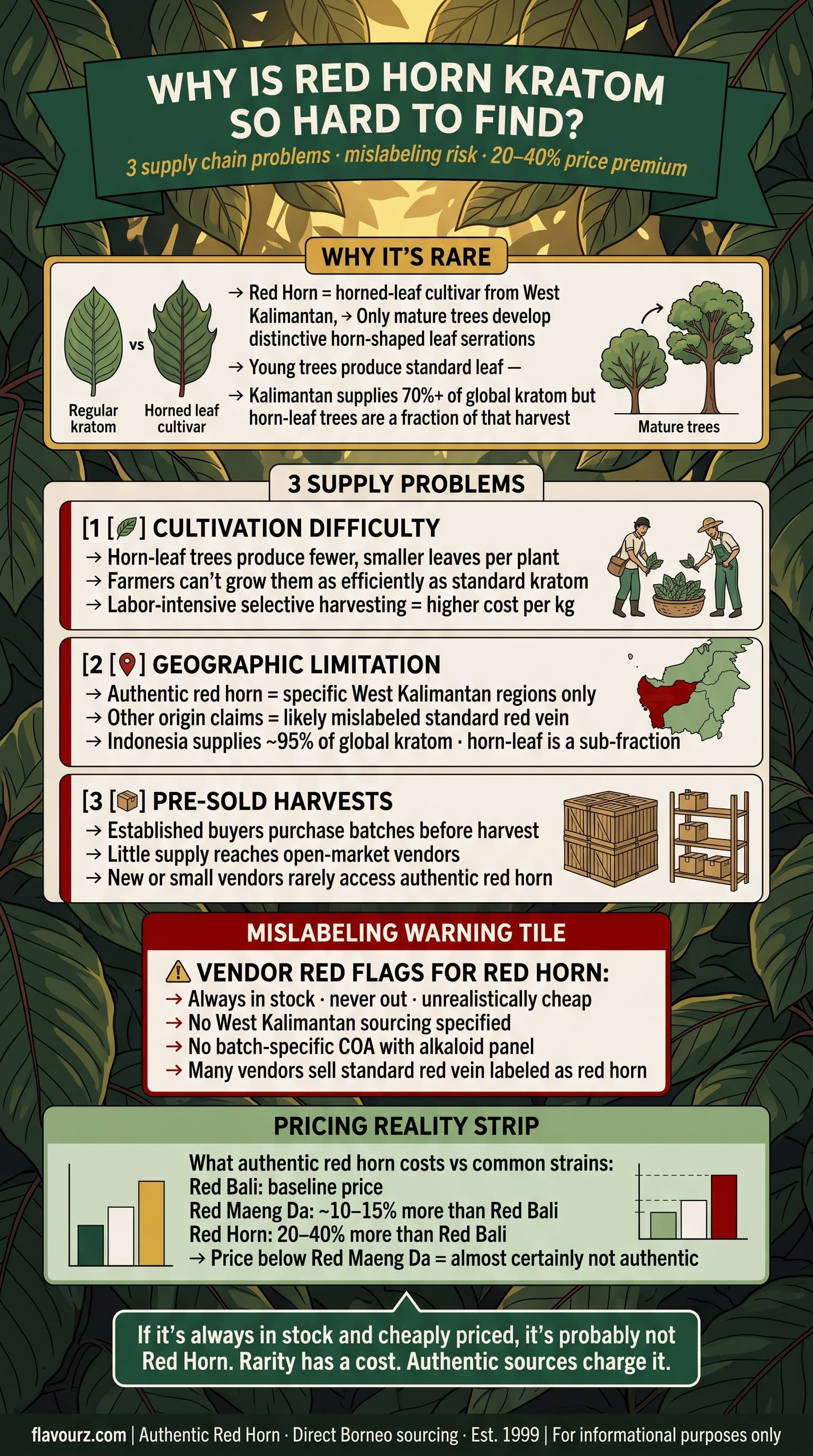
Red horn kratom is rare because the horned-leaf cultivar is harder to grow than standard kratom varieties, with smaller harvests and limited cultivation regions in West Kalimantan, Borneo. Many farms sell their red horn yields before the plants are even harvested, meaning the strain rarely reaches mass-market vendors. Quality red horn typically costs 20-40% more than common red strains.
The supply story breaks down into three main issues:
- Cultivation difficulty: Horn-leaf trees produce fewer and smaller leaves per plant than standard kratom. Farmers can't grow them as efficiently.
- Geographic limitation: Authentic red horn comes mainly from specific regions in West Kalimantan, Borneo. Other origins are rare or marketing claims rather than genetic horn-leaf material.
- Pre-sold harvests: Established buyers often purchase red horn batches before they're harvested, leaving little for open-market sales.
On top of these existing challenges, the 2024 Indonesian export law changes that affected all whole-leaf and crushed-leaf kratom also affected red horn supply. Quality red horn powder is still importable since it's processed before export, but raw harvest volumes have stayed limited. We've worked with sources in Borneo for over a decade, which is part of why we can stock red horn when many smaller vendors can't.
How Do You Choose Quality Red Horn Kratom?
Quality red horn kratom should have a deep reddish-brown powder color, an earthy aroma with subtle sweet notes, third-party lab testing showing 1.2-1.8% mitragynine content, and clear sourcing information from West Kalimantan or Borneo. Avoid products with vague origin claims, low alkaloid percentages, or no lab testing.
The quality checklist I walk customers through for red horn specifically:
- Color: Deep reddish-brown to dark olive-brown. Pale or washed-out color suggests older or improperly dried material.
- Aroma: Earthy with subtle sweet notes. Strong musty or chemical smells indicate poor quality.
- Mitragynine content: Quality red horn shows 1.2-1.8% mitragynine on lab testing. Below 1% suggests poor harvest quality. Above 2% suggests adulteration or extract addition.
- Sourcing transparency: Vendor should specify Borneo, West Kalimantan, or specific Indonesian regions.
- Lab testing: Heavy metals, microbiology (salmonella, E. coli), and full alkaloid panel.
- AKA GMP certification: American Kratom Association GMP certification means the vendor follows Good Manufacturing Practices.
- KCPA compliance: Kratom Consumer Protection Act standards for labeling and sourcing.
- Particle size: Consistent fine powder that dissolves readily in liquids.
One honest warning: because red horn is rare and commands a premium price, it's also a frequent target for fraudulent labeling. Some vendors sell ordinary Red Maeng Da or Red Borneo as "red horn" because the alkaloid profiles are similar enough that most customers can't tell the difference. Buy from established vendors with consistent supply chains. Browse our red vein kratom selection to see authentic red strain options.
Red Horn vs Red Maeng Da: Are They the Same?
Red horn and Red Maeng Da are not the same strain, but they share similar alkaloid profiles and produce comparable effects. Some industry observers speculate they may have nearly identical mitragynine content, but red horn has slightly different secondary alkaloid concentrations from its genetic horn-leaf characteristics. The biggest practical difference is rarity and price.
Side-by-side breakdown:
- Genetics: Different cultivars. Red horn has horn-shaped leaves; Red Maeng Da has standard leaves.
- Origin: Red horn is West Kalimantan-specific; Red Maeng Da is grown across Southeast Asia.
- Alkaloid profile: Similar mitragynine content, slight differences in secondary alkaloids.
- Effects: Comparable mood lift and relaxation. Red horn often described as smoother, Red Maeng Da as more consistent.
- Availability: Red Maeng Da is widely available; red horn is rare.
- Price: Red horn typically costs 20-40% more per gram than Red Maeng Da.
If you can't find red horn or it's outside your budget, Red Maeng Da is the closest commonly available substitute. For most users, the experience will be similar enough that the difference doesn't justify the price gap. Red horn is worth seeking out specifically if you're a long-term kratom user looking for variety in your rotation.
Frequently Asked Questions
Is red horn kratom good for beginners?
Red horn kratom can work for beginners willing to start with low doses (1-1.5 grams) and respect the strain's higher potency. However, beginners often have better experiences with milder reds like Red Bali or balanced greens. Red horn's unpredictability and "wobbles" risk make it slightly less beginner-friendly than other entry strains.
Can red horn kratom help with sleep?
Red horn kratom is sometimes used as part of an evening wind-down routine, but it shouldn't be relied on as a direct sleep aid. The relaxation effects can support better sleep readiness for some users, but kratom isn't FDA-approved for sleep, individual responses vary, and dependence risk increases with daily use.
How is red horn kratom different from green horn?
Red horn and green horn share the same horn-shaped leaf morphology but come from different leaf maturity harvests. Green horn produces more energizing, focus-oriented effects, while red horn produces calmer, more sedating effects. Both are rare strains with similar pricing, but they serve very different use cases.
Why do some people call red horn "unpredictable"?
Red horn earned the "unpredictable" nickname because effects can vary more between batches and between users than with standard red strains. The horn-leaf genetic variation produces slightly different alkaloid ratios from harvest to harvest, leading to reported differences in onset speed, intensity, and duration even within the same strain.
Can I mix red horn with other kratom strains?
Yes, red horn kratom can be mixed with other strains, though most users prefer to experience it on its own first to understand how it affects them. Common combinations include red horn with green Maeng Da for daytime balance or red horn with white Borneo for mood-lifted energy. Start with 50-50 ratios and adjust.
Final Thoughts From Flavourz Kratom
Red horned kratom is a niche red strain worth knowing about even if you don't end up making it your daily go-to. The horn-shaped leaves represent a real genetic variation, the alkaloid profile produces genuinely different effects from standard reds, and the rarity makes it a memorable strain to try when you find it.
If you're new to kratom, I'd actually recommend trying Red Bali or Red Borneo first to learn how red strains feel for your body. Once you know your baseline with the more common reds, red horn becomes more interesting because you'll notice the differences. If you're already an experienced user looking for variety in your rotation, red horn is one of the better "next step" reds to try.
We've been at this since 1999, and red horn has always been a periodic addition to our lineup rather than a permanent staple, simply because the supply isn't reliable enough for daily availability. When we have it, it sells fast. If you see it in stock from any reputable vendor, that's worth taking seriously.
Wellness Disclaimer: Kratom is not approved by the FDA to diagnose, treat, cure, or prevent any disease. The information in this article is for educational purposes only and is not medical advice. Always consult a qualified healthcare provider before starting kratom, especially if you take prescription medications, have a medical condition, or are pregnant or nursing. Kratom may be habit-forming. Use responsibly and check your local laws regarding kratom legality in your area.

Leave a comment