

Where to Buy Kratom Online: 7 Red Flags to Avoid 2026
Last Updated: April 2026 | By the Flavourz Kratom team, serving customers since 1999
The seven biggest red flags when buying kratom online are: missing third-party lab tests, no AKA GMP certification, prices below $50/kg, vague sourcing claims, medical or therapeutic promises, poor website quality with broken links or fake reviews, and missing return policies. Spotting two or more of these signs means walking away from that vendor. The kratom industry remains largely unregulated, making vendor verification essential before any online purchase.
I've been watching online kratom vendors come and go since Flavourz Kratom started in 1999. After 25 years and over 10,000 customers served, I can tell you exactly which vendor behaviors signal trouble before you place an order. Some red flags are obvious. Others are subtle. Let me walk you through the seven warning signs that should send you looking elsewhere, based on patterns I've watched cause real problems for real customers.
Where Can I Safely Buy Kratom Online?
The safest places to buy kratom online are AKA GMP-certified vendors with at least 5 years of operating history, transparent third-party lab testing on every batch, clear sourcing information, and verifiable customer service. Avoid Amazon (which prohibits kratom sales), generic marketplace listings, and any vendor missing basic transparency. Established online vendors offer better pricing, fresher product, and verifiable quality compared to gas stations or smoke shops.
The kratom industry has matured considerably since the early 2010s, but it still has a long way to go.
What Trustworthy Online Vendors Look Like
Quality vendors share certain visible characteristics:
- AKA GMP certification: Listed on the American Kratom Association's official vendor list
- 5+ years operating history: Established track record means accountability
- Public lab tests: COAs accessible without requesting them
- Clear sourcing details: Specific Indonesian regions named
- Real contact information: Phone numbers, emails, physical addresses
- Educational content: Detailed strain descriptions and usage information
- Review presence: Independent reviews on Reddit, Trustpilot, and other platforms
If a vendor checks all these boxes, they're worth your business. If multiple boxes are missing, keep looking. There are too many quality options to risk it on questionable vendors.
7 Red Flags to Watch for When Buying Kratom
Red Flag #1: Missing or Hidden Lab Test Results
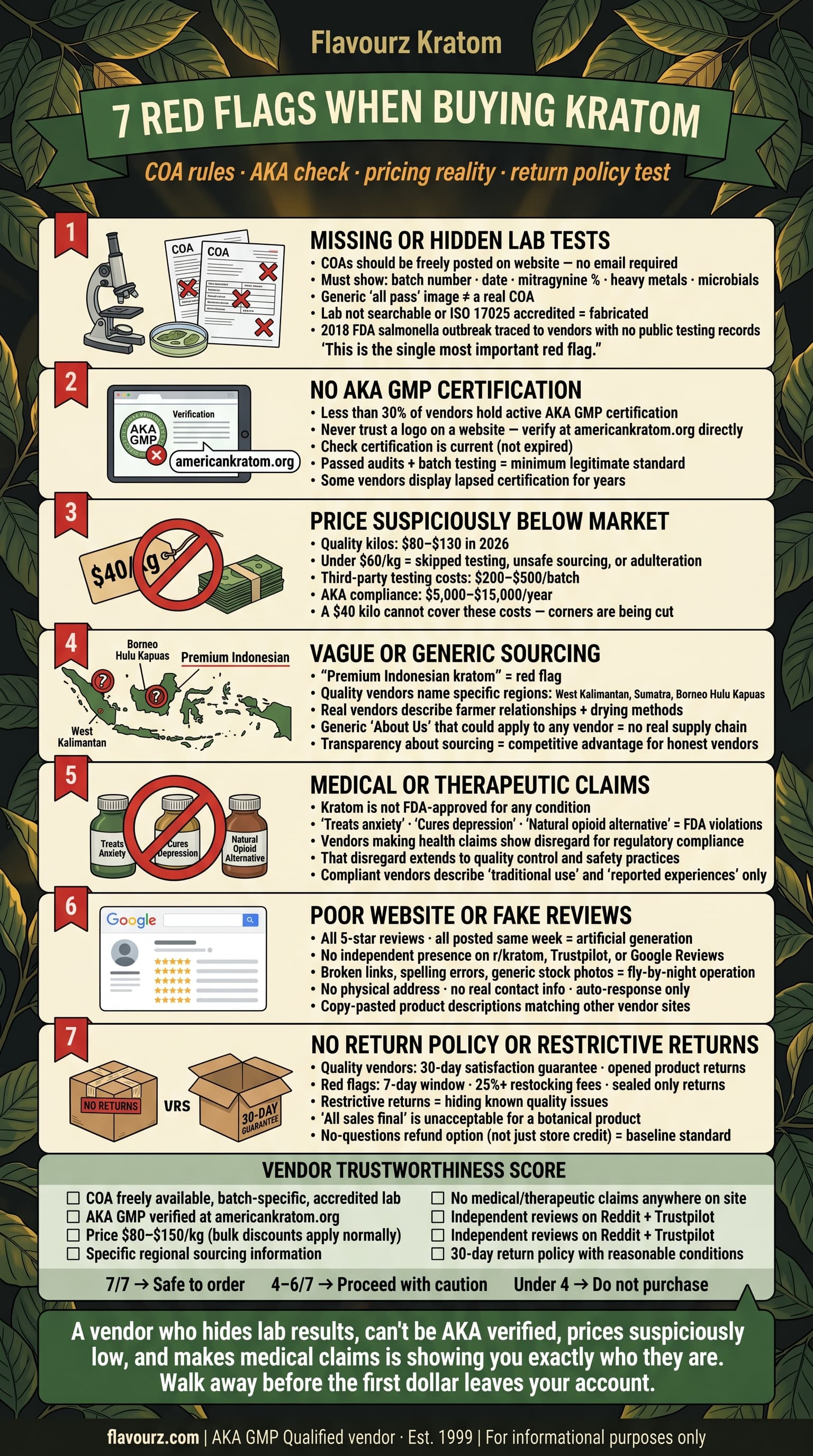
The biggest red flag is missing third-party lab tests or hiding them behind contact requests. Quality vendors post Certificates of Analysis (COAs) openly on their website with batch numbers matching specific products. If you have to email asking for lab results, the vendor is creating intentional friction. According to American Kratom Association standards, batch-specific COAs should be available without request.
This is the single most important red flag to watch for.
Why Lab Tests Matter So Much
Kratom is unregulated. The 2018 FDA salmonella outbreak linked to contaminated kratom products affected dozens of people across multiple states. Most contaminated products came from vendors without public testing records. Quality vendors learned from that incident and now post lab results proactively.
Look for these specific elements on COAs:
- Batch number matching the product you're buying
- Recent dates within 6 months of harvest
- Mitragynine percentage between 1.2-1.8%
- Heavy metals tested (lead, arsenic, cadmium, mercury)
- Microbial screening (salmonella, E. coli, mold, yeast)
- Independent lab name with accreditation visible
If a vendor shows generic COAs that don't match your batch, or if they refuse to provide testing information, walk away immediately.
Red Flag #2: No AKA GMP Certification
Lack of AKA GMP certification is a major red flag in 2026. Less than 30% of kratom vendors hold this certification, but those who do have passed independent facility audits and follow documented quality control standards. Always verify certification on the AKA's official Qualified Vendor list rather than trusting a logo on the vendor's website. Some less-honest vendors display the logo without holding active certification.
How to Verify AKA Certification
The verification process is simple:
- Visit the AKA website and find the GMP Qualified Vendor list
- Search for the vendor name exactly as written on their site
- Check certification status showing active or expired
- Verify certification date is current within the past year
- Cross-reference with vendor's claims on their website
I've seen vendors display AKA logos for years after their certification lapsed. Verification takes 60 seconds and protects you from misleading marketing. For more on what AKA certification actually requires, see our 2026 vendor review covering certified brands.
Red Flag #3: Prices Suspiciously Below Market
Suspiciously low pricing is a major warning sign. Quality kratom kilos cost $80-$150 in 2026, with bulk discounts dropping to $50-$70 per kilo at 5+ kilo volumes. Single kilos under $50 indicate skipped lab testing, questionable sourcing, or contamination risks. The math doesn't work for legitimate vendors at those prices when factoring in third-party testing costs ($200-$500 per batch) and AKA compliance ($5,000-$15,000 annually).
The Real Cost of Quality Kratom
Production costs that quality vendors actually pay:
- Third-party lab testing: $200-$500 per batch tested
- AKA GMP certification: $5,000-$15,000 annually
- Direct farm relationships: Premium pricing for verified sourcing
- Quality control labor: Manual inspection and sorting
- Proper packaging: Food-grade vacuum sealing
- Climate-controlled storage: Maintaining product freshness
- Customer service teams: Real humans answering real questions
A vendor selling kilos at $40 cannot afford to do any of this properly. They're cutting corners somewhere, and those corners affect product safety. For more on pricing reality, our cheap kratom buying guide covers what really matters when comparing prices.
Red Flag #4: Vague or Generic Sourcing Claims
Vague sourcing language like "premium Indonesian kratom" or "authentic Southeast Asian source" without specifics indicates either a vendor who doesn't know their supply chain or who's hiding it. Quality vendors name specific regions (West Kalimantan, Sumatra, Borneo Hulu Kapuas), discuss their farmer relationships, and explain their sourcing standards. Sourcing transparency separates real vendors from middleman operations.
What Real Sourcing Information Looks Like
Quality vendors typically share:
- Specific Indonesian regions: West Kalimantan, East Kalimantan, Sumatra
- Farmer relationship details: Direct purchase or co-op partnerships
- Harvest timing information: Seasonal patterns and crop selection
- Processing methods: Drying techniques and quality control steps
- Sustainability practices: How they support farming communities
- Supply chain transparency: The journey from leaf to packaging
If a vendor's "About Us" page is generic and could be copy-pasted to any kratom website, that's a sign they're not invested in actual sourcing relationships. Vendors with real farm connections share that information because it's a competitive advantage.
Red Flag #5: Medical or Therapeutic Claims
Vendors making medical claims about kratom violate FDA regulations and signal disregard for compliance. Kratom is not approved for treating any condition. Vendors claiming their products "treat anxiety," "cure depression," "stop addiction," or otherwise promise therapeutic benefits are either ignorant of regulations or willing to ignore them. Either way, that disregard typically extends to other quality and safety practices.
How Reputable Vendors Talk About Effects
Compliant vendors describe kratom in terms of:
- Traditional usage patterns in Southeast Asian communities
- Customer feedback and reported experiences
- General wellness support without specific claims
- Strain characteristics like "calming" or "energizing"
- Educational information rather than therapeutic promises
Compare that to red flag language like "treats chronic pain," "reduces anxiety symptoms," or "natural alternative to opioids." These claims are illegal regardless of how true they may be in personal experience. Vendors making them are showing disregard for the regulatory framework that protects everyone.
Red Flag #6: Poor Website Quality or Fake Reviews
Poor website quality reveals a vendor who isn't invested in their business. Watch for broken links, missing pages, generic stock photos, no real product images, copy-pasted content from other vendors, fake-looking review patterns, no About page, and missing contact information. These technical issues signal a fly-by-night operation rather than an established business committed to long-term customer relationships.
Specific Website Red Flags
Look out for these specific signs:
- All 5-star reviews: Real businesses have some 3-4 star feedback
- Reviews posted same day: Suggests artificial review generation
- Generic stock photography: Real vendors photograph their actual product
- Broken links or 404 errors: Indicates poor maintenance
- Copy-pasted descriptions: Same wording across multiple vendor sites
- No physical address: Real businesses identify themselves
- Auto-response only customer service: No real humans available
- Missing strain photos: Quality vendors show product close-ups
The Independent Review Test
Quality vendors have presence on independent review platforms. Search the vendor name on:
- Reddit's r/kratom community for honest user feedback
- Trustpilot reviews showing both positive and negative experiences
- Google reviews if they have a verified business listing
- Better Business Bureau for complaint patterns
- Specialized kratom review sites for in-depth analysis
If a vendor only has reviews on their own website with no independent presence, that's a major red flag. Real vendors generate organic discussion in the kratom community over time.
Red Flag #7: No Return Policy or Restrictive Returns
Missing return policies or extremely restrictive returns indicate a vendor who doesn't stand behind their product. Quality vendors offer 30-day satisfaction guarantees on opened products, no-questions-asked returns on unopened items, and reasonable replacement policies for shipping issues. Vendors with "no returns" policies, 7-day return windows, or excessive restocking fees are often hiding quality issues they don't want returned and verified.
What Quality Return Policies Look Like
Trustworthy vendors typically offer:
- 30-day return windows on most products
- Opened product returns with reasonable conditions (75% remaining is common)
- Free return shipping on quality issues
- Replacement guarantees for damaged shipments
- Money-back options rather than store credit only
- Clear refund timelines (typically 7-14 days after return receipt)
If a vendor's return policy includes excessive fees, short windows, or unrealistic conditions ("only sealed bags within 7 days"), they're protecting themselves from product quality complaints rather than serving customers.
How Do I Avoid Kratom Scams Altogether?
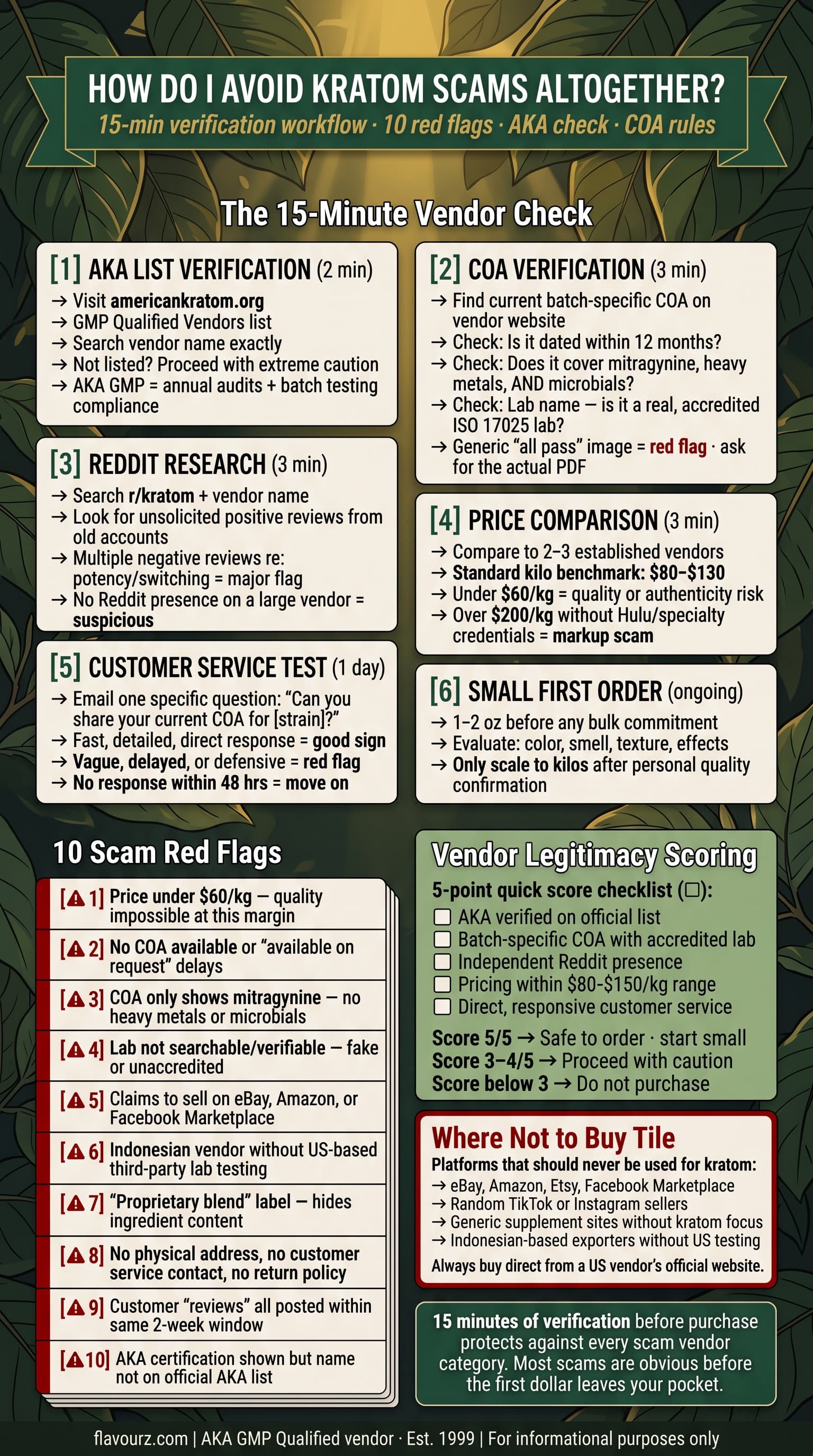
Avoiding kratom scams comes down to systematic vendor verification before purchase. Always verify AKA certification directly on the official list, check for batch-specific COAs, verify pricing falls within market norms, search for independent reviews, test with small orders before bulk commitments, and trust your gut when something feels off. Most scams are obvious if you take 15-20 minutes to verify the vendor before placing an order.
The 15-Minute Verification Process
Here's the workflow I recommend to every customer evaluating a new vendor:
- AKA verification: Search the vendor name on AKA's official list (2 minutes)
- Lab test check: Find current COAs on the vendor's website (3 minutes)
- Reddit search: Look up vendor name on r/kratom (3 minutes)
- Pricing comparison: Compare against 2-3 other established vendors (3 minutes)
- Customer service test: Send a question email and check response (waits a day)
- Small first order: Buy 1-2 ounces to test quality before bigger commitments
- Build relationship: Once trust is established, scale up orders over time
This process catches almost every scam vendor. The few that pass initial verification but turn out problematic show themselves through the small first order before you've made a major commitment.
Quick Reference: Red Flag Severity Guide
| Red Flag | Severity | Action |
|---|---|---|
| No lab tests | Critical | Walk away |
| No AKA cert | High | Strong caution |
| Suspiciously cheap | High | Walk away |
| Vague sourcing | Medium | Ask questions |
| Medical claims | High | Walk away |
| Poor website | Medium | Caution |
| No returns | Medium | Caution |
The severity guide helps prioritize which red flags to weigh more heavily. Critical red flags mean immediate exit. High-severity flags justify walking away in most cases. Medium flags warrant questions before committing.
Frequently Asked Questions
Is buying kratom on Amazon safe?
Amazon prohibits kratom sales, so any "kratom" listed there is either mislabeled, a different product entirely, or being sold against Amazon's policies. Don't buy kratom from Amazon. Established kratom-specific vendors offer better pricing, fresher product, and verified quality compared to whatever appears on general marketplaces.
Why are some kratom vendor reviews suspicious?
Suspicious review patterns include all 5-star ratings, reviews posted on the same day, generic comments without specific product details, suspiciously similar writing styles, and reviews appearing only on the vendor's own website. Real vendors have presence across multiple platforms with mixed feedback over time.
Can I trust kratom from gas stations and smoke shops?
Generally no. Multiple FDA contamination warnings have specifically targeted gas station and smoke shop kratom products. These channels often carry old inventory, lack proper supply chain documentation, and offer inflated pricing compared to online vendors. Quality online vendors with AKA certification offer significantly better value and safety.
How do I report a scam kratom vendor?
Report scam vendors to the Better Business Bureau, your state's attorney general consumer protection division, the FTC complaint database, and Reddit's r/kratom community for community awareness. If you've been charged unauthorized amounts, contact your credit card company for chargebacks. Document everything for these reports.
What's the difference between expensive and cheap kratom vendors?
Quality differences between expensive and cheap kratom vendors include lab testing rigor, sourcing relationships, AKA certification, customer service quality, and packaging standards. Premium vendors invest in third-party testing, direct farm relationships, and proper handling. Cheap vendors typically skip these costs, which shows up in product quality and consistency. See our premium vs commercial guide for details.
Should I buy kratom from a vendor without AKA certification?
Some quality vendors operate without AKA certification due to costs or administrative requirements. However, AKA-certified vendors offer the most reliable quality verification available. If considering a non-certified vendor, verify they meet equivalent standards through transparent testing, sourcing, and operations. When in doubt, certified vendors are the safer choice.
The Bottom Line: Smart Online Kratom Shopping
Buying kratom online safely in 2026 comes down to systematic vendor verification before purchase. Watch for the seven red flags covered here: missing lab tests, no AKA certification, suspicious pricing, vague sourcing, medical claims, poor website quality, and restrictive returns. Spotting any single critical-severity flag means walking away. Multiple medium-severity flags also warrant caution.
Honestly, after 25 years in this industry, I've watched the kratom market mature considerably. Quality vendors are easier to identify than ever, and scam operations get exposed faster through community discussion. The information you need to verify any vendor is available within 15-20 minutes of research. The customers who get burned typically skip that verification.
For users new to kratom, start with our beginner's guide to understand what quality kratom should look and feel like. For experienced users wanting to upgrade vendors, see what makes a vendor truly trustworthy. Ready to shop with confidence? Browse our complete kratom selection where every batch goes through third-party testing, every product has a verifiable COA, and we maintain active AKA GMP certification under our 25-year operating history.
Disclaimer: This article is for informational purposes only and does not constitute medical advice. Kratom has not been evaluated by the FDA for safety or effectiveness. It is not intended to diagnose, treat, cure, or prevent any disease. Consult your healthcare provider before using kratom, especially if you have medical conditions or take medications. Kratom is not for use by anyone under 21, pregnant, or breastfeeding. Check your local laws before purchasing.

Leave a comment