

Yellow Vein Kratom: Fermented Strains Guide 2026
Last Updated: April 2026
Yellow vein kratom is a processing style, not a natural vein color. Producers create it by fermenting or extended-drying red, green, or white vein leaves, which shifts the alkaloid balance and produces a distinctive yellow-hued powder. The result is a smoother, more balanced strain that sits between the stimulation of white vein and the calm of red vein kratom.
What Is Yellow Vein Kratom?
Yellow vein kratom refers to kratom leaves that have gone through an extended drying or fermentation process after harvest, changing their alkaloid composition and giving the finished powder its yellow-gold color. Unlike red, green, and white strains, yellow doesn't describe a natural leaf vein color. Kratom trees don't grow yellow-veined leaves. The color comes entirely from post-harvest processing.
After 25+ years at Flavourz watching kratom processing evolve, I can tell you yellow strains are one of the more misunderstood categories in the market. Most buyers assume yellow is a separate variety like red or green. It isn't. A "Yellow Bali" is essentially a Red or Green Bali that's been fermented or dried differently. The source leaves matter, but the processing is what makes it yellow.
Why Isn't Yellow a Natural Vein Color?
Kratom trees produce leaves with red, green, or white veins based on leaf maturity at harvest. Red veins indicate fully mature leaves, green veins show mid-maturity, and white veins appear on young leaves. There's no stage of growth where kratom veins naturally turn yellow. The yellow color develops only through specific post-harvest processing, typically extended fermentation or alternating sun-shade drying cycles.
How Is Yellow Kratom Made?
Yellow kratom is made through two main production methods: extended fermentation of already-dried red, green, or white vein leaves, or blending different vein colors followed by additional drying. Fermentation typically takes 2 to 3 days in controlled humidity and temperature conditions, during which natural enzymes shift the alkaloid balance and produce the characteristic yellow hue.
The Two Main Production Methods
Both methods produce yellow kratom, but they create slightly different results:
- Controlled fermentation: Leaves are stored in sealed bags or containers for 2-3 days at specific humidity and temperature levels, allowing natural enzymes to convert alkaloids before the final drying step
- Extended drying cycles: Leaves are alternated between direct sunlight and indoor shade over an extended period, producing gentler alkaloid shifts than full fermentation
- Strain blending: Some producers mix red and white or red and green vein powders and then ferment the blend to achieve specific effect profiles
- Light fermentation: A shorter fermentation step that retains more of the parent strain's character while adding smoothness
Research from ACS Laboratory kratom analysis confirmed that red kratom leaves are typically fermented in plastic bags for about three days depending on humidity and temperature, and that this fermentation process is what gives various kratom colors their distinct character. Lab testing is the only reliable way to know exactly how fermentation impacted any given batch.
What Are the Effects of Yellow Kratom?
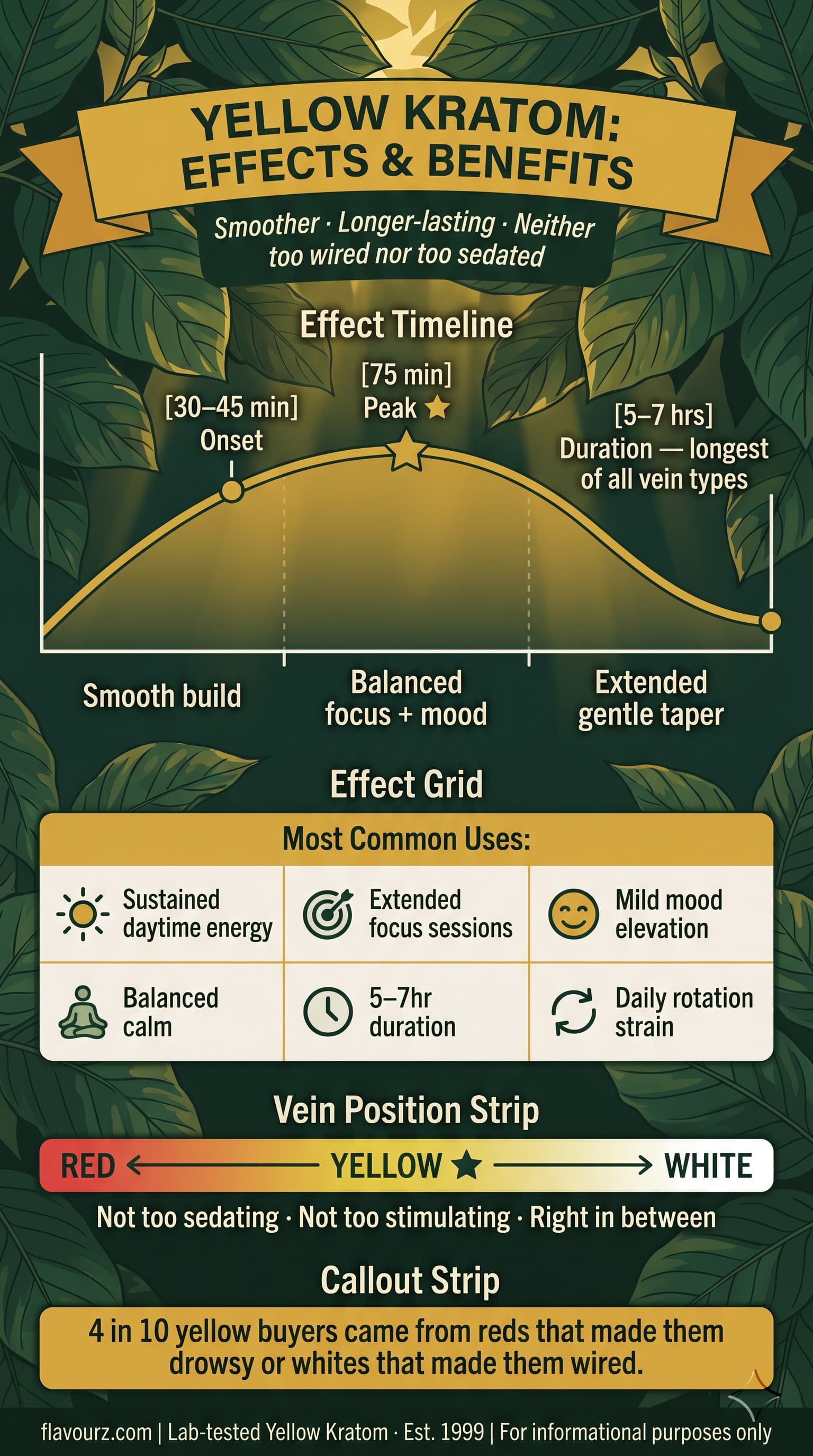
Yellow vein kratom effects typically include balanced energy, mild mood elevation, gentle relaxation, and sustained focus without heavy stimulation or deep sedation. Users describe the experience as smoother and more rounded than traditional vein colors. Onset occurs within 30 to 45 minutes, peak effects hit around 75 minutes, and total duration runs 5 to 7 hours, which is longer than most red or green strains.
Common Yellow Kratom Benefits
Yellow vein is most commonly used for:
- Sustained daytime energy without coffee-like jitters
- Mild mood lift with subtle relaxation layered in
- Longer-lasting focus for extended work sessions
- Balanced effects for users who find white too stimulating and red too sedating
- Smoother onset with less pronounced peak and taper
- Everyday use without commitment to energy or relaxation extremes
Here's what I've noticed from roughly 25 years of customer conversations at Flavourz: yellow strains appeal most to people who've tried the big three vein colors and feel like something's missing in each one. It's the "Goldilocks" of kratom processing. Not too energizing, not too calming. About 4 out of 10 yellow vein buyers I've talked with came to it specifically because standard reds made them drowsy and standard whites made them wired.
How Does Fermentation Change the Alkaloid Profile?
Fermentation changes kratom's alkaloid profile by shifting the ratios of mitragynine, 7-hydroxy alkaloids, speciogynine, paynantheine, and other minor alkaloids. The process can reduce mitragynine slightly while producing more balanced alkaloid distributions. This is why yellow strains often feel less intense at peak but last longer than their source material.
The specific changes depend heavily on fermentation duration, humidity, temperature, and whether the starting material was red, green, or white vein. There's no single "yellow alkaloid profile." Each batch differs based on how it was processed. That's both the appeal and the challenge of yellow strains: the variety is wider, but consistency between vendors is harder.
Yellow vs Other Vein Colors
| Vein Type | Source | Typical Profile | Duration |
|---|---|---|---|
| Red | Mature leaves | Calm, relaxing | 4–6 hours |
| Green | Mid-maturity | Balanced | 3–5 hours |
| White | Young leaves | Energizing | 3–5 hours |
| Yellow | Fermented | Smooth, rounded | 5–7 hours |
Yellow vs Gold Kratom: What's the Difference?
Yellow and gold kratom are closely related but not identical. Yellow kratom typically undergoes moderate fermentation or extended drying, producing a balanced effect profile. Gold kratom involves longer fermentation, often resulting in slightly stronger relaxation effects. Some vendors use the terms interchangeably, while others distinguish gold as a higher-quality or longer-fermented yellow strain.
Honestly, the yellow-vs-gold distinction is more about marketing than hard chemistry. Different vendors use the terms differently. Some reserve "gold" for their premium yellow lineup. Others treat them as separate categories based on fermentation length. For a deeper breakdown, see our red and gold kratom comparison.
What Are the Most Popular Yellow Kratom Strains?
The most popular yellow kratom strains include Yellow Bali, Yellow Borneo, Yellow Vietnam, Yellow Maeng Da, and Yellow Indo. Yellow Bali is the most widely available and comes from fermenting Red Bali leaves. Yellow Vietnam offers distinctive mood-lifting effects. Yellow Borneo provides well-rounded balanced effects suitable for all-day use.
Popular Yellow Strain Varieties
| Strain | Source Leaf | Best For |
|---|---|---|
| Yellow Bali | Red Bali | Smooth relaxation |
| Yellow Vietnam | Vietnamese stock | Mood elevation |
| Yellow Borneo | Red/White Borneo | Balanced daytime |
| Yellow Maeng Da | 80% White + 20% Red | Focus with lift |
| Yellow Indo | Indonesian stock | Long duration |
Yellow Vietnam deserves special attention because Vietnamese kratom has a distinctive growing region along the Mekong river with mineral-rich soil. The result is a fermented strain with noticeable mood effects and longer duration than most other yellows. Our Yellow Vietnam strain guide covers the specifics in detail.
How Much Yellow Kratom Should I Take?
Yellow kratom dosage typically ranges from 2 to 5 grams depending on experience. Beginners should start at 2 grams, moderate users take 3 to 4 grams for balanced effects, and experienced users may take 4 to 5 grams for stronger results. Because yellow strains have slower onset than white or green, wait at least 45 minutes before re-dosing to avoid overshooting.
Yellow Kratom Dosage Reference
| Experience | Amount | Expected Effect |
|---|---|---|
| Beginner | 1.5–2 g | Mild lift, subtle calm |
| Moderate | 2.5–3.5 g | Balanced energy, mood |
| Experienced | 4–5 g | Strong sustained effects |
| High (caution) | 6+ g | Diminishing returns |
My biggest piece of advice for yellow strains: patience matters more than for other veins. Yellow's slower onset makes people think the dose didn't work, so they re-dose at 30 minutes. Then effects from both doses hit at once, and it's uncomfortable. Wait the full 45-60 minutes before adjusting anything.
Is Yellow Kratom Good for Beginners?
Yellow kratom can work for beginners, but it's not the best starting point. Standard red or green strains offer more predictable effects with better documentation and consistency between vendors. Yellow's reliance on fermentation processing means quality varies more widely, making it harder for new users to evaluate whether a disappointing experience is the strain or the batch.
For first-time kratom users, I usually point people toward standard strains first. Try a reliable red like Red Bali, or a balanced green like Green Malay, and see how kratom affects you. After a few experiences with traditional strains, yellow makes more sense as a next step because you'll have a baseline to compare against. Our beginner's kratom guide covers first-time protocols.
How to Take Yellow Kratom
Yellow kratom can be taken as powder mixed in water or juice, as capsules for convenience, or brewed as tea. Because fermentation gives yellow strains a smoother, less bitter taste than standard red or green kratom, some users find toss-and-wash more tolerable with yellow varieties. Capsules delay onset by 15-20 minutes.
One benefit of yellow strains I've heard from long-term customers: the taste is noticeably smoother than traditional reds or greens. Fermentation mellows the bitterness. People who struggle with kratom taste often find yellow easier to work with. If taste is a barrier, this matters. For preparation methods, see our kratom powder usage guide.
What Do Experienced Users Say About Yellow Kratom?
Experienced kratom users describe yellow vein as "rounded," "smooth," and "long-lasting." Common praise includes the extended duration compared to standard strains, the gentler peak that avoids jittery or sedating extremes, and the distinctive mood character fermentation produces. The most common criticism is inconsistency between vendors and batches due to processing variations.
What I hear from long-term buyers: yellow is a rotation strain, not usually a daily driver. People keep Yellow Bali or Yellow Vietnam on hand for specific days when they want something different from their standard strain. It's the "in-between" category that fills a specific need.
What to Watch Out For With Yellow Kratom
Three things to consider before buying yellow strains:
1. Quality varies significantly. Because fermentation is harder to control than basic drying, yellow kratom batches can differ by 30% or more in alkaloid content between vendors. Lab testing matters more here than with standard strains.
2. Some "yellow" is just rebranded red or green. A few low-quality vendors label standard strains as "yellow" without proper fermentation processing. Look for vendors who specify their production method.
3. Fermentation can go wrong. Poorly controlled fermentation can degrade kratom quality rather than enhance it. If yellow strains smell off or have visible mold risks, return the product immediately.
Is Yellow Kratom Legal?
Yellow kratom is federally legal in the U.S. as of 2026, but kratom (all strains) is banned in Alabama, Arkansas, Indiana, Rhode Island, Vermont, and Wisconsin. Several states enforce Kratom Consumer Protection Acts with age restrictions or labeling requirements. Yellow strains fall under the same legal framework as red, green, and white kratom.
Check local laws before purchasing, especially in states with KCPA requirements. Our state-by-state kratom legal status guide tracks updates regularly.
Where to Buy Quality Yellow Kratom
Quality yellow kratom should come from vendors who disclose their fermentation methods, publish lab tests showing alkaloid content, source from reputable Southeast Asian farms, and provide batch-specific Certificates of Analysis. Avoid vendors who simply label products "yellow" without explaining how they produced the strain.
At Flavourz, our yellow strains go through the same lab testing as our standard lineup, checking for mitragynine content, heavy metals, and microbial contamination. After 25+ years sourcing kratom, I can tell you fermentation quality is visible in the powder itself. Proper yellow kratom has a consistent pale gold-yellow color. If it looks brown or uneven, the fermentation didn't go right.
Browse our yellow vein kratom selection or explore specific strains like Yellow Vietnam kratom powder.
Frequently Asked Questions
Is yellow kratom stronger than red or green?
No, yellow kratom isn't inherently stronger than red or green strains. It typically produces more balanced effects with longer duration (5-7 hours vs 3-5 hours for most standard strains), but peak intensity is usually lower. Strength depends more on batch quality and dose than vein color.
How long does yellow kratom last?
Yellow kratom effects typically last 5 to 7 hours from a standard 3 to 4 gram dose, making it one of the longer-acting kratom categories. Onset starts within 30 to 45 minutes, peak effects hit around 75 to 90 minutes, and the taper is gradual. Fermentation extends total duration compared to source material.
Can I mix yellow kratom with other strains?
Yes, experienced users sometimes blend yellow kratom with small amounts of red for extra calm or white for additional energy. However, strain blending is not recommended for new users. Understand how each strain affects you individually before combining them.
Does yellow kratom cause tolerance?
Yes, daily yellow kratom use typically leads to tolerance within 2 to 4 weeks. Because yellow effects are already subtle compared to other strains, tolerance can make them feel ineffective faster. Rotating with other strains and taking 5 to 7 day breaks helps preserve sensitivity.
What's the difference between Yellow Bali and Red Bali?
Yellow Bali starts as Red Bali leaves that go through extended fermentation or specialized drying, which shifts the alkaloid profile. The result is smoother effects, longer duration, and less pronounced sedation than standard Red Bali. Our yellow kratom benefits and differences guide covers this in detail.
How many capsules equal a gram of yellow kratom?
Standard "00" kratom capsules hold approximately 0.5 grams each, so 2 capsules equal 1 gram. A typical 3-gram yellow kratom dose equals 6 capsules. For precise conversions across capsule sizes, see our kratom capsule dosage guide.
Final Thoughts on Yellow Vein Kratom
Yellow vein kratom occupies a specific niche. It's not for everyone, and it's not the best starting point for new users. What it is, after 25+ years of Flavourz watching the industry mature, is a legitimate processing category that gives experienced users access to effects they can't get from standard red, green, or white strains alone.
If you've tried the traditional vein colors and feel like something's missing, yellow is worth exploring. Start with a reliable strain like Yellow Bali or Yellow Vietnam from a vendor who documents their fermentation process. And remember: yellow rewards patience. The slower onset and longer duration are features, not bugs. For more strain options, see our yellow strain kratom effects guide and our complete kratom strain differences guide.
Important Disclaimer
Kratom is not approved by the FDA and is not intended to diagnose, treat, cure, or prevent any disease. This guide reflects general information and personal industry experience as of April 2026. Consult your healthcare provider before using kratom, especially if you take other medications or have existing health conditions. Legal status varies by state. Always verify local laws before purchasing.

Leave a comment