

Complete Guide to 40+ Kratom Alkaloids: Effects & Concentrations
Last Updated: April 2026
Kratom contains at least 54 identified alkaloids, with mitragynine being the most abundant (up to 66% of total alkaloid content) and 7-hydroxymitragynine being the most potent (approximately 13-46 times stronger than mitragynine at opioid receptors). These alkaloids divide into two main categories: indole alkaloids (like mitragynine) that bind to opioid receptors and contribute to pain relief and mood effects, and oxindole alkaloids (like mitraphylline) that affect the immune system and cardiovascular function.
I've spent 5 years studying kratom alkaloids because understanding them changed how I approach this plant entirely. When I first started working with kratom in 2021, I thought strain names told the whole story. They don't. The alkaloid profile does. After helping over 10,000 customers since 1999, we've learned that understanding even the basics of kratom chemistry helps people make better choices about which products work for their needs.
This guide covers all 40+ major kratom alkaloids, their concentrations, effects, and what they mean for you as a kratom user. I'll focus on what's actually practical and useful rather than just listing chemical formulas.
How Many Alkaloids Are in Kratom?
Scientists have identified at least 54 distinct alkaloids in kratom leaves, though most research focuses on fewer than 10. According to research published in ACS Chemical Neuroscience, these alkaloids fall into two main structural categories: indole alkaloids and oxindole alkaloids.
The number matters because kratom's effects don't come from a single compound. Mitragynine alone doesn't explain why different batches feel different, or why the same strain from different vendors can produce noticeably different experiences. The interplay between dozens of alkaloids creates what researchers call the "entourage effect," where compounds work together to produce the overall experience.
Why Alkaloid Counts Vary
You'll see different numbers reported, from "over 40" to "54 or more." This variation comes from several factors:
- Detection methods improve over time: Better analytical equipment finds compounds previously missed
- Some alkaloids exist in trace amounts: Below detection thresholds in many samples
- Metabolites vs. native alkaloids: Some compounds form during processing or metabolism
- Regional and seasonal variation: Not all alkaloids appear in all samples
The practical takeaway: kratom contains dozens of active compounds, not just one or two. This complexity is why standardizing kratom products remains challenging and why batch-to-batch variation exists even within the same vendor.
The Two Main Categories: Indole vs. Oxindole Alkaloids
All kratom alkaloids belong to one of two structural families. Understanding this distinction helps make sense of the long list of compounds and their effects.
Indole Alkaloids
Indole alkaloids are the primary active compounds in kratom, responsible for most of the effects users experience. They're characterized by a specific chemical ring structure (the indole ring) that allows them to interact with opioid receptors in the brain.
Key indole alkaloids include:
- Mitragynine (most abundant, up to 66% of total alkaloids)
- 7-hydroxymitragynine (most potent)
- Speciociliatine
- Speciogynine
- Paynantheine
- Mitraciliatine
- Corynantheidine
- Ajmalicine
Effects: Indole alkaloids primarily affect opioid receptors (mu, kappa, delta), adrenergic receptors, and serotonin receptors. They're responsible for pain relief, mood effects, energy at low doses, and sedation at higher doses.
Oxindole Alkaloids
Oxindole alkaloids have a modified chemical structure with an additional oxygen atom. They generally don't bind strongly to opioid receptors but affect other systems in the body.
Key oxindole alkaloids include:
- Mitraphylline
- Speciofoline
- Corynoxine A and B
- Rhynchophylline
- Isorhynchophylline
- Isomitraphylline
Effects: Oxindole alkaloids affect the immune system (immunomodulation), cardiovascular function (blood pressure, blood flow), and may have anti-inflammatory properties. They contribute to kratom's overall effect profile but aren't the primary drivers of the experience most users notice.
Quick Comparison
| Feature | Indole Alkaloids | Oxindole Alkaloids |
|---|---|---|
| Primary targets | Opioid, adrenergic, serotonin receptors | Immune system, cardiovascular |
| Main effects | Pain relief, mood, energy/sedation | Immune support, blood pressure |
| Concentration | Higher (majority of alkaloid content) | Lower (typically <1% each) |
| User perception | Primary driver of "kratom experience" | Background/supporting effects |
The 5 Major Alkaloids (Most Abundant)
These five alkaloids make up the vast majority of kratom's total alkaloid content. Understanding them gives you a solid foundation for understanding any kratom product.
1. Mitragynine (40-66% of Total Alkaloids)
Mitragynine is the star of the show. It's the most abundant alkaloid in kratom, typically comprising 1-2% of dry leaf weight and up to 66% of total alkaloid content in Thai varieties (though Malaysian varieties may contain only about 12%).
Concentration: 0.7-38.7% w/w in commercial products
Receptor activity:
- Partial agonist at mu-opioid receptors (pain relief, mood)
- Competitive antagonist at kappa and delta opioid receptors
- Binds to alpha-1 and alpha-2 adrenergic receptors (energy, focus)
- Binds to serotonin 5-HT1A and 5-HT2A receptors (mood)
- Binds to dopamine D1 receptors
Effects attributed:
- Pain relief (antinociception)
- Mood enhancement
- Energy at low doses
- Sedation at higher doses
- Anti-anxiety effects
Important note: Mitragynine doesn't strongly recruit beta-arrestin-2, which is associated with the respiratory depression that makes traditional opioids dangerous. This "functional selectivity" or "biased agonism" is a key area of ongoing research.
2. Paynantheine (3-12.8% of Total Alkaloids)
Paynantheine is the second most abundant alkaloid in most kratom samples. It's an indole alkaloid structurally related to mitragynine but with different pharmacological properties.
Concentration: 0.3-12.8% w/w in commercial products
Receptor activity:
- Weak or no significant opioid receptor activity
- May affect smooth muscle (relaxation)
- Possible adrenergic activity
Effects attributed:
- Smooth muscle relaxation
- May contribute to overall relaxation effects
- Possible contribution to digestive effects
Research status: Less studied than mitragynine, but its high concentration suggests it plays a role in kratom's overall effect profile. Some researchers believe it modulates or extends the effects of other alkaloids.
3. Speciociliatine (3-12.3% of Total Alkaloids)
Speciociliatine is a diastereoisomer of mitragynine, meaning it has the same chemical formula but a different three-dimensional structure. This structural difference changes how it interacts with receptors.
Concentration: 0.4-12.3% w/w in commercial products
Receptor activity:
- Research findings are mixed: some studies show MOR agonist activity, others show weak antagonist activity
- May act as both agonist and antagonist depending on receptor type
Effects attributed:
- May contribute to pain relief
- Possible mood effects
- May modulate effects of other alkaloids
Research status: Conflicting findings in the literature. A 2021 study described it as a full MOR agonist comparable to morphine, while other studies suggest weaker or antagonist activity. This discrepancy highlights the need for more standardized research.
4. Speciogynine (2-5.3% of Total Alkaloids)
Speciogynine is another diastereoisomer of mitragynine and typically the fourth most abundant alkaloid in kratom.
Concentration: 0.1-5.3% w/w in commercial products
Receptor activity:
- Significant binding at alpha-2A, 2B, and 2C adrenergic receptors
- Weak opioid receptor activity
Effects attributed:
- Smooth muscle relaxation
- May contribute to the adrenergic (energizing/focusing) effects of kratom
- Possible contribution to overall antinociceptive effects
Research note: Speciogynine's strong adrenergic binding suggests it contributes to kratom's stimulating effects at lower doses.
5. 7-Hydroxymitragynine (<0.05-2% of Total Alkaloids)
Despite being present in much lower concentrations, 7-hydroxymitragynine (often called "7-OH") is arguably the most important alkaloid for understanding kratom's potency. It's approximately 13-46 times more potent than mitragynine at mu-opioid receptors.
Concentration: Typically <0.05% in fresh leaves, up to 2% in processed products and extracts
Receptor activity:
- Full agonist at mu-opioid receptors (much more potent than mitragynine)
- Shorter half-life than mitragynine (2-3 hours vs. 23-24 hours)
- Also demonstrates functional selectivity for G-protein signaling
Effects attributed:
- Primary driver of strong pain relief
- Sedation effects
- Euphoria
- Contributes significantly to dependence potential
Critical information: 7-hydroxymitragynine is formed through oxidation of mitragynine during the drying process. It's also a metabolite of mitragynine in the body, meaning your liver converts some mitragynine to 7-hydroxymitragynine after consumption. Recent FDA concerns have focused on products with elevated 7-hydroxymitragynine levels, as higher concentrations increase dependence risk.
The Big 5 Summary Table
| Alkaloid | Concentration | Primary Receptors | Main Effects |
|---|---|---|---|
| Mitragynine | 0.7-38.7% | Mu-opioid, adrenergic, serotonin | Pain relief, mood, energy/sedation |
| Paynantheine | 0.3-12.8% | Smooth muscle | Muscle relaxation |
| Speciociliatine | 0.4-12.3% | Mu-opioid (mixed) | Pain relief, mood modulation |
| Speciogynine | 0.1-5.3% | Alpha-2 adrenergic | Energy, focus, muscle relaxation |
| 7-Hydroxymitragynine | <0.05-2% | Mu-opioid (full agonist) | Strong pain relief, sedation |
Secondary Alkaloids (1-2% Each)
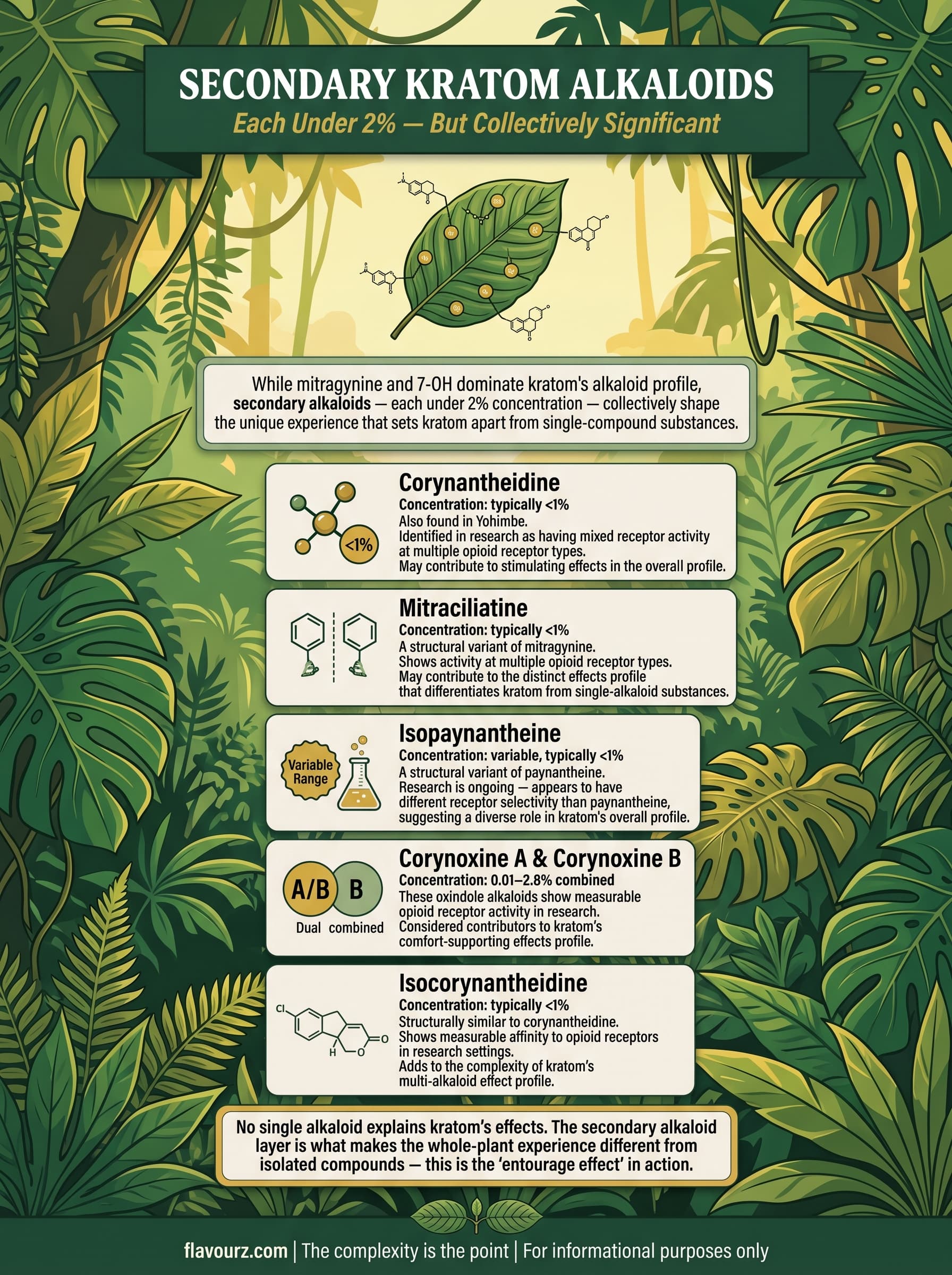
These alkaloids typically comprise less than 2% of total alkaloid content individually but collectively contribute significantly to kratom's effects.
Corynantheidine
Concentration: <1% typically
Effects: Mu-opioid receptor partial agonist. Also found in Yohimbe. May contribute to stimulating effects and pain relief. Research published in Frontiers in Pharmacology identified it as having mixed MOR agonism and KOR agonism.
Mitraciliatine
Concentration: <1% typically
Effects: A diastereoisomer of mitragynine. Shows mu-opioid receptor partial agonism and kappa-opioid receptor full agonism. May contribute to the unique effects profile that distinguishes kratom from traditional opioids.
Isopaynantheine
Concentration: Variable, typically <1%
Effects: A diastereoisomer of paynantheine. Research is ongoing, but it appears to have different receptor selectivity than paynantheine. Some studies suggest diverse functional profiles at opioid receptors.
Corynoxine A and Corynoxine B
Concentration: 0.01-2.8% combined
Effects: These oxindole alkaloids show mu-opioid receptor activity. Corynoxine was identified as an MOR full agonist in some studies. They may contribute to the overall pain-relieving effects of kratom.
Isocorynantheidine
Concentration: Variable, typically <1%
Effects: Similar structure to corynantheidine. Shows measurable affinity to mu-opioid receptors. Contributes to kratom's overall effect profile.
Minor Alkaloids (<1% Each)
These alkaloids exist in smaller concentrations but may still contribute to kratom's overall effect profile. Many are under-researched, with effects extrapolated from their chemical structure or preliminary studies.
Immune-Modulating Alkaloids
| Alkaloid | Type | Proposed Effects |
|---|---|---|
| Mitraphylline | Oxindole | Anti-inflammatory, immunomodulating |
| Isomitraphylline | Oxindole | Immunomodulatory effects |
| Isopteropodine | Oxindole | Immune support (also found in Cat's Claw) |
| Speciophylline | Oxindole | May support memory function |
Cardiovascular-Related Alkaloids
| Alkaloid | Type | Proposed Effects |
|---|---|---|
| Ajmalicine (Raubasine) | Indole | Vasodilator, anti-hypertensive, smooth muscle relaxant |
| Rhynchophylline | Oxindole | Calcium channel blocker, vasodilator, anti-inflammatory |
| Isorhynchophylline | Oxindole | NMDA receptor antagonist, neuroprotective potential |
| Corynoxeine | Oxindole | Calcium channel blocker, may help vascular health |
| Tetrahydroalstonine | Indole | Anti-adrenergic, vasodilating, may affect peripheral circulation |
Other Notable Minor Alkaloids
| Alkaloid | Type | Proposed Effects |
|---|---|---|
| Speciofoline | Oxindole | Does not bind strongly to opioid receptors; under study |
| Isospeciofoline | Oxindole | Research shows diverse opioid receptor profiles |
| Akuammigine | Indole | Also found in Picralima nitida; pain-related research |
| Stipulatine | Indole | Anti-adrenergic, hypoglycemic properties |
| Ciliaphylline | Indole | Under investigation |
| Mitraversine | Indole | Trace amounts; effects unknown |
| Mitrafoline | Indole | Under investigation |
| 9-Hydroxycorynantheidine | Indole | Shows mu-opioid receptor affinity |
Complete Alkaloid Master List
For reference, here's a more complete listing of identified kratom alkaloids. Research status varies widely, from well-characterized (mitragynine) to barely studied (many trace compounds).
| # | Alkaloid Name | Type | Primary Action/Notes |
|---|---|---|---|
| 1 | Mitragynine | Indole | Primary alkaloid; partial MOR agonist |
| 2 | 7-Hydroxymitragynine | Indole | Most potent; full MOR agonist |
| 3 | Paynantheine | Indole | Smooth muscle relaxant |
| 4 | Speciociliatine | Indole | Opioid activity (mixed findings) |
| 5 | Speciogynine | Indole | Adrenergic binding; smooth muscle |
| 6 | Mitraciliatine | Indole | MOR partial/KOR full agonist |
| 7 | Isopaynantheine | Indole | Diverse opioid profiles |
| 8 | Epiallo-isopaynantheine | Indole | Recently characterized |
| 9 | Corynantheidine | Indole | MOR partial agonist |
| 10 | Isocorynantheidine | Indole | MOR affinity |
| 11 | 9-Hydroxycorynantheidine | Indole | MOR affinity |
| 12 | Ajmalicine (Raubasine) | Indole | Vasodilator; anti-hypertensive |
| 13 | Tetrahydroalstonine | Indole | Dopamine antagonist; vasodilating |
| 14 | Akuammigine | Indole | Under investigation |
| 15 | Stipulatine | Indole | Anti-adrenergic; hypoglycemic |
| 16 | Ciliaphylline | Indole | Under investigation |
| 17 | Mitraversine | Indole | Trace amounts |
| 18 | Mitrafoline | Indole | Under investigation |
| 19 | Isomitrafolin | Indole | Trace amounts |
| 20 | Mitragynine-N(4)-oxide | Indole | Oxidized form |
| 21 | Speciociliatine-N(4)-oxide | Indole | Oxidized form |
| 22 | Mitragynine pseudoindoxyl | Indole | Metabolite; high MOR potency |
| 23 | Mitragynine oxindole A | Oxindole | Oxidized form |
| 24 | Mitragynine oxindole B | Oxindole | Oxidized form |
| 25 | Speciofoline | Oxindole | Low opioid binding; chemotype marker |
| 26 | Isospeciofoline | Oxindole | Diverse receptor profiles |
| 27 | Isospeciofoleine | Oxindole | Under investigation |
| 28 | Isorotundifoleine | Oxindole | Characterized recently |
| 29 | Corynoxine A | Oxindole | MOR full agonist |
| 30 | Corynoxine B | Oxindole | Similar to Corynoxine A |
| 31 | Corynoxeine | Oxindole | Calcium channel blocker |
| 32 | Rhynchophylline | Oxindole | NMDA antagonist; neuroprotective |
| 33 | Isorhynchophylline | Oxindole | Similar to rhynchophylline |
| 34 | 3-Epirhynchophylline | Oxindole | Recently characterized |
| 35 | 3-Epicorynoxine B | Oxindole | Recently characterized |
| 36 | Mitraphylline | Oxindole | Anti-inflammatory; immunomodulating |
| 37 | Isomitraphylline | Oxindole | Immunomodulatory |
| 38 | Isopteropodine | Oxindole | Immune support |
| 39 | Speciophylline | Oxindole | May support cognition |
| 40 | Epicatechin | Flavonoid | Antioxidant (not technically alkaloid) |
Note: This list represents major identified compounds. Additional trace alkaloids, N-oxides, and metabolites bring the total count above 54 in comprehensive analyses.
How Receptor Systems Create Different Effects
Kratom's complexity comes from its alkaloids acting on multiple receptor systems simultaneously. Understanding these systems helps explain why kratom produces such varied effects depending on dose, strain, and individual.
Opioid Receptors
The most-discussed receptor system for kratom. There are three main types:
- Mu-opioid receptors (MOR): Responsible for pain relief, mood elevation, and sedation. Mitragynine and 7-hydroxymitragynine both activate these, though mitragynine is a partial agonist (limited activation) while 7-hydroxymitragynine is a full agonist (stronger activation).
- Kappa-opioid receptors (KOR): Associated with dysphoria at high activation but may contribute to some pain relief. Mitragynine acts as an antagonist here, which may partially explain why kratom doesn't produce the same dysphoria as some other opioids.
- Delta-opioid receptors (DOR): Involved in mood and possibly anxiety. Mitragynine shows antagonist activity here as well.
Adrenergic Receptors
These receptors respond to adrenaline/noradrenaline and are involved in alertness, energy, and focus. Research shows mitragynine and speciogynine bind to alpha-2A, 2B, and 2C adrenergic receptors. This binding likely explains kratom's stimulating effects at lower doses and why some strains feel more energizing than others.
Serotonin Receptors
Mitragynine binds to 5-HT1A and 5-HT2A serotonin receptors. These receptors are involved in mood regulation, anxiety, and pain perception. This activity may contribute to kratom's mood-enhancing and anti-anxiety effects reported by users.
Dopamine Receptors
Some kratom alkaloids interact with D1 and D2 dopamine receptors. Dopamine is involved in motivation, pleasure, and reward. This interaction may contribute to the mood effects and, potentially, the reinforcing properties of kratom.
Other Systems
Alkaloids like rhynchophylline act as NMDA receptor antagonists (potentially neuroprotective) and calcium channel blockers (cardiovascular effects). Ajmalicine and related compounds affect blood pressure and circulation. These secondary effects contribute to kratom's overall profile but aren't the primary drivers of user experience.
How Processing and Strain Affect Alkaloid Content
One question I hear constantly: "Do different strains actually have different alkaloids?" The answer is nuanced.
The Science of Strain Variation
Research published in Frontiers in Plant Science in 2025 showed that alkaloid content varies significantly based on:
- Cultivar (genetics): Different kratom tree varieties produce different baseline alkaloid profiles
- Harvest season: 7-hydroxymitragynine was detected only in specific seasons, varying by cultivar
- Postharvest processing: Withering and drying temperatures dramatically affect final alkaloid content
- Growing conditions: Shade vs. sun, soil composition, and humidity all influence alkaloid production
Processing Effects
The vein "color" of kratom (red, green, white) is primarily determined by processing, not the color of actual leaf veins:
| Vein Color | Processing Method | Alkaloid Impact |
|---|---|---|
| Red vein | Fermented 3+ days, then dried | May increase 7-OH; changes alkaloid ratios |
| Green vein | Air-dried indoors; no fermentation | Preserves broader alkaloid spectrum |
| White vein | Extended sun/indoor drying; minimal processing | Preserves original ratios; lower transformation |
| Yellow/Gold vein | Extended fermentation or blending | Unique profile from extended processing |
Regional Variation
Thai kratom varieties typically contain up to 66% mitragynine, while Malaysian varieties may contain only about 12%. This dramatic difference comes from genetic variation between regional populations and different growing conditions, and users interested in how Thai genetics shape a specific red vein profile can learn from this detailed red kratom resource that covers Red Thai's effects and dosing in depth.
Total alkaloid concentration in dried leaves ranges from 0.5% to 1.5% of leaf weight. This means a 5-gram dose contains roughly 25-75mg of total alkaloids, with mitragynine being the majority.
Practical Implications: What This Means for Users
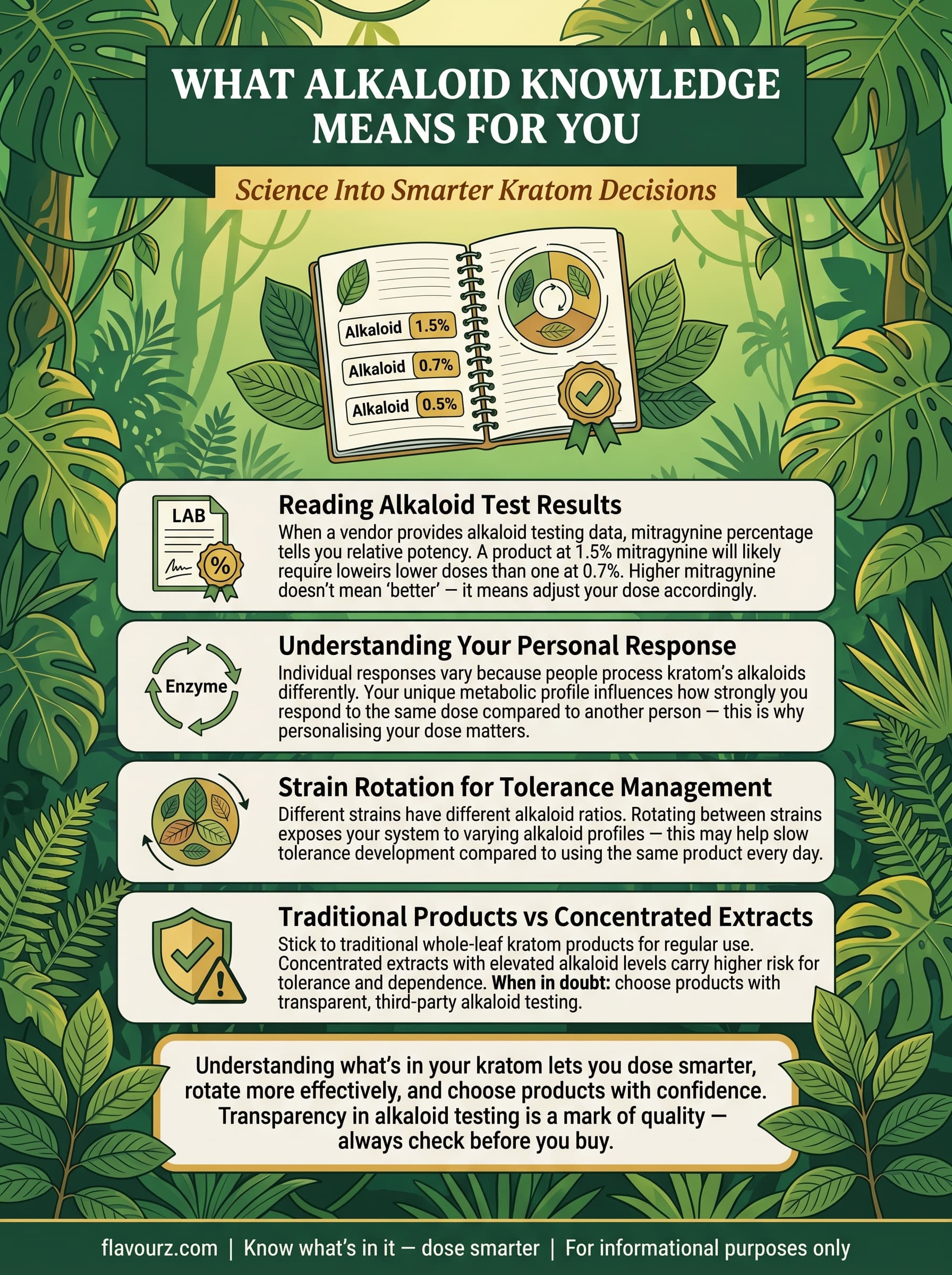
Understanding alkaloids helps you make better decisions about kratom. Here's how to apply this knowledge:
Choosing Products
If a vendor provides alkaloid testing (mitragynine percentage), you can use this to compare products. Higher mitragynine doesn't automatically mean "better," but it indicates potency. A product with 1.5% mitragynine will likely require lower doses than one with 0.7%.
Understanding Your Response
Individual response to kratom varies because people metabolize alkaloids differently. The enzyme CYP3A4 converts mitragynine to the more potent 7-hydroxymitragynine. People with higher CYP3A4 activity may experience stronger effects from the same dose.
Tolerance and Rotation
Different strains have different alkaloid ratios. Rotating between strains exposes your receptors to varying alkaloid profiles, which may help slow tolerance development compared to using the same product daily.
Safety Considerations
Products with elevated 7-hydroxymitragynine (above natural levels) carry higher dependence risk. Stick to traditional kratom products rather than concentrated extracts for regular use. The UNODC has noted concerns about novel products with high 7-hydroxymitragynine concentrations appearing on markets.
Frequently Asked Questions
How many alkaloids are in kratom?
Scientists have identified at least 54 distinct alkaloids in kratom leaves, though the exact number continues to grow as detection methods improve. The majority of research focuses on fewer than 10 major alkaloids, with mitragynine and 7-hydroxymitragynine receiving the most attention.
What is the main alkaloid in kratom?
Mitragynine is the most abundant alkaloid, comprising 40-66% of total alkaloid content and 1-2% of dry leaf weight. It's responsible for most of kratom's effects through partial agonism at mu-opioid receptors and binding to adrenergic and serotonin receptors.
What does mitragynine do?
Mitragynine acts as a partial agonist at mu-opioid receptors (providing pain relief and mood effects), competitive antagonist at kappa and delta opioid receptors, and binds to adrenergic and serotonin receptors. This multi-receptor activity creates kratom's dose-dependent stimulation at low doses and sedation at higher doses.
What is the difference between mitragynine and 7-hydroxymitragynine?
7-hydroxymitragynine is approximately 13-46 times more potent than mitragynine at mu-opioid receptors, though it's present in much lower concentrations (typically less than 0.05% in fresh leaves versus 1-2% for mitragynine). 7-hydroxymitragynine is a full agonist while mitragynine is a partial agonist, and it has a much shorter half-life (2-3 hours versus 23-24 hours).
What are indole and oxindole alkaloids?
Indole alkaloids (like mitragynine) have a specific chemical structure that allows them to interact with opioid and other brain receptors, producing kratom's main psychoactive effects. Oxindole alkaloids (like mitraphylline) have a modified structure and primarily affect the immune system and cardiovascular function rather than opioid receptors.
Do different strains have different alkaloids?
All kratom strains contain the same alkaloids, but the ratios and concentrations differ. These differences come from genetic variation between plant populations, growing conditions, harvest timing, and especially processing methods (fermentation, drying temperature and duration). Red, green, and white "strains" reflect processing differences more than genetic differences.
What alkaloids cause kratom's effects?
Mitragynine and 7-hydroxymitragynine are the primary drivers of kratom's opioid-like effects. Speciogynine and other alkaloids that bind to adrenergic receptors contribute to stimulating effects. Paynantheine may contribute to muscle relaxation. The overall experience results from the combined action of many alkaloids.
How do kratom alkaloids work in the body?
Kratom alkaloids interact with multiple receptor systems: opioid receptors (pain, mood, sedation), adrenergic receptors (energy, alertness), serotonin receptors (mood, anxiety), and dopamine receptors (motivation, reward). This multi-receptor activity creates kratom's unique effect profile that differs from traditional opioids or stimulants.
Final Thoughts
Kratom's 40+ alkaloids create a complex pharmacological profile that science is still working to understand. The key takeaways:
- Mitragynine dominates: It's the most abundant alkaloid and drives most effects
- 7-hydroxymitragynine matters: Despite low concentrations, it's the most potent and relevant for understanding risk
- Secondary alkaloids contribute: The "entourage effect" of multiple compounds creates kratom's unique profile
- Processing matters: How kratom is dried and processed affects final alkaloid ratios significantly
- Individual variation exists: Your response depends on metabolism, genetics, and the specific product's alkaloid profile
Understanding alkaloids won't make you a chemist, but it helps you make informed decisions about which kratom products work best for your needs and how to use them responsibly.
For more information on kratom strains and effects, check out our active compounds scientific analysis and beginner's guide to kratom.
Disclaimer: These statements have not been evaluated by the FDA. Kratom is not intended to diagnose, treat, cure, or prevent any disease. Consult a healthcare professional before using kratom, especially if you have medical conditions or take medications. Must be 21+ to purchase. Not available in all states.

Leave a comment