

Does Kratom Show on Drug Tests? 10 Facts You Need to Know
Last Updated: April 2026
No, kratom does not show up on standard drug tests. The 5-panel, 10-panel, and 12-panel tests used by most employers, probation officers, and the Department of Transportation do not screen for kratom's alkaloids (mitragynine and 7-hydroxymitragynine). Only specialized tests that explicitly target kratom can detect it, and these must be specifically ordered and paid for separately.
After 5 years working with kratom and serving over 10,000 customers at Flavourz Kratom since 1999, including many bulk buyers through our kratom wholesale program, I've answered this question hundreds of times. People worry about employment screenings, probation tests, and military service. The reality is simpler than most think, but there are important exceptions you need to know about.
Here are 10 facts that cover everything from standard workplace tests to military regulations, false positives, and what actually triggers a kratom-specific screen.
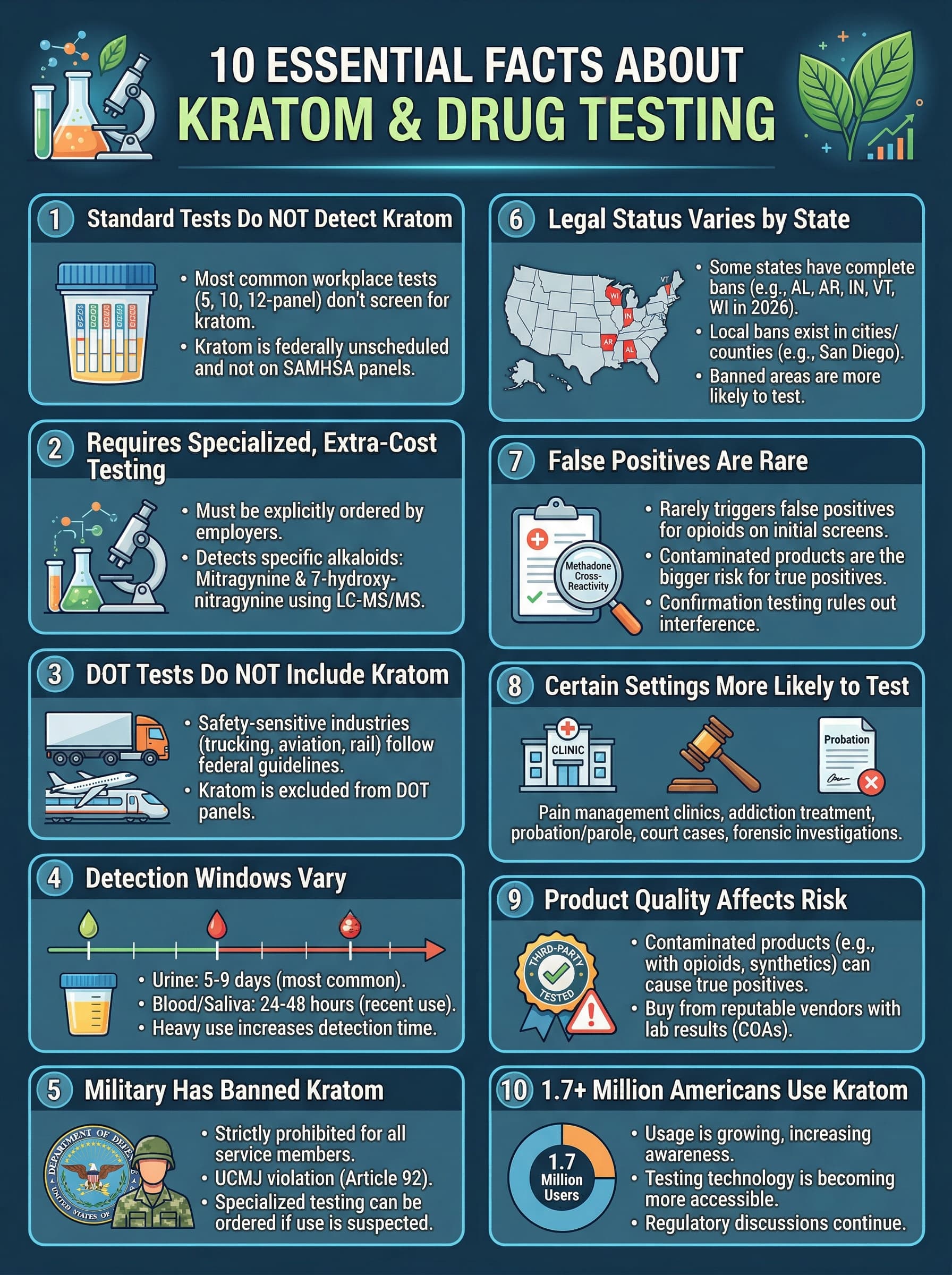
Fact #1: Standard Drug Tests Do NOT Detect Kratom
Standard workplace drug tests do not screen for kratom. This includes the most common panels used across the United States.
What standard tests actually screen for:
| Panel Type | Substances Screened | Kratom Included? |
|---|---|---|
| 5-Panel (DOT Standard) | Marijuana, cocaine, amphetamines, opioids, PCP | No |
| 10-Panel | Above + benzodiazepines, barbiturates, methadone, propoxyphene, quaaludes | No |
| 12-Panel | Above + extended opioids (oxycodone, hydrocodone), MDMA | No |
The reason? Kratom remains unscheduled at the federal level. Standard drug panels align with SAMHSA (Substance Abuse and Mental Health Services Administration) guidelines that focus on federally controlled substances. In January 2025, HHS and SAMHSA published updated authorized drug testing panels for federal workplace programs, effective July 7, 2025. Kratom was not listed.
Fact #2: Kratom Requires Specialized Testing to Detect
Kratom can only be detected with specialized tests that specifically target its alkaloids. These tests must be explicitly ordered and cost extra.
How specialized kratom tests work:
- Immunoassay screening: Initial screen at cutoffs as low as 5 ng/mL
- LC-MS/MS confirmation: Liquid chromatography-tandem mass spectrometry confirms at 1 ng/mL
- Target compounds: Mitragynine and 7-hydroxymitragynine
For example, Labcorp offers a kratom-specific test (test code 791750) that uses a 5.0 ng/mL immunoassay screen with 1.0 ng/mL LC-MS/MS confirmation. This test must be separately ordered. It's not included in any standard panel.
For more on kratom's alkaloid profile, see: Kratom's Active Compounds: A Scientific Analysis.
Fact #3: DOT Tests Do NOT Include Kratom
Department of Transportation (DOT) drug tests do not screen for kratom. This applies to all DOT-regulated industries.
DOT-regulated industries include:
- Commercial trucking
- Aviation
- Rail transportation
- Mass transit
- Pipeline operations
- Maritime operations
The DOT's drug testing panels follow federal HHS guidelines precisely. Since kratom is not a federally scheduled substance, it's automatically excluded from DOT testing requirements. Quest Diagnostics' DOT 5-drug panel, one of the most widely used, does not screen for kratom alkaloids.
The DOT did propose adding fentanyl and norfentanyl to its panels (final rule expected early 2026), but kratom remains excluded.
Fact #4: Detection Windows Vary by Test Type
If you're facing a specialized kratom test, detection windows depend on the sample type.
| Test Type | Detection Window | Notes |
|---|---|---|
| Urine | 5-9 days | Most common method |
| Blood | 24-48 hours | Confirms recent use |
| Saliva | 24-48 hours | Rarely used for kratom |
| Hair follicle | Up to 90 days | Forensic/legal settings only |
Individual factors like metabolism, body fat percentage, dosage, and frequency of use all affect these timelines. Heavy users may test positive for longer than occasional users.
For a complete breakdown of detection factors, see: Kratom Detection Timeline: 7 Factors That Affect How Long It Stays in Your System.
Fact #5: The Military Has Banned Kratom
While kratom isn't on routine military drug panels, its use is strictly prohibited for all service members. This is one of the most important distinctions to understand.
What happened: In September 2025, the Department of Defense declared kratom use a violation of the Uniform Code of Military Justice (UCMJ), enforceable under Article 92. This became effective December 31, 2025.
Branch-specific guidance:
- Navy/Marines: ALNAV 003/26 prohibits kratom and kratom-derived compounds
- Air Force: Public warning that kratom is on the DoD's prohibited substance list
- Army: Criminal Investigation Command warned of UCMJ consequences
The key distinction: Kratom won't show up on routine military urinalysis (which follows standard federal panels). But if you're a service member caught with kratom or its use is suspected, the military can order specialized testing. And regardless of testing, using kratom violates military regulations and can result in disciplinary action.
The DoD lists kratom on the Operation Supplement Safety (OPSS) prohibited dietary supplement ingredients list.
Fact #6: Seven States Have Banned Kratom
Kratom's legal status varies by state, and this affects testing practices in some areas.
States with complete kratom bans (as of 2026):
- Alabama
- Arkansas
- Indiana
- Vermont
- Wisconsin
Additionally, some cities and counties have local bans even in states where kratom is otherwise legal (examples: San Diego, California and Union County, Mississippi).
Recent changes: Rhode Island transitioned from a complete ban to regulated legalization under the Rhode Island Kratom Act (2025), effective April 1, 2026. Adults 21+ can purchase regulated kratom with licensing and a 15% wholesale tax.
In banned jurisdictions, employers may be more likely to add kratom to their testing panels due to compliance concerns. For current state-by-state information, see: Is Kratom Legal Where I Live?
Fact #7: Kratom Rarely Causes False Positives
Pure, lab-verified kratom almost never triggers false positives for opioids or other substances on standard immunoassay screens. But "almost never" isn't "never."
When false positives happen:
- Methadone cross-reactivity: In rare cases, high doses of kratom have caused false positives for methadone on some immunoassay tests
- Cross-reactivity mechanism: Kratom alkaloids interact with opioid receptors similarly to some opioids, which can cause test interference
- Confirmation testing: GC-MS or LC-MS/MS confirmatory testing will correctly identify kratom and rule out actual opioids
The bigger risk: Product contamination. FDA and independent laboratory analyses have found some commercially sold kratom products adulterated with pharmaceutical opioids (fentanyl, tramadol, hydrocodone), synthetic cannabinoids, and heavy metals. Using contaminated products can cause true positive results for these substances on any standard drug test.
This is why buying from reputable, third-party tested vendors matters. If you get a false positive and have only used kratom, request confirmatory testing with mass spectrometry.
Fact #8: Certain Settings Are More Likely to Test for Kratom
While standard employment tests don't include kratom, certain specialized settings may order kratom-specific testing.
Settings where kratom testing is more common:
- Pain management clinics: Strict non-opioid policies may include kratom monitoring
- Addiction treatment programs: May test to ensure compliance with treatment protocols
- Forensic toxicology: Investigations after accidents or overdoses
- Child custody/family court: Cases where substance use is contested
- Probation/parole: Some jurisdictions prohibit kratom and may test if use is suspected
- Drug courts: May include kratom in their testing panels
In each of these scenarios, the ordering agency must explicitly request and pay extra for the specialized kratom panel. It's not automatic.
What to do: If you're facing testing in any of these settings, ask directly what substances the test screens for. You have the right to know what you're being tested for.
Fact #9: Product Quality Affects Your Risk
Not all kratom products are equal, and contamination can create testing problems that pure kratom wouldn't cause.
What contaminants have been found in kratom products:
- Pharmaceutical opioids (fentanyl, tramadol, hydrocodone)
- Synthetic cannabinoids
- Heavy metals (lead, mercury)
- Salmonella and other pathogens
- Undisclosed additives
If you test positive for opioids, amphetamines, or other substances after using kratom from an unreliable source, the test may actually be detecting contaminants, not kratom itself.
How to protect yourself:
- Buy from vendors who provide third-party lab testing (COAs)
- Choose vendors following American Kratom Association (AKA) Good Manufacturing Practice (GMP) standards
- Avoid gas station or convenience store kratom products
- Be wary of unusually cheap prices
We've been serving customers since 1999 at Flavourz Kratom, and I've seen the market change dramatically. Quality control matters more than ever. For guidance on choosing reliable vendors, see: Best Kratom Brands 2026.
Fact #10: 1.7 Million Americans Use Kratom
Kratom use is more common than many people realize, which has implications for testing policies and public awareness.
Usage statistics: According to SAMHSA (2022), approximately 1.7 million Americans aged 12 or older reported using kratom within the previous year. Other surveys suggest the number may be higher, with some estimates reaching 10-15 million users.
Why this matters for drug testing:
- Growing usage increases awareness among employers and testing agencies
- More research is being conducted on kratom detection methods
- Policy discussions continue at federal and state levels
- Testing technology for kratom is becoming more accessible and affordable
The landscape is evolving. While standard tests don't currently include kratom, this could change as usage increases and regulatory attention grows. The FDA has recommended scheduling action for concentrated kratom alkaloid products (particularly those with high 7-hydroxymitragynine content), which could affect future testing requirements.
Quick Reference: Will Kratom Show Up on Your Test?
| Testing Scenario | Kratom Detected? | Notes |
|---|---|---|
| Standard employment (5/10/12-panel) | No | Not included in standard panels |
| DOT testing | No | Follows federal HHS guidelines |
| Standard probation | Usually no | Unless specifically ordered |
| Military routine urinalysis | No | But use is prohibited regardless |
| Pain management clinic | Possibly | May order specialized panels |
| Drug court/treatment program | Possibly | May include kratom screening |
| Specialized kratom test | Yes | Specifically designed to detect kratom |
What to Do If You're Concerned About a Drug Test
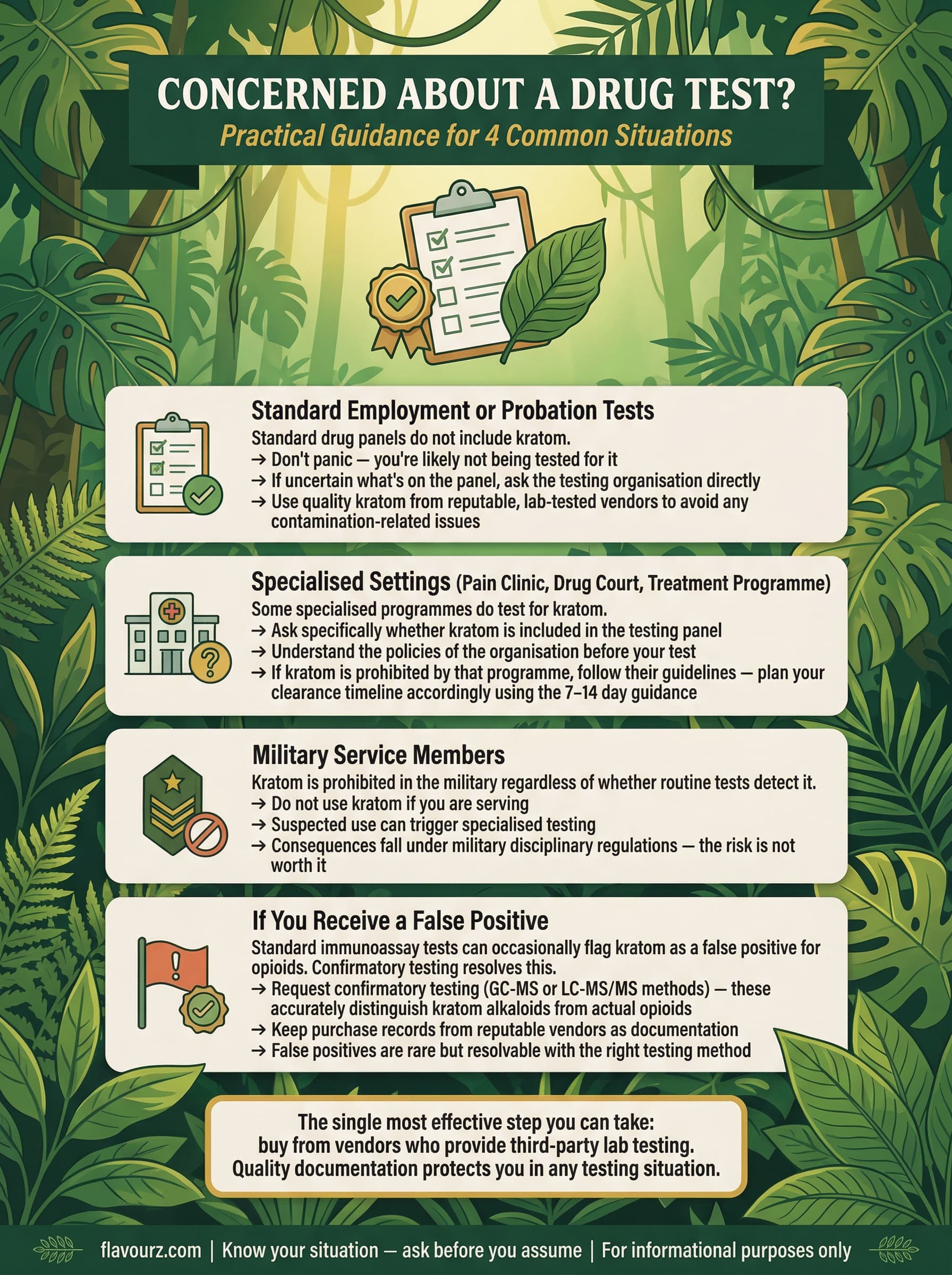
Based on helping thousands of customers navigate these concerns, here's practical guidance:
For standard employment or probation tests:
- Don't panic. Standard panels don't include kratom.
- If you're uncertain what's being tested, ask the testing organization directly.
- Use quality kratom from reputable sources to avoid contamination issues.
For specialized settings (pain clinic, drug court, treatment program):
- Ask specifically whether kratom is included in the testing panel.
- Understand the policies of the organization testing you.
- If kratom use is prohibited, follow the guidelines of that program.
For military service members:
- Do not use kratom. It's prohibited regardless of whether routine tests detect it.
- Being caught with kratom or having suspected use can trigger specialized testing.
- Consequences include disciplinary action under UCMJ.
If you get a false positive:
- Request confirmatory testing using GC-MS or LC-MS/MS.
- These methods will accurately identify kratom alkaloids vs. actual opioids.
- Keep records of your kratom purchases from reputable vendors.
Frequently Asked Questions
Does kratom show up on a drug test?
No, kratom does not show up on standard drug tests. The 5-panel, 10-panel, and 12-panel tests used by most employers do not screen for kratom alkaloids. Only specialized tests that specifically target mitragynine and 7-hydroxymitragynine can detect kratom, and these must be explicitly ordered.
Does kratom show up on a 10-panel drug test?
No. A standard 10-panel drug test does not detect kratom. It screens for marijuana, cocaine, amphetamines, opioids, PCP, benzodiazepines, barbiturates, methadone, propoxyphene, and quaaludes. Kratom is not included. You would need a specialized kratom-specific test ordered separately.
Can kratom cause a false positive for opioids?
In rare cases, high doses of kratom have caused false positives for methadone on some immunoassay tests. This is uncommon with modern testing. Confirmatory testing using GC-MS or LC-MS/MS will correctly identify kratom and rule out opioids. Request confirmation if you get an unexpected positive.
Does the military test for kratom?
Routine military drug tests do not detect kratom. But kratom use is strictly prohibited for all service members under UCMJ (effective December 31, 2025). The military can order specialized testing if use is suspected. Using kratom can result in disciplinary action regardless of test results.
How long does kratom stay in your system for a drug test?
Kratom is detectable in urine for 5-9 days with specialized testing. Blood tests detect it for 24-48 hours. Saliva for 24-48 hours. Hair follicle tests can detect use for up to 90 days. Standard tests won't detect it at all since they don't screen for kratom alkaloids.
Is kratom detected on probation drug tests?
Standard probation drug tests typically do not detect kratom. But some jurisdictions prohibit kratom and may order specialized testing if use is suspected. Drug courts and treatment programs may include kratom screening. Ask your probation officer what substances are tested.
What drug tests detect kratom?
Only specialized tests using liquid chromatography-mass spectrometry (LC-MS/MS) or immunoassay specifically targeting kratom alkaloids can detect it. Labcorp test code 791750 is one example. These tests screen for mitragynine and 7-hydroxymitragynine at very low detection thresholds (1-5 ng/mL).
Can contaminated kratom cause me to fail a drug test?
Yes. Some kratom products have been found contaminated with pharmaceutical opioids, synthetic cannabinoids, or other substances. Using contaminated products can cause true positive results for these substances on standard tests. Buy from reputable vendors with third-party lab testing to avoid this risk.
The Bottom Line
For most people worried about drug testing, kratom is not a concern. Standard workplace, DOT, and probation tests don't screen for it. The important exceptions:
- Military: Use is prohibited regardless of testing
- Specialized settings: Pain clinics, drug courts, and treatment programs may test
- Product quality: Contaminated products can cause problems
If you're new to kratom and want to learn more about responsible use, check out our beginner's guide to kratom. And when you're ready to explore quality, lab-tested kratom from a vendor serving customers since 1999, browse our kratom powder collection.
Disclaimer: This information is for educational purposes only and is not medical or legal advice. These statements have not been evaluated by the FDA. Kratom is not intended to diagnose, treat, cure, or prevent any disease. Drug testing policies vary by organization and jurisdiction. This guide should not be used to evade legitimate drug testing. Must be 21+ to purchase. Not available in all states.

Leave a comment