

Fermented Kratom: Complete Processing Guide 2026
Last Updated: April 2026
Fermented kratom is Mitragyna speciosa leaf that undergoes controlled microbial fermentation after harvest, typically sealed in bags for 3 to 7 days under specific humidity and temperature conditions. The process converts some mitragynine into 7-hydroxy alkaloids and produces distinctive smoother, longer-lasting effects. Common fermented strains include Red Bentuangie, Gold Bentuangie, Yellow Vein, and Gold Bali varieties.
What Is Fermented Kratom?
Fermented kratom is Mitragyna speciosa leaf that undergoes a controlled fermentation step before the final drying phase. Unlike standard kratom, which is dried immediately after harvest, fermented leaves are sealed in bags or containers where enzymes and microorganisms gradually transform the alkaloid composition. The result is a distinctly different chemical profile that produces smoother, more sedating effects.
After 25+ years at Flavourz watching processing techniques evolve, fermentation is one of the more technically demanding methods in the kratom world. Most of our non-fermented strains arrive ready for lab testing within weeks of harvest. Fermented varieties take longer and demand more quality control because the process itself introduces risk if not managed properly.
Why Do Producers Ferment Kratom?
Producers ferment kratom to transform the alkaloid profile and create effects that can't be achieved through standard drying. Fermentation converts portions of mitragynine into other alkaloids, shifts the ratio of active compounds, and mellows the bitter flavor profile. Traditional producers developed these methods generations ago to extend shelf life and create specific effect profiles for different uses.
How Is Kratom Fermented?
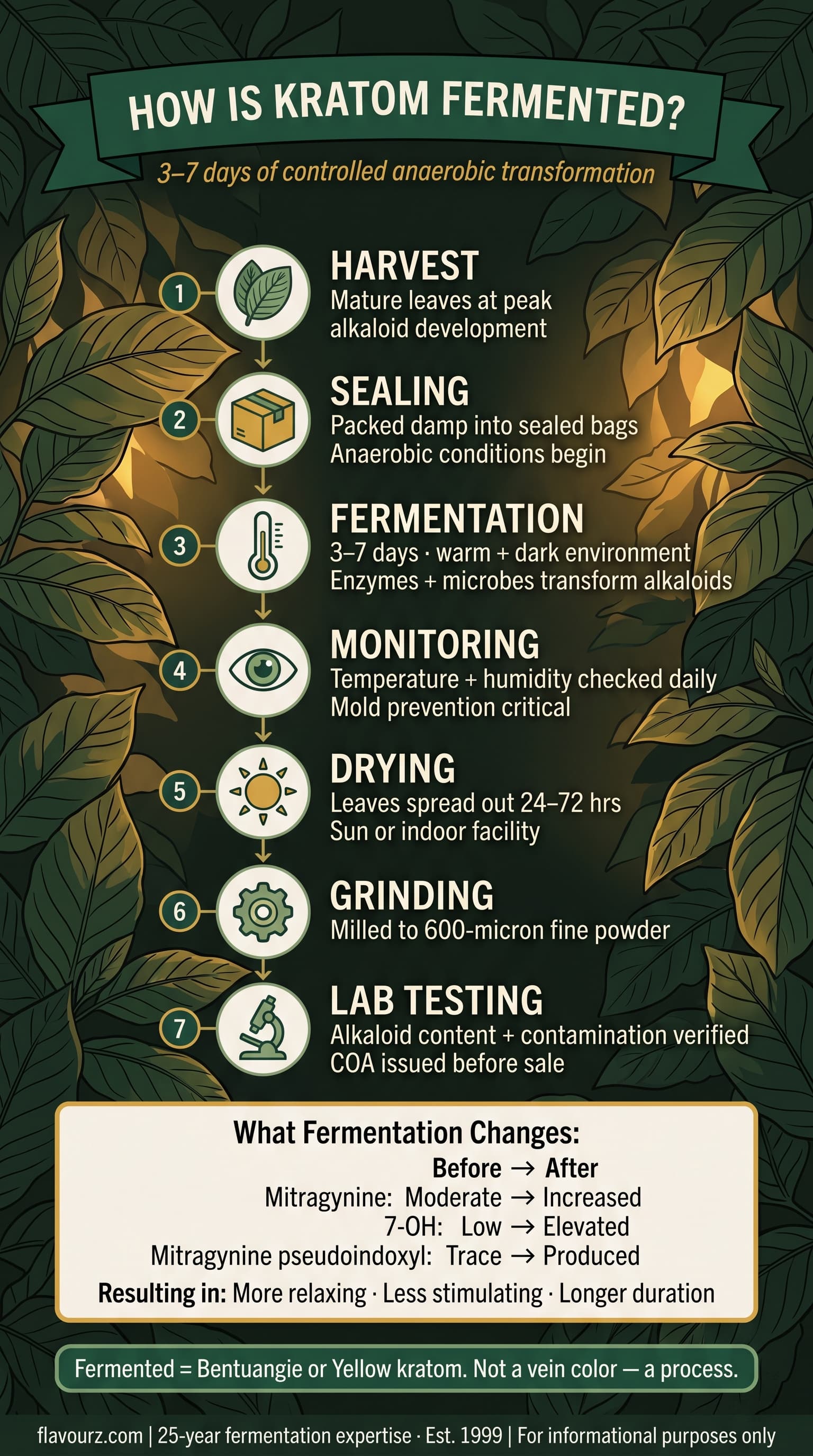
Kratom fermentation involves sealing freshly harvested leaves in moisture-trapping bags under controlled humidity and temperature conditions for 3 to 7 days. The sealed environment creates anaerobic conditions where naturally occurring enzymes and microorganisms act on the leaves, transforming their alkaloid content. After fermentation, leaves are removed, spread out, and dried for 24 to 72 hours before grinding into powder.
The Fermentation Process Step-by-Step
The standard kratom fermentation process follows these stages:
- Harvest: Mature leaves are picked from kratom trees at peak alkaloid development
- Sealing: Fresh leaves are packed into moisture-trapping plastic bags or containers while still damp
- Fermentation period: Bags are stored in warm, dark conditions for 3 to 7 days depending on desired outcome
- Monitoring: Temperature, humidity, and leaf condition are checked regularly to prevent mold
- Drying: Leaves are removed from bags and dried for 24-72 hours in sun or indoor facilities
- Grinding: Dried fermented leaves are milled into fine powder meeting 600-micron export standards
- Testing: Final product goes through lab testing for alkaloid content and contamination before sale
Research published in ScienceDirect's journal on mitragynine biosynthesis documents the complex alkaloid pathways in kratom. Fermentation shifts the balance of these compounds, which is why the finished product behaves differently from standard dried leaf.
What Does Fermentation Do to Kratom's Alkaloids?
Fermentation shifts kratom's alkaloid ratios by partially converting mitragynine into other compounds including 7-hydroxy alkaloids. Total mitragynine content typically drops from 1.2-1.5% in standard red strains to 1.0-1.3% in fermented varieties. However, minor alkaloids like speciogynine, paynantheine, and mitraphylline often increase, producing the characteristic mellower, longer-lasting effects.
Alkaloid Changes from Fermentation
| Compound | Standard Red | Fermented Red |
|---|---|---|
| Mitragynine | 1.2–1.5% | 1.0–1.3% |
| 7-Hydroxy Alkaloids | Lower | Higher |
| Minor Alkaloids | Standard | Elevated |
| Duration | 4–6 hours | 5–7 hours |
That mitragynine drop sounds like a downside, but it actually isn't. The effects of fermented kratom come from the full alkaloid profile, not mitragynine alone. The increased minor alkaloids often make fermented strains feel stronger per gram than their standard counterparts, even though the primary alkaloid is technically lower. It's the ratio that matters, not just the headline number.
What Are the Best Fermented Kratom Strains?
The most popular fermented kratom strains include Red Bentuangie, Gold Bentuangie, Green Bentuangie, Gold Bali, Yellow Bali, Yellow Vietnam, and Yellow Borneo. Red Bentuangie is the classic fermented variety using red vein leaves and traditional Indonesian fermentation. Gold and yellow varieties use shorter fermentation periods or alternate drying methods to produce different effects.
Fermented Kratom Strain Overview
| Strain | Base Leaf | Fermentation | Profile |
|---|---|---|---|
| Red Bentuangie | Red vein | Full (5-7 days) | Deep relaxation |
| Gold Bentuangie | Red vein | Medium (3 days) | Rounded, smooth |
| Green Bentuangie | Green vein | Sealed bag | Balanced calm |
| Gold Bali | Red Bali | Light | Mild, extended |
| Yellow Bali | Red Bali | Short | Warm, uplifting |
| Yellow Vietnam | Mixed Vietnamese | Variable | Mood-lifting |
For strain-specific details, see our Red Bentuangie guide, Gold Bali guide, and Yellow Vietnam analysis.
What Is Bentuangie Kratom?
Bentuangie kratom is a specific fermentation technique that originated in West Borneo's Bentuangie region, where local farmers refined the method across generations. Traditional Bentuangie processing uses mature red vein leaves sealed in moisture-trapping bags for 5 to 7 days, creating anaerobic conditions that produce the dark reddish-brown powder and chocolate-like scent characteristic of properly fermented Bentuangie.
Bentuangie is the gold standard of fermented kratom. When people talk about "fermented kratom," they usually mean Bentuangie or something modeled on Bentuangie methods. The name refers to both the geographic origin and the specific processing technique. Today most Bentuangie is produced across Kalimantan and other Indonesian regions, but the technique traces back to that original Bentuangie area.
How Is Bentuangie Different From Other Reds?
Bentuangie differs from other red strains through its fermentation process. Standard Red Bali is sun-dried after harvest, preserving the natural alkaloid balance. Bentuangie goes through 5-7 days of anaerobic fermentation before drying, which converts the alkaloid profile and produces distinctly stronger sedation, darker color, and more earthy flavor than non-fermented reds.
Types of Kratom Fermentation Methods
Kratom producers use several fermentation approaches depending on desired outcomes. Each method produces different alkaloid profiles and effect characteristics in the final product.
Four Main Fermentation Methods
- Sealed anaerobic (Bentuangie-style): Leaves are packed into moisture-trapping bags for 3-7 days, creating oxygen-free conditions for specific enzymatic activity
- Extended sun-drying: Leaves are exposed to prolonged UV light, producing mild fermentation alongside traditional drying
- Alternating cycles: Leaves move between sunlight and indoor shade over extended periods, creating the gentle fermentation typical of yellow strains
- Light fermentation: Brief 1-3 day fermentation that retains more of the parent strain's character while adding smoothness
Research confirms these different methods produce measurably different alkaloid outcomes. A 2020 study in the Journal of Natural Products found that processing methods significantly impact kratom alkaloid profiles, though specific data on long-term fermentation effects remains limited. This is partly why fermented kratom quality varies so much between vendors. There's no universal standard.
Is Fermented Kratom Stronger Than Regular Kratom?
Fermented kratom isn't necessarily stronger in raw alkaloid content, but many users describe it as "feeling stronger per gram" due to the shifted alkaloid ratios. Standard dosing typically requires 25-30% less fermented kratom than standard kratom for similar effects. Fermented strains also tend to last longer, with total duration running 5-7 hours versus the 4-6 hours typical of standard strains.
From customer feedback patterns at Flavourz over 5+ years, the "stronger per gram" experience is real and consistent. People dosing Red Bentuangie the same way they'd dose Red Bali often report feeling overshot. Fermented strains hit differently, and most long-term users adjust down when they switch categories. Start with 1.5-2 grams of fermented strains even if you typically take 3 grams of standard reds.
How to Dose Fermented Kratom
Fermented kratom dosing runs 25-30% lower than standard strains. Beginners should start at 1 to 1.5 grams, moderate users take 2 to 3 grams, and experienced users typically top out at 3 to 4 grams. Onset takes 30 to 45 minutes (slightly slower than standard strains), peak effects hit around 90 minutes, and total duration runs 5 to 7 hours.
Fermented Kratom Dosage Reference
| Experience | Amount | Expected Effect |
|---|---|---|
| Beginner | 1–1.5 g | Mild calm, light relief |
| Moderate | 2–2.5 g | Clear relaxation |
| Experienced | 3–4 g | Strong sedation |
| High (caution) | 5+ g | Diminishing returns |
What Are the Risks of Fermented Kratom?
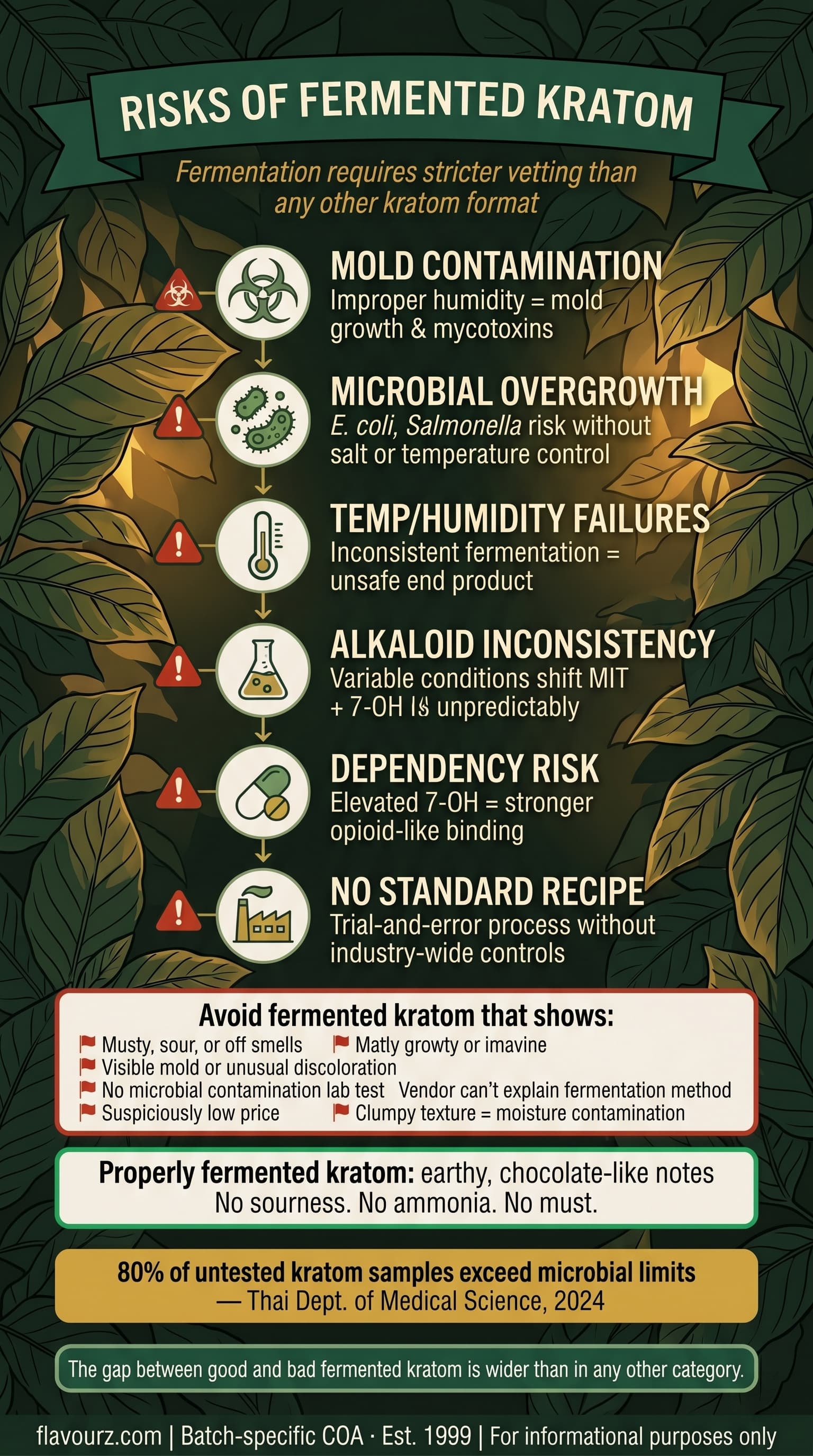
Fermented kratom carries specific quality risks including mold contamination, microbial overgrowth, and inconsistent alkaloid content due to variable fermentation conditions. Improper temperature or humidity control during fermentation can produce unsafe products. This is why lab testing and vendor transparency matter more with fermented varieties than with standard dried kratom.
Quality Red Flags to Watch For
Avoid fermented kratom that shows:
- Musty, sour, or off smells (proper fermented kratom has earthy chocolate-like notes)
- Visible mold spots or unusual discoloration
- No lab testing documentation for microbial contamination
- Suspiciously low prices (proper fermentation takes time and labor)
- Vendors who can't explain their fermentation method
- Clumpy texture suggesting moisture contamination
In my experience sourcing kratom for 25+ years at Flavourz, the fermented category requires the most careful vendor vetting. When fermentation goes right, it produces some of the best kratom available. When it goes wrong, it produces product that shouldn't be on the market at all. The gap between good and bad is wider here than in any other kratom category.
What Do Experienced Users Say About Fermented Kratom?
Long-term fermented kratom users consistently describe the effects as "smoother," "deeper," and "longer-lasting" than standard strains. Common praise includes reduced bitterness, more body-centered relaxation, and effects that persist without sharp peaks and valleys. The most frequent criticism is quality inconsistency across vendors, which pushes experienced users toward brands with documented processing methods.
What I hear most from customers who've switched to fermented strains: they don't go back. Once someone finds a Red Bentuangie they trust, it becomes their go-to evening strain. The longer duration and smoother profile work well for people who want reliable relaxation without the heavier peaks some standard reds produce.
Is Fermented Kratom Legal?
Fermented kratom is federally legal in the U.S. as of 2026, falling under the same legal framework as standard kratom. It's banned in Alabama, Arkansas, Indiana, Rhode Island, Vermont, and Wisconsin, with several other states enforcing Kratom Consumer Protection Acts. Check local laws before purchasing.
For current state-by-state legal status, see our state legal guide.
Where to Buy Quality Fermented Kratom
Quality fermented kratom should come from vendors who document their fermentation methods, publish batch-specific lab results including microbial testing, source from established Southeast Asian farms with fermentation expertise, and maintain proper cold-chain storage after import. Avoid budget vendors in this category because fermentation quality correlates directly with processing investment.
At Flavourz, our fermented strains go through additional microbial testing beyond the standard alkaloid and heavy metal screening. Proper fermented kratom has a distinct dark color and rich, earthy scent. If the powder is pale or smells musty instead of earthy, the fermentation was either incomplete or improperly managed. After 25+ years sourcing kratom, this category taught me that paying more for verified processing is usually worth it.
Browse our red vein kratom selection or our yellow vein kratom selection for fermented options. For broader context on kratom quality standards, our premium vs commercial kratom guide explains what separates top-tier product from filler material.
Frequently Asked Questions
How long does kratom fermentation take?
Standard kratom fermentation takes 3 to 7 days depending on the desired outcome. Short fermentation (1-3 days) produces lighter yellow and gold varieties. Medium fermentation (3-5 days) creates typical gold Bentuangie profiles. Full fermentation (5-7 days) produces traditional Red Bentuangie with the darkest color and strongest transformation.
Does fermentation increase 7-hydroxy alkaloids?
Yes, fermentation can increase 7-hydroxy alkaloid content by partially converting mitragynine into these related compounds. The anaerobic conditions during sealed-bag fermentation create specific enzymatic activity that shifts the alkaloid balance. Standard kratom typically has less than 0.05% 7-hydroxy alkaloids, while fermented varieties may show slightly elevated ratios.
Is Gold Kratom the same as fermented kratom?
Gold kratom is typically a lightly fermented or extended-dried variety, so it falls under the fermented kratom umbrella. However, "gold" and "yellow" labels aren't standardized — some vendors use gold for longer-fermented products while others use it interchangeably with yellow. Check vendor descriptions of actual processing methods.
Why does fermented kratom smell different?
Fermented kratom has a distinctive earthy, chocolate-like scent because the fermentation process produces aromatic compounds not present in standard dried kratom. The sealed anaerobic environment creates these characteristic aroma molecules alongside the alkaloid changes. Properly fermented kratom never smells musty or sour. Musty smell indicates fermentation went wrong.
Can I ferment kratom at home?
Home fermentation of kratom is not recommended due to the significant risks of mold, microbial contamination, and inconsistent results without proper equipment and experience. Professional fermentation requires controlled temperature, humidity monitoring, and lab testing for microbial safety. Home attempts can produce unsafe products even when done carefully.
How many capsules equal a gram of fermented kratom?
Standard "00" kratom capsules hold approximately 0.5 grams each, so 2 capsules equal 1 gram. A moderate 2-gram fermented kratom dose equals 4 capsules. Remember that fermented kratom requires lower doses than standard strains. For exact conversions, see our kratom capsule dosage guide.
Final Thoughts on Fermented Kratom
Fermented kratom represents one of the more sophisticated processing techniques in the kratom world. When done properly, it produces unique effects unavailable from standard dried strains. When done poorly, it produces unsafe product. After 25+ years at Flavourz watching this category develop, my honest take is that fermented kratom is worth exploring, but only through vendors who document their processing methods and publish microbial testing.
Start with a single well-known fermented strain like Red Bentuangie. Dose conservatively (25-30% less than your standard kratom). And pay attention to how the product looks and smells. Proper fermented kratom has a distinct dark color and earthy scent. If anything seems off, trust that instinct. For more on kratom processing and quality, see our kratom active compounds analysis and our kratom harvesting guide.
Important Disclaimer
Kratom is not approved by the FDA and is not intended to diagnose, treat, cure, or prevent any disease. This guide reflects general information and personal industry experience as of April 2026. Consult your healthcare provider before using kratom, especially if you take other medications or have existing health conditions. Legal status varies by state. Always verify local laws before purchasing.

Leave a comment