
Kratom Extract vs Powder: Potency, Dosage & Cost 2026
Last Updated: April 2026
Kratom extract is 5x to 50x stronger than regular kratom powder, but it costs roughly 8x to 15x more per gram. Powder gives you flexible dosing at $0.30 to $0.50 per gram with a balanced alkaloid profile. Extract delivers concentrated effects in tiny servings at $0.80 to $1.50 per gram, but trades dosing precision and full-spectrum balance for raw potency.
I've spent over 5 years working hands-on with both forms here at Flavourz Kratom. After 25 years in this industry and conversations with thousands of customers, I can tell you the right answer depends on three things: how often you use kratom, how your body responds, and what you actually want out of it. Let's break this down properly.
What's the Difference Between Kratom Extract and Powder?
Kratom powder is dried, ground leaves from the Mitragyna speciosa tree. Kratom extract is the same leaf, but processed to pull out the active alkaloids and concentrate them. Powder typically contains 1-2% mitragynine. Extracts can run from 10% to over 50% mitragynine, depending on the product.
That's the technical answer. Here's the practical one.
Powder feels like brewed coffee. Extract feels like a shot of espresso. Same plant. Different intensity. Different use case.
I remember the first time we started carrying kratom extracts back in the early 2010s. Customers would call confused about why 1 gram of extract hit so much harder than 5 grams of their usual Red Bali. The answer is simple math: when you boil down 10 grams of leaf into 1 gram of concentrate, you've packed 10 leaves' worth of alkaloids into a single serving. Most experienced users I've talked to over the years prefer powder for daily routines and keep extract on hand for travel or specific situations.
How Is Each One Made?
Kratom powder requires minimal processing: harvest mature leaves, wash, dry, mill into fine powder. That's it. The full alkaloid profile stays intact, including mitragynine, paynantheine, speciogynine, and speciociliatine. All these compounds work together to create what experienced users call "full-spectrum" effects.
Extract production is a different beast. Leaves get soaked in water, ethanol, or food-safe acids to dissolve the alkaloids. The liquid gets filtered, then reduced through evaporation until you're left with a dense paste or resin. This concentrate then becomes liquid shots, tinctures, capsules, or enhanced powders. Per American Kratom Association GMP standards, reputable extract producers run third-party lab tests on every batch to verify alkaloid content and screen for contaminants.
Is Kratom Extract Stronger Than Powder?
Yes. Kratom extract is significantly stronger than powder, typically delivering 5 to 50 times the alkaloid concentration. A 10x extract means 1 gram of extract contains roughly the same alkaloid load as 10 grams of plain leaf. Most extract shots labeled at 50mg or 100mg of mitragynine equal 2.5 to 5 grams of standard powder.
But strength isn't the whole story. Extract works faster. It also wears off faster. Powder builds gradually and lasts longer.
Quick Comparison Table
| Feature | Powder | Extract |
|---|---|---|
| Potency | 1-2% mitragynine | 10-50%+ mitragynine |
| Onset | 30-45 minutes | 10-20 minutes |
| Duration | 4-6 hours | 2-4 hours |
| Cost/Gram | $0.30-$0.50 | $0.80-$1.50 |
| Typical Dose | 2-5 grams | 0.1-0.5 grams |
| Best For | Daily routine | Travel, occasional use |
| Beginner-Friendly | Yes | No |
What Do Extract Ratios Actually Mean?
Extract ratios like 5x, 10x, or 50x tell you how concentrated the product is compared to regular leaf. A 10x extract uses about 10 grams of starting leaf to produce 1 gram of finished concentrate. Higher numbers mean more leaf material was reduced down. But here's where it gets tricky: there's no industry-wide standard for these labels.
I've personally seen two products both labeled "20x" that tested wildly differently for actual mitragynine content. This is why we always recommend looking at the actual milligrams of mitragynine listed on the lab report, not just the ratio. A bottle that lists "150mg mitragynine per serving" tells you something concrete. A label that just says "50x" without test data tells you almost nothing.
How Much Kratom Extract Equals 1 Gram of Powder?
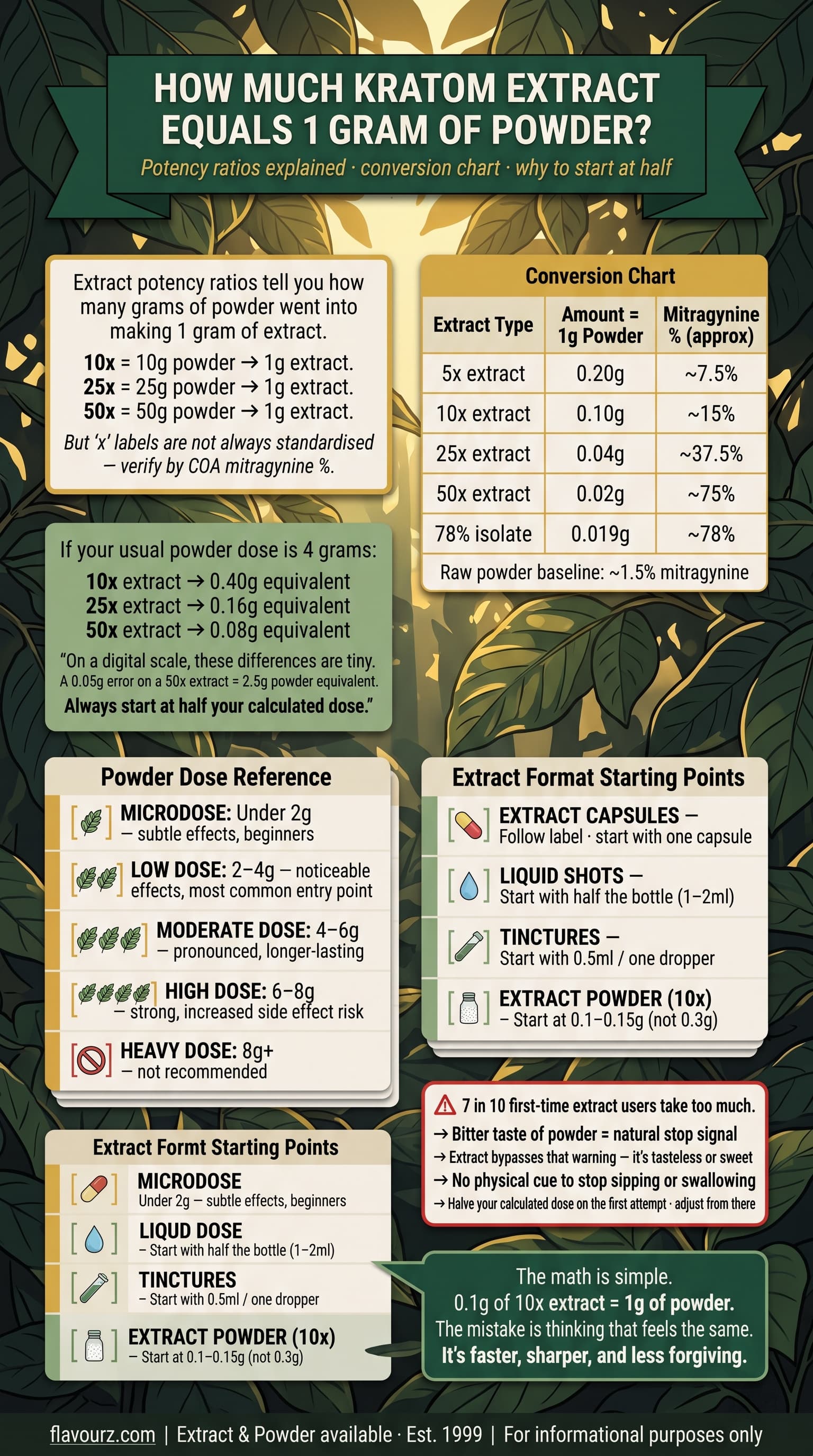
Roughly speaking, 0.1 to 0.2 grams of a 10x kratom extract equals 1 gram of standard powder. For a 5x extract, you'd need about 0.2 to 0.3 grams to match a gram of powder. This is approximate because extract potency varies widely between brands and even between batches from the same producer.
The safest approach: start with about half what you think you need.
Dosage Guidelines for Both Forms
For kratom powder, here's what we typically recommend based on years of customer feedback:
- Microdose: Less than 2 grams (subtle, light effects)
- Low dose: 2-4 grams (noticeable effects)
- Moderate dose: 4-6 grams (more pronounced, longer-lasting)
- High dose: 6-8 grams (stronger experience, increased side effect risk)
- Heavy dose: Over 8 grams (we don't recommend this range)
For kratom extract, the math changes drastically:
- Liquid shots: Start with half a bottle (typically 1-2ml)
- Tinctures: Start with 0.5ml or one dropper
- Extract powder (10x): 0.1-0.3 grams
- Extract capsules: Follow label, start with one
About 7 out of 10 first-time extract customers I've spoken with took too much on their first try. The bitter taste of powder gives most people natural feedback that says "okay, that's enough." Extract bypasses that warning system. For more detail on getting your dose right, our complete dosage guide covers both forms in depth.
Which Costs More: Kratom Extract or Powder?
Kratom extract costs 2 to 5 times more per gram than powder. Quality powder runs $0.30-$0.50 per gram in retail sizes, dropping to $0.05-$0.10 per gram at kilo bulk pricing. Extract products typically cost $0.80-$1.50 per gram for powder extracts, while liquid shots run $8-$25 per single serving.
But raw price-per-gram is misleading. You need to compare cost per effective dose.
Real Cost Math: Extract vs Powder
Here's an example I walk customers through all the time. Say you typically use 4 grams of powder per session at $0.40 per gram. That's $1.60 per dose. Now consider a 10x extract at $1.20 per gram. You'd only need 0.4 grams of extract to match that 4-gram powder dose, costing $0.48. The extract actually wins on cost-per-dose.
So why don't more people switch? Three reasons.
First, tolerance builds faster with extracts. That $0.48 dose creeps up to $0.96 within a few weeks of daily use, and keeps climbing. Second, extracts lack the strain-specific nuance of full-spectrum powder. Customers who love the calming feel of Red Bali or the energy of White Maeng Da often find extracts feel "flat" by comparison. Third, daily extract users almost always end up spending more total money because they need increasingly larger doses to feel anything.
Format-Specific Pricing Breakdown
| Product Type | Typical Price | Cost Tier |
|---|---|---|
| Powder (1 oz) | $10-$20 | Base price |
| Powder (kilo) | $80-$150 | Best value |
| Capsules | +30-50% | Convenience tier |
| Extract shot | $8-$25 | Premium tier |
| Liquid extract (15ml) | $25-$50 | Premium tier |
| Enhanced powder (oz) | $25-$50 | Mid-premium |
Which Is Better for Beginners?
Powder is better for beginners, full stop. New users need room to find their personal sweet spot, and powder gives you that flexibility. You can adjust your dose by half a gram at a time, brew it into tea, mix it with juice, or split a serving across the day. Extract doesn't give you that flexibility because the effects are too concentrated.
I tell every first-timer the same thing: spend at least 30 days with powder before you even consider extract.
Why Powder Wins for New Users
The bitter taste of powder is actually a feature, not a bug. It forces you to slow down. It gives you natural feedback. When you're toss-and-washing 3 grams of Green Maeng Da, you know exactly what you took.
Compare that to a flavored extract shot that tastes like fruit punch. The masking flavor removes that physical reminder of what you're consuming. We've heard from countless customers over the years who started with extracts, built tolerance fast, and then struggled to enjoy regular powder later. Starting with our beginner-friendly powders and learning your body's response sets you up for success long-term.
When Extract Makes Sense
Extract has its place. Based on thousands of customer conversations, here's when it actually fits:
- You're traveling and can't carry powder discreetly
- You've used powder for 6+ months and know your tolerance
- You need fast onset for a specific situation, not daily use
- You can't tolerate the taste of powder under any circumstance
- You only use kratom occasionally, maybe once or twice a week
- You want something portable for emergencies
If you fall into one of those categories, a quality kratom tincture or extract product can be a smart addition to your routine, not a replacement for powder.
Does Kratom Extract Build Tolerance Faster?
Yes, kratom extract builds tolerance significantly faster than powder. The high concentration of mitragynine and other concentrated alkaloids in extracts means your body adjusts to those elevated levels quickly. Daily extract users often report needing larger doses within 2-4 weeks. Powder users typically maintain steady doses for months when rotating strains.
This is the single biggest issue I see with extract users.
The Tolerance Trap I See Every Week
Here's a pattern I've watched play out over and over: a customer tries extract, loves the convenience, switches to it daily. Four weeks in, they call asking why their usual shot doesn't work anymore. They're now taking 2-3 shots to get the same effect. Six weeks in, regular powder feels like nothing to them.
This happens because extracts deliver concentrated alkaloids without the secondary compounds in whole-leaf powder. Your body adapts to that intense alkaloid signal much faster than it adapts to balanced, whole-plant material. According to research published in the journal Drug and Alcohol Dependence, kratom tolerance follows similar patterns to other plant-based compounds where concentrated forms drive faster receptor adaptation than whole-plant preparations.
Strain rotation with powder, on the other hand, helps prevent tolerance buildup. Switching between red vein, green vein, and white vein strains gives different alkaloid profiles a chance to work without your body settling into a tolerance pattern.
How Long Do the Effects Last?
Kratom powder effects typically last 4-6 hours after onset, with onset taking 30-45 minutes when taken on an empty stomach. Kratom extract effects last 2-4 hours but kick in within 10-20 minutes. The shorter duration of extract is one of its biggest trade-offs against the faster onset.
This duration difference shapes how people use each form.
Why Duration Matters More Than People Realize
If you're using kratom for an 8-hour workday or a long social event, powder's longer duration means one dose might cover you. Extract users often need a second dose mid-day, which adds up fast in cost and tolerance.
I've talked with shift workers and busy parents who swore by extract for the convenience, then switched back to powder when they realized they were dosing 2-3 times per day instead of once. The math worked out worse for them. The same goes for anyone using kratom for focus during extended work sessions.
Is Kratom Extract Worth the Extra Cost?
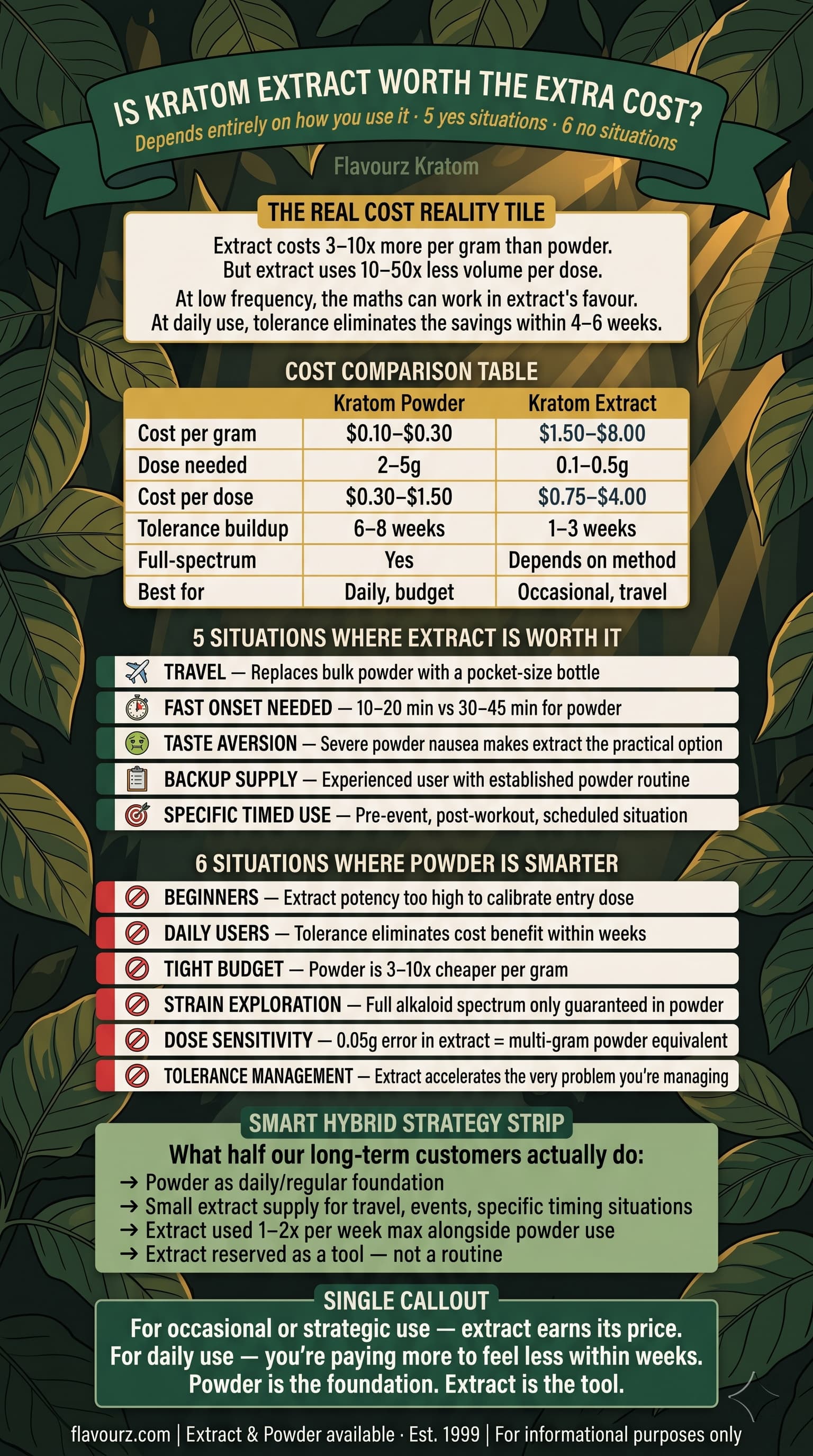
Kratom extract is worth the cost for occasional users who prioritize convenience, faster onset, or travel-friendly portability. It's not worth the premium for daily users, beginners, or anyone trying to stretch their kratom budget. The faster tolerance buildup with extracts often eliminates any cost savings within 4-6 weeks of regular use.
Here's how I help customers decide.
Extract Makes Sense When:
- You use kratom less than 3 times per week
- You travel frequently and need discreet, portable options
- You have an established powder routine and want a backup
- The taste of powder genuinely makes you nauseous
- You need fast onset for specific scheduled situations
Stick With Powder When:
- You're new to kratom (under 3 months experience)
- You use kratom daily or near-daily
- Budget is a real factor for you
- You enjoy strain experimentation and full-spectrum effects
- You're sensitive to dose changes
- You want to minimize tolerance buildup
For most people, the smart play is keeping powder as your foundation and adding a small extract supply for specific use cases. That's actually what about half our long-term customers do.
What to Watch Out For With Each Form
Both forms have downsides worth knowing about. Being honest about the limitations matters more than overselling the benefits.
Powder Drawbacks:
- Bitter taste: Real and not for everyone
- Slower onset: Not ideal for spontaneous use
- Larger doses needed: Less convenient than concentrated formats
- Preparation required: Tea, capsules, or toss-and-wash
- Storage volume: A kilo of powder takes real shelf space
Extract Drawbacks:
- Faster tolerance: Can become an expensive problem
- Higher cost per use: Especially for daily users
- Easier to overdo: No taste feedback to slow you down
- Inconsistent labeling: "10x" varies wildly between brands
- Less full-spectrum: Loses some natural alkaloid balance
- Quality concerns: Some products contain isolated compounds without disclosure
This is also why we strongly recommend buying only from AKA-certified vendors who provide third-party lab tests. Extract production has more potential failure points than simple powder grinding, so transparency matters more.
Frequently Asked Questions
Can I switch between extract and powder?
Yes, but be careful with dose calculations. After regular extract use, your tolerance to powder may seem reduced and you'll need higher amounts. After regular powder use, start with very small extract servings since your system isn't adapted to concentrated alkaloids.
Does kratom extract show up differently on drug tests?
No, both forms contain the same alkaloids and would show similar results on tests that screen for kratom compounds. Standard drug tests don't typically include kratom screening, but specialized panels can detect mitragynine regardless of whether it came from powder or extract.
Can I make my own kratom extract at home?
Technically yes, but I don't recommend it for most people. Home extraction lacks the precision needed to know your final alkaloid concentration. If you must try, a simple tincture method using powder is safer than concentrated boiling extractions.
How should I store kratom extract vs powder?
Both need cool, dark, dry storage in airtight containers. Powder maintains potency for 12-18 months when stored properly. Extracts in dark glass bottles can last 2+ years. Avoid sunlight exposure for both, since UV degrades alkaloids regardless of form.
Are kratom extracts legal everywhere kratom is legal?
Generally yes, but some states have specific regulations on extract concentrations or alkaloid content. Always check your state's current kratom laws before purchasing extracts, since regulations can change.
What's the strongest form of kratom available?
Concentrated extract products are the strongest form available, with some reaching 50%+ mitragynine content. However, "strongest" isn't always "best." Most experienced users find balanced powder gives more sustainable effects than chasing maximum potency.
The Bottom Line: Which Should You Choose?
For 90% of users, kratom powder is the right starting point and ongoing primary format. It's cheaper, more flexible, easier to dose, and produces more balanced effects. Extract works as a useful tool for specific situations, but shouldn't be your default choice unless you have particular reasons it fits your lifestyle better.
Here's my honest take after 25 years of watching this industry.
The customers who stay happy with kratom long-term are the ones who built a foundation with quality powder, learned their body's response, and added extracts (or capsules, or tinctures) only as supplements to that core routine. The customers who jumped straight to extracts looking for maximum potency usually came back to powder eventually, often after expensive lessons about tolerance.
If you're just getting started, browse our selection of premium kratom products and pick a powder strain that matches what you're looking for. If you've been using powder for a while and want to try a concentrated option, our extract collection has been carefully curated based on what actually works for our long-term customers.
Either way, start low. Go slow. And don't trust any vendor who can't show you third-party lab results.
Disclaimer: This article is for informational purposes only and does not constitute medical advice. Kratom has not been evaluated by the FDA for safety or effectiveness. It is not intended to diagnose, treat, cure, or prevent any disease. Consult your healthcare provider before using kratom, especially if you have medical conditions or take medications. Kratom is not for use by anyone under 21, pregnant, or breastfeeding. Check your local laws before purchasing.

Leave a comment