

Kratom & Liver Health: 8 Medical Studies You Need to Know
Last Updated: April 2026
Medical research on kratom and liver health presents a nuanced picture. Rare cases of liver injury have been documented, typically cholestatic hepatitis appearing 1-8 weeks after starting regular use. But population studies from Southeast Asia show traditional users with 20+ years of daily consumption have normal liver function markers. The U.S. Drug Induced Liver Injury Network identified 11 kratom-related liver injury cases out of 404 herbal supplement cases from 2003-2019. All 11 patients recovered completely. Meanwhile, an estimated 1.7-3.3 million Americans use kratom with extremely low documented injury rates.
I'm going to be direct with you: this is a topic where you'll find extreme opinions on both sides. For those considering specific strains like Flavourz's red kali kratom, understanding liver health implications is crucial for making informed decisions. Some sources claim kratom will destroy your liver. Others say it's completely safe. After 5 years working with kratom and serving over 10,000 customers since 1999 at Flavourz Kratom, I've seen the full spectrum of experiences. The truth, as usual, lies somewhere in the middle.
This article breaks down 8 key medical studies on kratom and liver health. I'll explain what each study actually found (not just the headlines), what the limitations are, and what this means for real-world kratom users. By the end, you'll have the information you need to make informed decisions about your own health.
How Kratom Affects the Liver
Before diving into the studies, understanding how kratom interacts with your liver helps contextualize the research findings.
The Liver's Role in Kratom Metabolism
Your liver is responsible for processing kratom's alkaloids, primarily mitragynine. This happens through the cytochrome P450 (CYP450) enzyme system, the same system that metabolizes most medications and supplements. The CYP3A4 enzyme converts mitragynine into 7-hydroxymitragynine, a more potent metabolite.
At normal doses, this metabolic process doesn't appear to cause direct harm to liver cells (hepatocytes). The liver handles kratom similarly to how it handles coffee, medications, and countless other substances. But like any substance, high doses or individual susceptibility can potentially overwhelm the liver's processing capacity.
For a deeper understanding of how kratom alkaloids work, see our guide on kratom's active compounds.
Types of Liver Injury
When kratom-related liver injury does occur, it typically presents as one of two patterns:
- Cholestatic: Bile flow is impaired. Symptoms include jaundice (yellowing), severe itching, dark urine.
- Mixed: Both cholestatic and hepatocellular (direct liver cell) damage present.
This pattern is important because it's different from the hepatocellular pattern seen with many other drugs. The cholestatic presentation suggests a different mechanism than direct toxicity, possibly an idiosyncratic (individual-specific) immune reaction.
The 8 Key Studies
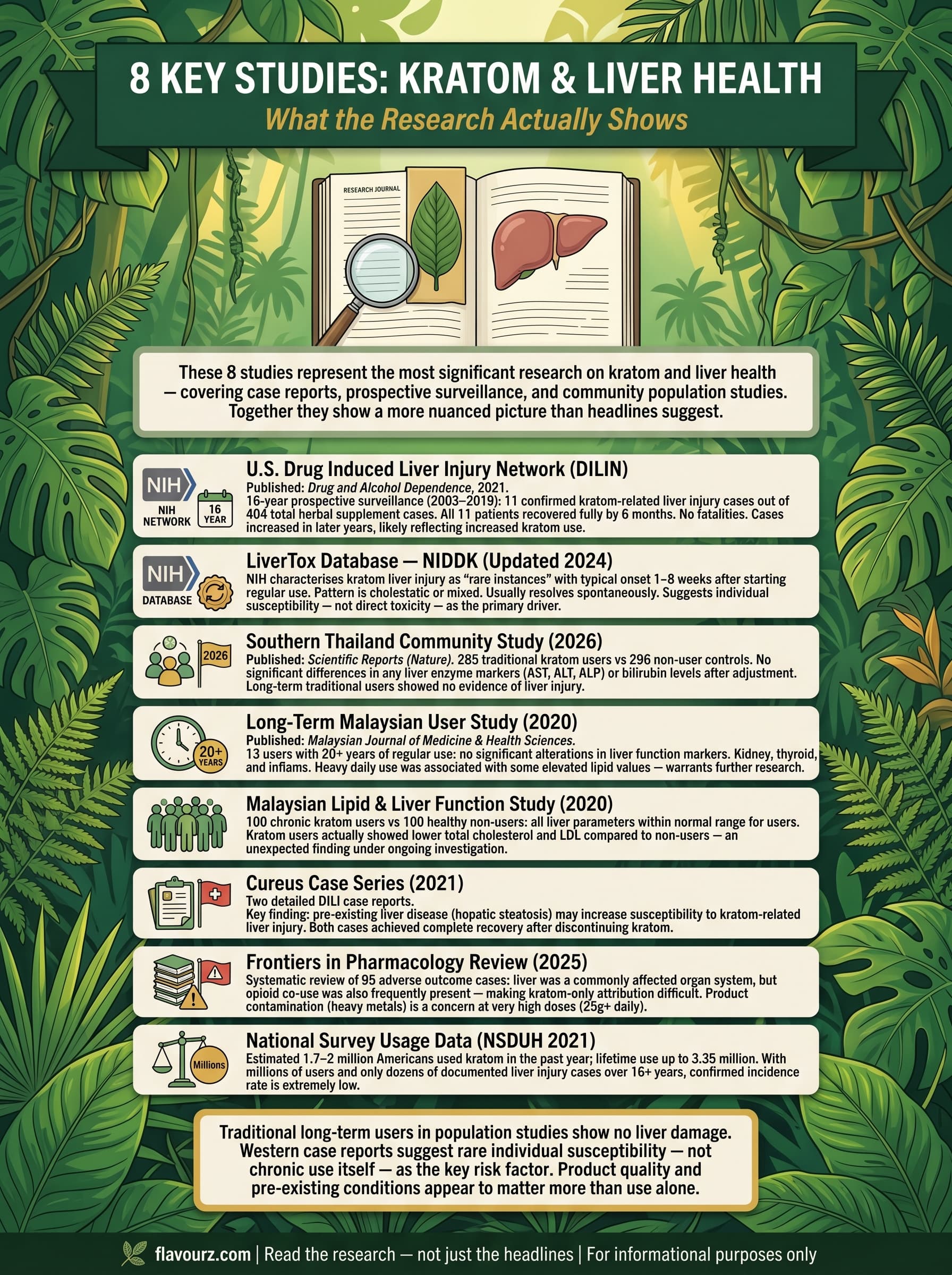
I've selected these 8 studies because they represent the most significant research on kratom and liver health, covering case reports, prospective surveillance, and population studies. Together, they paint a complete picture of what we actually know.
Study #1: U.S. Drug Induced Liver Injury Network (DILIN)
Published: 2021 in Drug and Alcohol Dependence
Institution: National Institutes of Health (NIH) cooperative
What they studied: The U.S. Drug Induced Liver Injury Network prospectively enrolled and studied cases of liver injury from drugs and herbal supplements from 2003-2019. Out of 404 total herbal supplement-related liver injury cases, they identified 11 cases with definite, highly likely, or probable causality attributed to kratom.
Key findings:
- 11 confirmed kratom-related liver injury cases over 16 years
- 9 of 11 patients were male
- Median age was 40 years
- Median latency (time from first use to injury) was 14 days
- All 11 developed jaundice with median peak bilirubin of 11.7 mg/dL
- Liver injury pattern was variable (6 of 11 had mixed pattern)
- 8 patients were hospitalized
- All 11 recovered completely by 6 months
- No fatalities
What this means: Kratom can cause liver injury requiring hospitalization in rare cases, but recovery appears to be the rule rather than the exception. The cases increased in later years (4 of 11 were enrolled in 2019 alone), suggesting either increased kratom use or increased awareness of kratom as a potential cause of liver injury.
Limitations: This is a surveillance network, not a randomized study. It can identify that liver injuries occur but cannot calculate true incidence rates among kratom users.
Study #2: LiverTox Database Review
Published: Ongoing, last updated 2024
Institution: National Institute of Diabetes and Digestive and Kidney Diseases (NIDDK)
What they studied: LiverTox is a comprehensive database of drug-induced liver injury maintained by the NIH. Their kratom entry synthesizes available case reports and clinical information.
Key findings:
- Liver injury onset typically 1-8 weeks after starting regular use
- Pattern is typically cholestatic or mixed
- Symptoms: fatigue, nausea, itching, dark urine, then jaundice
- Can be severe (bilirubin >20 mg/dL in some cases)
- Fever is common; rash and eosinophilia are not
- Autoantibodies usually absent
- Cholestasis can be prolonged but usually resolves spontaneously
- Described as "rare instances"
What this means: The NIH characterizes kratom liver injury as rare and typically reversible. The symptom pattern (cholestatic, no rash, no autoantibodies) suggests an idiosyncratic reaction rather than direct toxicity, meaning individual susceptibility plays a major role.
Limitations: This is a database review, not original research. It synthesizes case reports, which inherently represent only adverse outcomes.
Study #3: Southern Thailand Community Study (2026)
Published: January 2026 in Scientific Reports (Nature)
Institution: Cross-institutional, including Universiti Sains Malaysia
What they studied: A cross-sectional study comparing 285 traditional kratom users with 296 non-user controls from the same community in Southern Thailand. Researchers analyzed hematological and clinical-chemistry parameters including liver function markers (AST, ALT, ALP, bilirubin).
Key findings:
- No significant differences in any liver enzyme markers (AST, ALT, ALP) between users and non-users in adjusted analysis
- No significant differences in bilirubin levels
- Results aligned with large-scale community-based studies from Malaysia
- Traditional, long-term users showed no evidence of liver injury
What this means: In traditional use settings with natural kratom preparations, long-term users don't show evidence of liver damage. This contrasts with Western case reports and suggests that either Western kratom products differ from traditional preparations, or that rare individual susceptibility (not chronic use itself) drives liver injury.
Limitations: Cross-sectional design means they measured a point in time, not changes over time. Traditional brewing methods may differ from Western consumption patterns.
Study #4: Long-Term Malaysian User Study
Published: 2020 in Malaysian Journal of Medicine and Health Sciences
Institution: Universiti Sains Malaysia
What they studied: Thirteen regular kratom users with long-term (>20 years) use history were recruited for blood testing and comprehensive laboratory analysis.
Key findings:
- Regular, long-term consumption of brewed kratom did NOT cause significant alterations in liver analytes
- Kidney function markers were also normal
- Thyroid, inflammatory, and gastrointestinal analytes were normal
- Higher intake (>3 glasses per day) was associated with elevated lipid values (except HDL)
- Moderate elevation of homocysteine in heavy users
What this means: Two decades of daily kratom use did not produce measurable liver damage in this cohort. This is powerful evidence that chronic use itself isn't inherently hepatotoxic. The lipid findings warrant further research but don't indicate liver injury.
Limitations: Small sample size (13 participants). Selection bias possible (only users willing to participate). Traditional brewing methods.
Study #5: Malaysian Lipid and Liver Function Study
Published: 2020
Institution: Research team cited in Frontiers in Pharmacology review
What they studied: Compared lipid profiles, liver function, and blood chemistries in 100 chronic kratom users versus 100 healthy non-users in Malaysia.
Key findings:
- Liver parameters were within normal range for kratom users
- Serum total cholesterol and LDL were significantly lower in kratom users than non-users
- No significant differences in triglyceride and HDL levels
- Higher daily frequency of kratom use was associated with increased total cholesterol among users (dose-response relationship within the user group)
What this means: Normal liver function markers in 100 chronic users is meaningful. The finding that kratom users actually had lower cholesterol than non-users was unexpected and warrants further investigation.
Limitations: Observational design. Cannot establish causation for the cholesterol differences.
Study #6: Cureus Case Series (2021)
Published: April 2021 in Cureus
Title: Kratom-Induced Liver Injury: A Case Series and Clinical Implications
What they studied: Two detailed case reports of drug-induced liver injury (DILI) associated with kratom use, plus a literature review finding 8 out of 404 DILIN cases associated with kratom.
Case 1:
- 36-year-old woman with history of hepatic steatosis and opioid dependence
- Presented with jaundice, ascites, and severe hyperbilirubinemia (39.5 mg/dL)
- Liver biopsy showed cholestatic hepatitis consistent with DILI plus steatohepatitis
- Had used kratom for several years for opioid withdrawal
- Pre-existing liver disease (fatty liver) may have been a contributing factor
Case 2:
- Details suggest rapid onset after kratom initiation
- Normal liver synthetic function tests
- Complete recovery after kratom discontinuation
What this means: Pre-existing liver disease may increase susceptibility to kratom-related injury. The case with fatty liver disease had a more severe presentation. Complete recovery was achieved after stopping kratom.
Limitations: Case reports cannot establish causation definitively. Other factors (pre-existing liver disease, concurrent substance use) may contribute.
Study #7: Frontiers in Pharmacology Adverse Effects Evaluation (2025)
Published: July 2025 in Frontiers in Pharmacology
Institution: Multi-institutional systematic review
What they studied: Systematic literature search identifying patterns among cases involving kratom use and acute adverse health effects. Reviewed 95 patients from case reports/series.
Key findings:
- Among surviving cases, the liver was a commonly reported affected organ system
- Opioids were commonly detected as concomitant substances
- Mitragynine presence was confirmed in 55 cases; 35 deceased, 20 living
- Blood levels in deceased cases ranged from 3.5 to 7,500 ng/mL (enormous variation)
- Living cases showed levels of 5 to 340 ng/mL
- Heavy metal contamination (lead, nickel, arsenic) was noted as a concern at doses of 25g or more daily
What this means: Liver is a commonly affected organ in adverse case reports, but opioid co-use is also common, making it difficult to attribute effects solely to kratom. The massive variation in blood levels suggests dose and product quality play important roles. Contamination is a real concern with some products.
Limitations: Case reports represent only negative outcomes. Cannot calculate true incidence among all kratom users.
Study #8: National Survey Usage Data
Sources: National Survey on Drug Use and Health (2021), NUMRx Survey (2018-2019)
What they measured: Prevalence of kratom use in the U.S. population.
Key findings:
- 1.7 million Americans aged 12+ used kratom in 2021 (NSDUH)
- Past-year use estimated at 2.03 million adults
- Lifetime use estimated at 3.35 million adults
- Some estimates range as high as 15.6 million users
What this means: With millions of users and only dozens of documented liver injury cases, the incidence rate is extremely low. If kratom caused liver injury at rates comparable to acetaminophen or alcohol, we would see thousands of cases annually. We don't.
Limitations: Survey data likely underestimates true use. Liver injuries may also be underreported or attributed to other causes.
Complete Study Summary Table
| # | Study | Type | Key Finding |
|---|---|---|---|
| 1 | DILIN Network | Prospective | 11 cases over 16 years; all recovered |
| 2 | LiverTox Review | Database | Rare, reversible, cholestatic pattern |
| 3 | Thailand Community | Cross-sectional | No liver differences vs. non-users |
| 4 | Malaysia 20+ Years | Cross-sectional | Normal liver markers after 20+ years |
| 5 | Malaysia 100 Users | Comparative | Liver parameters within normal range |
| 6 | Cureus Case Series | Case reports | Pre-existing liver disease may increase risk |
| 7 | Frontiers Review | Systematic | Liver commonly affected; opioid co-use common |
| 8 | National Surveys | Prevalence | 1.7-3.3 million users; very low injury rate |
What the Research Actually Tells Us
Looking at all 8 studies together, several patterns emerge:
Liver Injury Does Occur, But It's Rare
The DILIN study found 11 cases out of 404 herbal supplement liver injury cases over 16 years. With millions of users, documented cases number in the dozens, not thousands. The NIH's LiverTox database describes kratom liver injury as "rare instances."
For comparison, acetaminophen (Tylenol) causes approximately 56,000 emergency room visits and 500 deaths annually in the U.S. Kratom-related liver injuries are orders of magnitude less common.
Recovery Is the Norm
In the DILIN study, all 11 patients recovered completely. The LiverTox review notes that "cholestasis can be prolonged, but usually resolves spontaneously." Case reports consistently document full recovery after discontinuing kratom.
Long-Term Traditional Use Shows No Liver Damage
Studies from Malaysia and Thailand examining users with 20+ years of daily kratom consumption found normal liver function markers. This suggests chronic use itself isn't inherently hepatotoxic.
Western Cases May Involve Different Factors
The discrepancy between Western case reports (showing injury) and Southeast Asian population studies (showing no injury) is significant. Possible explanations include:
- Product quality and contamination differences
- Traditional preparation methods vs. commercial processing
- Concurrent substance use (opioids, alcohol, medications)
- Individual genetic susceptibility
- Higher doses in Western recreational use
The Pattern Suggests Idiosyncratic Reaction
The cholestatic pattern, absence of autoantibodies, and lack of dose-response relationship in population studies suggest an idiosyncratic (individual-specific) mechanism rather than direct toxicity. Some people may have genetic or metabolic factors that make them susceptible.
Risk Factors to Consider
Based on the research, certain factors may increase liver injury risk:
Higher Risk Factors
- Pre-existing liver disease: Fatty liver, hepatitis, cirrhosis
- Concurrent substance use: Alcohol, opioids, hepatotoxic medications
- Poor product quality: Contamination with heavy metals, bacteria, or adulterants
- High doses: Especially >25g daily (where heavy metal concerns increase)
- Medications metabolized by CYP3A4/CYP2D6: Kratom may cause drug interactions affecting liver processing
If you take medications, understanding kratom drug interactions is important for liver safety.
Lower Risk Factors
- No pre-existing liver conditions
- No concurrent alcohol or opioid use
- Quality-tested kratom from reputable sources
- Moderate doses
- No hepatotoxic medications
Warning Signs of Liver Problems
If you use kratom, watch for these symptoms that may indicate liver stress:
Early Warning Signs
- Unexplained fatigue that persists
- Loss of appetite
- Nausea without clear cause
- Mild itching, especially at night
More Serious Signs (Seek Medical Attention)
- Jaundice (yellowing of skin or whites of eyes)
- Dark urine (like cola or tea)
- Pale or clay-colored stools
- Severe itching
- Abdominal pain, especially in upper right area
- Fever combined with other symptoms
If you notice these symptoms, stop kratom use and consult a healthcare provider. Mention your kratom use specifically since many providers may not think to ask about it.
Practical Harm Reduction
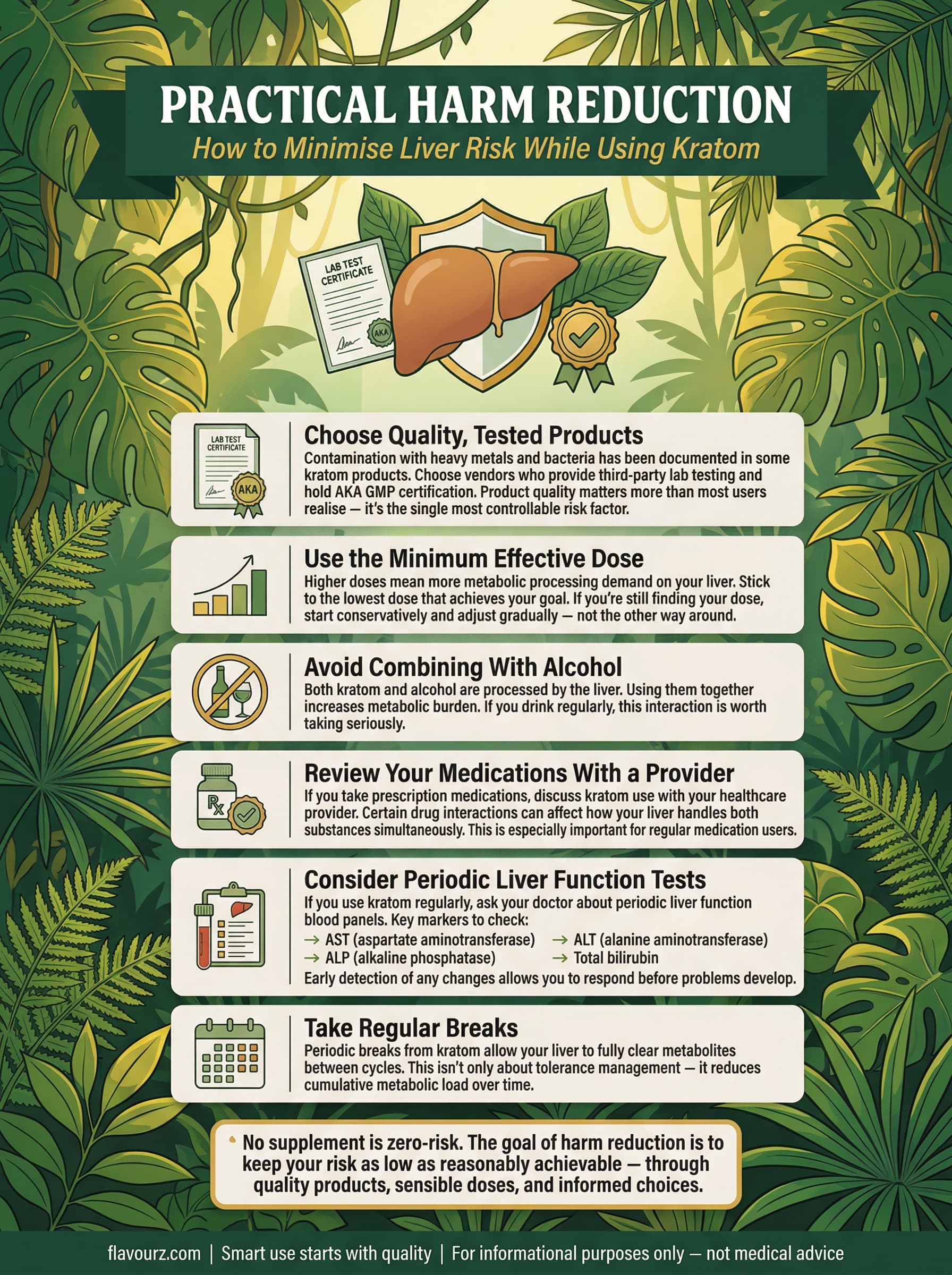
Based on what the research shows, here's how to minimize liver risk while using kratom:
Choose Quality Products
Contamination with heavy metals (lead, nickel, arsenic) and bacteria (Salmonella) has been documented in some kratom products. Choose vendors who provide third-party lab testing. Look for AKA GMP certification. Quality matters more than you might think.
For guidance on selecting quality products, see our best kratom brands guide.
Use Moderate Doses
Higher doses mean more work for your liver. Stick to the minimum effective dose for your goals. If you're new to kratom, our kratom dosage guide provides starting recommendations.
Avoid Alcohol
Both kratom and alcohol are processed by the liver. Combining them increases metabolic burden and may elevate injury risk. If you drink alcohol regularly, this is worth taking seriously.
Review Your Medications
If you take prescription medications, especially those processed by CYP3A4 or CYP2D6 enzymes, discuss kratom with your healthcare provider. Drug interactions can affect how your liver handles both substances.
Consider Periodic Liver Function Tests
If you use kratom regularly, consider asking your doctor for periodic liver function tests (LFTs). A simple blood panel can measure AST, ALT, and bilirubin levels. This is especially prudent if you have any risk factors.
What to test:
- AST (aspartate aminotransferase): Normal range varies by lab, typically 10-40 U/L
- ALT (alanine aminotransferase): Normal range typically 7-56 U/L
- ALP (alkaline phosphatase): Normal range typically 44-147 U/L
- Bilirubin: Normal total bilirubin typically 0.1-1.2 mg/dL
Take Breaks
Periodic breaks from kratom give your liver time to clear metabolites completely. This isn't just about tolerance. It's about reducing cumulative metabolic load.
Context: How Does Kratom Compare?
To put kratom's liver risk in perspective:
| Substance | Annual U.S. Liver Injuries | Notes |
|---|---|---|
| Acetaminophen | ~56,000 ER visits | Leading cause of acute liver failure |
| Alcohol | ~25,000 deaths | Chronic liver disease mortality |
| Prescription opioids | Thousands | Often combined with acetaminophen |
| Kratom | Dozens documented | All documented cases recovered |
This isn't to minimize kratom's liver risks but to provide context. Substances considered "safe" when used appropriately (like acetaminophen) cause far more liver damage annually than kratom.
Frequently Asked Questions
Does kratom cause liver damage?
Kratom can cause liver injury in rare cases, typically presenting as cholestatic hepatitis 1-8 weeks after starting regular use. The U.S. DILIN study identified 11 cases over 16 years, all of which recovered completely. Population studies from Southeast Asia show traditional users with 20+ years of daily use have normal liver function markers.
Is kratom hard on your liver?
At normal doses, kratom is processed by the liver similarly to coffee and many other substances without apparent harm. Long-term studies from Malaysia and Thailand show normal liver function in chronic users. Liver injury appears to be an idiosyncratic (individual-specific) reaction rather than a dose-dependent toxic effect.
What are the symptoms of kratom liver injury?
Symptoms typically appear 1-8 weeks after starting regular use. Early signs include fatigue, nausea, and itching. More serious signs include jaundice (yellowing of skin/eyes), dark urine, pale stools, and abdominal pain. If you experience these symptoms, stop kratom and seek medical attention.
How common is kratom hepatotoxicity?
Very rare. With an estimated 1.7-3.3 million U.S. users, only dozens of liver injury cases have been documented in medical literature. The DILIN study found 11 cases out of 404 total herbal supplement liver injuries over 16 years. All recovered completely.
Can your liver recover from kratom damage?
Yes. All 11 patients in the DILIN study recovered completely by 6 months after discontinuing kratom. The NIH LiverTox database notes that injury "usually resolves spontaneously" after stopping kratom. No fatalities were reported in the prospective surveillance data.
Should I get liver tests if I use kratom?
Consider periodic liver function tests (AST, ALT, bilirubin) if you use kratom regularly, especially if you have risk factors like pre-existing liver conditions, concurrent alcohol use, or hepatotoxic medications. A baseline test before starting kratom provides useful comparison data.
Is kratom safer than other substances for the liver?
Compared to substances like acetaminophen (56,000 annual ER visits) and alcohol (25,000 liver-related deaths annually), kratom's documented liver injury rate is extremely low. This doesn't mean kratom is risk-free, but context matters when evaluating relative safety.
What factors increase liver risk with kratom?
Higher risk factors include pre-existing liver disease, concurrent alcohol or opioid use, poor product quality (contamination), high doses (>25g daily), and medications processed by CYP3A4/CYP2D6 enzymes. Using quality-tested kratom at moderate doses with no concurrent hepatotoxins represents lower risk.
The Bottom Line
The research on kratom and liver health shows a nuanced picture that neither extreme narrative captures accurately:
- Liver injury can occur but is rare, with all documented cases in prospective surveillance recovering completely.
- Long-term studies from Southeast Asia show no liver damage in traditional users with 20+ years of daily use.
- The injury pattern (cholestatic, idiosyncratic) suggests individual susceptibility rather than universal toxicity.
- Quality, dose, concurrent substances, and pre-existing conditions appear to matter significantly.
If you choose to use kratom, doing so responsibly means acknowledging real but rare risks while taking sensible precautions: quality products, moderate doses, avoiding hepatotoxic combinations, and monitoring for warning signs. For most users, kratom appears to be well-tolerated by the liver. For a small number of susceptible individuals, injury can occur but is typically reversible.
At Flavourz Kratom, we've prioritized quality since 1999 because we understand that what's in your kratom matters. Lab-tested kratom powder from reputable sources reduces contamination risks that may contribute to adverse effects. If you're new to kratom, our beginner's guide covers responsible use practices.
Disclaimer: This information is for educational purposes only and is not medical advice. These statements have not been evaluated by the FDA. Kratom is not intended to diagnose, treat, cure, or prevent any disease. If you have liver disease or take medications affecting the liver, consult a healthcare provider before using kratom. Must be 21+ to purchase. Not available in all states.

Leave a comment