


Kratom Tolerance: 10 Proven Management Strategies That Work
Last Updated: April 2026
Kratom tolerance develops when your body becomes less responsive to kratom's alkaloids over time, typically within 2-6 weeks of daily use. The most effective strategies to manage tolerance include strain rotation, scheduled breaks (7-14 days for most users), gradual dose reduction (20-30%), and supporting supplements like magnesium. Using multiple approaches together works better than relying on any single strategy. Choosing the right kratom strain for your rotation strategy can significantly impact tolerance management, and our white bali kratom guide explains why white vein strains work particularly well in morning rotations.
After 5 years of personal kratom use and helping over 10,000 customers at Flavourz Kratom since 1999, I've seen the tolerance question come up constantly. People find their usual dose stops working, panic, and often make it worse by doubling their intake. There's a better way.
This guide covers 10 strategies that actually work, based on both the science of how tolerance develops and real-world experience from our customer community.
Why Does Kratom Tolerance Develop?
Understanding why tolerance happens helps you prevent it. Here's what's going on in your body:
The Receptor Adaptation Process
Kratom's main alkaloid, mitragynine, acts as a partial agonist at μ-opioid receptors. With repeated exposure, your brain adapts by:
- Receptor downregulation: Your brain reduces the number of available receptors
- Receptor desensitization: Existing receptors become less responsive
- Compensatory changes: Other neurotransmitter systems adjust to maintain balance
This is your body doing exactly what it's designed to do: maintain homeostasis. The problem is, these adaptations mean you need more kratom to achieve the same effects.
How Fast Does Tolerance Build?
Based on user reports and clinical observations:
- Daily moderate doses: Some tolerance typically develops within 2-6 weeks
- High doses or extracts: Tolerance can develop faster
- Occasional use (1-2x weekly): Minimal tolerance development
Individual factors matter too. Metabolism, body weight, genetics, and overall health all influence how quickly your receptors adapt.
For more on kratom's pharmacology, see: Kratom's Active Compounds: A Scientific Analysis.
Signs Your Kratom Tolerance Is Building
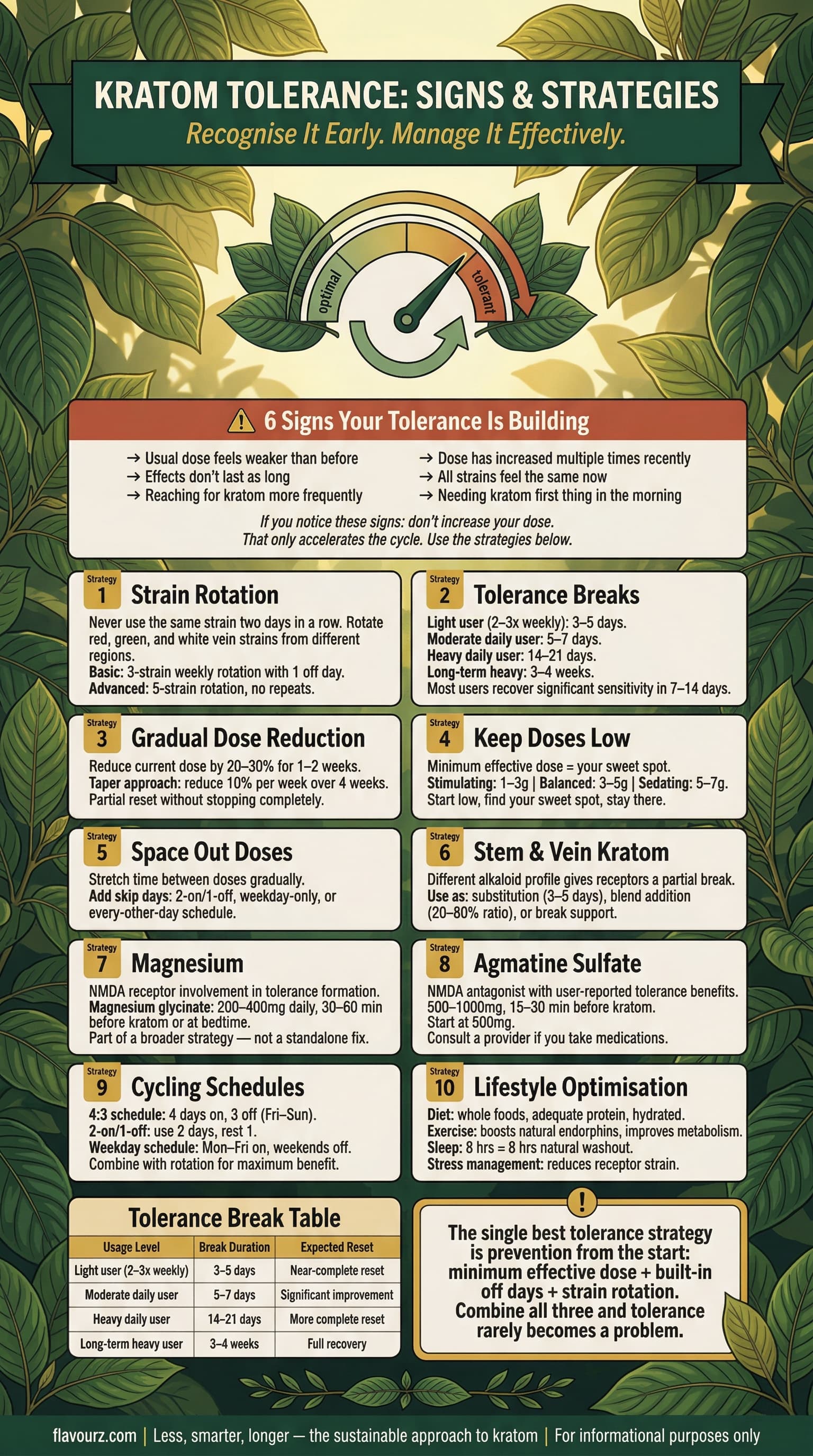
Recognize these early warning signs before tolerance becomes a bigger issue:
- Your usual dose feels weaker than it used to
- Effects don't last as long as before
- You're reaching for kratom more frequently
- You've increased your dose multiple times in the past few weeks
- Different strains all feel "the same" now
- You need kratom first thing in the morning when you didn't before
If you're experiencing these, don't increase your dose further. That only accelerates the cycle. Instead, use one or more of the strategies below.
Strategy #1: Strain Rotation
Strain rotation is one of the most effective ways to slow tolerance development, and it's the strategy our customers report the most success with.
Why It Works
Each kratom strain has a unique alkaloid profile. While all strains contain mitragynine, the ratios of secondary alkaloids (paynantheine, speciogynine, speciociliatine, and dozens more) vary by strain and vein color. By rotating, your receptors don't receive the exact same combination every day.
How to Implement Rotation
Basic 3-Strain Rotation (for beginners):
- Monday/Thursday: Red strain (e.g., Red Bali)
- Tuesday/Friday: Green strain (e.g., Green Maeng Da)
- Wednesday/Saturday: White strain (e.g., White Maeng Da)
- Sunday: Off day
Advanced 5-Strain Rotation:
More strains means more variety. Rotate through 5 different strains, never using the same one two days in a row. This gives your receptors maximum variation.
Key Rules for Effective Rotation
- Never use the same strain two days in a row
- Include different vein colors (red, green, white)
- Include strains from different regions (Bali, Maeng Da, Borneo, etc.)
- Keep your dose consistent across strains
For understanding strain differences, see: What Is the Actual Difference Between Kratom Strains?
Strategy #2: Scheduled Tolerance Breaks
Sometimes you need to give your receptors a complete rest. Tolerance breaks are the most reliable way to reset your sensitivity.
How Long Should a Tolerance Break Be?
| Usage Level | Break Duration | Expected Reset |
|---|---|---|
| Light user (2-3x weekly) | 3-5 days | Near-complete reset |
| Moderate daily user | 5-7 days | Significant improvement |
| Heavy daily user | 14-21 days | More complete reset |
| Long-term heavy user | 3-4 weeks | Full receptor recovery |
Most users report that 7-14 days restores most of their original sensitivity.
Making Breaks More Comfortable
If you've been using daily, breaks can be uncomfortable. These approaches help:
- Taper first: Reduce your dose gradually before the break
- Use stem and vein: See Strategy #6
- Stay active: Exercise helps with discomfort
- Support sleep: Melatonin, magnesium, or calming herbs
- Stay hydrated: Drink plenty of water
Strategy #3: Gradual Dose Reduction
You don't always need a full break. Simply dropping your dose can partially reset your sensitivity while maintaining some effects.
The 20-30% Rule
Reduce your current dose by 20-30% for 1-2 weeks. This approach:
- Slows tolerance progression
- Partially resets receptor sensitivity
- Is more sustainable than cold-turkey breaks
- Extends the time between full tolerance breaks
Example: If you're taking 6 grams per dose, reduce to 4-5 grams for two weeks. You may notice effects are slightly less pronounced initially, but your sensitivity will improve.
The Taper Approach
For more significant tolerance reduction:
- Week 1: Reduce dose by 10%
- Week 2: Reduce by another 10%
- Week 3: Reduce by another 10%
- Week 4: Hold at this lower dose
After a month at the lower dose, your tolerance will have adjusted downward.
Strategy #4: The "Less Is More" Approach
This is about prevention. Keeping your doses low from the start is the single best way to avoid tolerance problems.
Why Lower Doses Work Better Long-Term
Higher doses accelerate tolerance development. The math is simple: more receptor activation = faster adaptation. Users who maintain moderate doses (3-5 grams) typically report sustainable effects for much longer than those taking high doses.
Finding Your "Sweet Spot"
Your sweet spot is the minimum effective dose that gives you the effects you want. For most people:
- Stimulating effects: 1-3 grams
- Balanced effects: 3-5 grams
- Sedating/relaxing effects: 5-7 grams
Start low and increase gradually until you find your sweet spot. Then stay there. Resist the urge to increase just because you think more would be better.
For detailed dosing guidance, see: Kratom Dosage Recommendations.
Strategy #5: Spacing Out Doses
Instead of reducing how much you take, reduce how often you take it.
The Time-Stretching Method
Keep your dose the same, but increase the time between doses:
- If you usually dose every 4 hours, stretch to every 5 hours
- Then stretch to every 6 hours
- Eventually, you're taking fewer doses per day
This reduces your total daily intake without reducing individual dose effectiveness.
The Skip-Day Approach
Another effective method is scheduled off days:
- Two-day rule: Use kratom for two days, then take one day off
- Weekday-only: Use Monday through Friday, weekends off
- Every-other-day: Only use kratom on alternating days
The more off days you include, the slower your tolerance will build.
Strategy #6: Using Stem and Vein Kratom
Stem and vein kratom comes from the stems and central veins of the kratom leaf, rather than the leaf material itself. It has a different alkaloid profile that can help manage tolerance.
How Stem and Vein Helps
- Different alkaloid ratios: Contains lower mitragynine but different secondary alkaloids
- Milder effects: Roughly 1/3 the potency of leaf material
- Receptor variation: Gives your μ-opioid receptors a partial break while providing some alkaloid activity
How to Use It for Tolerance
Method 1: Substitution
Replace your regular kratom with stem and vein for 3-5 days. Use 2-3 grams per session. This gives your receptors a break without going completely without.
Method 2: Blending
Mix stem and vein with your regular kratom:
- Start with 20% stem and vein, 80% regular kratom
- Gradually increase the stem and vein proportion
- After several days, return to regular kratom
Method 3: Tolerance Break Support
Use stem and vein during a tolerance break to ease discomfort while still allowing receptors to reset.
Strategy #7: Magnesium Supplementation
Magnesium is the most commonly discussed supplement for kratom tolerance, and many users report positive results.
The Theory
Magnesium is an NMDA receptor antagonist. NMDA receptors are involved in tolerance formation to various substances. By blocking NMDA activity, magnesium may slow tolerance development.
Additionally, about 50% of Americans are deficient in magnesium, so supplementation may simply be correcting a deficiency that affects overall receptor function.
Which Form to Use
Not all magnesium is equal for this purpose:
- Magnesium glycinate: Most recommended; well-absorbed, calming
- Magnesium citrate: Good absorption; can have laxative effect
- Magnesium oxide: Poorly absorbed; not recommended
Dosage and Timing
- Typical dose: 200-400mg daily
- Take 30-60 minutes before kratom or at bedtime
- Start low and assess your response
Important: Don't expect miracles. Magnesium may help slow tolerance development, but it won't eliminate it. Use it as part of a broader strategy.
Strategy #8: Agmatine Sulfate
Agmatine is another supplement that has gained attention in the kratom community for tolerance management.
The Science
Agmatine acts as an NMDA receptor antagonist (similar to magnesium) and also modulates alpha-2 adrenergic receptors. Studies with morphine have shown agmatine can:
- Potentiate analgesic effects
- Reduce tolerance development
- Lower dependence and withdrawal symptoms
While kratom isn't identical to morphine, they share some receptor interactions, so the benefits may transfer.
How to Use Agmatine
- Typical dose: 500-1000mg, 1-3 times daily
- Timing: 15-30 minutes before kratom
- Start low: Begin with 500mg and assess effects
What Users Report
User experiences vary. Some report:
- Reduced need to increase doses over time
- Enhanced pain relief effects
- Some report reduced euphoric effects (trade-off for tolerance benefits)
Caution: As with any supplement, consult a healthcare provider before starting, especially if you take medications.
Strategy #9: Skip Days and Cycling
Structured cycling prevents the constant receptor stimulation that leads to tolerance.
Popular Cycling Schedules
The 4:3 Schedule:
- Use kratom 4 days per week
- Take 3 consecutive off days (e.g., Friday-Sunday)
- Good balance of use and recovery
The 2-On/1-Off Schedule:
- Use kratom for 2 days
- Take 1 day off
- Repeat
- Works well for maintaining consistent effects
The Weekday Schedule:
- Use Monday through Friday
- Weekends completely off
- Easy to remember and stick to
Combining Cycling with Rotation
For maximum tolerance prevention, combine cycling with strain rotation:
- Use different strains on your "on" days
- Never use the same strain two days in a row
- Include built-in off days
This gives your receptors variation during use AND complete rest during off days.
Strategy #10: Lifestyle Optimization
Your overall health affects how your body processes kratom and how quickly tolerance develops.
Diet
Poor nutrition can mimic or worsen tolerance:
- Eat clean: Whole foods support healthy metabolism
- Adequate protein: Supports neurotransmitter production
- Stay hydrated: Dehydration affects all body systems
- Empty stomach: Kratom often works better on an empty stomach
Exercise
Regular exercise:
- Boosts natural endorphins
- Improves metabolism
- Enhances overall receptor function
- Helps with tolerance break discomfort
Some users report that kratom feels more effective on days they exercise.
Sleep
Quality sleep is crucial:
- Sleep is when your body repairs and resets
- Poor sleep can reduce kratom effectiveness
- 8 hours of sleep = 8 hours of natural "washout" time
- Consider skipping evening doses to improve sleep quality
Stress Management
Chronic stress affects neurotransmitter systems. Managing stress through meditation, exercise, or other methods can improve your kratom experience and slow tolerance.
Creating Your Personal Tolerance Management Plan
The best approach combines multiple strategies. Here's a template:
For Prevention (If You Haven't Built Significant Tolerance Yet)
- Start with low doses and find your sweet spot
- Rotate through 3-5 strains (never same strain two days in a row)
- Include 2-3 off days per week
- Consider daily magnesium supplementation
- Maintain healthy lifestyle habits
For Reset (If Tolerance Has Already Built Up)
- Taper dose by 10% per day for one week
- Take a 7-14 day break (use stem and vein if needed)
- During break: exercise, stay hydrated, consider magnesium
- When returning: start at 50-70% of your previous dose
- Immediately implement rotation and cycling schedules
Frequently Asked Questions
How long does a kratom tolerance break take?
For most moderate daily users, 7-14 days restores significant sensitivity. Light users may only need 3-5 days. Heavy long-term users may need 2-4 weeks for a complete reset. Individual factors like metabolism, usage history, and overall health affect the timeline.
Does rotating kratom strains really prevent tolerance?
Strain rotation can slow tolerance development but may not completely prevent it. Each strain has a different alkaloid profile, so rotating gives your receptors variation. Users who practice consistent rotation report maintaining their original dose longer than those who use the same strain daily.
What supplements help with kratom tolerance?
Magnesium (glycinate or citrate) is most commonly reported to help, likely through NMDA receptor antagonism. Agmatine sulfate is another option with some research support. Both may slow tolerance development when used consistently. Results vary between individuals.
How fast does kratom tolerance build?
With daily moderate doses, some tolerance typically develops within 2-6 weeks. Higher doses and extracts accelerate this timeline. Occasional use (1-2 times weekly) results in minimal tolerance. Individual factors like metabolism and genetics also influence the rate.
Can you reset kratom tolerance?
Yes. Tolerance is reversible. Taking a break allows your receptors to upregulate and resensitize. The longer the break, the more complete the reset. Most users find 7-14 days sufficient to notice significant improvement when they resume at a lower dose.
What is stem and vein kratom?
Stem and vein kratom comes from the stems and central veins of the kratom leaf rather than the leaf material. It has a different alkaloid profile, with lower mitragynine content. It's roughly 1/3 the potency of regular kratom and is often used during tolerance breaks to ease discomfort while allowing receptors to reset.
Does the "less is more" approach really work?
Yes. Lower doses stimulate receptors less intensely, leading to slower adaptation. Users who maintain moderate doses (3-5 grams) typically report sustainable effects for much longer than those taking high doses. Starting low and staying at your minimum effective dose is the best prevention strategy.
How do I know if my tolerance is too high?
Signs include: your usual dose feels weaker, effects don't last as long, you're dosing more frequently, you've increased your dose multiple times recently, and different strains all feel similar. If you're experiencing these, it's time to implement tolerance management strategies rather than increasing your dose further.
The Bottom Line
Kratom tolerance is manageable. The key principles:
- Prevention is easier than reset. Start with low doses, rotate strains, and include off days from the beginning.
- Multiple strategies work better together. Combine rotation, cycling, appropriate dosing, and lifestyle factors.
- Don't chase the dragon. When tolerance builds, resist the urge to increase doses. That only makes it worse.
- Breaks work. 7-14 days is enough for most people to reset significant sensitivity.
- Be patient. Both tolerance development and reset take time. Work with your body, not against it.
For new users looking to start right, check out our beginner's guide to kratom. And when you're ready to build a rotation schedule with quality strains from a vendor serving customers since 1999, explore our kratom powder collection.
Disclaimer: This information is for educational purposes only. These statements have not been evaluated by the FDA. Kratom is not intended to diagnose, treat, cure, or prevent any disease. Consult a healthcare provider before taking supplements like magnesium or agmatine, especially if you take medications. Must be 21+ to purchase. Not available in all states.

Leave a comment