

Understanding Kratom Lab Tests: 10 Contaminants to Check
Last Updated: April 2026
A kratom Certificate of Analysis is not a pass/fail stamp — it is a multi-panel safety document covering up to ten distinct contaminant categories, each with its own threshold, its own health risk profile, and its own action implication if a tested value exceeds the acceptable limit. Most buyers who request a COA before purchasing look at the mitragynine percentage and stop reading. That's leaving nine safety checks unreviewed — including, in the case of vendors without adulteration testing, the check that protects against fentanyl contamination.
At Flavourz Kratom, every production batch is tested by a third-party accredited laboratory against the full contaminant panel — not a subset selected for marketing convenience. This guide explains exactly what each of the ten contaminants is, why it appears in kratom, what the verified safe threshold looks like numerically on a COA, and how to rank the contaminants by the severity of their health risk so you know which number to check first. The official AKA GMP testing requirements, FDA study data, and peer-reviewed research findings on kratom contamination are cited throughout so every safety claim in this guide is externally verifiable.
Why Third-Party Lab Testing Is Non-Negotiable for Kratom
Kratom is not subject to the same pre-market approval requirements as pharmaceuticals or conventional food products in most US states — which means the safety guarantee that buyers assume exists for most consumed products does not exist for kratom by default. Without mandatory federal testing requirements, the only structural protection available to buyers is voluntary third-party lab testing by vendors who choose to implement it.
The documented contamination risk is not theoretical. A 2019 FDA laboratory analysis of 30 kratom products found significant lead and nickel concentrations exceeding safe oral daily intake thresholds across multiple products. As the FDA's published analysis confirmed, heavy kratom users consuming non-tested products could be exposed to lead and nickel at levels many times greater than the safe daily exposure established in Appendix 2 of the Q3D Elemental Impurities Guidance for Industry. A peer-reviewed 2020 study published in PMC/NIH testing kratom products specifically found nickel levels between 0.73–7.4 µg/g, lead between 0.16–1.6 µg/g, and chromium between 0.21–5.7 µg/g across seven products — with the study authors concluding that "more stringent standards for the production and sale of kratom products" are needed.
The American Kratom Association's GMP Standards Program represents the most comprehensive voluntary testing standard in the US market, and it exists precisely because this contamination risk is documented and real. As the AKA confirmed at the program's launch, its GMP program is designed to protect consumers from "unscrupulous vendors who produce kratom products using sloppy manufacturing procedures that allow for contamination" and equally from vendors who "deliberately adulterate kratom products to boost their effect by adding dangerous and sometimes deadly substances like fentanyl or morphine." AKA GMP requires every production lot to be tested across five categories: microorganisms of public health concern, heavy metals, chemical contaminants, synthetic drugs, and shelf-life verification.
The 10 Contaminants — Ranked by Health Risk Severity
The ten contaminants are organized below by severity tier — from immediately life-threatening through chronic toxicity risk through acute illness risk through long-term exposure risk. This hierarchy is the most practically useful framing for COA review: start with the highest-severity category and work down.
Tier 1: Immediately Life-Threatening — Synthetic Drug Adulterants
Contaminant 1: Synthetic Opioid Adulterants (Fentanyl, Carfentanil)
Synthetic opioid adulteration is the only contaminant in this list that can produce death at a single dose in an unsuspecting user. Fentanyl is approximately 100 times more potent than morphine by weight; carfentanil is approximately 10,000 times more potent than morphine. A kratom product adulterated with either compound at dosing weights designed to "boost" kratom effects places a user at immediate overdose risk with zero warning — the powder looks identical, smells similar, and tastes comparable to uncontaminated kratom.
As confirmed by the AKA's GMP program announcement, the explicit target of the synthetic drug testing requirement is protection against vendors deliberately adulterating products with fentanyl or morphine. This is not a historical or hypothetical risk — it is an active market problem that the AKA designed a mandatory testing protocol around. The acceptable limit for any synthetic opioid in a kratom product is zero detection.
- Safe limit: Zero tolerance — any detection is an immediate discard and vendor disqualification
- Source in kratom: Deliberate adulteration by unscrupulous vendors
- COA check: Look for "synthetic drug screen," "opiate panel," or "adulterant screening" — if this panel is absent from a COA entirely, the vendor has not tested for the most critical safety category
- Action if detected: Do not consume; report to the vendor and to the FDA MedWatch program immediately
Contaminant 2: Other Synthetic Adulterants (Morphine, Synthetic Cannabinoids)
Beyond fentanyl, the adulterant testing panel covers morphine, synthetic cannabinoids (spice/K2), and other controlled or synthetic substances that have been documented in adulterated herbal products. Kratom Spot's 2026 quality standards documentation confirms "artificial or synthetic ingredients, such as preservatives and dyes" as a distinct contaminant category — a reminder that adulteration extends beyond opioids to include synthetic dyes that mask color degradation (covering freshness failures), preservatives not disclosed on the label, and flavor compounds added to disguise off-notes from aged or low-quality material.
- Safe limit: Zero tolerance for any unlabeled synthetic compound
- Source in kratom: Deliberate adulteration; undisclosed additive manufacturing practices
- COA check: "Synthetic cannabinoid panel," "morphine," "adulterant screen" — all should show "not detected" or "ND"
Tier 2: Acute Illness Risk — Microbial Contaminants
Contaminant 3: Salmonella spp.
Salmonella is the most clinically significant microbial contaminant in herbal powder products and one of the AKA GMP's explicitly named testing requirements. Columbia Laboratories' ISO 17025:2017 accredited kratom testing panel lists Salmonella as the first safety method for powder testing — reflecting its status as the primary pathogen of concern for ingested plant material. Salmonella contamination in kratom powder can produce Salmonella gastroenteritis (fever, diarrhea, abdominal cramping) with onset within 12–72 hours of ingestion, and can be life-threatening in immunocompromised users or the elderly.
The mechanism of contamination is specific to kratom's production environment: Indonesian kratom farms are near livestock operations, and post-harvest handling in warm, humid conditions creates Salmonella colonization windows. Proper drying protocols, GMP-compliant handling, and finished-product testing are the three-stage protection chain — the testing stage being the only one the buyer can verify.
- Safe limit: Absent in any portion tested per AKA GMP microbial standard; zero tolerance for per-serving presence
- Source in kratom: Post-harvest contamination in warm humid Indonesian processing environments; animal fecal contact
- COA check: "Salmonella spp. — Not Detected" or "Absent" is the required result
Contaminant 4: Escherichia coli (E. coli) and Coliforms
Coliform bacteria — including E. coli — are fecal indicator organisms. Their presence in a kratom product indicates that the material came into contact with fecal matter at some stage of processing or handling. Columbia Laboratories' AKA-compliant test panel specifically includes "Coliforms + E. coli" and "Enterobacteriaceae" as separate testing categories — reflecting the distinction between total coliforms (broader indicator), fecal coliforms (more specific to fecal contamination), and E. coli 0157:H7 (the pathogenic strain capable of producing hemorrhagic colitis and hemolytic uremic syndrome).
- Safe limit: E. coli 0157:H7 — absent per serving; total coliform — below colony-forming unit (CFU) limits specified by AKA microbial standards
- Source in kratom: Fecal contamination of harvest materials, water sources, or processing surfaces
- COA check: "E. coli — Not Detected" or "E. coli 0157 — ND"; coliform CFU value should be stated with the acceptable limit for comparison
Contaminant 5: Yeast and Mold (Aerobic Plate Count)
Yeast and mold contamination in kratom powder is a dual-risk category: primary mold growth presents direct illness risk (Aspergillus and other species produce mycotoxins that are themselves a separate contaminant category), while Aerobic Plate Count (APC) — a measure of total viable bacteria — provides a general indicator of the product's microbial burden that encompasses both pathogenic and non-pathogenic organisms. High APC counts indicate poor hygienic manufacturing conditions even when specific pathogens test negative.
Moisture exposure is the primary driver of yeast and mold contamination in kratom, connecting the microbial testing results directly to the storage and processing conditions evaluated in our kratom freshness guide — clumped, moisture-exposed kratom is the same product most likely to carry elevated yeast and mold counts.
- Safe limit: APC — typically below 100,000 CFU/g for herbal powder products; yeast and mold — typically below 1,000 CFU/g per AKA microbial standards
- Source in kratom: Moisture during post-harvest processing, shipping, or storage
- COA check: CFU/g values with acceptable limit stated alongside for direct comparison
Tier 3: Chronic Toxicity Risk — Heavy Metals
Heavy metals are chronic toxicity risks — they accumulate in tissue over repeated exposure rather than causing acute illness from a single dose. This makes them more insidious than microbial contaminants: a user consuming heavy-metal-contaminated kratom daily for months may not connect their developing neurological, renal, or hepatic symptoms to their kratom use without testing confirmation. The four core heavy metals tested in every AKA-compliant panel have individually documented chronic health effects at the exposure levels the FDA found in non-tested kratom products.
Contaminant 6: Lead (Pb)
Lead is the most widely tested and most frequently flagged heavy metal in kratom products. The FDA's 2019 analysis specifically identified lead at levels exceeding safe daily oral intake thresholds. Lead is a neurotoxin with no safe level of cumulative exposure — it accumulates in bone tissue and the brain, and chronic low-level lead exposure produces cognitive impairment, increased blood pressure, and kidney damage over time. The safe limit for kratom is established by consensus of accredited kratom testing laboratories at below 1.2 PPM.
As documented by Authentic Kratom's COA reading guide, an example passing lead result reads "0.397 mg/kg detected — well below the acceptable limit." This is the format to expect on a legitimate COA: a detected value in mg/kg (equivalent to PPM), the acceptable limit stated alongside it, and a pass/fail determination.
- Safe limit: < 1.2 PPM (mg/kg)
- Source in kratom: Soil absorption in Indonesian growing regions with historical industrial activity; atmospheric deposition
- COA check: Detected value in mg/kg must be below 1.2; the COA should state both the detected value AND the limit, not just "Pass"
Contaminant 7: Arsenic (As)
Arsenic occurs naturally in Southeast Asian soil and agricultural water — making it the heavy metal most directly tied to kratom's growing environment rather than to contamination during processing. Chronic arsenic exposure is associated with skin lesions, peripheral neuropathy, cardiovascular disease, and increased cancer risk (bladder, lung, skin). The acceptable limit for kratom is below 2 PPM — the widest safe threshold of the four core heavy metals, reflecting arsenic's natural-source prevalence in the growing region.
- Safe limit: < 2 PPM (mg/kg)
- Source in kratom: Natural soil and groundwater contamination in Southeast Asian agricultural regions
- COA check: Detected value below 2 PPM; note that a value of 1.8 PPM is technically a pass but indicates high regional soil contamination — a batch-to-batch comparison trend worth monitoring in regular buyers
Contaminant 8: Cadmium (Cd)
Cadmium accumulates primarily in the kidneys, with chronic exposure producing a progressive nephropathy (kidney disease) that may not present clinically for years. It is also a Group 1 human carcinogen per the IARC classification — meaning sufficient evidence exists for human carcinogenicity. Cadmium's safe limit in kratom is the tightest of the four core heavy metals at below 0.82–0.85 PPM, reflecting its high bioaccumulation potential and organ-specific toxicity profile.
- Safe limit: < 0.82–0.85 PPM (mg/kg) — the tightest heavy metal threshold
- Source in kratom: Phosphate fertilizer use in Indonesian cultivation; industrial soil contamination
- COA check: Particular attention warranted given IARC Group 1 carcinogen status — confirm numerical value, not just "Pass" designation
Contaminant 9: Mercury (Hg)
Mercury in kratom is primarily inorganic mercury from soil and water sources, though organic methylmercury — the most toxic form — can form through microbial action in contaminated water used in irrigation. Chronic mercury exposure targets the central nervous system (tremors, cognitive changes, sensory disturbances) and the kidneys. The safe limit is below 0.4–0.41 PPM — the second tightest threshold of the four core heavy metals. As an example from Authentic Kratom's published COA reading guide, a passing mercury result reads "0.0259 mg/kg detected — well below the acceptable limit."
- Safe limit: < 0.4 PPM (mg/kg)
- Source in kratom: Contaminated irrigation water; atmospheric mercury deposition in Southeast Asian growing regions
- COA check: Numerical value below 0.4; passing values are typically very low (0.01–0.05 PPM) in clean batches
Contaminant 10 (Bonus): Nickel (Ni)
Nickel is included in Columbia Laboratories' full heavy metals Profile K as a fifth metal beyond the core four — and for good reason. The 2020 PMC/NIH study found nickel at 0.73–7.4 µg/g across seven tested products — the widest contamination range of any metal tested, and the upper end (7.4 µg/g) representing a level that would be flagged as a safety concern under dietary supplement heavy metals guidance. Nickel is a known allergen and Group 1 carcinogen (IARC) for respiratory tract cancers in occupational exposure contexts. While dietary exposure limits are less precisely established for nickel than for the core four metals, its presence in kratom at variable and sometimes elevated concentrations warrants testing and documentation.
- Safe limit: Varies by reference standard; flag any result above 2 PPM as a quality concern pending vendor clarification
- Source in kratom: Naturally occurring in Southeast Asian soils; documented by both the FDA 2019 study and PMC 2020 research as a significant kratom contamination finding
- COA check: Not all basic COA panels include nickel — vendors testing only the core four metals (As, Cd, Pb, Hg) are omitting a documented risk. Request nickel inclusion specifically from your vendor
Tier 4: Long-Term Exposure Risks — Chemical Contaminants
Contaminant 10 (from original count): Pesticide Residues
Kratom cultivation in Indonesia uses pesticide applications that can leave residue in the harvested leaf material if pre-harvest intervals are not properly observed. Columbia Laboratories' AKA-compliant testing package includes a Multi-Residue Pesticide Profile specifically calibrated for kratom — reflecting that kratom's alkaloid-rich leaf matrix requires testing parameters different from general agricultural commodity testing. The AKA GMP standards require written procedures for chemical contaminant analysis including pesticide residues on all raw material lots.
Pesticide residues in botanical products are regulated by EU and US standards that set maximum residue limits (MRLs) for specific compounds — organophosphates (acute neurotoxicity risk), organochlorines (persistent bioaccumulation), pyrethroids (nervous system effects at high doses), and carbamates are the primary classes tested. A kratom product sourced from organically certified cultivation — as Super Speciosa and Kats Botanicals document for their sourcing — has verifiably lower pesticide residue risk than conventionally farmed material.
- Safe limit: Compound-specific MRLs — the COA should state each detected compound and compare to applicable MRL
- Source in kratom: Agricultural pesticide application in Indonesian kratom farms; varies with farming practice and pre-harvest interval compliance
- COA check: "Multi-residue pesticide screen — all detected compounds within MRL" or "No pesticide residues detected." Organic-sourced products have a structural advantage on this metric
Residual Solvents (Extraction Products)
Residual solvents are specific to kratom extract products — powders produced from whole-leaf material don't carry residual solvent risk unless extraction solvents are used in processing. For kratom extracts, kratom gummies, and kratom chewable tablets — all of which use solvent-based extraction to concentrate alkaloids — residual solvent testing is the critical additional safety panel that powder-only buyers don't need but extract buyers require. Columbia Labs' AKA-compliant extract testing includes Residual Solvents (USP Modified) as a mandatory panel for extract products.
Common extraction solvents tested include ethanol, methanol, acetone, isopropanol, and hexane — each with USP Class 1, 2, or 3 residual solvent limits based on their toxicity profiles. Class 1 solvents (benzene, carbon tetrachloride) are subject to near-zero tolerance; Class 2 solvents (methanol, hexane) carry PPM limits; Class 3 solvents (ethanol, acetone) are low-toxicity but still require testing confirmation.
- Applies to: Extract products only — powders from whole-leaf processing don't require this panel
- Safe limit: USP Class-specific limits by solvent compound
- COA check: Any extract product COA missing a residual solvents panel is incomplete for that product type
The 10 Contaminants at a Glance: Safe Limits Reference Table
| Contaminant | Category | Safe Limit | Risk Tier | If Absent from COA |
|---|---|---|---|---|
| Fentanyl / synthetic opioids | Synthetic adulterant | Zero detection | ? Immediately life-threatening | Do not buy — critical missing panel |
| Morphine / other synthetics | Synthetic adulterant | Zero detection | ? Immediately life-threatening | Do not buy — critical missing panel |
| Salmonella spp. | Microbial pathogen | Absent per serving | ? Acute illness risk | Request or switch vendor |
| E. coli / Coliforms | Microbial indicator | Below CFU/g limit | ? Acute illness risk | Request or switch vendor |
| Yeast and Mold (APC) | Microbial load | <1,000 CFU/g yeast/mold; <100,000 CFU/g APC | ? Acute illness risk | Request or switch vendor |
| Lead (Pb) | Heavy metal | < 1.2 PPM | ? Chronic toxicity | Request numerical data |
| Arsenic (As) | Heavy metal | < 2 PPM | ? Chronic toxicity | Request numerical data |
| Cadmium (Cd) | Heavy metal / carcinogen | < 0.85 PPM | ? Chronic toxicity + IARC Group 1 | Request numerical data |
| Mercury (Hg) | Heavy metal | < 0.41 PPM | ? Chronic toxicity | Request numerical data |
| Pesticide residues | Chemical contaminant | Compound-specific MRLs | ? Long-term exposure risk | Request or prioritize organic-sourced |
| Residual solvents | Processing chemical | USP Class limits by compound | ? Extract products only | Required for all extract COAs |
How to Read a Kratom COA: Step-by-Step
A COA from an accredited third-party laboratory contains several standardized sections. Panacea Natural's 2026 COA reading guide walks through a real lab report example with section-by-section annotations — and the framework below adapts their methodology to the full ten-contaminant protocol established by this guide.
- Step 1 — Match the batch number: The lot number or batch number on the COA must match the lot number on your packaging. A COA without a batch-specific identifier — or a batch number that doesn't match your product — cannot confirm the safety of what you received
- Step 2 — Verify the testing laboratory: The lab must be a third-party accredited facility — ISO 17025:2017 accreditation is the standard to look for. Columbia Laboratories, ACS Labs, and Murray Brown Labs are documented AKA-compliant testing facilities. A COA from an in-house vendor lab is not an independent verification
- Step 3 — Check the test date relative to purchase: A COA more than 12 months old has documented the product's state at testing time — not now. Request current batch COAs; a quality vendor reissues COAs with each production lot
- Step 4 — Confirm all panels are present: Cross-reference the COA against the full contaminant list above. A COA missing the synthetic drug adulterant panel is the most critical gap. A COA covering only heavy metals and missing microbial testing is inadequate. The full panel requires: alkaloid content, heavy metals (As, Cd, Pb, Hg, and ideally Ni), microbial (Salmonella, E. coli, APC, yeast/mold), pesticide residues, and synthetic drug screen
- Step 5 — Read numerical values, not just "Pass": As Panacea Natural's COA guide emphasizes, "the presence of a detectable number does not automatically mean a product is unsafe — what matters is that levels are tested, documented, and evaluated against safety standards." A COA that only reports "Pass" without showing detected values and limits provides less information than one that states "Lead: 0.397 mg/kg detected / Limit: 1.2 mg/kg / Pass." Request numerical-value COAs from any vendor that only provides pass/fail summaries
- Step 6 — Check the alkaloid content: Mitragynine percentage confirms both freshness and authenticity. Strain-appropriate ranges: 1.0–1.5% for standard green/red/white powders; 1.5–2.0% for genuine Maeng Da blends. Utah state law additionally requires that 7-OH content must be below 2% of the total kratom alkaloid fraction — a regulatory threshold to confirm on any COA for extract or concentrated products
AKA GMP vs. Non-Certified Vendors: What the Difference Means for Contaminant Risk
The practical implication of AKA GMP certification for contaminant risk is not subtle. AKA GMP-qualified vendors are required by their certification to test every production lot across all five AKA-required categories — microorganisms, heavy metals, chemical contaminants, synthetic drugs, and shelf-life verification. Non-certified vendors have no external obligation to test any of these categories on any batch. The contaminant risk profile for a non-AKA-certified vendor is structurally different — and higher — than for an AKA-certified vendor, because the entire testing protocol that protects against fentanyl adulteration, Salmonella contamination, and lead exposure is voluntary and unaudited in the non-certified tier.
Our best kratom brands 2026 guide ranks vendors specifically on testing depth, AKA certification status, and batch COA accessibility — the three metrics that determine whether the safety information in this guide can actually be verified for a specific product. For buyers who've found a strain they want to continue purchasing — whether Green Maeng Da, Red Maeng Da, or any other variety — verifying that the specific batch's COA covers the full ten-contaminant panel is the single most important safety habit in the kratom buyer's practice, and buyers specifically interested in a popular Indonesian red vein who want to understand its strain profile alongside the testing standards covered here can read our red indo kratom guide before purchasing. Full kratom dosage guide and kratom strains guide documentation are available for buyers who want to complete their safety and selection research in a single session.
Frequently Asked Questions
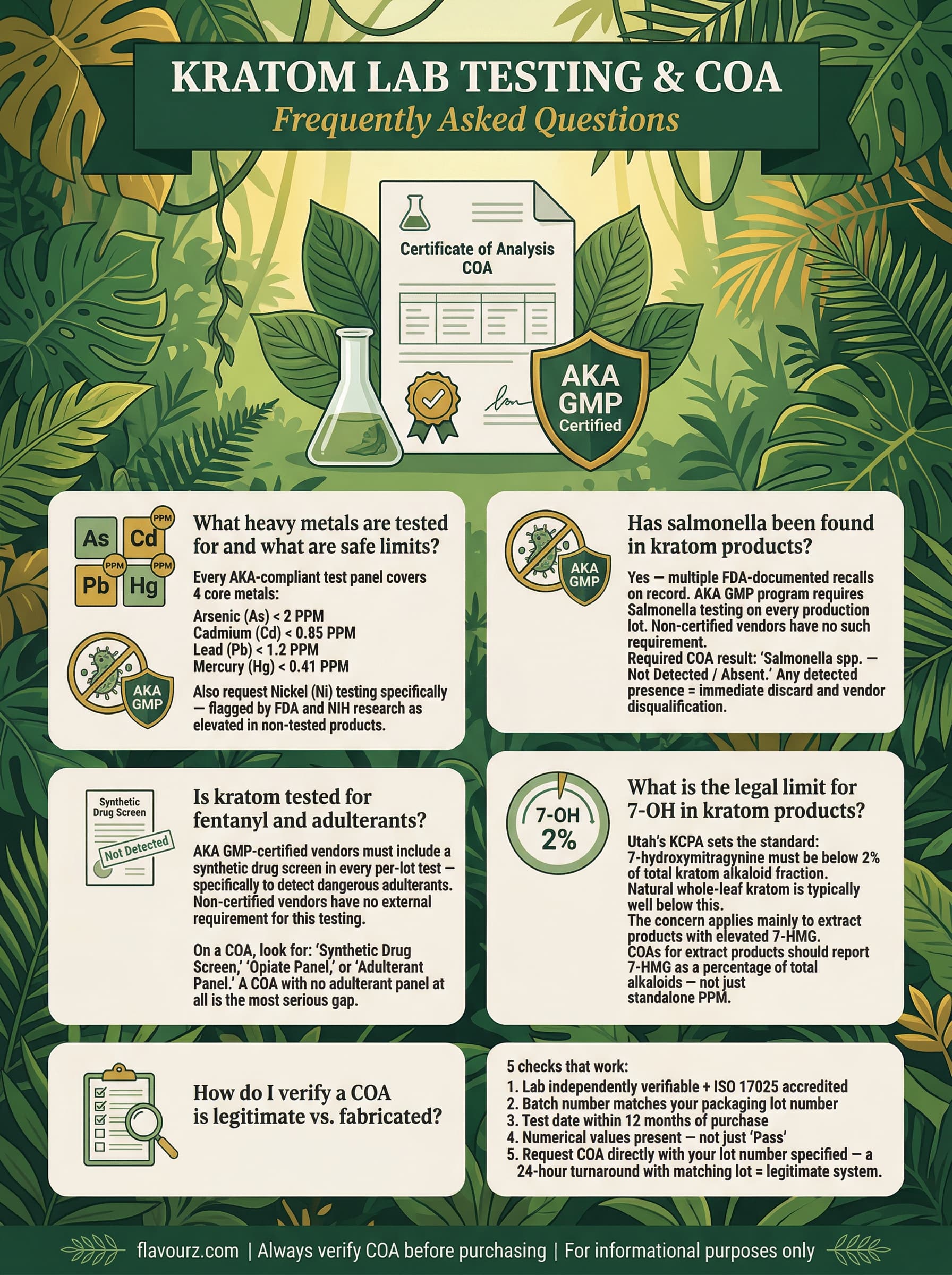
What heavy metals are tested for in kratom, and what are the safe limits?
Every AKA-compliant kratom test panel covers four core heavy metals with the following consensus safe limits: Arsenic (As) below 2 PPM, Cadmium (Cd) below 0.85 PPM, Lead (Pb) below 1.2 PPM, and Mercury (Hg) below 0.41 PPM. These limits are consistent across Columbia Laboratories, Murray Brown Labs, Kraken Kratom's published testing standards, OG Botanicals, and The Kratom Company — reflecting their basis in established natural health product heavy metals guidance. A fifth metal, Nickel (Ni), appears in Columbia Laboratories' extended heavy metals Profile K and was specifically flagged by both the FDA's 2019 kratom analysis and a 2020 PMC/NIH peer-reviewed study as occurring at elevated concentrations in non-tested kratom products. Request nickel testing specifically when evaluating a vendor's COA completeness.
Has salmonella been found in kratom products?
Yes — multiple Salmonella-related kratom product recalls have been documented by the FDA. The contamination risk is structurally grounded in kratom's production environment: Indonesian farms in warm humid conditions with proximity to livestock operations create post-harvest Salmonella colonization windows that require GMP-compliant handling and finished-product testing to prevent. The AKA GMP program explicitly requires testing for microorganisms of public health concern — including Salmonella — on every production lot. Non-GMP-certified vendors carry measurably higher Salmonella risk because this testing requirement is absent from their manufacturing obligations. A COA that shows "Salmonella spp. — Not Detected" or "Absent" is the required result; any detected presence is an immediate discard and vendor disqualification.
Is kratom tested for fentanyl adulteration?
AKA GMP-certified vendors are required to include synthetic drug testing in their mandatory per-lot testing protocol — the program was explicitly designed, in the AKA chairman's words, to exclude "vendors who deliberately adulterate kratom products to boost their effect by adding dangerous and sometimes deadly substances like fentanyl or morphine." Non-certified vendors have no external requirement to perform this testing. When reviewing a COA, look for "synthetic drug screen," "opiate panel," or "adulterant panel" — all detected compounds in this category should show "Not Detected." A COA that has no synthetic drug panel at all is the most serious gap in any kratom safety document, because it leaves the most immediately life-threatening contamination risk unverified.
What is the 7-OH legal limit in kratom products?
Utah's state Kratom Consumer Protection Act — one of the most specific regulatory frameworks for kratom in the US — requires that 7-hydroxymitragynine content must be below 2% of the total kratom alkaloid fraction for any product sold in the state. This regulatory threshold reflects concern about 7-HMG's high mu-opioid receptor potency (approximately 13× more potent per milligram than mitragynine). Natural whole-leaf kratom typically contains 7-HMG well below this threshold — the concern applies primarily to extract products or concentrated formulas where 7-HMG may be intentionally elevated. COAs for any extract-based kratom product should report 7-HMG as a percentage of total alkaloids specifically, not just as a standalone PPM number, to allow verification against this regulatory standard.
How do I know if a kratom COA is legitimate vs. fabricated?
Five verification checks reliably distinguish legitimate COAs from fabricated documents. First, the testing laboratory should be independently verifiable — search the lab name to confirm it exists, is accredited (ISO 17025:2017), and lists kratom testing among its services. Columbia Laboratories, ACS Labs, and Murray Brown Labs are confirmed legitimate AKA-compliant facilities. Second, the batch number on the COA should match the lot number on your packaging — a mismatch means the COA doesn't document your product. Third, the test date should be within 12 months of your purchase date. Fourth, numerical values should be present for each tested parameter — fabricated COAs frequently show only "Pass" without detected values, because inventing plausible numerical data across a full multi-panel COA requires significantly more effort than printing a "Pass" table. Fifth, request the COA directly from the vendor with your lot number specified — a vendor that provides a COA matching your lot number within 24 hours has an actual documentation system; a vendor that provides a generic undated document in response to a specific lot number request does not.
Disclaimer: This article is for informational purposes only. Kratom is not FDA-approved and is not intended to diagnose, treat, cure, or prevent any disease or condition. Always consult a qualified healthcare provider before use, especially if you take prescription medications or have existing health conditions. If you believe you have consumed adulterated kratom, contact Poison Control (1-800-222-1222) or emergency services immediately.
Last Updated: April 2026 | Flavourz Kratom has served over 10,000 customers since 1999. Shop our full kratom selection here.

Leave a comment