
Kratom and Alcohol: Safety Risks & What Research Shows
Last Updated: April 2026
Combining kratom and alcohol is not recommended due to significant safety risks. Both substances affect the central nervous system, and research shows that 79% of kratom-associated deaths involved multiple substances, with alcohol being one of the most common co-ingestants. CDC data from 2015-2025 found that kratom exposures involving other substances had a 3x higher ICU admission rate (28.3%) compared to kratom alone (8.6%). If you use kratom, the safest approach is to avoid alcohol entirely on the same day.
After 5 years working with kratom and speaking with over 10,000 customers at Flavourz Kratom since 1999, this is one of the most common questions I get: "Can I have a drink if I'm using kratom?" The answer is more complicated than a simple yes or no, but the research points clearly toward caution.
This guide covers what happens when you combine these substances, what the research actually shows, who's most at risk, and harm reduction strategies for those who need them. I'll also address an interesting flip side: emerging research suggesting kratom may actually help some people reduce their alcohol consumption.
Why Kratom and Alcohol Is a Risky Combination
The core problem is straightforward: both kratom and alcohol depress the central nervous system at higher doses. When you combine two CNS depressants, their effects don't just add up. They multiply in unpredictable ways.
How Both Substances Work
Kratom: At low doses (1-4g), kratom produces stimulant effects that vary across different varieties, as explored in our indo kratom vs maeng da comparison. At higher doses (5g+), kratom's active alkaloids, primarily mitragynine and 7-hydroxymitragynine, act on opioid receptors. This produces sedation, relaxation, and pain relief similar to opioids.
Alcohol: Alcohol is a CNS depressant at all doses. It impairs coordination, slows breathing, reduces judgment, and produces sedation. These effects increase with the amount consumed.
The combination: When you take higher-dose kratom with alcohol, you're stacking two depressants. This can amplify sedation, impair breathing, reduce coordination dramatically, and overwhelm your liver's ability to process both substances.
The Additive CNS Depression Problem
Your central nervous system controls essential functions: breathing, heart rate, consciousness, coordination. Both kratom and alcohol slow these functions down.
When combined:
- Respiratory depression: Breathing can become dangerously slow or shallow
- Excessive sedation: You may lose consciousness unexpectedly
- Impaired coordination: Fall risk increases significantly
- Reduced gag reflex: Choking risk if vomiting occurs
- Cognitive impairment: Judgment and decision-making are compromised
Research confirms this pattern. A 2024 analysis published in Frontiers in Pharmacology noted that "kratom use with alcohol, opioids, benzodiazepines, stimulants, and antidepressants might increase risk through additive pharmacodynamic effects on central nervous system pathways."
What the Research Actually Shows
Let's look at what the data tells us about kratom and alcohol together.
CDC Poison Center Data (2015-2025)
The most recent CDC analysis, published in March 2025, examined 14,449 kratom-related exposure reports to U.S. poison centers. Key findings:
| Metric | Kratom Alone | With Other Substances |
|---|---|---|
| Percentage of cases | 62% | 38% |
| ICU admission rate | 8.6% | 28.3% |
| Hospitalization rate | ~25% | ~50% |
| Serious medical outcomes (2025) | Lower | 60% |
| Percentage of deaths | 21% | 79% |
The pattern is clear. When kratom is combined with other substances, outcomes are significantly worse. Ethanol (alcohol) was specifically identified as "among the most common co-ingestants" in kratom-related exposures.
Polysubstance Death Data
A CDC analysis of overdose deaths from July 2016 to December 2017 found:
- 152 deaths tested positive for kratom
- 91 (60%) had kratom listed as a cause of death
- Only 7 deaths involved kratom alone
- The remaining 84 deaths (92%) involved multiple substances
- Common co-substances: fentanyl, heroin, benzodiazepines, and alcohol
A 2019 analysis reported that about 35% of kratom-related poison center calls involved multiple substances, with ethanol among the most frequent co-ingestants alongside benzodiazepines, opioids, and acetaminophen.
ICU Admission Rates
Research examining Georgia and Alabama poison center calls found that kratom exposures with any co-ingested substance had more than 3x the ICU admission rate compared to kratom alone: 28.3% versus 8.6%.
This data doesn't prove that alcohol specifically caused these outcomes, but it demonstrates that combining kratom with other substances, including alcohol, significantly increases the risk of serious medical consequences.
Specific Risks of Mixing Kratom and Alcohol
Based on the pharmacology and available research, here are the specific risks when combining these substances.
Risk #1: Respiratory Depression
At higher doses, kratom's opioid-like activity can slow breathing. Alcohol also depresses respiratory function. Combined, the risk of dangerously slowed or stopped breathing increases significantly.
This is the most serious acute risk. Research published in Frontiers in Pharmacology notes that kratom's partial opioid receptor activity normally confers "less overdose risk" than full opioids, but "that margin disappears when alcohol enters the equation."
Risk #2: Excessive Sedation
Both substances cause drowsiness at higher doses. Together, sedation can become overwhelming, potentially leading to:
- Loss of consciousness
- Inability to wake if breathing problems occur
- Aspiration risk if vomiting
- Falls and injuries
Risk #3: Liver Strain
Both kratom and alcohol are metabolized by the liver through cytochrome P450 enzymes (particularly CYP2D6 and CYP3A4). When you combine them, your liver works harder to process both substances simultaneously.
Notably, a study from the Drug-Induced Liver Injury Network (DILIN) examined 7 cases of kratom-associated liver injury. All 7 patients reported alcohol use. While this doesn't prove alcohol caused the liver problems, it suggests the combination may increase hepatotoxicity risk.
For more context on kratom and liver health, see our detailed analysis: Kratom & Liver Health: 8 Medical Studies You Need to Know.
Risk #4: Impaired Coordination and Judgment
Both substances impair motor function and cognitive judgment. Combined, these effects intensify, increasing risks of:
- Accidents and falls
- Driving impairment (never drive after using either substance)
- Poor decision-making
- Taking more of either substance than intended
Risk #5: Unpredictable Interactions
Because kratom products aren't standardized, alkaloid content varies widely between products and batches. This variability makes it nearly impossible to predict how any individual dose will interact with alcohol.
Research notes: "The unpredictability of kratom products, which vary widely in mitragynine and 7-hydroxymitragynine content, makes it nearly impossible to calculate a safe drinking interval."
Who Is Most at Risk?
Some individuals face higher risks when combining kratom and alcohol:
- People with liver conditions: Pre-existing liver problems increase vulnerability to hepatotoxicity from both substances
- Those taking other medications: Additional drug interactions compound risks
- Individuals with respiratory conditions: Any respiratory compromise increases danger
- People with low tolerance: Those new to either substance may have stronger reactions
- Older adults: Age-related metabolism changes increase sensitivity
- Those using high doses of either: Higher doses mean higher risks
This combination is discussed in our comprehensive guide: Kratom Drug Interactions: 15 Combinations to Avoid.
How Long Should You Wait Between Kratom and Alcohol?
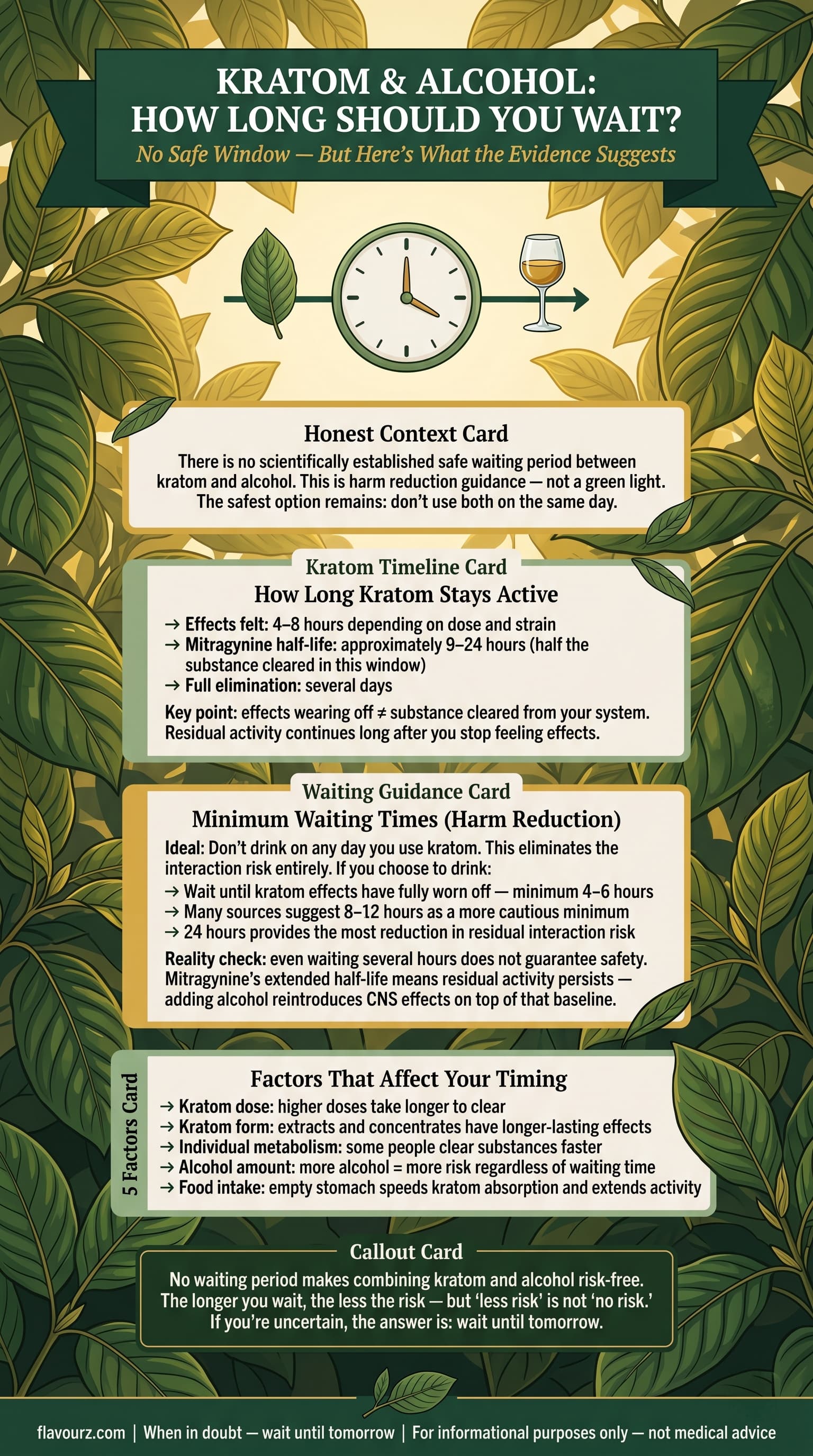
There's no scientifically established "safe" waiting period. That said, here's what we know:
Kratom's Duration in Your System
- Effects: Last 4-8 hours depending on dose and strain
- Mitragynine half-life: Approximately 24 hours (meaning half the substance is eliminated in 24 hours)
- Complete clearance: Several days for full elimination
Minimum Waiting Times (Harm Reduction)
Ideally: Don't drink alcohol on days you use kratom. This eliminates the interaction risk entirely.
If you choose to drink: Wait at least several hours after kratom's effects have fully worn off. Some sources suggest waiting 24 hours to minimize risk, given mitragynine's extended half-life.
The reality: Even waiting several hours doesn't guarantee safety. Mitragynine's long half-life means residual effects persist, and adding alcohol reintroduces CNS depression on top of that baseline.
Factors That Affect Timing
- Kratom dose: Higher doses take longer to clear
- Kratom form: Extracts and concentrates may have longer-lasting effects
- Individual metabolism: Some people metabolize substances faster
- Alcohol amount: More alcohol means more risk
- Food intake: Taking kratom on an empty stomach speeds absorption
Warning Signs of a Dangerous Reaction
If you or someone you know has combined kratom and alcohol, watch for these warning signs:
Seek Emergency Help Immediately If You Notice:
- Extremely slow or irregular breathing
- Blue-tinged lips or fingernails
- Loss of consciousness or inability to wake someone
- Severe confusion or disorientation
- Seizures
- Vomiting while unconscious
- Slow or irregular heartbeat
Other Concerning Symptoms:
- Excessive drowsiness beyond normal effects
- Severe dizziness
- Nausea and vomiting
- Memory blackouts
- Extreme difficulty walking or standing
- Slurred speech worse than expected
If someone is unconscious after combining kratom and alcohol, call 911 immediately. Position them on their side to reduce aspiration risk if they vomit. Naloxone (Narcan) may partially reverse kratom's opioid effects and has been used successfully in some kratom-related emergencies, though evidence is limited.
The Flip Side: Kratom for Reducing Alcohol Consumption
Here's where the research gets interesting. While combining kratom and alcohol acutely is dangerous, some research suggests kratom may help people reduce their overall alcohol consumption.
Survey Data on Kratom and Alcohol Reduction
A 2019 survey of 3,024 kratom users found that 18% reported using kratom specifically "to cut down or quit using alcohol." This pattern has been documented in both U.S. and Southeast Asian kratom users.
Malaysian Study on Alcohol Substitution
A 2025 study published in Substance Use & Misuse examined 16 Malaysian adults who used kratom to manage alcohol use problems. Key findings:
- All participants reported significant reduction in alcohol frequency and quantity
- Cessation from alcohol typically occurred within 1-3 months
- Kratom was used as a direct substitute for alcohol
- Participants reported reduced alcohol cravings
The researchers concluded: "Our findings highlight that kratom was being consumed as a substitute for alcohol and suggests its potential utility to reduce or cease alcohol consumption."
Animal Research
Multiple animal studies have found that kratom alkaloids, particularly through delta-opioid receptor activity, can decrease voluntary alcohol consumption in mice. A 2021 study in Frontiers in Pharmacology noted that mitragynine and related alkaloids "decrease alcohol consumption in mice."
A 2026 study found that combining mitragynine with naltrexone (an FDA-approved medication for alcohol use disorder) reduced alcohol consumption in rats more than either substance alone.
Important Caveats
This research is preliminary. It does not mean you should combine kratom and alcohol simultaneously. The potential benefit is using kratom as a substitute for alcohol, not mixing them together.
If you're struggling with alcohol use, speak with a healthcare provider about evidence-based treatment options. Kratom is not FDA-approved for treating alcohol use disorder.
Harm Reduction Guidelines
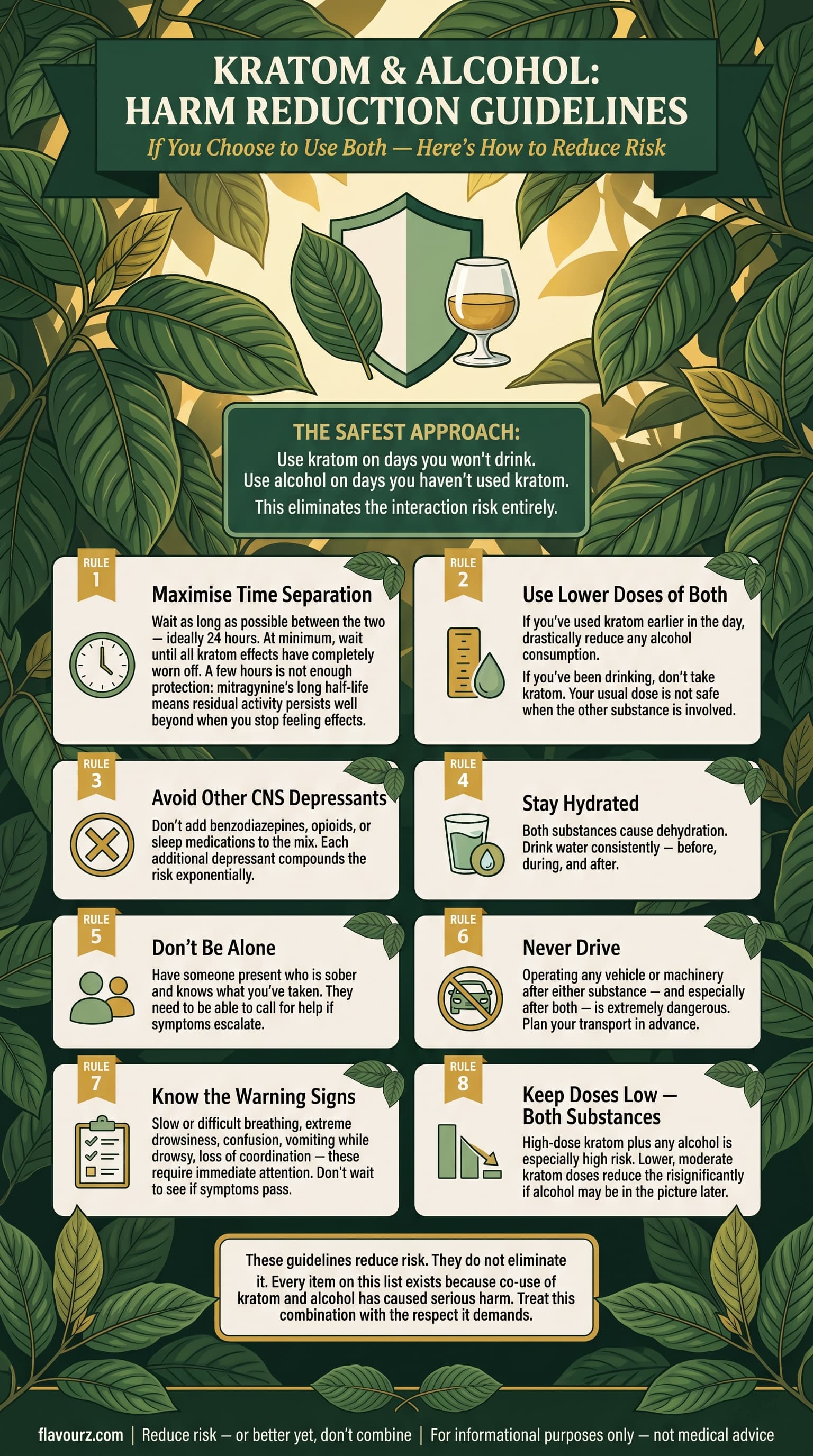
If you use kratom and are considering alcohol, or vice versa, these strategies can reduce risk:
The Safest Approach
Don't combine them. Period. Use kratom on days you won't drink alcohol, and vice versa. This eliminates the interaction risk entirely.
If You Choose to Use Both (High Risk)
- Maximize time separation: Wait as long as possible. Ideally 24 hours. At minimum, wait until all kratom effects have worn off completely (several hours after your last dose).
- Use lower doses of both: If you've taken kratom earlier in the day, drastically reduce alcohol consumption. If you've been drinking, don't take kratom.
- Never combine high doses: High-dose kratom plus alcohol is especially dangerous.
- Stay hydrated: Both substances can cause dehydration.
- Don't be alone: Have someone present who can call for help if needed.
- Know the warning signs: Review the emergency symptoms listed above.
- Never drive: Operating vehicles or machinery is extremely dangerous after using either substance, and especially after both.
- Avoid other CNS depressants: Don't add benzodiazepines, opioids, or sleep medications to the mix.
Dosage Considerations
For those who use kratom regularly, following proper kratom dosage guidelines becomes even more important if alcohol might be in the picture. Lower, more moderate doses reduce the risk profile.
How Kratom and Alcohol Compare
Some people ask whether kratom is "safer" than alcohol. While that's not the focus of this article, here's some context:
| Factor | Kratom | Alcohol |
|---|---|---|
| Annual U.S. deaths | ~100 (most involve other substances) | ~178,000 |
| Liver damage risk | Rare cases reported | Well-established with chronic use |
| Addiction potential | Yes (opioid-like dependence possible) | Yes (alcohol use disorder common) |
| Withdrawal severity | Generally mild to moderate | Can be life-threatening |
| Respiratory depression | Possible at high doses | Possible at high doses |
| Regulatory status | Legal in most states, unregulated | Legal, regulated |
Neither substance is without risk. Both can cause dependence. Combining them amplifies the dangers of each.
Frequently Asked Questions
Can you mix kratom and alcohol?
No, mixing kratom and alcohol is not recommended. Both are CNS depressants at higher doses, and combining them increases risks of respiratory depression, excessive sedation, liver strain, and serious medical outcomes. CDC data shows kratom exposures involving other substances have 3x higher ICU admission rates. The safest approach is to avoid alcohol on days you use kratom.
How long should you wait between kratom and alcohol?
There's no proven safe waiting period. Kratom effects last 4-8 hours, but mitragynine's half-life is approximately 24 hours. Ideally, don't drink alcohol on days you use kratom. If you must, wait at least several hours after all kratom effects have worn off. Some harm reduction sources suggest waiting 24 hours minimum.
What happens if you drink alcohol with kratom?
Combining kratom and alcohol can cause excessive drowsiness, respiratory depression, severe dizziness, impaired coordination, nausea, vomiting, and memory blackouts. In serious cases, it can lead to loss of consciousness, breathing problems, or medical emergencies. Effects are unpredictable and depend on doses of both substances.
Does kratom help reduce alcohol cravings?
Some research suggests kratom may help reduce alcohol cravings and consumption. A survey found 18% of kratom users reported using it to cut down on alcohol. A 2025 Malaysian study found kratom helped participants reduce or stop alcohol use within 1-3 months. This is not the same as mixing them. Using kratom instead of alcohol (not with alcohol) may have potential benefits under research.
Is kratom safer than alcohol?
Both substances carry risks. Alcohol causes approximately 178,000 U.S. deaths annually versus roughly 100 for kratom (most involving other substances). Alcohol's liver damage, addiction potential, and withdrawal risks are well-documented. Kratom can cause dependence and rare liver issues. Neither is completely safe, and combining them is particularly risky.
Can kratom damage your liver like alcohol?
Kratom-related liver injury has been reported in rare cases. The DILIN study identified 7 cases over several years, with symptoms appearing after about 20 days of use. All patients recovered. Notably, all 7 also used alcohol. Combining kratom and alcohol may increase liver strain since both are metabolized by the same liver enzymes.
What are the signs of kratom and alcohol overdose?
Emergency signs include extremely slow breathing, blue-tinged lips or fingernails, loss of consciousness, severe confusion, seizures, and vomiting while unconscious. Other concerning symptoms: excessive drowsiness, severe dizziness, memory blackouts, and inability to walk. Call 911 immediately if someone is unconscious after combining these substances.
Can naloxone (Narcan) help in a kratom-alcohol emergency?
Naloxone may partially reverse kratom's opioid effects since kratom alkaloids are partial opioid receptor agonists. It has been used successfully in some kratom-related emergencies. In a combined kratom-alcohol situation, naloxone might help with kratom's contribution but won't address alcohol's effects. Call 911 regardless.
The Bottom Line
The research is clear: combining kratom and alcohol increases risk significantly. CDC data shows that 79% of kratom-associated deaths involved multiple substances, and polysubstance use with kratom leads to 3x higher ICU admission rates.
Here's what I tell customers at Flavourz Kratom:
- Don't mix them. Use kratom on days you won't drink, and vice versa.
- If you must use both, wait as long as possible between them (ideally 24 hours), use lower doses, and never combine high doses of either.
- Know the warning signs of respiratory depression and excessive sedation.
- If you're using kratom to reduce alcohol consumption, that's a different situation than mixing them. Some research supports this approach, but consult a healthcare provider.
For those interested in exploring kratom safely, start with our beginner's guide and browse our kratom powder selection. We've been serving customers since 1999, and safety has always been our priority.
Disclaimer: This information is for educational purposes only and is not medical advice. These statements have not been evaluated by the FDA. Kratom is not intended to diagnose, treat, cure, or prevent any disease. If you struggle with alcohol use, speak with a healthcare provider about evidence-based treatment options. If you're in a medical emergency, call 911 immediately. Must be 21+ to purchase. Not available in all states.

Leave a comment