


Kratom Detection Timeline: 7 Factors Affecting Your System

Last Updated: April 2026
Kratom stays in your system for approximately 5-7 days for most users, with mitragynine having a half-life of roughly 23-24 hours based on human pharmacokinetic studies. Standard drug tests (5-panel, 10-panel, 12-panel) do not screen for kratom. Only specialized tests can detect mitragynine and 7-hydroxymitragynine. Detection times vary significantly based on 7 key factors: dose, frequency of use, metabolism, body fat percentage, age, liver function, and hydration levels.
After 5 years working with kratom and helping over 10,000 customers at Flavourz Kratom since 1999, including many who rely on our premium kratom capsules for pain and have questions about detection times, I get these questions regularly. Whether you're concerned about workplace screening, a legal situation, or just want to understand how kratom moves through your body, this guide covers everything you need to know.
I'll break down the actual science, including human pharmacokinetic data, explain the 7 factors that determine how long kratom stays in your system, and clarify what types of tests can actually detect it. Understanding how different strains like red kali kratom process through your system can help you make informed decisions about timing and usage, particularly when it comes to red kali kratom effects.
What Is Kratom's Half-Life?
The half-life of a substance tells you how long it takes for your body to eliminate half of it. For kratom, the primary alkaloid mitragynine has a half-life of approximately 23-24 hours in humans.
The Key Human Study
The landmark pharmacokinetic study was published in 2015 by Trakulsrichai and colleagues. They studied 10 chronic kratom users and found:
- Time to peak concentration: 0.83 hours (about 50 minutes)
- Terminal half-life: 23.24 hours (±16.07 hours)
- Volume of distribution: 38.04 L/kg (indicating extensive tissue distribution)
- Urine excretion of unchanged drug: Only 0.14%
This means that 24 hours after your last dose, roughly half the mitragynine remains in your system. After 48 hours, about 25% remains. After 72 hours, about 12.5%, and so on.
Why Half-Life Varies
The study found significant individual variation, with half-lives ranging from about 7 to 39 hours. This variation explains why some people clear kratom faster than others.
For more detailed information on duration by strain, see our complete guide: Kratom Half-Life: Duration Times for 10 Popular Strains.
Detection Windows by Test Type
Different drug tests have different detection windows. Here's what the research shows:
| Test Type | Detection Window | Common Use |
|---|---|---|
| Urine (occasional user) | 3-5 days | Most common test type |
| Urine (regular user) | 5-7 days | Specialized panels only |
| Urine (heavy/chronic user) | 7-14 days | Extended detection possible |
| Blood | 24-48 hours | Confirms recent use |
| Saliva | 24-48 hours | Rarely used for kratom |
| Hair follicle | Up to 90 days | Forensic/legal settings |
Important Note About Standard Drug Tests
Standard workplace drug tests (5-panel, 10-panel, even 12-panel) do NOT screen for kratom. These tests look for marijuana, cocaine, amphetamines, opioids, PCP, and sometimes benzodiazepines or barbiturates.
Kratom's alkaloids (mitragynine and 7-hydroxymitragynine) are chemically distinct from traditional opioids and are not included in standard panels. Only specialized tests that specifically target kratom alkaloids can detect them.
The 7 Factors That Affect Kratom Detection Time
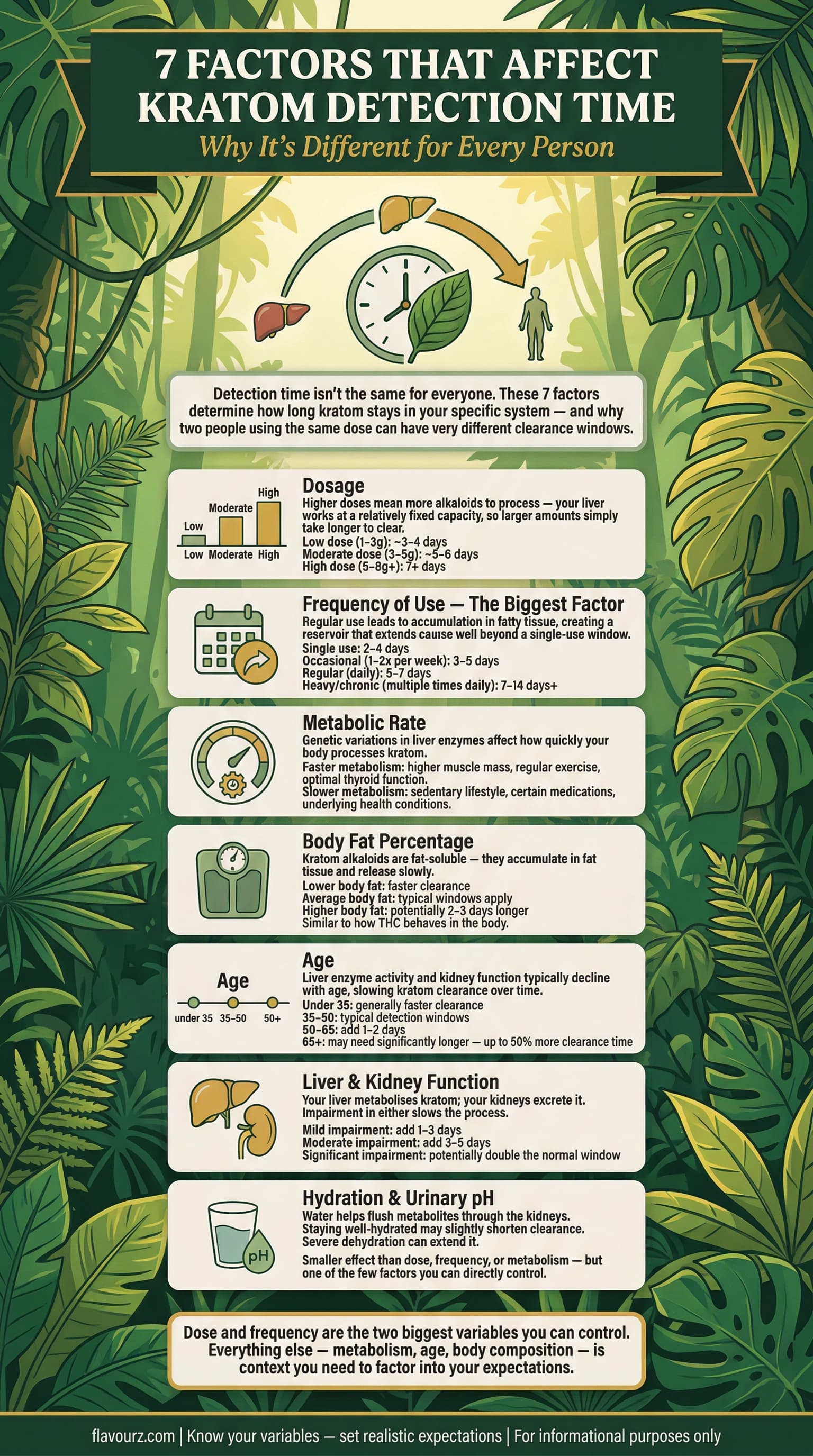
Detection time isn't the same for everyone. These 7 factors determine how long kratom stays in your specific system:
Factor #1: Dosage
Higher doses mean more alkaloids to eliminate, which extends detection time.
How it works: Your body can only metabolize kratom at a certain rate. When you take larger doses, there's simply more mitragynine to process. The liver's CYP enzymes work at a relatively fixed capacity, so higher doses create a backlog.
The difference:
- Low dose (1-3g): May clear in 3-4 days
- Moderate dose (3-5g): Typically 5-6 days
- High dose (5-8g+): May take 7+ days
For proper dosing guidance, see our kratom dosage recommendations.
Factor #2: Frequency of Use
This is the single biggest factor affecting detection time. Regular use leads to accumulation.
How it works: With repeated dosing, your body can't fully clear one dose before the next arrives. Mitragynine accumulates in fatty tissue, creating a reservoir that takes longer to deplete.
The difference:
- Single use: 2-4 days detection window
- Occasional use (1-2x/week): 3-5 days
- Regular use (daily): 5-7 days
- Heavy/chronic use (multiple times daily): 7-14 days or longer
Case reports document kratom detection in urine up to approximately 2 weeks after last use in heavy, long-term users.
Factor #3: Metabolic Rate
Your metabolism determines how quickly your body processes and eliminates substances.
How it works: Kratom is metabolized primarily by cytochrome P450 enzymes in the liver, specifically CYP3A4 and CYP2D6. Genetic variations in these enzymes affect how quickly you process kratom.
Faster metabolism factors:
- Higher muscle mass
- Regular physical activity
- Adequate thyroid function
- Genetic variations favoring enzyme activity
Slower metabolism factors:
- Sedentary lifestyle
- Certain medications that inhibit CYP enzymes
- Genetic variations reducing enzyme activity
- Underlying health conditions
Medications that affect kratom metabolism are covered in our guide: Kratom Drug Interactions: 15 Combinations to Avoid.
Factor #4: Body Fat Percentage
Kratom alkaloids are fat-soluble, meaning they accumulate in adipose (fat) tissue.
How it works: Fat-soluble substances get stored in fat cells and are released slowly over time. People with higher body fat percentages have more storage capacity for mitragynine, leading to longer detection windows.
The difference:
- Lower body fat (under 15% men, under 20% women): Faster clearance
- Average body fat: Typical detection windows apply
- Higher body fat: Extended detection, potentially 2-3 days longer
This is similar to how THC (also fat-soluble) can be detected longer in people with higher body fat.
Factor #5: Age
Age affects multiple aspects of kratom metabolism and elimination.
How it works: As you age, liver enzyme activity typically decreases, kidney function declines, and body composition changes (often more fat, less muscle). All these factors slow kratom clearance.
The difference:
- Under 35: Generally faster metabolism and clearance
- 35-50: Moderate, typical detection windows
- Over 50: Potentially slower clearance, add 1-2 days
- Over 65: Significantly slower, may need 50% longer clearance time
The NIH StatPearls resource notes that older individuals metabolize kratom more slowly due to reduced renal activity.
Factor #6: Liver and Kidney Function
Your liver processes kratom, and your kidneys eliminate it. Impairment in either organ extends detection time.
How it works:
- Liver: Kratom undergoes first-pass metabolism in the liver via CYP3A4 and CYP2D6 enzymes. These enzymes convert mitragynine into metabolites, including 7-hydroxymitragynine. Liver disease or damage reduces this capacity.
- Kidneys: After metabolism, kratom metabolites are primarily excreted through urine. Kidney impairment slows this excretion.
Impact of impairment:
- Mild liver/kidney issues: May add 1-3 days to detection window
- Moderate impairment: May add 3-5 days
- Severe liver/kidney disease: Significantly extended, potentially double normal detection time
For more on how kratom interacts with the liver, see: Kratom & Liver Health: 8 Medical Studies.
Factor #7: Hydration and pH
Your hydration level and urinary pH affect how quickly kratom metabolites are excreted.
How it works:
- Hydration: Water helps flush metabolites through the kidneys. Better hydration means more efficient excretion.
- Urinary pH: The acidity of your urine can affect reabsorption of kratom alkaloids. More acidic urine tends to promote faster excretion of alkaline substances like mitragynine.
Practical impact:
- Staying well-hydrated may slightly shorten clearance time
- Severe dehydration can extend detection
- This factor has a smaller effect than dose, frequency, or metabolism
Don't expect hydration alone to dramatically speed up clearance, but it's one of the few factors you can control.
Does Kratom Show Up on Standard Drug Tests?
No. Standard drug tests do not detect kratom. This is one of the most common misconceptions.
What Standard Tests Screen For
5-Panel Test (DOT Standard):
- Marijuana (THC)
- Cocaine
- Amphetamines
- Opioids (morphine, codeine, heroin)
- Phencyclidine (PCP)
10-Panel Test:
- All of the above, plus:
- Benzodiazepines
- Barbiturates
- Methadone
- Propoxyphene
- Quaaludes
12-Panel Test:
- All of the above, plus:
- Extended opioids (oxycodone, hydrocodone)
- Ecstasy (MDMA)
None of these include kratom. Mitragynine and 7-hydroxymitragynine are not part of any standard panel.
When Kratom IS Tested For
Specialized kratom testing requires explicit ordering and additional cost. It's typically used in:
- Pain management clinics with strict protocols
- Forensic toxicology investigations
- Certain military or federal contractor positions
- Child custody or family court cases
- Some addiction treatment programs
These specialized tests use liquid chromatography-mass spectrometry (LC-MS/MS) to specifically identify mitragynine and 7-hydroxymitragynine. Labs like Labcorp screen at 5 ng/mL and confirm at 1 ng/mL.
Can Kratom Cause a False Positive?
In rare cases, kratom has caused false positives for methadone on immunoassay tests. This is uncommon, and confirmatory testing (GC-MS or LC-MS/MS) will correctly identify kratom and rule out actual opioids.
Why false positives happen: Kratom alkaloids interact with opioid receptors similarly to some opioids. Some immunoassay tests may show cross-reactivity, though this is rare with modern testing methods.
What to do if it happens: Request a confirmatory test using mass spectrometry. This will definitively show kratom alkaloids (not opioids) and clear the false positive.
A bigger concern: Product contamination. Some kratom products have been found adulterated with pharmaceutical opioids, synthetic cannabinoids, or other substances. Using contaminated products can cause true positive results for these substances. This is why buying from reputable, tested sources matters.
Kratom Metabolism: How Your Body Processes It
Understanding kratom metabolism helps explain why detection times vary.
Step 1: Absorption
After you take kratom (typically as powder or capsules), it's absorbed through the gastrointestinal tract. Peak blood levels occur around 50-60 minutes after ingestion.
Step 2: Distribution
Kratom has a high volume of distribution (38 L/kg), meaning it spreads extensively into tissues, including fat. This is why it takes time to fully clear, even after blood levels drop.
Step 3: Metabolism
The liver metabolizes kratom via CYP450 enzymes:
- CYP3A4: Primary enzyme responsible for mitragynine metabolism
- CYP2D6: Secondary contribution
- CYP2C9/CYP2C19: Minor contributions
Mitragynine is converted into several metabolites, including 7-hydroxymitragynine (the more potent alkaloid). This is why effects can shift over time after dosing.
For more on kratom's alkaloid profile, see: Kratom's Active Compounds: A Scientific Analysis.
Step 4: Elimination
Kratom metabolites are primarily excreted in urine. Only about 0.14% of mitragynine is excreted unchanged; the rest leaves as metabolites. This is why urine tests look for metabolites, not just mitragynine itself.
Detection Timeline Calculator
Use this general timeline to estimate how long kratom might stay in your system:
| User Type | Urine | Blood | Hair |
|---|---|---|---|
| Single use, low dose | 2-3 days | 12-24 hours | Unlikely detected |
| Occasional user (1-2x/week) | 3-5 days | 24-48 hours | Up to 90 days |
| Regular user (daily) | 5-7 days | 24-48 hours | Up to 90 days |
| Heavy user (multiple times/day) | 7-14 days | 48+ hours | Up to 90 days |
Add 1-3 days if you have:
- Higher body fat percentage
- Age over 50
- Liver or kidney impairment
- Slow metabolism
Can You Speed Up Kratom Clearance?
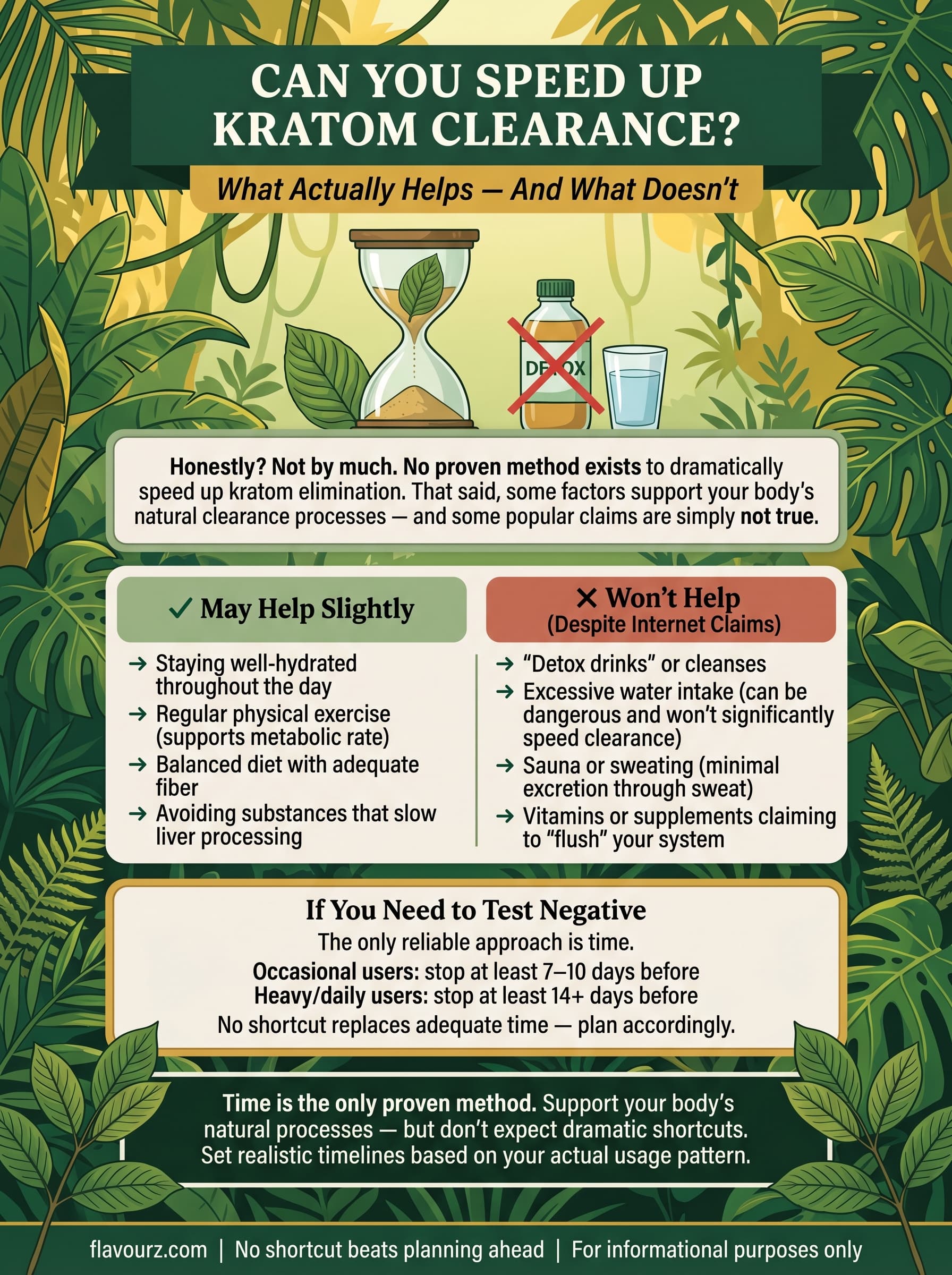
Honestly? Not by much. No proven method exists to dramatically speed up kratom elimination. That said, these factors support your body's natural clearance processes:
May help slightly:
- Staying well-hydrated
- Regular physical exercise (increases metabolism)
- Eating a balanced diet with adequate fiber
- Avoiding substances that slow liver metabolism
Won't help (despite internet claims):
- "Detox drinks" or cleanses
- Excessive water intake (can be dangerous and won't significantly speed clearance)
- Sauna or sweating (minimal excretion through sweat)
- Vitamins or supplements claiming to "flush" your system
The only reliable way to test negative is time. If you need to pass a kratom-specific test, the safest approach is to stop using kratom at least 7-10 days before (for occasional users) or 14+ days (for heavy users).
Frequently Asked Questions
How long does kratom stay in your system?
Kratom stays in your system for approximately 5-7 days for most users. Mitragynine has a half-life of about 23-24 hours based on human studies. Occasional users may clear it in 3-5 days, while heavy or chronic users may test positive for 7-14 days. Detection time depends on dose, frequency, metabolism, body fat, age, and liver/kidney function.
Does kratom show up on a drug test?
No, kratom does not show up on standard drug tests. The common 5-panel, 10-panel, and 12-panel tests do not screen for kratom. Mitragynine and 7-hydroxymitragynine are not included in standard panels. Only specialized tests that specifically target kratom alkaloids can detect them, and these must be explicitly ordered.
How long is kratom detectable in urine?
Kratom is detectable in urine for 5-7 days in typical users. Occasional users (1-2 times per week) may clear it in 3-5 days. Daily users typically need 5-7 days. Heavy users taking multiple doses daily may test positive for 7-14 days. Standard urine tests don't detect kratom; specialized tests are required.
Can kratom cause a false positive for opioids?
In rare cases, kratom has caused false positives for methadone on some immunoassay tests due to cross-reactivity. This is uncommon. Confirmatory testing using GC-MS or LC-MS/MS will correctly identify kratom alkaloids and rule out actual opioids. If you get a false positive, request confirmatory testing.
What factors affect how long kratom stays in your system?
Seven main factors affect kratom detection time: dosage (higher = longer), frequency of use (more frequent = longer), metabolic rate (slower = longer), body fat percentage (higher = longer), age (older = longer), liver/kidney function (impaired = longer), and hydration levels (dehydrated = slightly longer). Frequency of use has the biggest impact.
Does kratom show up on a 10-panel drug test?
No. A standard 10-panel drug test does not detect kratom. It screens for marijuana, cocaine, amphetamines, opioids, PCP, benzodiazepines, barbiturates, methadone, propoxyphene, and quaaludes. Kratom alkaloids are not included. You would need a specialized kratom-specific test to detect mitragynine and 7-hydroxymitragynine.
What is kratom's half-life?
Mitragynine, kratom's primary alkaloid, has a half-life of approximately 23-24 hours based on human pharmacokinetic studies. This means half the substance is eliminated in about one day. Complete elimination takes 5-7 half-lives, or roughly 5-7 days. Individual variation is significant, with half-lives ranging from 7-39 hours in some studies.
How long should I stop kratom before a drug test?
For standard drug tests (5-panel, 10-panel), you don't need to stop since they don't detect kratom. For specialized kratom tests: occasional users should stop 7-10 days before. Regular daily users should stop 10-14 days before. Heavy users should stop 14+ days before. These are conservative estimates to ensure clearance below detection thresholds.
The Bottom Line
Understanding kratom detection comes down to a few key points:
- Standard drug tests don't detect kratom. You'll only test positive if a specialized kratom-specific test is ordered.
- Mitragynine half-life is about 24 hours. This means it takes roughly 5-7 days for complete clearance in most users.
- Seven factors affect your personal timeline: dose, frequency, metabolism, body fat, age, liver/kidney function, and hydration.
- Frequency matters most. Daily users take longer to clear kratom than occasional users.
- No quick fixes exist. Time is the only reliable way to clear kratom from your system.
If you're new to kratom and want to understand more about safe usage, check out our beginner's guide to kratom. And when you're ready to explore quality kratom products, browse our kratom powder collection from Flavourz Kratom, serving customers since 1999.
Disclaimer: This information is for educational purposes only and is not medical or legal advice. These statements have not been evaluated by the FDA. Kratom is not intended to diagnose, treat, cure, or prevent any disease. Detection times vary significantly between individuals. This guide should not be used to evade legitimate drug testing. Must be 21+ to purchase. Not available in all states.

Leave a comment