

Kratom for ADHD: Benefits, Best Strains & Dosage Guide 2026
Last Updated: April 2026
Kratom is not an FDA-approved treatment for ADHD. However, some individuals with ADHD report using kratom to support focus and concentration, with survey data showing 60.3% of kratom users with ADHD/ADD reported "significant improvement" in their symptoms. White and green vein strains at low doses (1-3 grams) are most commonly used for these purposes. Understanding red vs green kratom differences helps ADHD users select strains that best support their focus and concentration goals. This guide covers what users report, the science behind why it might help, best strains, dosing, and critical safety considerations.
Important disclaimer upfront: Kratom cannot cure ADHD, is not a substitute for professional medical treatment, and should never replace prescribed ADHD medications without consulting your doctor. What follows is educational information based on user reports and available research, not medical advice.
What Is ADHD and Why Are People Looking for Alternatives?
Attention Deficit Hyperactivity Disorder (ADHD) is a neurodevelopmental condition affecting approximately 8.4% of children and 2.5% of adults worldwide. It's characterized by difficulty with focus, impulse control, and hyperactivity that interferes with daily functioning.
Standard ADHD Treatments
Conventional ADHD medications fall into two categories:
- Stimulants: Medications like Adderall (amphetamine) and Ritalin (methylphenidate) work by increasing dopamine and norepinephrine in the brain. They're effective for many people but can cause side effects like appetite suppression, insomnia, anxiety, and cardiovascular effects.
- Non-stimulants: Medications like Strattera (atomoxetine) offer alternatives for those who don't respond well to stimulants. They generally have fewer side effects but may be less effective.
Why Some People Explore Kratom
Based on conversations with customers who order kratom online at Flavourz Kratom over 25+ years, people explore kratom for ADHD-related concerns for several reasons:
- Side effects from prescription medications
- Difficulty accessing or affording healthcare
- Preference for botanical options
- Looking for something to use occasionally, not daily
- Seeking support for focus without a formal diagnosis
None of these reasons make kratom a medical treatment. But they explain why interest exists.
What Does the Research Say About Kratom and ADHD?
Let me be direct: there are no clinical trials studying kratom as an ADHD treatment. What we have are surveys of kratom users and scientific understanding of how kratom affects the brain.
Survey Data on Kratom Users with ADHD
A cross-sectional survey published in the journal Experimental and Clinical Psychopharmacology (Grundmann et al., 2023) examined kratom use patterns among people with various health conditions:
- 60.3% of kratom users with diagnosed ADHD/ADD reported "significant improvement" in their symptoms
- Kratom was used to "increase energy or focus" and to self-treat ADHD symptoms
- Users with ADHD were more likely to also use cannabis and had higher rates of benzodiazepine use
This is self-reported data, not a controlled study. It tells us some people believe kratom helps them, not that it objectively does.
How Kratom Affects the Brain
According to the FDA and published research, kratom's alkaloids affect multiple receptor systems relevant to attention and focus:
| Receptor System | Kratom's Effect | Relevance to ADHD |
|---|---|---|
| Dopamine (D2) | Partial agonist activity | Dopamine dysregulation is central to ADHD |
| Norepinephrine (Adrenergic) | Alpha-2 receptor activity | Norepinephrine affects alertness and attention |
| Serotonin (5-HT) | 5-HT2C and 5-HT7 activity | Serotonin affects mood and impulse control |
| Opioid (Mu) | Partial agonist | May affect motivation and reward |
For a deeper understanding, see our article on kratom's active compounds.
Why Low Doses Matter
Kratom's effects are dose-dependent in a way that's critically important for focus:
- Low doses (1-3 grams): Stimulating, energizing, may enhance focus and alertness
- Moderate doses (3-5 grams): Transitional effects, may start to become more relaxing
- High doses (5+ grams): Sedating, relaxing, counterproductive for focus
If you're seeking focus benefits, staying at lower doses is essential. Higher doses will likely make attention problems worse, not better.
What Users Report About Kratom and ADHD Symptoms
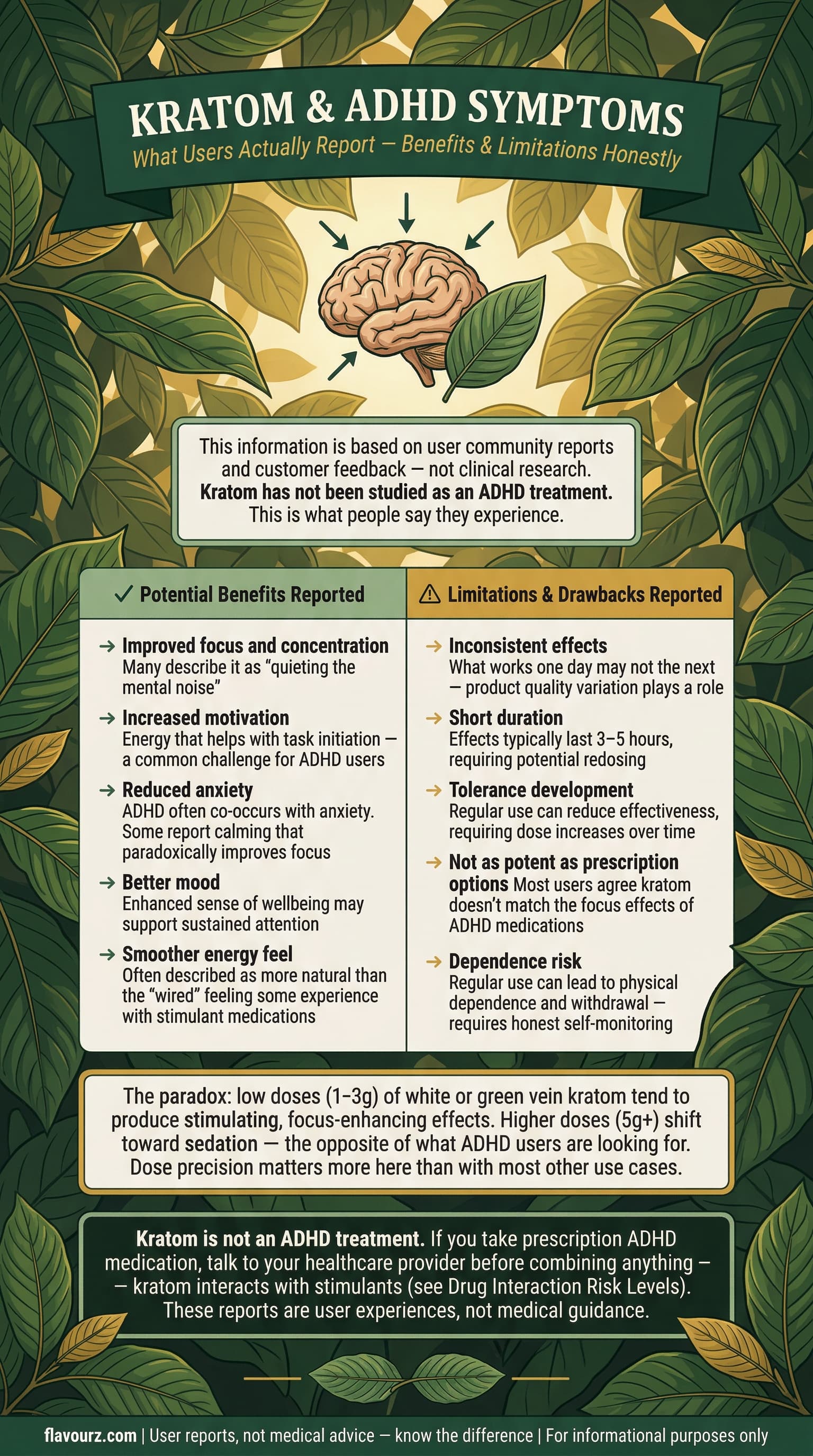
Based on customer feedback at Flavourz Kratom and online user communities, here's what people commonly report:
Potential Benefits Reported
- Improved focus and concentration: The most commonly reported benefit. Some describe it as "quieting the mental noise."
- Increased motivation: Energy boost that helps with task initiation, often a challenge for people with ADHD.
- Reduced anxiety: ADHD frequently co-occurs with anxiety. Some users report calming effects that paradoxically help focus.
- Better mood: Enhanced sense of wellbeing may support sustained attention.
- Smoother energy: Unlike the "wired" feeling some experience with prescription stimulants, kratom's energy is often described as more natural.
Limitations and Drawbacks Reported
- Inconsistent effects: What works one day may not work the next, especially with variable product quality.
- Short duration: Effects typically last 3-5 hours, requiring potential redosing.
- Tolerance development: Regular use can lead to needing higher doses for the same effect.
- Not as strong: Most users agree kratom doesn't match the focus effects of prescription ADHD medications.
- Dependency risk: Regular use can lead to physical dependence and withdrawal symptoms.
Best Kratom Strains for Focus and ADHD Symptoms
Based on user reports and the pharmacological profiles of different strains, these are most commonly used for focus-related purposes.
| Strain | Primary Effects | Duration | Best For |
|---|---|---|---|
| White Maeng Da | Strong energy, focus, mental clarity | 4-6 hours | Maximum focus and alertness |
| Green Maeng Da | Balanced energy + mood support | 4-6 hours | Focus with reduced anxiety |
| Green Malay | Long-lasting, moderate energy | 6-8 hours | All-day sustained attention |
| White Thai | Clean energy, mental clarity | 4-5 hours | Creative focus |
| White Borneo | Moderate energy, mood boost | 5-6 hours | Focus without overstimulation |
1. White Maeng Da: Most Potent for Focus
White Maeng Da is the most commonly recommended strain for focus and ADHD-related concerns. It has the highest stimulating alkaloid profile among common strains.
Why users choose it:
- Strongest energy and mental clarity effects
- Fast onset (15-30 minutes)
- May help with task initiation and sustained attention
- Nootropic-like effects reported by many users
Considerations: The intensity can cause anxiety or overstimulation in some people. Those sensitive to stimulants may want to start with green strains instead.
2. Green Maeng Da: Balanced Focus + Calm
Green Maeng Da provides energy and focus with additional mood support. Many ADHD users prefer it because it addresses both attention issues and the anxiety that often accompanies them.
Why users choose it:
- Good focus without the "edge" of white strains
- May help with emotional regulation
- Better for those who get anxious from stimulants
- Versatile for both mental work and physical activity
3. Green Malay: Longest-Lasting Effects
Green Malay stands out for its exceptionally long duration of 6-8 hours, nearly double most other strains. For people who struggle with attention throughout a full day, this can be advantageous.
Why users choose it:
- One dose may support focus all day
- Smooth, gradual onset without intensity spikes
- Balanced effects without excessive stimulation
- Less need for redosing
Strains to Avoid for Focus
Red vein strains are generally not recommended for focus or ADHD-related concerns. They're more sedating and relaxing, which typically works against concentration. However, some users with significant ADHD-related anxiety find low doses of red strains helpful in the evening.
Dosage Guidelines for Focus
Dose is critical. The focus-enhancing effects only occur at lower doses. Taking too much will likely impair concentration rather than help it.
Focus-Specific Dosing Protocol
| User Level | Dose Range | Notes |
|---|---|---|
| Beginners | 1-1.5 grams | Start low, assess response |
| Regular users | 2-3 grams | Typical focus dose |
| Experienced users | 3-4 grams | Max for focus; higher may sedate |
Key principle: For focus, less is more. If you're not feeling improved concentration, taking more is usually the wrong approach. The effects may already be past the stimulating threshold.
For comprehensive guidance, see our kratom dosage recommendations.
Timing Considerations
- Empty stomach: Faster onset (15-30 minutes), stronger effects
- Light meal: Slower onset (30-45 minutes), more consistent effects
- Duration: Plan for 3-6 hours of effects depending on strain
- Timing: Take 30-45 minutes before you need to focus
Critical Safety Considerations
This section is essential reading. There are real risks to understand before considering kratom for any purpose.
Do NOT Combine Kratom with ADHD Medications
This is not negotiable. Combining kratom with prescription ADHD medications like Adderall, Ritalin, or Vyvanse is potentially dangerous:
- Dopamine overload: Both kratom and stimulant medications affect dopamine. Combining them could lead to excessive dopaminergic activity.
- Cardiovascular strain: Both can elevate heart rate and blood pressure. The combination compounds these effects.
- Drug interactions: Kratom may alter how ADHD medications are metabolized through CYP2D6 enzyme interactions.
- Unpredictable effects: The combination can lead to overstimulation, anxiety, or paradoxical sedation.
For more details, see our guide on kratom drug interactions.
Dependency and Tolerance Risks
Regular kratom use carries dependency risks that are particularly relevant for people considering it for ADHD management:
- Tolerance develops: With daily use, you'll likely need higher doses for the same effect
- Physical dependence: Regular use can lead to withdrawal symptoms when stopping
- Withdrawal symptoms: May include irritability, anxiety, insomnia, and difficulty concentrating, which ironically worsen ADHD symptoms
Risk reduction strategies:
- Limit use to 2-3 times per week maximum
- Take regular breaks (at least 2 consecutive days off)
- Rotate strains to prevent tolerance to specific alkaloid profiles
- Keep doses as low as effective
Not Safe for Minors
Kratom should not be used by children, adolescents, or teenagers, even if they have ADHD. The developing brain is particularly vulnerable to substances affecting dopamine systems, and the risk of dependency is higher.
Quality Matters Enormously
Inconsistent kratom products are a significant problem:
- Alkaloid content varies widely between vendors and batches
- Some products may be contaminated or adulterated
- Inconsistent products lead to inconsistent effects
- Always choose lab-tested kratom from established vendors
Kratom vs. ADHD Medications: An Honest Comparison
Let me be straightforward about how kratom compares to prescription ADHD treatments.
| Factor | Kratom | ADHD Medications |
|---|---|---|
| Clinical evidence | No clinical trials; survey data only | Extensive clinical research |
| FDA approval | Not approved for any use | Approved for ADHD treatment |
| Effectiveness for focus | Anecdotally helpful; variable | Clinically proven; consistent |
| Side effect profile | Nausea, constipation, dependency | Appetite loss, insomnia, anxiety |
| Dependency potential | Yes, with regular use | Yes, particularly with stimulants |
| Quality control | Unregulated; highly variable | Regulated; standardized |
| Medical supervision | Typically used without | Requires prescription/monitoring |
| Access | OTC in most states | Prescription required |
The bottom line: Kratom is not a replacement for ADHD medication. If you have diagnosed ADHD and your current treatment isn't working, the answer is to work with your doctor to adjust your treatment, not to self-medicate with kratom.
Who Might Consider Kratom for Focus (And Who Shouldn't)
 kratom.jpg)
Might Be Worth Exploring If:
- You experience occasional focus challenges without a formal ADHD diagnosis
- You're looking for occasional support, not daily treatment
- You've discussed it with your healthcare provider
- You're not taking ADHD medications or other drugs that interact
- You're over 21 and in good health
- You understand and accept the risks
Should Avoid Kratom If:
- You're currently taking ADHD medications (never combine)
- You're under 21 years old
- You have a history of substance dependency
- You have heart conditions or uncontrolled blood pressure
- You're pregnant or breastfeeding
- You have liver problems
- You're looking for a daily, long-term solution
Frequently Asked Questions
What kratom strain is best for ADHD?
White Maeng Da is most commonly recommended for focus and ADHD-related concerns due to its strong stimulating effects. Green Maeng Da offers balanced focus with mood support, making it good for those with ADHD-related anxiety. Green Malay provides the longest duration (6-8 hours) for all-day focus. Avoid red strains as they're sedating.
Does kratom help with focus and concentration?
Many users report improved focus with white and green vein kratom at low doses (1-3g). These effects are attributed to kratom's activity on dopamine, norepinephrine, and serotonin receptors. Higher doses have the opposite effect and cause sedation. Effects typically last 3-6 hours.
What is the best kratom dose for ADHD?
For focus purposes, 1-3 grams is typically optimal. Beginners should start at 1-1.5 grams. Higher doses (5+ grams) cause sedation and impair focus. The stimulating, focus-enhancing effects only occur at lower doses.
Is kratom safe to take with ADHD medication?
No. Combining kratom with ADHD medications like Adderall, Ritalin, or Vyvanse is potentially dangerous. Both affect dopamine systems, and the combination can cause cardiovascular strain, overstimulation, and unpredictable drug interactions. Never combine these substances.
Can kratom help with ADHD-related anxiety?
Some users report that green strains (2-3g) help with ADHD-related anxiety while still supporting focus. Green Maeng Da and Green Malay are commonly mentioned for this purpose. However, anxiety relief from kratom comes with dependency risks, and regular use may worsen anxiety over time.
Is kratom safe for teenagers with ADHD?
No. Kratom is not safe for anyone under 21. The developing brain is particularly vulnerable to substances affecting dopamine, and the risk of dependency is higher in younger people. Teenagers with ADHD should work with healthcare providers for appropriate treatment.
The Bottom Line
Let me summarize this honestly:
- Kratom is not an ADHD treatment. It's not FDA-approved, has no clinical trials, and cannot cure or manage ADHD medically.
- Some users report benefits. Survey data shows a majority of kratom users with ADHD perceive improvement in symptoms, but this is self-reported data.
- Low doses of white or green strains are used for focus purposes. High doses are counterproductive.
- Real risks exist. Dependency, tolerance, withdrawal, and interactions with medications are serious concerns.
- Never combine with ADHD medications. This is potentially dangerous.
- Talk to your doctor. If you're considering kratom for focus concerns, especially if you have ADHD, discuss it with a healthcare provider.
If you're new to kratom and curious about trying it for any purpose, read our beginner's guide first.
Disclaimer: This information is for educational purposes only. These statements have not been evaluated by the FDA. Kratom is not intended to diagnose, treat, cure, or prevent any disease, including ADHD. Kratom is not a substitute for professional medical treatment. If you have ADHD, work with a qualified healthcare provider. Never combine kratom with ADHD medications. Must be 21+ to purchase. Not available in all states.

Leave a comment